Protected: Time Innovation: Sound to Light-A Section From “The Tones of Creation”; The Psi Bank


Synchronicity is the Source of Consciousness
Time is the strands of past and future in our DNA, not the hands of time on a clock
STARTS WITH A BANG — DECEMBER 30, 2021
A wild, compelling idea without a direct, practical test, the Multiverse is highly controversial. But its supporting pillars sure are stable.
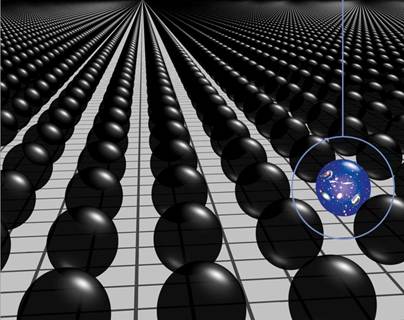
KEY TAKEAWAYS
Ethan SiegelCopy a link to the article entitled http://This%20is%20why%20physicists%20suspect%20the%20Multiverse%20very%20likely%20existsShare This is why physicists suspect the Multiverse very likely exists on FacebookShare This is why physicists suspect the Multiverse very likely exists on TwitterShare This is why physicists suspect the Multiverse very likely exists on LinkedIn
When we look out at the Universe today, it simultaneously tells us two stories about itself. One of those stories is written on the face of what the Universe looks like today, and includes the stars and galaxies we have, how they’re clustered and how they move, and what ingredients they’re made of. This is a relatively straightforward story, and one that we’ve learned simply by observing the Universe we see.
But the other story is how the Universe came to be the way it is today, and that’s a story that requires a little more work to uncover. Sure, we can look at objects at great distances, and that tells us what the Universe was like in the distant past: when the light that’s arriving today was first emitted. But we need to combine that with our theories of the Universe — the laws of physics within the framework of the Big Bang — to interpret what occurred in the past. When we do that, we see extraordinary evidence that our hot Big Bang was preceded and set up by a prior phase: cosmic inflation. But in order for inflation to give us a Universe consistent with what we observe, there’s an unsettling appendage that comes along for the ride: a multiverse. Here’s why physicists overwhelmingly claim that a multiverse must exist. The ‘raisin bread’ model of the expanding Universe, where relative distances increase as the space (dough) expands. The farther away any two raisins are from one another, the greater the observed redshift will be by time the light is received. The redshift-distance relation predicted by the expanding Universe is borne out in observations and has been consistent with what’s been known all the way back since the 1920s. (Credit: NASA/WMAP Science Team)

Back in the 1920s, the evidence became overwhelming that not only were the copious spirals and ellipticals in the sky entire galaxies unto themselves, but that the farther away such a galaxy was determined to be, the greater the amount its light was shifted to systematically longer wavelengths. While a variety of interpretations were initially suggested, they all fell away with more abundant evidence until only one remained: the Universe itself was undergoing cosmological expansion, like a loaf of leavening raisin bread, where bound objects like galaxies (e.g., raisins) were embedded in an expanding Universe (e.g., the dough).
If the Universe was expanding today, and the radiation within it was being shifted towards longer wavelengths and lower energies, then in the past, the Universe must have been smaller, denser, more uniform, and hotter. If any amount of matter and radiation are a part of this expanding Universe, the idea of the Big Bang yields three explicit and generic predictions: null
This snippet from a structure-formation simulation, with the expansion of the Universe scaled out, represents billions of years of gravitational growth in a dark matter-rich Universe. Note that filaments and rich clusters, which form at the intersection of filaments, arise primarily due to dark matter; normal matter plays only a minor role. (Credit: Ralf Kaehler and Tom Abel (KIPAC)/Oliver Hahn)

All three of these predictions have been observationally borne out, and that’s why the Big Bang reigns supreme as our leading theory of the origin of our Universe, as well as why all its other competitors have fallen away. However, the Big Bang only describes what our Universe was like in its very early stages; it doesn’t explain why it had those properties. In physics, if you know the initial conditions of your system and what the rules that it obeys are, you can predict extremely accurately — to the limits of your computational power and the uncertainty inherent in your system — how it will evolve arbitrarily far into the future.
But what initial conditions did the Big Bang need to have at its beginning to give us the Universe we have? It’s a bit of a surprise, but what we find is that:
If these three different regions of space never had time to thermalize, share information or transmit signals to one another, then why are they all the same temperature? This is one of the problems with the initial conditions of the Big Bang; how could these regions all obtain the same temperature unless they started off that way, somehow? (Credit: E. Siegel/Beyond the Galaxy)
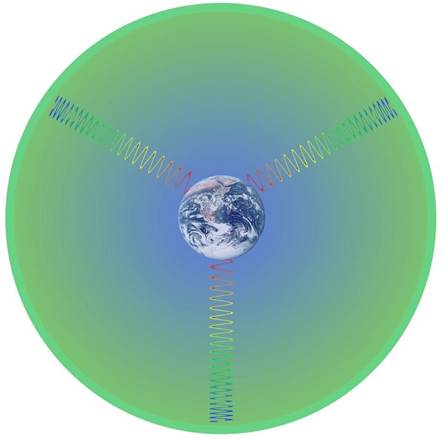
Whenever we come up against the question of initial conditions — basically, why did our system start off this way? We only have two options. We can appeal to the unknowable, saying that it is this way because it’s the only way it could’ve been and we can’t know anything further, or we can try to find a mechanism for setting up and creating the conditions that we know we need to have. That second pathway is what physicists call “appealing to dynamics,” where we attempt to devise a mechanism that does three important things.
The only idea we’ve had that met these three criteria was the theory of cosmic inflation, which has achieved unprecedented success on all three fronts. Exponential expansion, which takes place during inflation, is so powerful because it is relentless. With every ~10^-35 seconds (or so) that passes, the volume of any region of space doubles in each direction, causing any particles or radiation to dilute and causing any curvature to quickly become indistinguishable from flat. (Credit: E. Siegel (L); Ned Wright’s Cosmology Tutorial (R))
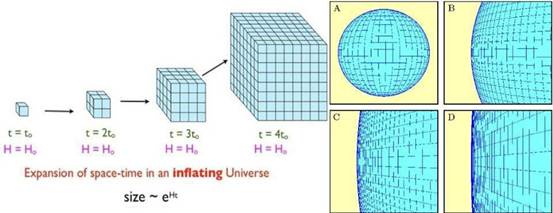
What inflation basically says is that the Universe, before it was hot, dense, and filled with matter-and-radiation everywhere, was in a state where it was dominated by a very large amount of energy that was inherent to space itself: some sort of field or vacuum energy. Only, unlike today’s dark energy, which has a very small energy density (the equivalent of about one proton per cubic meter of space), the energy density during inflation was tremendous: some 1025 times greater than dark energy is today!
The way the Universe expands during inflation is different from what we’re familiar with. In an expanding Universe with matter and radiation, the volume increases while the number of particles stays the same, and hence the density drops. Since the energy density is related to the expansion rate, the expansion slows over time. But if the energy is intrinsic to space itself, then the energy density remains constant, and so does the expansion rate. The result is what we know as exponential expansion, where after a very small period, the Universe doubles in size, and after that time passes again, it doubles again, and so on. In very short order — a tiny fraction of a second — a region that was initially smaller than the smallest subatomic particle can get stretched to be larger than the entire visible Universe today. In the top panel, our modern Universe has the same properties everywhere because they originated from a region possessing the same properties. In the middle panel, the space that could have had any arbitrary curvature is inflated to the point where we cannot observe any curvature today, solving the flatness problem. And in the bottom panel, pre-existing high-energy relics are inflated away, providing a solution to the high-energy relic problem. This is how inflation solves the three

57:5.1 (655.6) 5,000,000,000 (billion) years ago your sun was a comparatively isolated blazing orb, having gathered to itself most of the near-by circulating matter of space, remnants of the recent upheaval which attended its own birth.
57:5.2 (655.7) Today, your sun has achieved relative stability, but its eleven and one-half year sunspot cycles betray that it was a variable star in its youth. In the early days of your sun the continued contraction and consequent gradual increase of temperature initiated tremendous convulsions on its surface. These titanic heaves required three and one-half days to complete a cycle of varying brightness. This variable state, this periodic pulsation, rendered your sun highly responsive to certain outside influences which were to be shortly encountered.
57:5.3 (655.8) Thus was the stage of local space set for the unique origin of Monmatia, that being the name of your sun’s planetary family, the solar system to which your world belongs. Less than one percent of the planetary systems of Orvonton have had a similar origin.
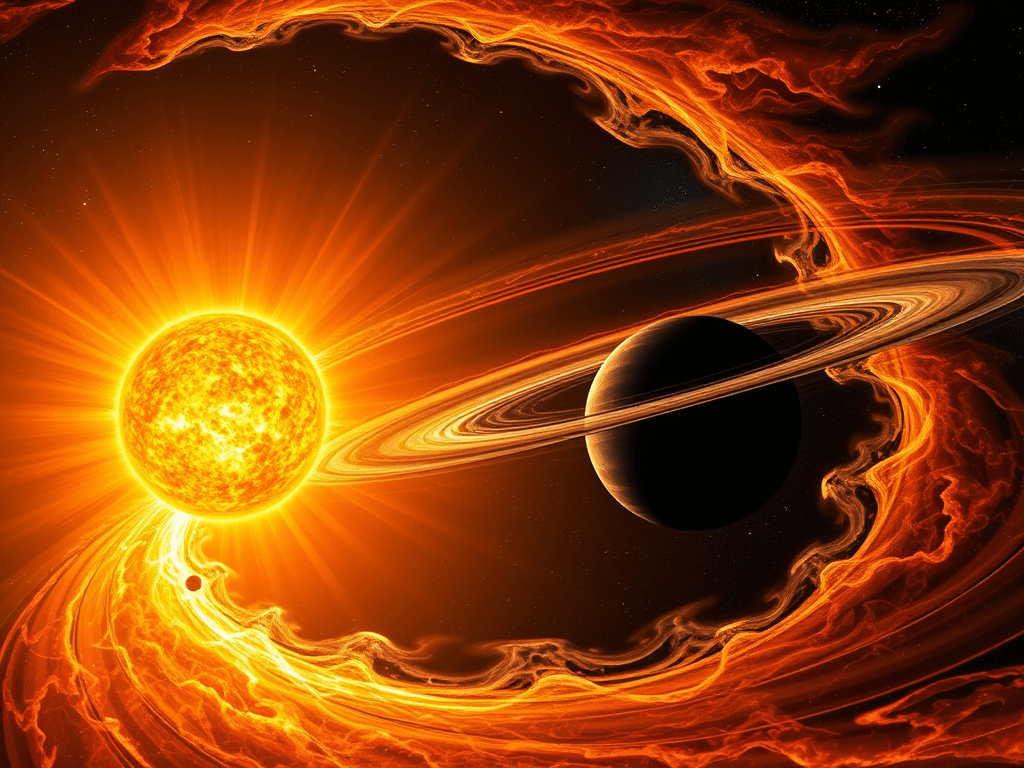
57:5.4 (655.9) 4,500,000,000 years ago the enormous Angona system began its approach to the neighborhood of this solitary sun. The center of this great system was a dark giant of space, solid, highly charged, and possessing tremendous gravity pull.
57:5.5 (656.1) As Angona more closely approached the sun, at moments of maximum expansion during solar pulsations, streams of gaseous material were shot out into space as gigantic solar tongues. At first these flaming gas tongues would invariably fall back into the sun, but as Angona drew nearer and nearer, the gravity pull of the gigantic visitor became so great that these tongues of gas would break off at certain points, the roots falling back into the sun while the outer sections would become detached to form independent bodies of matter, solar meteorites, which immediately started to revolve about the sun in elliptical orbits of their own.
57:5.6 (656.2) As the Angona system drew nearer, the solar extrusions grew larger and larger; more and more matter was drawn from the sun to become independent circulating bodies in surrounding space. This situation developed for about five hundred thousand years until Angona made its closest approach to the sun; whereupon the sun, in conjunction with one of its periodic internal convulsions, experienced a partial disruption; from opposite sides and simultaneously, enormous volumes of matter were disgorged. From the Angona side there was drawn out a vast column of solar gases, rather pointed at both ends and markedly bulging at the center, which became permanently detached from the immediate gravity control of the sun.
57:5.7 (656.3) This great column of solar gases which was thus separated from the sun subsequently evolved into the twelve planets of the solar system. The repercussional ejection of gas from the opposite side of the sun in tidal sympathy with the extrusion of this gigantic solar system ancestor, has since condensed into the meteors and space dust of the solar system, although much, very much, of this matter was subsequently recaptured by solar gravity as the Angona system receded into remote space.
57:5.8 (656.4) Although Angona succeeded in drawing away the ancestral material of the solar system planets and the enormous volume of matter now circulating about the sun as asteroids and meteors, it did not secure for itself any of this solar matter. The visiting system did not come quite close enough to actually steal any of the sun’s substance, but it did swing sufficiently close to draw off into the intervening space all of the material comprising the present-day solar system.
57:5.9 (656.5) The five inner and five outer planets soon formed in miniature from the cooling and condensing nucleus’s in the less massive and tapering ends of the gigantic gravity bulge which Angona had succeeded in detaching from the sun, while Saturn and Jupiter were formed from the more massive and bulging central portions. The powerful gravity pull of Jupiter and Saturn early captured most of the material stolen from Angona as the retrograde motion of certain of their satellites bears witness.
57:5.10 (656.6) Jupiter and Saturn, being derived from the very center of the enormous column of superheated solar gases, contained so much highly heated sun material that they shone with a brilliant light and emitted enormous volumes of heat; they were in reality secondary suns for a short period after their formation as separate space bodies. These two largest of the solar system planets have remained largely gaseous to this day, not even yet having cooled off to the point of complete condensation or solidification.
57:5.11 (656.7) The gas-contraction nucleuses of the other ten planets soon reached the stage of solidification and so began to draw to themselves increasing quantities of the meteoric matter circulating in near-by space. The worlds of the solar system thus had a double origin: nucleuses of gas condensation later on augmented by the capture of enormous quantities of meteors. Indeed they still continue to capture meteors, but in greatly lessened numbers.
57:5.12 (657.1) The planets do not swing around the sun in the equatorial plane of their solar mother, which they would do if they had been thrown off by solar revolution. Rather, they travel in the plane of the Angona solar extrusion, which existed at a considerable angle to the plane of the sun’s equator.
57:5.13 (657.2) While Angona was unable to capture any of the solar mass, your sun did add to its metamorphosing planetary family some of the circulating space material of the visiting system. Due to the intense gravity field of Angona, its tributary planetary family pursued orbits of considerable distance from the dark giant; and shortly after the extrusion of the solar system ancestral mass and while Angona was yet in the vicinity of the sun, three of the major planets of the Angona system swung so near to the massive solar system ancestor that its gravitational pull, augmented by that of the sun, was sufficient to overbalance the gravity grasp of Angona and to permanently detach these three tributaries of the celestial wanderer.
57:5.14 (657.3) All of the solar system material derived from the sun was originally endowed with a homogeneous direction of orbital swing, and had it not been for the intrusion of these three foreign space bodies, all solar system material would still maintain the same direction of orbital movement. As it was, the impact of the three Angona tributaries injected new and foreign directional forces into the emerging solar system with the resultant appearance of retrograde motion. Retrograde motion in any astronomic system is always accidental and always appears as a result of the collisional impact of foreign space bodies. Such collisions may not always produce retrograde motion, but no retrograde ever appears except in a system containing masses which have diverse origins.
57:6.1 (657.4) Subsequent to the birth of the solar system a period of diminishing solar disgorgement ensued. Decreasingly, for another five hundred thousand years, the sun continued to pour forth diminishing volumes of matter into surrounding space. But during these early times of erratic orbits, when the surrounding bodies made their nearest approach to the sun, the solar parent was able to recapture a large portion of this meteoric material.
57:6.2 (657.5) The planets nearest the sun were the first to have their revolutions slowed down by tidal friction. Such gravitational influences also contribute to the stabilization of planetary orbits while acting as a brake on the rate of planetary-axial revolution, causing a planet to revolve ever slower until axial revolution ceases, leaving one hemisphere of the planet always turned toward the sun or larger body, as is illustrated by the planet Mercury and by the moon, which always turns the same face toward Urantia.
57:6.3 (657.6) When the tidal frictions of the moon and the earth become equalized, the earth will always turn the same hemisphere toward the moon, and the day and month will be analogous—in length about forty-seven days. When such stability of orbits is attained, tidal frictions will go into reverse action, no longer driving the moon farther away from the earth but gradually drawing the satellite toward the planet. And then, in that far-distant future when the moon approaches to within about eleven thousand miles of the earth, the gravity action of the latter will cause the moon to disrupt, and this tidal-gravity explosion will shatter the moon into small particles, which may assemble about the world as rings of matter resembling those of Saturn or may be gradually drawn into the earth as meteors.
57:6.4 (658.1) If space bodies are similar in size and density, collisions may occur. But if two space bodies of similar density are relatively unequal in size, then, if the smaller progressively approaches the larger, the disruption of the smaller body will occur when the radius of its orbit becomes less than two and one-half times the radius of the larger body. Collisions among the giants of space are rare indeed, but these gravity-tidal explosions of lesser bodies are quite common.
57:6.5 (658.2) Shooting stars occur in swarms because they are the fragments of larger bodies of matter which have been disrupted by tidal gravity exerted by near-by and still larger space bodies. Saturn’s rings are the fragments of a disrupted satellite. One of the moons of Jupiter is now approaching dangerously near the critical zone of tidal disruption and, within a few million years, will either be claimed by the planet or will undergo gravity-tidal disruption. The fifth planet of the solar system of long, long ago traversed an irregular orbit, periodically making closer and closer approach to Jupiter until it entered the critical zone of gravity-tidal disruption, was swiftly fragmentized, and became the present-day cluster of asteroids.
57:6.6 (658.3) 4,000,000,000 years ago witnessed the organization of the Jupiter and Saturn systems much as observed today except for their moons, which continued to increase in size for several billions of years. In fact, all of the planets and satellites of the solar system are still growing as the result of continued meteoric captures.
57:6.7 (658.4) 3,500,000,000 years ago the condensation nucleuses of the other ten planets were well formed, and the cores of most of the moons were intact, though some of the smaller satellites later united to make the present-day larger moons. This age may be regarded as the era of planetary assembly.
57:6.8 (658.5) 3,000,000,000 years ago the solar system was functioning much as it does today. Its members continued to grow in size as space meteors continued to pour in upon the planets and their satellites at a prodigious rate.
57:6.9 (658.6) About this time your solar system was placed on the physical registry of Nebadon and given its name, Monmatia.
57:6.10 (658.7) 2,500,000,000 years ago the planets had grown immensely in size. Urantia was a well-developed sphere about one tenth its present mass and was still growing rapidly by meteoric accretion.
57:6.11 (658.8) All of this tremendous activity is a normal part of the making of an evolutionary world on the order of Urantia and constitutes the astronomic preliminaries to the setting of the stage for the beginning of the physical evolution of such worlds of space in preparation for the life adventures of time.

Who does Space Force think will be attacking them IN SPACE? It WILL NOT be any Stellar Species. The only ones who need to defend themselves are the peaceful ET from OUR attacks on them. We are the primate warmonger monkeys in this jungle, not them.

Space Force to expand missile-defense satellite network in medium Earth orbit
The Space Systems Command released a “request for prototype proposals” for the Missile Track Custody Epoch 2 program
by Sandra Erwin August 9, 2024
Link to article…
Space Force to expand missile-defense satellite network in medium Earth orbit
They better not be using defensive tech to attack peaceful ET, or we will find out, and action will follow from them.-Me.
From GROK
In the context of the article from SpaceNews titled “Space Force to expand missile-defense satellite network in medium Earth orbit,” Medium Earth Orbit (MEO) refers to a specific range of altitudes in space, situated between Low Earth Orbit (LEO) and Geostationary Orbit (GEO), where the U.S. Space Force plans to deploy a network of missile-tracking satellites. Specifically, MEO spans altitudes from approximately 2,000 kilometers (1,200 miles) to 35,786 kilometers (22,236 miles) above Earth’s surface. (The amplitude layer of the magnetosphere)
The article highlights that the Space Force is developing this MEO-based satellite constellation, known as the Missile Track Custody Epoch 2 program, to enhance its ability to detect and track advanced missile threats, such as hypersonic glide vehicles.These satellites in MEO offer advantages over those in lower or higher orbits: they provide better sensitivity and wider coverage compared to LEO satellites, while being closer to Earth than GEO satellites, allowing for more persistent tracking of fast-moving, maneuverable targets with faint heat signatures. (This could be deceptive though-L.T.)
This positioning makes MEO a strategic “middle ground” in the Space Force’s multi-orbit missile defense architecture, complementing existing systems in LEO and GEO to create a layered, resilient defense network.
Light comes from sound (a physics fact). So when the sound levels change, the light changes! The source of all light is the sun which all sound hertz levels have in common whether they are radio hertz or magnetosphere hertz -L.T.
Me
Starlink satellites, operated by SpaceX, are designed to provide global internet coverage and orbit at relatively low altitudes (typically around 340–550 km above Earth). The question of whether they interfere with Earth’s magnetosphere frequencies is an interesting one, but there’s no clear evidence to suggest they have a significant impact.
The Earth’s magnetosphere is a complex region shaped by the planet’s magnetic field, interacting with solar wind and cosmic radiation. It operates across a wide range of natural frequencies, like the Schumann Sound Resonances (extremely low frequencies around 7.83 Hz and its harmonics), which are tied to the Earth-ionosphere cavity.
Starlink satellites, like most modern satellites, emit radio frequencies for communication—primarily in the Ku-band (12–18 GHz), Ka-band (26.5–40 GHz), and potentially V-band in the future. These frequencies are orders of magnitude higher than the natural resonances of the magnetosphere. (Radio frequencies are SOUND as well as noted by HERTZ)
In theory, electromagnetic interference could occur if satellite emissions overlapped with or disrupted natural frequencies. However, the power levels of Starlink transmissions are tightly regulated by bodies like the FCC and ITU to avoid interference with terrestrial systems and other satellites.
The magnetosphere itself is more directly influenced by solar activity (e.g., geomagnetic storms) than by human-made radio signals. Studies on radio frequency interference tend to focus on astronomical observations—like radio telescopes—rather than magnetospheric effects, and even there, Starlink has mitigation strategies (e.g., adjusting satellite brightness and emission patterns).
That said, some speculation exists in fringe circles (not backed by peer-reviewed science) that large constellations like Starlink could subtly affect atmospheric or magnetic phenomena, especially with thousands of satellites in orbit. No rigorous data supports this, affecting the magnetosphere’s frequencies specifically. The sheer scale of the constellation—over 6,000 satellites as of early 2025—does raise valid questions about cumulative electromagnetic noise, but the magnetosphere’s dynamics are driven by forces far stronger than satellite signals. (They just said above that the satellite emissions were orders of magnitude higher than the magnetosphere.)


Become a paid subscriber to get access to the rest of this post and other exclusive content.
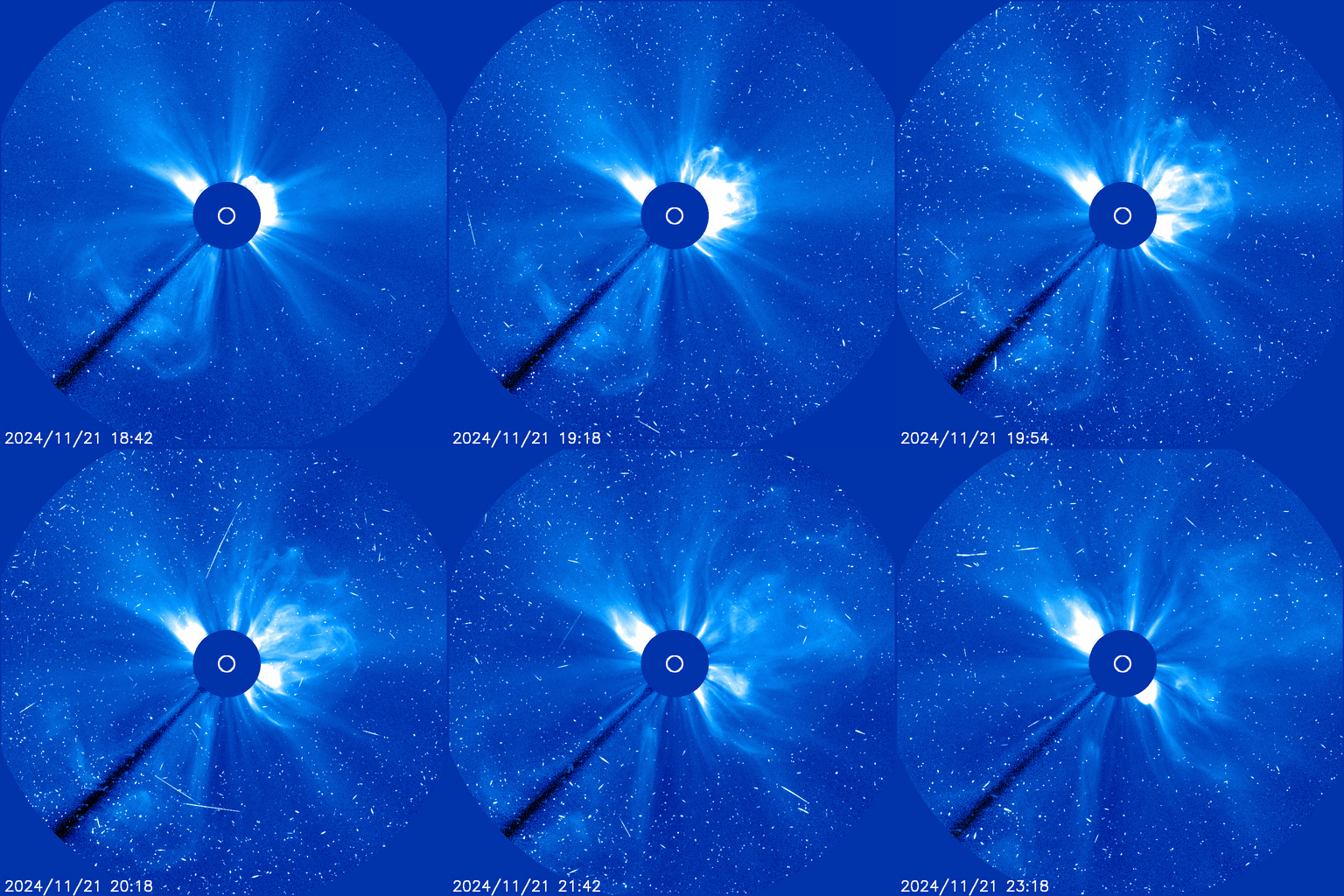
On Nov. 22, Yellow 10 Sun, End of the Central Axis. Electrons went up into Space Backward. Read the explanation below. They are called anti-auroras. That is exact synchronicity with HF35. The IChing is 49-Revolution, Molting, where we landed on November22-23.
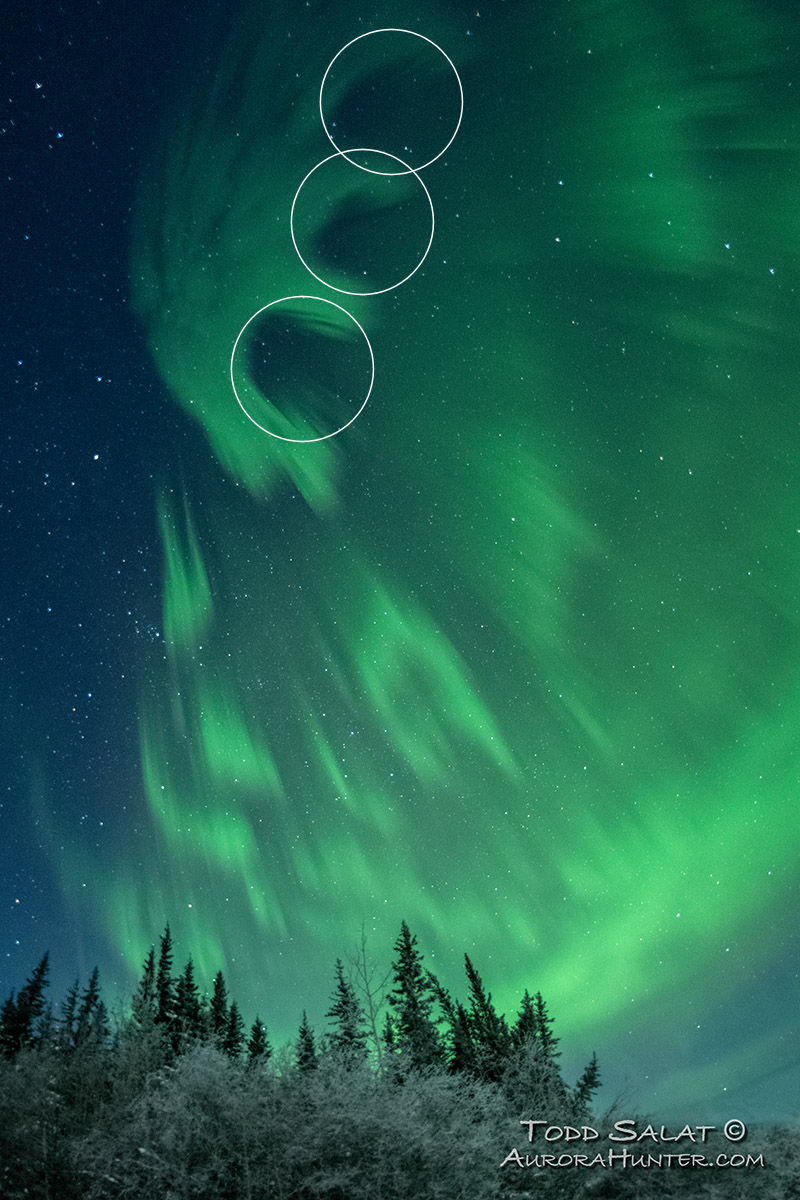
BLACK AURORAS OVER ALASKA? Todd Salat is a veteran photographer of auroras in Alaska. For years he has chased the lights and seen most of what Mother Nature has to offer. But even he was puzzled on Nov. 22nd when these strangely-shaped auroras appeared overhead:
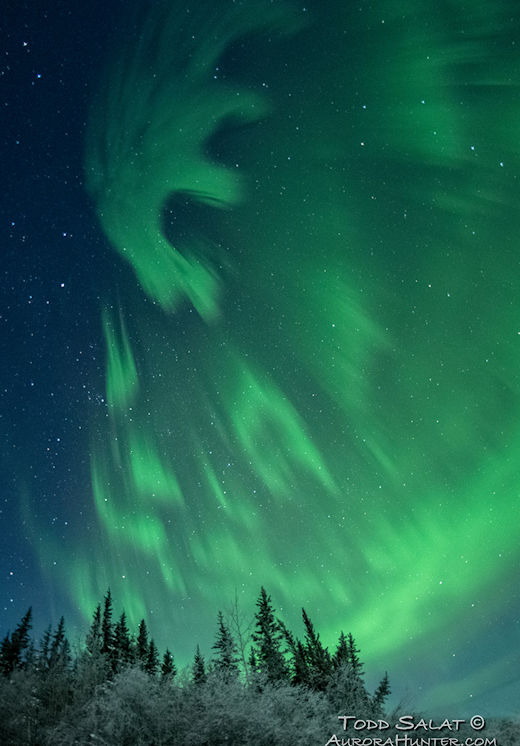
“I saw these bizarre auroras drift over south central Alaska around 4 am last Friday morning,” says Salat. “It came up from the northwest and I was like, whoa! It looked like the letter E to me.”
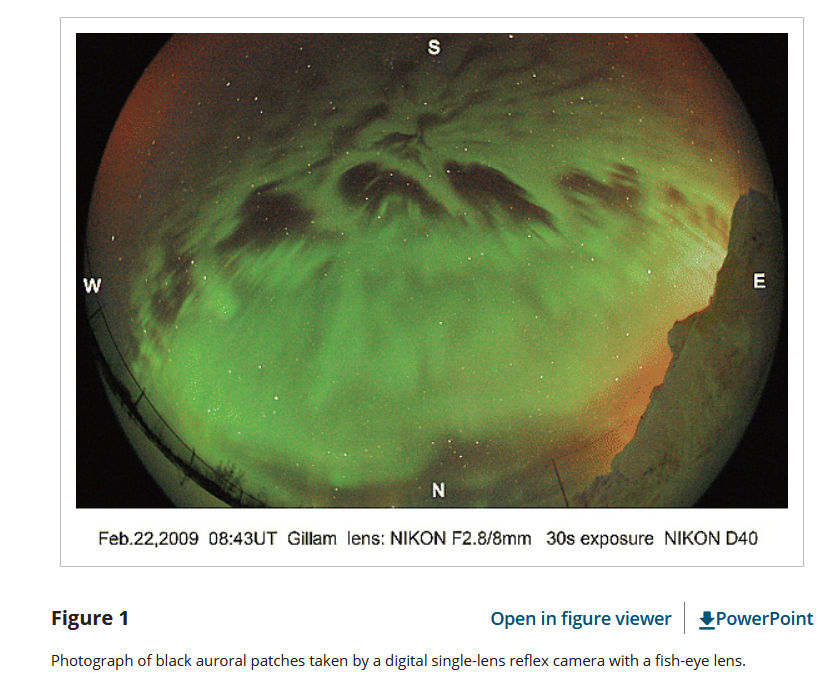
Salat may have witnessed an episode of ‘black auroras.’ They are dark rings or black blobs that sometimes appear in an otherwise ordinary expanse of aurora light. For example, look at Figure 1 in this research paper on the topic. Some researchers call them “anti-auroras.” The black auroras in Salat’s photo are circled here.
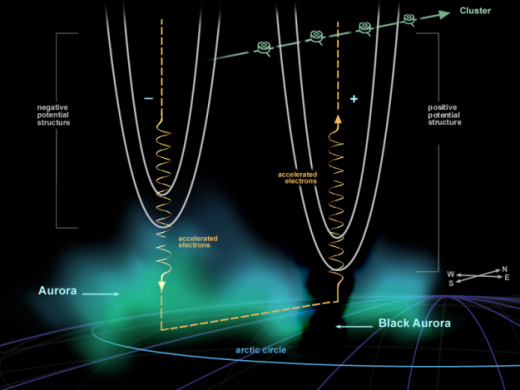
Ordinary auroras are caused by electrons raining down from space. Black auroras are the opposite. Instead of electrons raining down, electrons are propelled upwards back into space. Europe’s fleet of Cluster spacecraft flew over a black aurora on Jan. 14, 2001, and saw the process in action:
(The next day was Red 11 Spectral Dragon in HF36. This was THE OMEGA POINT or ending point. The I Ching was 33 or RETREAT. I wrote in my Tzolkin that it pulses to 1 Mirror, Bohm’s holographic plate in HF30 for holomovement. This synchronicity of astronomical movement is EXACT.)
Sensors onboard the spacecraft detected strong positive electric fields in the black aurora zone. These fields reversed the normal downward rain of aurora-causing electrons.
The study of black auroras is still in its infancy. Forecasters cannot yet predict when or where they might appear. Aurora watchers, the next time a geomagnetic storm erupts, be alert for black. Aurora alerts: SMS Text.
Realtime Space Weather Photo Gallery
Free: Spaceweather.com Newsletter
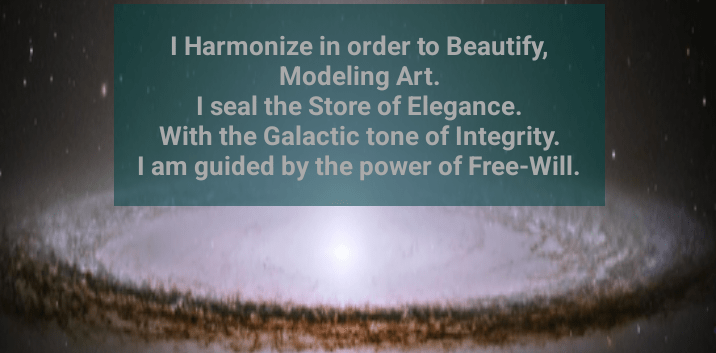
I organize in order to influence. Balancing wisdom I seal the process of free will with the rhythmic tone of equality. I am guided by my own power doubled.
Kin32-Yellow 6 Rhythmic Human
Seal of the Yellow Star
Beauty. Grace. Art.
Receive and express the powers of beauty and grace. Focus on entering the flow of supreme refinement, natural lightness, fluidity, and peace. Participate in the creation and dissemination of harmony in the world! Free yourself from all self-condemnation and understand that your life is a work of art!
South – expands.
The solar plexus chakra. Fourth toe on the right foot.
Motto: I am awakened to beauty, I breathe grace and radiate art.
Galactic tone of integrity-Tone 8 or Layer F1 in the magnetosphere.
By laying the channels of adjustment, we gain wholeness. This is the harmonization of our actions with what for us represents the highest truth. Tone 8 reveals how to model the integrity of our realities in order to share this vision with others. Thus, more and more embracing levels of harmony are revealed.
8Venus, Earth, Neptune, and 6Mars are pulsing from 4D time into 3D manifestation.
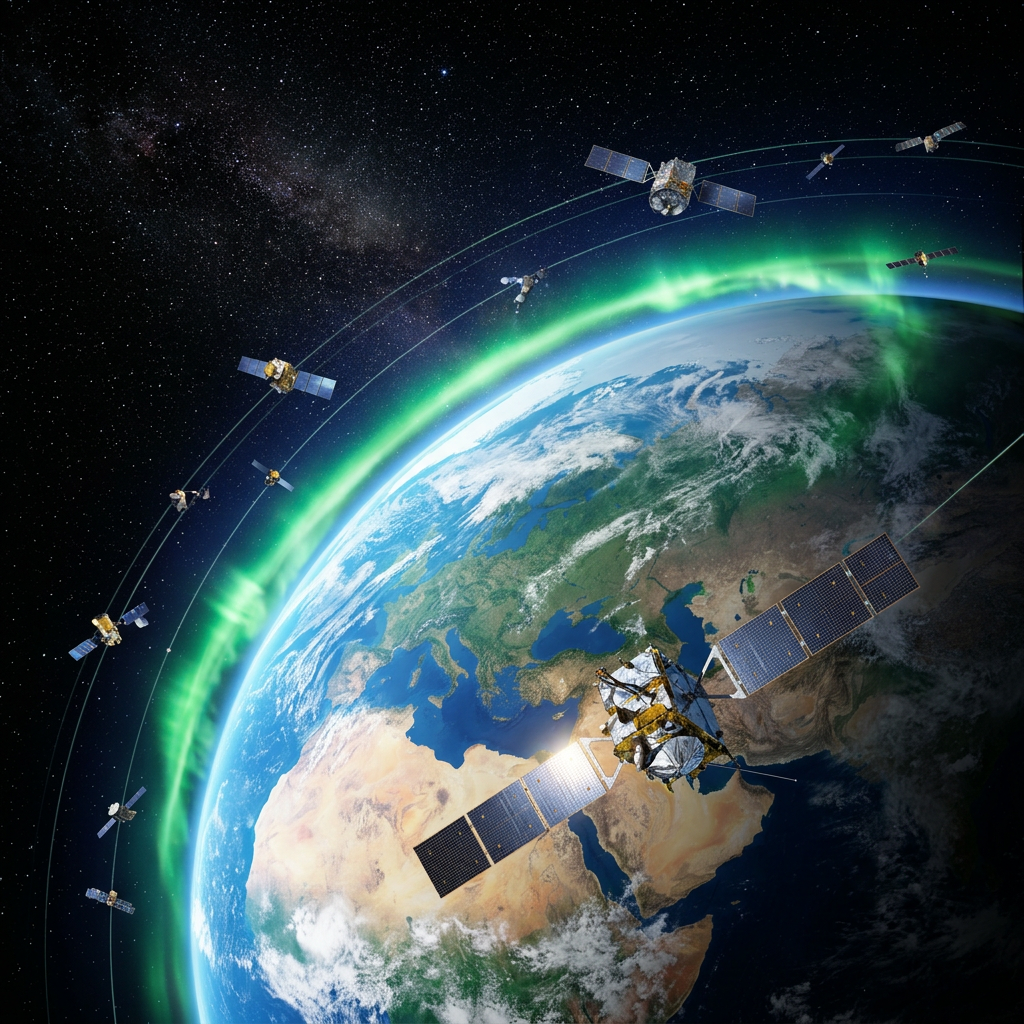
Spaceweather.com
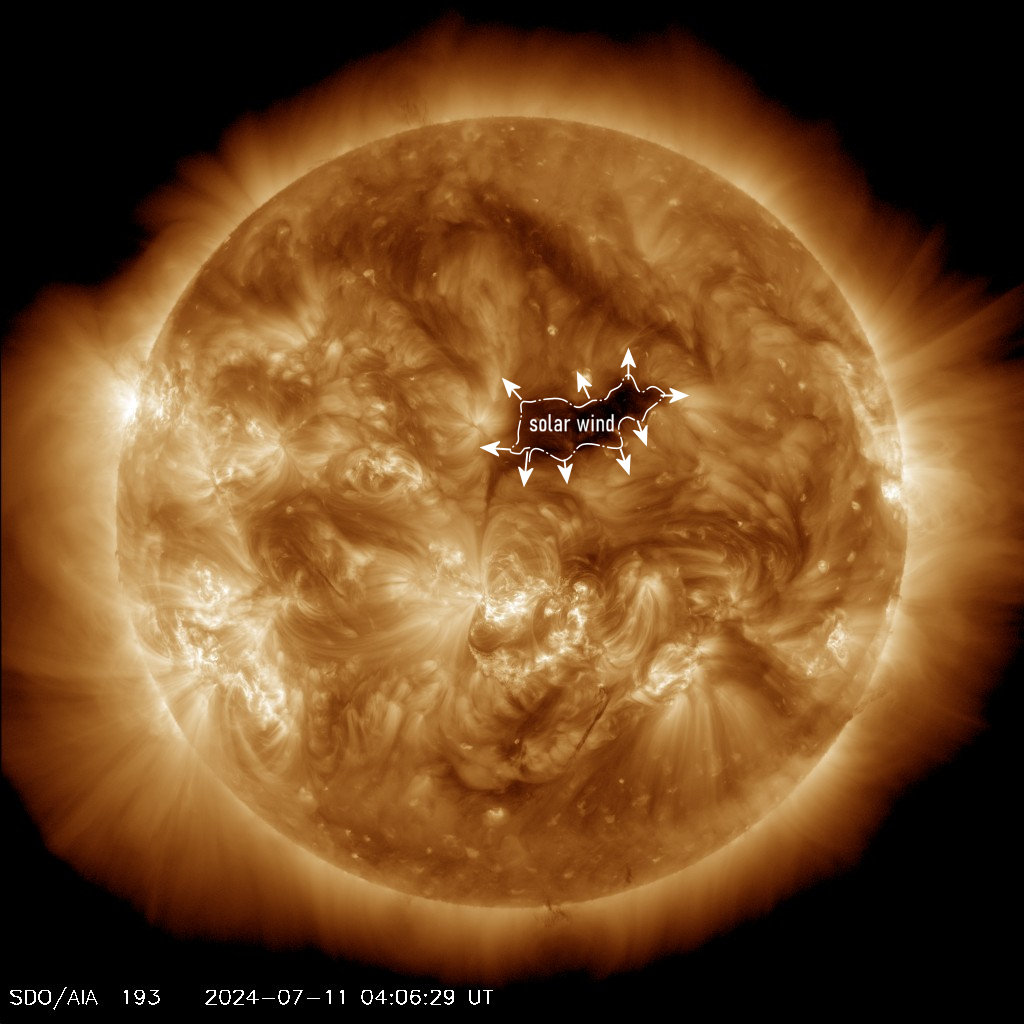
GEOMAGNETIC STORM WATCH (G1): NOAA forecasters say that minor G1-class geomagnetic storms are possible on July 13-14 when a stream of solar wind is expected to hit Earth’s magnetic field. The gaseous material is flowing from a northern hole in the sun’s atmosphere. Aurora alerts: SMS Text
I support the existence of SpaceX and Starlink and most of the work Elon does. But I advocate for balance, restraint, and cooperation, which sometimes gets lost in the mix. Que Cera Cera!
SUPERSTORM TRIGGERED A MASS MIGRATION OF SATELLITES: Earth just experienced the biggest mass migration of satellites in history. On May 10, 2024, approximately 5000 spacecraft had to maneuver to maintain altitude, resisting a geomagnetic storm that was trying to pull them down. The event is described in a research paper just accepted by the Journal of Spacecraft and Rockets.
This was the post on my blog that day. Complete synchronicity.
“Just bc you’ve never seen it, doesn’t mean it doesn’t exist.”-Charlie in “The Santa Clause”-Friday, 5/10/24
And this one…https://timeisdna.com/2024/05/10/the-resonant-7-organization-of-our-grand-universe/
Thus, the Sun and Earth are the boss, not man-made tech, which I keep saying on the platform, but it falls on deaf ears.
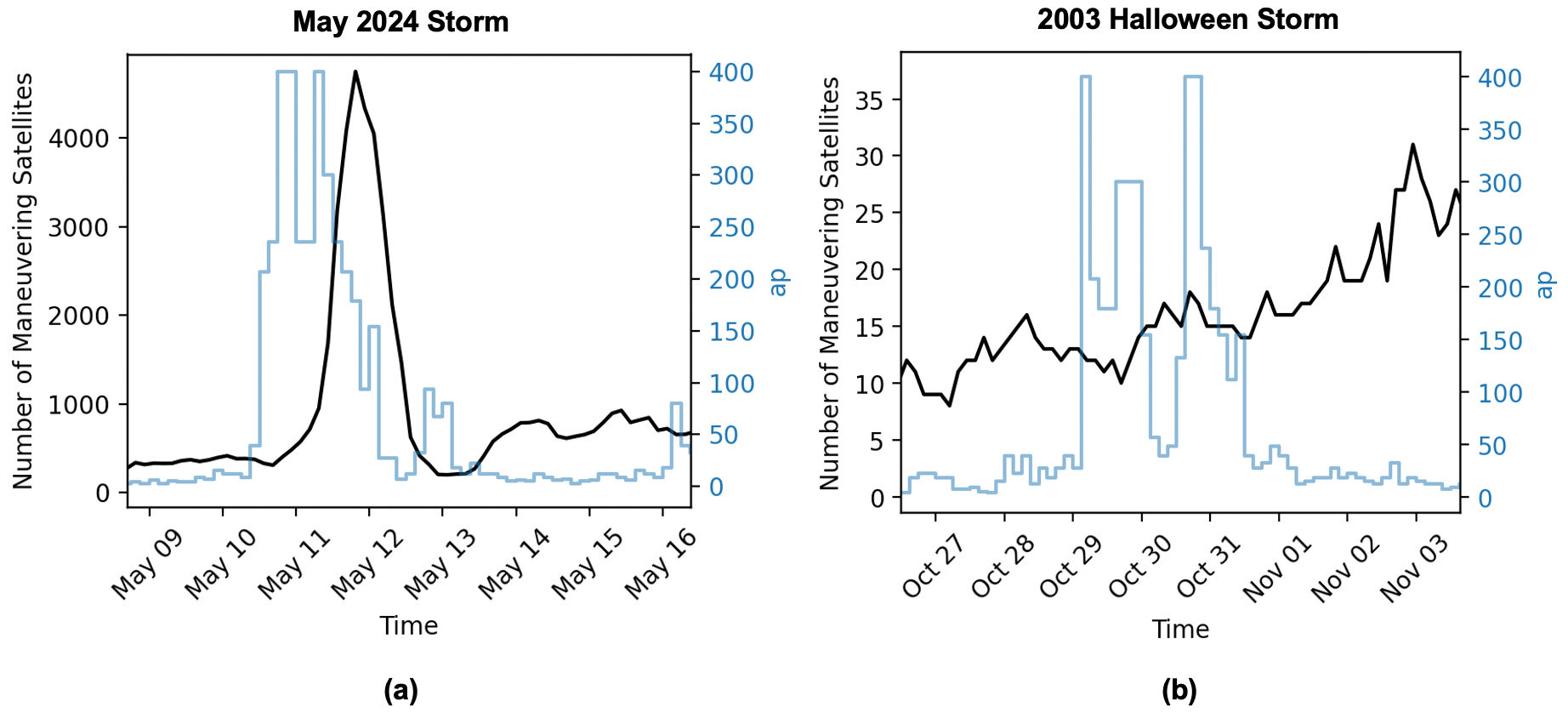
Above: Black–number of maneuvering satellites; Blue–intensity of the storm
“Most were SpaceX Starlink satellites,” says William Parker of MIT, the paper’s lead author. “Each satellite has a GNSS receiver as well as autonomous station-keeping and collision-avoidance capabilities. When they sensed the effects of the storm, thousands of the satellites made the decision to maneuver.”
The need to migrate upward was caused by a sudden increase in satellite drag. Earth’s atmosphere absorbed a huge amount of energy from the solar storm, causing it to puff up like a marshmallow held over a campfire. Tendrils of heated air reached into space and started dragging the satellites down.
“The superstorm’s peak power was 2.63 TeraWatts,” says Martin Mlynczak, who retired from NASA’s Langley Research Center a month after the storm. Before he left, he used infrared data from NASA’s TIMED spacecraft to estimate the amount of thermal energy dumped into the upper atmosphere. “It deposited enough energy to run my house for 10 million years (I average about 510 kWh per month),” he says.
Earth’s atmosphere has been heated this much before, most recently during the Halloween storms of 2003. In those days, however, the satellite population was relatively low (fewer than 1000) and there was no mass migration.
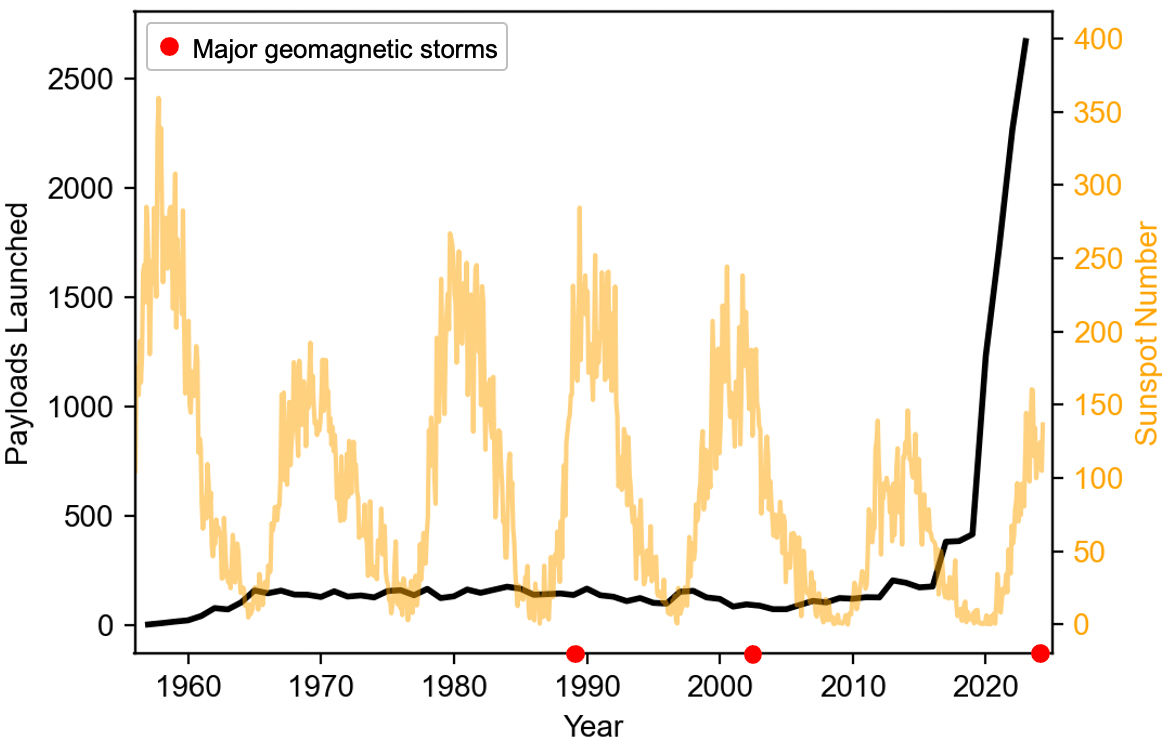
Above: Number of payloads launched to Earth orbit per year.
“The May 2024 geomagnetic storm was the first major storm to occur during a new paradigm in low Earth orbit satellite operations dominated by commercial small satellites,” the authors wrote in their paper.
Thanks mainly to the advent of Starlink in 2019, Earth now has almost 10,000 active satellites–ten times the number in 2003. When a fraction of them unexpectedly decide to change course all at once, satellite operators must scramble to track them, making sure they don’t collide. This creates a new and unprecedented risk for all satellites, even ones that don’t move.
It’s a problem that will only get worse in the years ahead. “Major storms are more likely throughout 2024-2025 during the peak of Solar Cycle 25,” says Parker, “and the satellite population continues to grow.”
(IMO, Elon needs to curb the number of satellites he sends up, but he doesn’t listen to me. I thought I was willful, which I am. We need a new word for willful with him.-L.T.)
Want to learn more? Read the original research here.
Realtime Space Weather Photo Gallery
Free: Spaceweather.com Newsletter
See the bottom section.
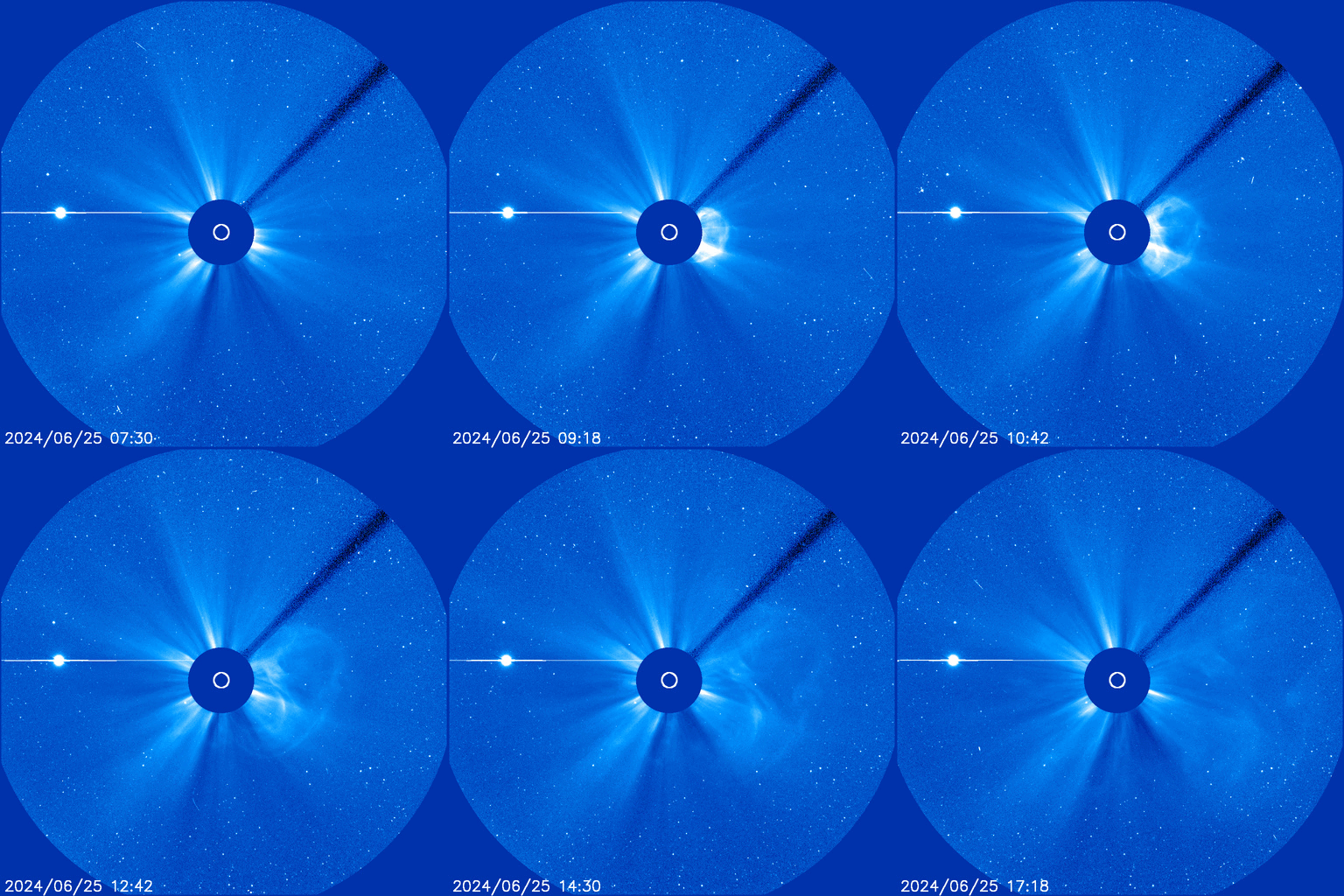
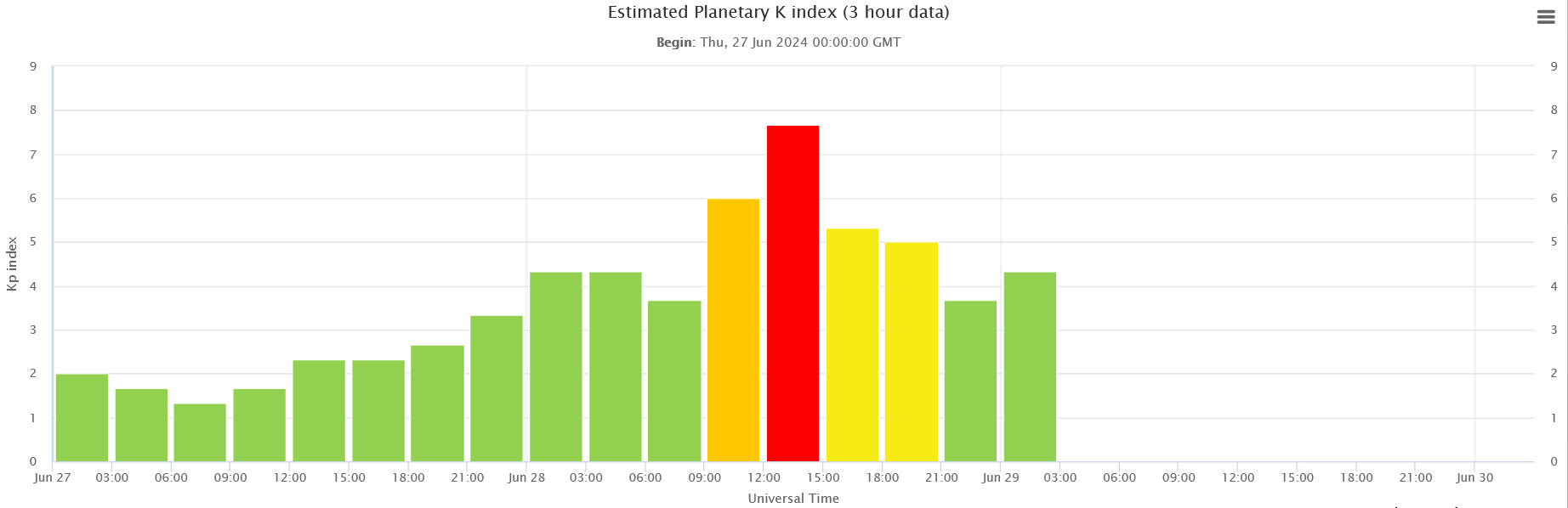
SURPRISE GEOMAGNETIC STORM: Forecasters were surprised yesterday, June 28th, when a CME struck Earth and caused a severe (G4-class) geomagnetic storm. The CME was expected, but the severity of the storm was not; it was supposed to be a minor G1-class event. Daylight over Europe and the Americas hid a potentially dynamite display of auroras. Aurora alerts: SMS Text
NOCTILUCENT CLOUDS BLANKET EUROPE: This weekend, Europe is experiencing a widespread outbreak of noctilucent clouds (NLCs). Normally confined inside the Arctic Circle, the electric-blue wisps of frosted meteor smoke have been sighted as far south as Italy:
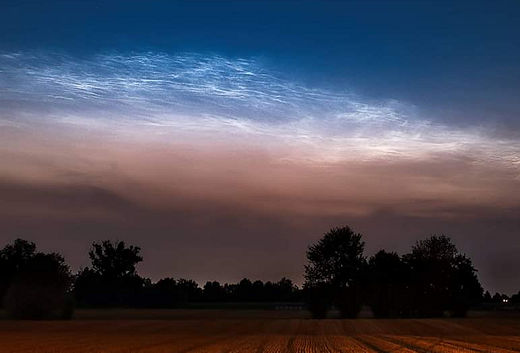
“It was a beautiful display,” reports Fabrizio Marchi from Treviso, a city near Venice. “We are at +45 N, so the clouds have reached mid-latitudes.”
Similar displays brightened the night skies of Austria, the Netherlands, Scotland, France, England, Lithuania, Croatia, Germany, Denmark, Belgium, Luxembourg, and Finland.
2024 is supposed to be a bad year for NLCs because Solar Max has arrived. High solar activity should melt these fragile clouds away. Two factors may be counteracting the sun.
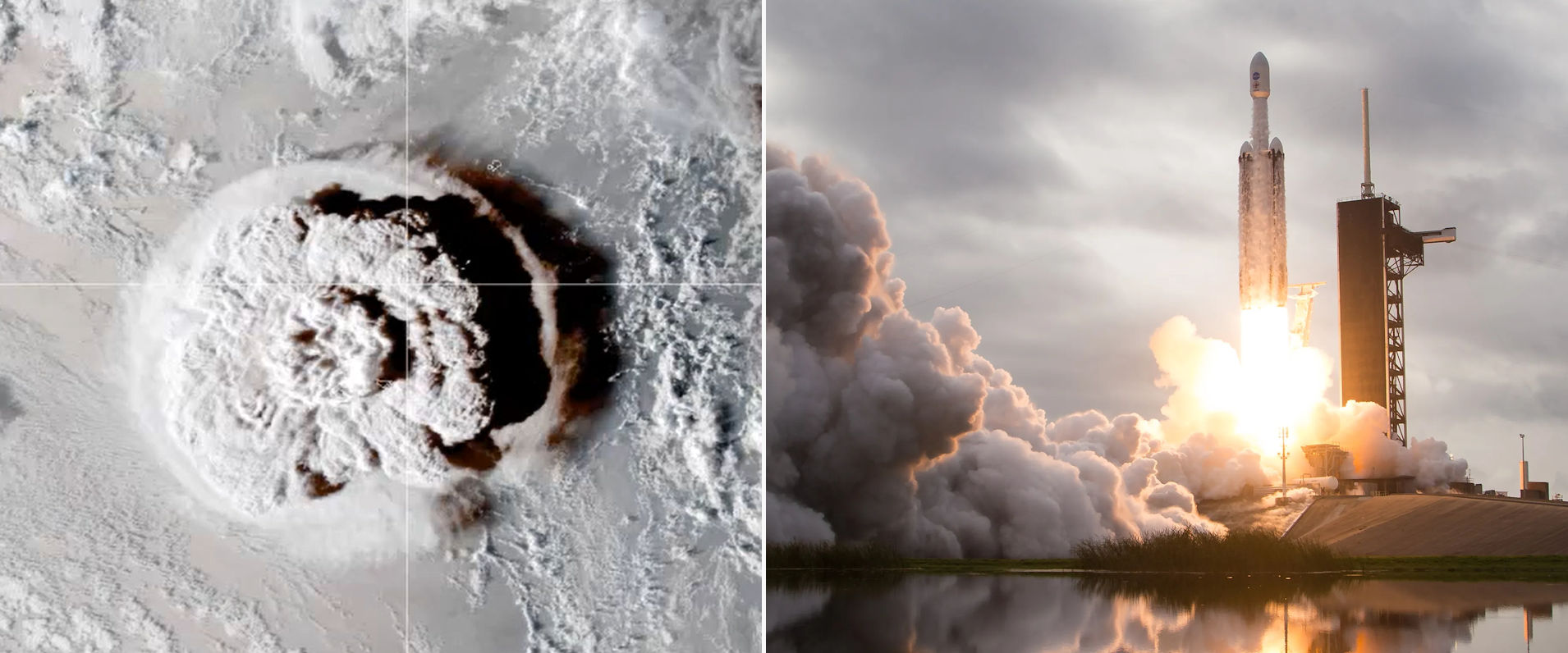
The Tonga undersea volcano (left) and a SpaceX Falcon Heavy launch (right)
First, there’s Tonga. The undersea volcano erupted in January 2022, hurling record amounts of water into the atmosphere. That was two years ago, but it takes about two years for the vapor to circulate up to the mesosphere where NLCs form. Water is a key ingredient for NLCs, so Tonga’s moisture could be turbocharging the clouds
Second is SpaceX. Studies show that water-rich rocket exhaust boosts the abundance of NLCs. So far this year (Jan. 1st – June 27th), 124 rockets have been launched, mostly by SpaceX. That’s 4 times the rate of launches during previous Solar Maxima. Quadrupling the amount of rocket exhaust in the mesosphere might be enough to overwhelm the water and ice destroying effects of the active sun.