

I don’t think that all of this manipulation from aerospace companies on the Psi Bank is a good thing. They’ve got karma coming from trying to use space to manipulate time-Lisa T.
It’s like the curbing of nuclear weapons. If their aerospace tools disturb THE EARTH HOLON, they’ll start dropping to earth. You either cooperate with the natural evolution of life, or you will be stopped.
When Firefly Aerospace’s Alpha rocket launched from Vandenberg Space Force Base in California on July 3rd, astronomer David Blanchard of Flagstaff, Arizona, thought he might be too far away to see. Instead, he had a front row seat as the rocket punched a huge glowing-red hole in the ionosphere:
“I wish I had started the video capture earlier, but I was using a telephoto lens expecting the rocket to be small and far downrange,” says Blanchard. “When I realized how large it was, I swapped in a wide angle lens and re-started recording mid-flight.”
The lingering red glow in Blanchard’s movie is “the hole.” Earth’s ionosphere is a layer of electrically-conducting gas enveloping our planet 100 to 600 km high. It plays a key role in shortwave radio communications and GPS positioning. When Alpha burned through the ionosphere, water and carbon dioxide in rocket’s exhaust quenched local ionization by as much as 70%. Red light is the afterglow of this process.
Firefly Aerospace isn’t the first to do this. Indeed, the phenomenon has been studied for decades. However, ionospheric holes are opening much more frequently than ever before–an unintended side effect of record-high launch rates led by SpaceX’s almost-weekly Starlink missions.
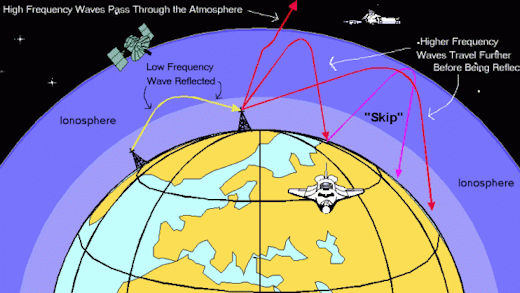
A NOAA diagram of the ionosphere
Ham radio operators may notice ionospheric holes when shortwave signals fail to skip over the horizon, shooting through holes instead of bouncing back to Earth. Sudden GPS errors may also result from the anomalies. So far as we know, these effects are short-lived. The holes close (re-ionization occurs) as soon as the sun comes up in the morning.
No harm done? Probably. But with launch rates continuing to climb, we are moving into uncharted territory. Observers are encouraged to photograph nighttime launches and check their images for the telltale red glow. There may be much to learn.
more images: from Paul D. Maley of Scottsdale, Arizona; from Chris Cook of Long Beach, California; from Stephen Sullivan of Malibu, California; from Jeremy Perez north of Flagstaff, Arizona
Realtime Space Weather Photo Gallery
Free: Spaceweather.com Newsletter
 Synchronicity is the Source of Consciousness