
LONG-DURATION SOLAR FLARE: New sunspot 4188 exploded, producing an M1-class solar flare that lasted more than 3 hours. The long-duration event engulfed almost half of the sun’s southeastern limb (movie) and probably hurled a significant CME into space. Stay tuned for updates. Aurora alerts: SMS Text
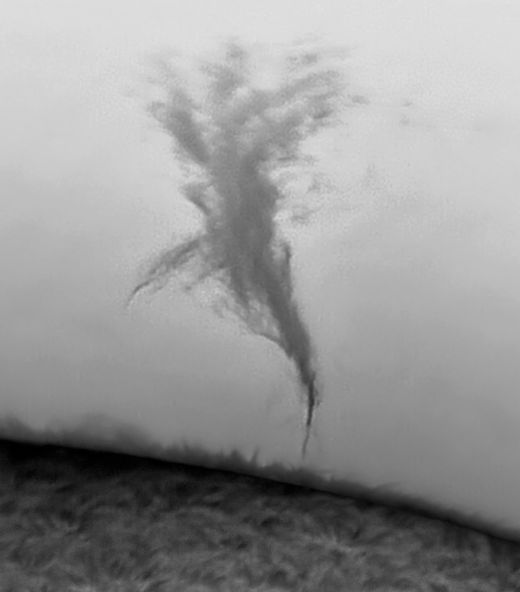
A PLASMA TORNADO ON THE SUN: Yesterday, astronomers around the world witnessed a fiery twister unraveling above the sun’s surface. It wasn’t a storm of wind and rain, but a plasma tornado–a column of hot gas spiraling thousands of kilometers high:
“My wife helped me capture this twister,” says Maximilian-Vlad Teodorescu of Romania’s Institute of Space Science, who photographed the storm despite drifting clouds and turbulent afternoon air. “The telescope’s mount was not properly aligned, so she centered the subject while I recorded the data–teamwork!”
Unlike tornadoes on Earth, solar tornadoes are not caused by pressure differences in the atmosphere. Instead, they are sculpted by twisted magnetic fields that channel plasma upward at speeds reaching 300,000 kilometers per hour. For comparison, the mightiest twisters on Earth are almost a thousand times slower.
Solar tornadoes can be surprisingly stable, swirling for hours or even days. Sometimes they dissolve in a harmless puff. Other times, they erupt, hurling plasma into space as part of a coronal mass ejection (CME). In this case, the tornado was relatively calm, holding its shape without producing a major eruption.
The plasma is still spinning today. If you have a solar telescope, take a look!
 Synchronicity is the Source of Consciousness