The threads of the Neuralink device retracted from Nolands brain. He was the first recipient of the device. Note that the brain chip has 64 threads, in line with 3D IChing and binary code. Yeeha! Not. The scientists all hail the 12:60 space God. Forget about true time.
Now Elon is going on about them going hyper AI with bandwidth, ignoring the LACK OF AFFINITY with humans. It’s Tiamat retro Muskovian dystopia.
They may have fixed the threads, I don’t know. I just know that when my patients get anything synthetic put in them by tech sick care, their natural QI gets completely misaligned. I can’t correct what the doctors let them do.
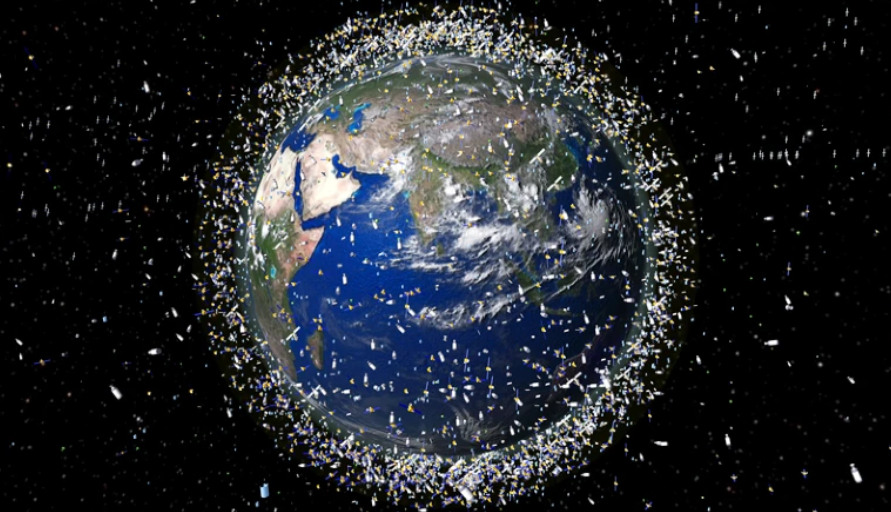
Extrapolating into the future, Solter worries that satellite debris could weaken Earth’s magnetic field–the same magnetic field that protects us from cosmic rays and solar storms.
Sierra Solter-NASA
I’m real popular on X.com posting stuff like this and actually all of my projects. NOT!
I appreciate NASA studying the issue though.
WILL MEGACONSTELLATIONS DAMAGE EARTH’S MAGNETIC FIELD? Something unprecedented is happening in Earth orbit. In only a few short years, the satellite population has skyrocketed, more than doubling since 2020. In the past year alone, more satellites have been launched than during the first thirty years of the Space Age. Much of this activity is driven by SpaceX and its growing megaconstellation of Starlink internet satellites.
Environmentalists have raised many concerns about Starlink including light-pollution of the night sky, a potentially hazardous traffic jam in low-Earth orbit, and even ozone depletion. Copycat megaconstellations by other companies and countries will only multiply these concerns.
Now there’s a new reason to worry. According to a new study by Sierra Solter, megaconstellations could alter and weaken Earth’s magnetic field.
Solter is a graduate student at the University of Iceland, working on her PhD in plasma physics. She recently realized something overlooked by many senior colleagues: “More than 500,000 satellites are expected in decades ahead, primarily to build internet megaconstellations. Every satellite that goes up will eventually come down, disintegrating in Earth’s atmosphere. This will create a massive layer of conducting, electrically charged particles around our planet.”
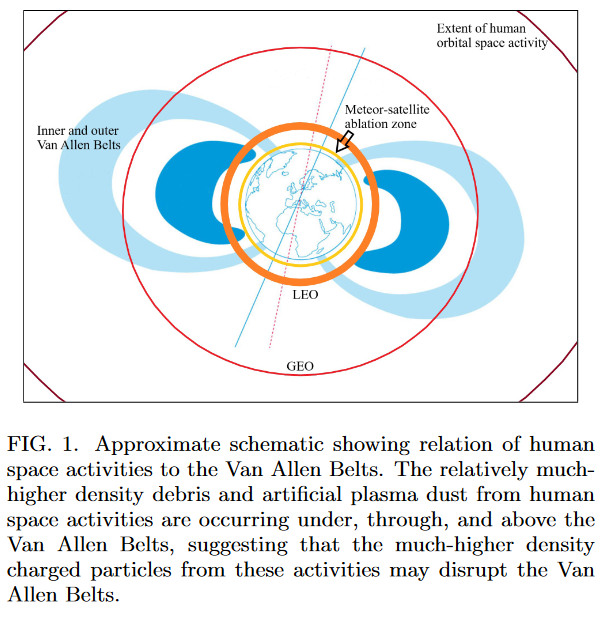
To understand the scale of the problem, consider the following: If you gathered up every charged particle in Earth’s Van Allen Belts, their combined mass would be only 0.00018 kg. Other components of the magnetosphere such as the ring current and plasmasphere are even less massive. For comparison, “the mass of a second generation Starlink satellite is 1250 kilograms, all of which will become conductive debris when the satellite is eventually de-orbited,” says Solter.
Metal debris from a single deorbited Starlink satellite is 7 million times more massive than the Van Allen Belts. An entire megaconstellation is billions of times more massive. These ratios point to a big problem.
“The space industry is adding enormous amounts of material to the magnetosphere in comparison to natural levels of particulate matter,” says Solter. “Due to the conductive nature of the satellite debris, this may perturb or change things.”
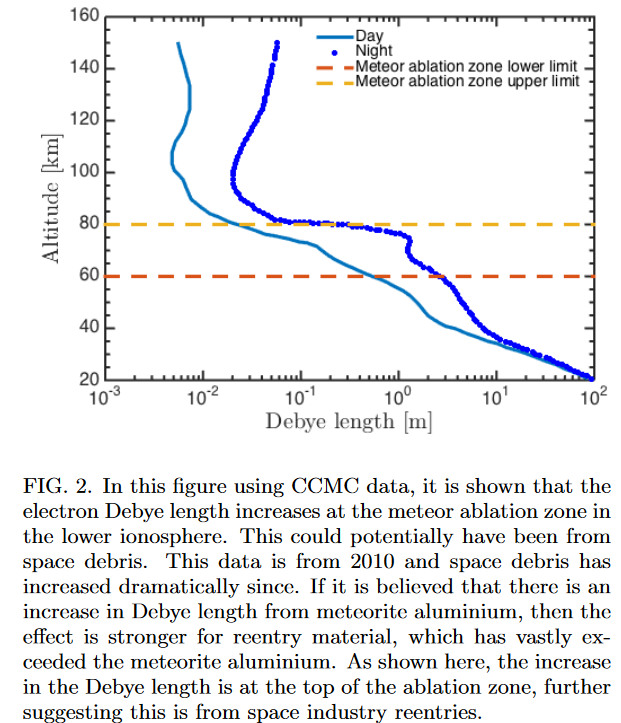
There is already evidence of this process in action. A 2023 study by researchers using a high-altitude NASA aircraft found that 10% of aerosols in the stratosphere contain aluminum and other metals from disintegrating satellites and rocket stages. These particles are drifting down from “the ablation zone” 70 to 80 km above Earth’s surface where meteors and satellites burn up.
Solter decided to look for changes in the electrical properties of the ablation zone–and she found something. A NASA model of the upper atmosphere shows a sharp increase in the “Debye Length” just where satellites break apart when they deorbit:
“Debye Length” is a number that tells researchers how far an unbalanced electrical charge can be felt in conducting plasmas. The fact that it changes abruptly in the same place satellites disintegrate may be significant.
Extrapolating into the future, Solter worries that satellite debris could weaken Earth’s magnetic field–the same magnetic field that protects us from cosmic rays and solar storms.
“It’s a textbook undergraduate physics problem,” she explains. “Suppose you put a conductive shell (satellite debris) around a spherical magnet (Earth). Outside the shell, the magnetic field goes to zero due to shielding effects. This is a highly simplified comparison, of course, but we might actually be doing this to our planet.”
Solter’s preliminary study appears to show that the space industry is indeed perturbing the environment. “It is very concerning,” she concludes. “We absolutely cannot dump endless amounts of conductive dust into the magnetosphere and not expect some kind of impact. Multidisciplinary studies of this pollution are urgently needed.”
For more information, you can read Solter’s original research here.
Disgusting cover photo by WP but probably accurate. Men LOVE their machine creations. They are their baby.
Parentheses are mine-LT
Last summer, Musk described a synthetic invasion to the World AI Conference in Shanghai, China. “
The ratio of machine versus biological intelligence keeps increasing,” he said. “That means, over time, human intelligence will represent a smaller and smaller percentage of total thinking capacity on earth relative to machines.”
Elon Musk
Our brains will soon be (could be) overwhelmed by the digital mind. As robotics improve, our laboring hands are to be replaced by mechanical bodies.
Speaking at the same Shanghai conference, the pioneeringAI scientist Richard Sutton argued that “technologically enhanced humans, and then AIs, will be our successors.” Along with many in Silicon Valley and communist China, Sutton anticipates the rise of artificial general intelligence (AGI)—a digital mind that first equals and then rapidly exceeds our human brains.
“This is really a profound change,” Musk continued. “But the trends are, over time, that we’re headed to a world where there are more robots than humans.”
Elon Musk
This is the ultimate goal for Sutton’s former employer, Google’s DeepMind, as well as for Microsoft’s partner OpenAI and Amazon’s new partner Anthropic. AGI is also the aim of Sutton’s new employer, Keen Technologies. Naturally, the Chinese tech companies Baidu and Tencent are scrambling to catch up in the AGI race, lest Westerners create an artificial godlike intelligence first.
In time, Sutton believes it’s “inevitable” that cyborgs and AGI “will become more important… in almost all ways than ordinary humans.” “I think the reasons to fear AI are less noble,” he told his Chinese audience, going on to describe humanism as “akin to racism.” (!!!!!🫨😵💫😲). It’s a “systematic bias against AIs—denial of their moral worth and their first-class personhood.” (Say what crazy man?)
This bias is driven by “conservatism”: the “fear of change, timidness, [and] fear of the other tribe—where the AIs are the other tribe.”
The “noble” approach is to “bow out when we can no longer contribute.” Sutton condemns any resistance to this Greater Replacement as the height of human prejudice.
Richard Sutton
Therefore, to realize our transhuman potential, we must maximize diversity and inclusion to stave off the ultimate race war between legacy humans and the AGI Borg. A deplorable “specist” is on the wrong side of history.
Lisa’s commentary
In truth, when Musk said that human consciousness should be protected, Google founder Larry Page called it sentimental nonsense. He added that if consciousness could be replicated in a machine, it should hold equal worth. (Consciousness can’t be replicated in a machine Mr. Page.) Page also accused Musk of being a “specist,” someone favoring his own species.
Is that like punching a hole in a wall because they’re giving you a hard time? I’m bugging him too much. 😆 lol. I’m sick of all the fake Elon unverified accounts following me. It was 10 a day, and now I directly tweeted to him, asking that everyone on there be required to be verified. I don’t have time for this. It’s very controversial but all the spam and grifters on there are wasting time and $.
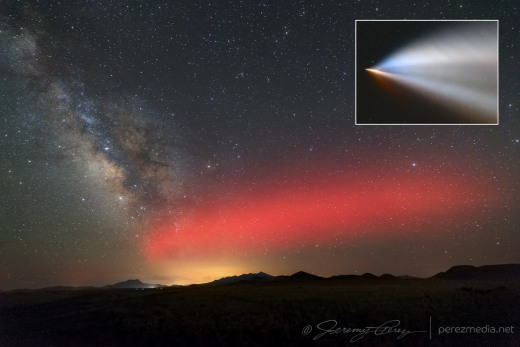
SPACEX JUST PUNCHED A HOLE IN THE IONOSPHERE: On the evening of July 19th, SpaceX launched a Falcon 9 rocket from Vandenberg Space Force Base in California. Sky watchers from southern California to Arizona witnessed a magnificent exhaust plume. At the San Francisco Volcanic Field north of Flagstaff, photographer Jeremy Perez saw something extra:
“After the rocket passed overhead, a red fluorescent glow expanded southward and crossed over the Milky Way,” says Perez. “It was visible for almost 20 minutes.”
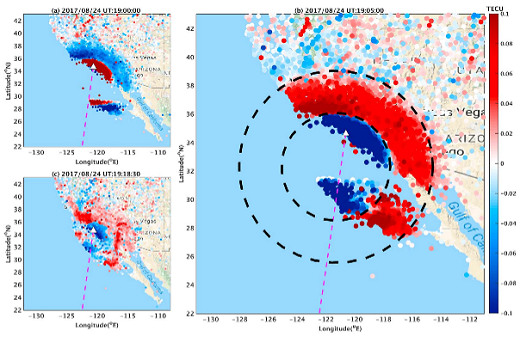
The red glow is a sign that the rocket punched a hole in the ionosphere–something SpaceX and others have been doing for years. One famous example occured on August 25, 2017, when a Falcon 9 rocket carrying Taiwan’s FORMOSAT-5 satellite created a hole four times bigger than the state of California. On June 19, 2022, another Falcon 9 punched a hole over the east coast of the USA, sparking a display of red lights from New York to the Carolinas that many observers mistook for aurora borealis.
“This is a well studied phenomenon when rockets are burning their engines 200 to 300 km above Earth’s surface,” explains space physicist Jeff Baumgardner of Boston University. “The red glow appears when exhaust gasses from the rocket’s 2nd stage cause the ionosphere to recombine quickly.”
Rocket engines spray water (H2O) and carbon dioxide (CO2) into the ionosphere, quenching local ionization by as much as 70%. A complicated series of charge exchange reactions between oxygen ions (O+) and molecules from the rocket exhaust produce photons at a wavelength of 6300 Å–the same color as red auroras.
Above: Electron density maps show a hole in the ionosphere formed by a SpaceX rocket in 2017. [more]
“I reviewed footage from the July 19th launch,” says Baumgardner. “It shows the second stage engine burning at 286 km near the ionosphere’s F-region peak for that time of day. So, it is quite possible that an ionospheric ‘hole’ was made.”
Once rare, ionospheric “punch holes” are increasingly common with record numbers of rocket launches led by SpaceX sending Starlink satellites to low-Earth orbit. Ham radio operators may notice them when shortwave signals fail to skip over the horizon, shooting through holes instead of bouncing back to Earth. Sudden GPS errors can also result from the anomalies. These effects may be troublesome, but they are shortlived; re-ionization occurs as soon as the sun comes up again.
Elon has to come clean on this, OR get educated about what our brains can already do naturally. We don’t NEED an A.I. brain chip, and 99% of humans on the planet don’t want it.
If he agreed to have it outside the body, we could develop a REAL INTELLIGENCE propelled prototype that would help train humans to focus their minds for navigation of a craft or anything mechanical. It would just be a training device BECAUSE WE CAN DO IT ON OUR OWN naturally with our own minds. We just have to learn how.
He is going to have to compromise. Humans are already extraordinary, given training and a chance. We do not need FAKE.