

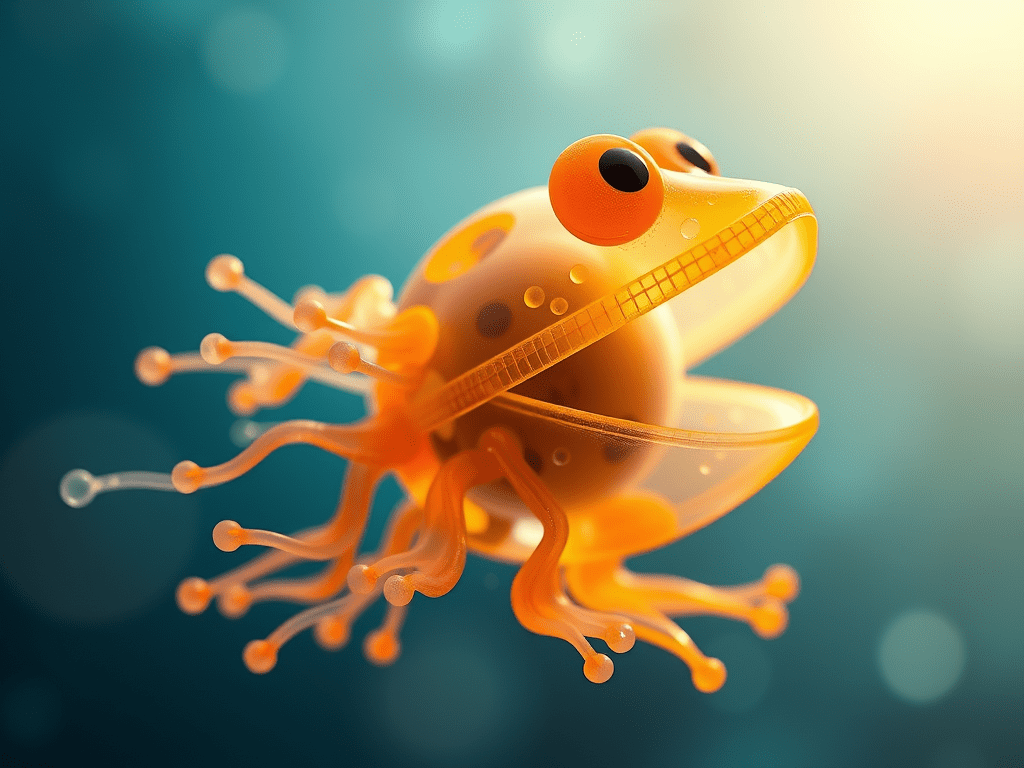
Oh, for God’s sake…🤫🤔🫣😳. They want to apply the Time Harmonic to these DNA beings? They shouldn’t be binary! Now I have new weirdness to worry about.
From GROK4
What Are Xenobots?
Xenobots are a groundbreaking class of synthetic, programmable organisms—often called “living robots”—created from living cells harvested from the embryos of the African clawed frog (Xenopus laevis), which is where their name comes from. Unlike traditional robots made from metal or plastic, Xenobots are entirely biological, composed solely of frog stem cells that are rearranged into novel forms. They represent a fusion of developmental biology, artificial intelligence, and robotics, blurring the lines between machine and lifeforms. First unveiled in 2020, they’ve since evolved in capability, demonstrating behaviors like movement, self-healing, and even reproduction.
How Are They Made?
The creation process starts with stem cells extracted from early-stage frog embryos (blastula stage). These cells are separated, incubated, and then assembled—either manually under a microscope or allowed to self-assemble—into specific shapes designed by AI. Key components include:
- Skin cells: Provide structural support, forming a rigid “body.”
- Heart muscle cells: Act as natural motors, contracting to enable movement (in early versions).
- Cilia (hair-like projections): Used in later versions for propulsion, like tiny oars, allowing faster swimming in liquid environments.
Designs are generated using evolutionary algorithms on supercomputers, which simulate billions of body shapes and cell arrangements to optimize for tasks like navigation or payload carrying. The result is a millimeter-scale (less than 1 mm wide) spheroid or custom form, such as the Pac-Man-like C-shape in reproductive models. No genetic modification is involved; the cells retain their natural programming but are repurposed in new contexts.
Capabilities and Behaviors
Xenobots exhibit remarkable, emergent abilities that go beyond their frog origins:
- Movement: They can walk, swim, or propel themselves across surfaces, using internal energy from stored fats and proteins—no batteries needed. Early models scuttle like tiny tanks; later ones use cilia for quicker, more fluid motion.
- Self-Healing: If cut or damaged, they can close wounds and reform their shape within minutes, leveraging the cells’ innate regenerative powers.
- Collective Behavior: In groups, they swarm to aggregate debris, push pellets, or carry payloads (e.g., medicine particles).
- Memory: Some versions incorporate RNA to “record” exposures, like glowing under specific light wavelengths to indicate environmental interactions.
- Lifespan: They operate for about 7–10 days before biodegrading harmlessly into dead skin cells, making them eco-friendly.
A major milestone came in 2021: certain designs (e.g., the C-shaped “parents”) can replicate by sweeping up loose stem cells in their environment, assembling them into “offspring” that mature into functional copies. This kinematic self-replication—distinct from sexual or asexual reproduction in nature—allows populations to sustain for multiple generations in lab dishes.
Potential Applications
While still in early stages (described by creators as “1940s computer” tech), Xenobots hold promise for:
- Medicine: Targeted drug delivery, scraping arterial plaque, or repairing damaged tissue (e.g., healing neuron gaps in lab tests).
- Environmental Cleanup: Swarming to collect microplastics or toxins from water.
- Research: Modeling regeneration, embryogenesis, or even cellular “consciousness” in a “third state” between life and death, where cells adapt post-organism.
Related work includes “Anthrobots,” human-cell versions from lung tissue, which also move and heal, expanding the concept beyond frogs.
Ethical and Scientific Considerations
Xenobots raise intriguing questions: Are they alive? Tools? A new lifeform? They’re biodegradable and contained in labs, minimizing risks, but concerns include unintended replication in wild environments or ethical issues around “playing God” with life. Some critics argue they’re overhyped extensions of basic cell cultures, but proponents see them as a window into scalable bioengineering.
This field continues to advance, with ongoing research at institutions like Tufts University, the University of Vermont, and Harvard’s Wyss Institute. For the latest, check sources like the original papers in PNAS or Science Robotics.









 Synchronicity is the Source of Consciousness
You must be logged in to post a comment.