
CO-ROTATING INTERACTION REGION: NOAA forecasters say that a co-rotating interaction region (CIR) could hit Earth later today. CIRs are shock-like transition zones between fast- and slow-moving streams of solar wind. Think of them as mini-CMEs. If this one arrives as predicted, Arctic sky watchers might witness an outburst of lights tonight. Aurora alerts: SMS Text.
‘DELTA SUNSPOT’ FACES EARTH: Sunspots are giant islands of magnetism floating on the surface of the sun. Usually their magnetic poles are well separated, plus (+) and minus (-) far apart. However, there is a sunspot now facing Earth with multiple poles mixed up and jostling together:

The magnetic classification of AR3460 is ‘beta-gamma-delta.’
This magnetic map from NASA’s Solar Dynamics Observatory shows the magnetic architecture of sunspot AR3460. It has many magnetic poles with + and – pressed together in close proximity. This could lead to magnetic reconnection and a strong, Earth-directed solar flare. Solar flare alerts: SMS Text
Realtime Space Weather Photo Gallery
Free: Spaceweather.com Newsletter
CRYOVOLCANIC COMET 12P: Some people look at this week’s outburst of cryovolcanic comet 12P/Pons-Brooks and see the Millennium Falcon. Bill Williams of Florida’s Chiefland Astro Village sees a different spaceship. “The Romulan Warbird flies again!” he says. The classic Star Trek vessel is inset in this picture Williams took on Oct 9th:
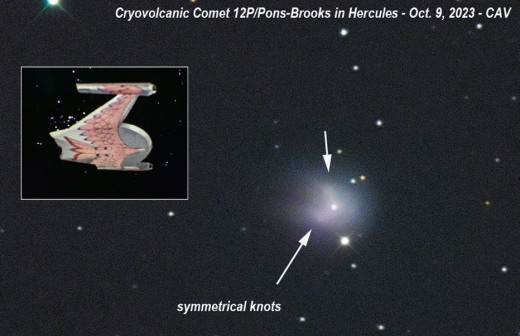
“It is fascinating to see Comet 12P/Pons-Brooks ‘come alive’ again, sporting peculiar horns and symmetrical knots around the comet coma,” he says.
This is the second time in 2023 that Comet 12P has erupted and–bafflingly–produced a spaceship-like silhouette. The first time in July was nearly identical. According to Richard Miles of the British Astronomical Association, “the two ‘horns’ may be caused by a peculiarly-shaped cryovolcanic vent with some sort of blockage causing material to be expelled with a weird flow pattern.”
This comet could cause a sensation next year. It is falling toward the sun and expected to become a naked-eye object only a few days before the total solar eclipse on April 8, 2024. Sky watchers in the path of totality could look up and see a spaceship-shaped outburst for themselves.
 Synchronicity is the Source of Consciousness