
Spaceweather.com
LYRID METEOR ALERT: The first significant meteor shower in months is about to begin. The annual Lyrid meteor shower peaks on the night of April 21-22 when Earth passes through a stream of debris from Comet Thatcher (C/1861 G1). These meteors are best seen from the northern hemisphere where the radiant is high in the sky before dawn: sky map.
THIS IS THE WORST TIME TO OBSERVE ‘THE DEVIL COMET’: If you get your science news from mainstream media, you might think this weekend is a great time to observe Comet 12P/Pons-Brooks, a.k.a. “The Devil Comet.” In fact, the opposite is true. The comet–barely a naked eye object on the best of nights–is almost completely overwhelmed by a combination of evening twilight and full Moonlight.
To illustrate the problem, Mike Olason photographed the comet sinking into the haze near of Tucson, Arizona, on April 20th:
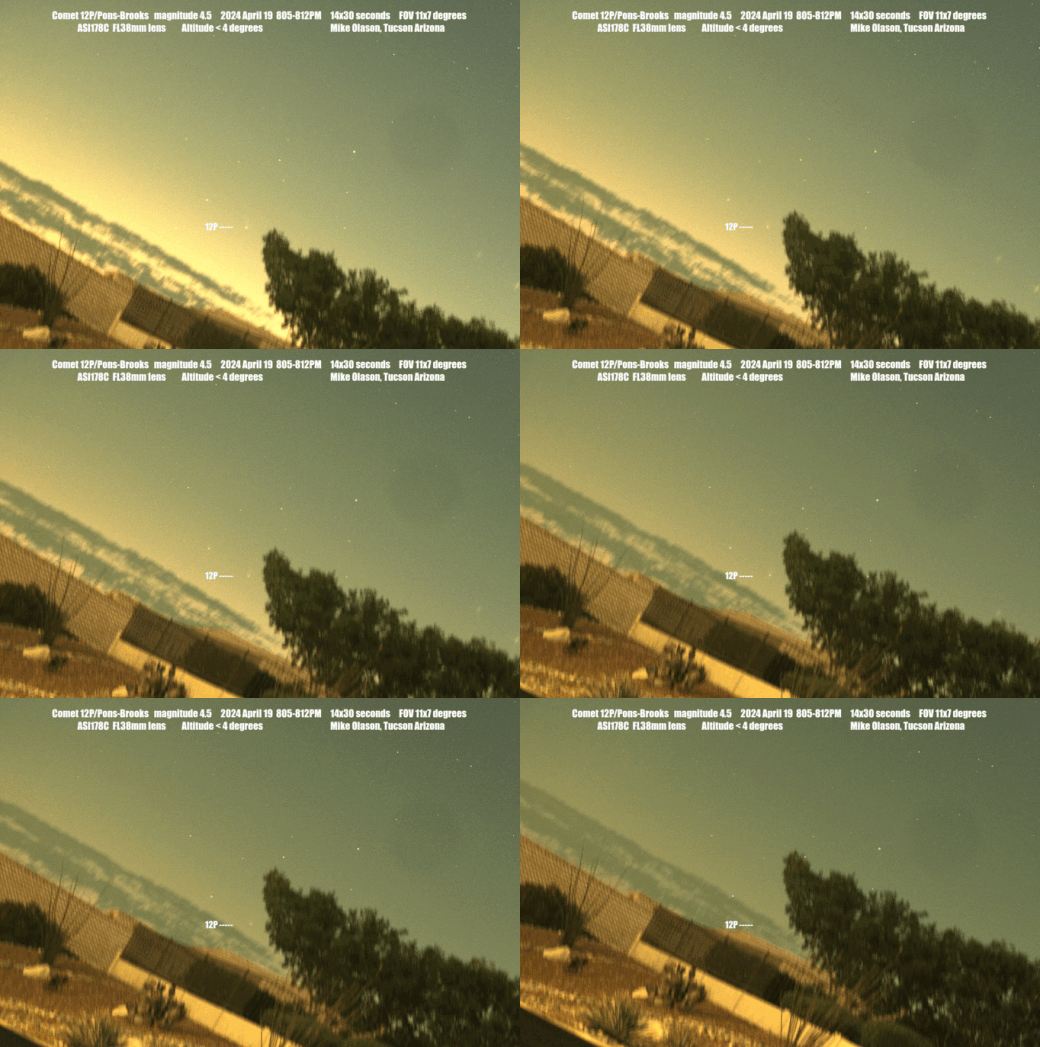
“As one can see from the animation, the images were collected as twilight started to fade only to be replaced by moonshine from the 87% illuminated Moon,” says Olason. “It also did not help that the comet was at an altitude below 6 degrees. Most of the tail and coma were washed out by light pollution, twilight, Moonlight and atmospheric interference.”
The kernel of truth in mainstream reports is that Comet 12P is at perihelion on April 21st–its closest approach to the sun. Solar heat is indeed brightening the comet to its maximum luminosity. However, Earth and the comet are far apart on opposite sides of the sun, and we have to squint through the glare of the sun to see the comet.
It all adds up to poor visibility–for now. In May the comet will move away from the sun and into the night skies of the southern hemisphere. In fact, astronomer Michael Mattiazzo is already seeing it from Australia.
Realtime Comet Photo Gallery
Free: Spaceweather.com Newsletter
YOU’RE GOING TO WANT TO CLICK ON THIS IMAGE: The white-light sun is a blinding ball of featureless light. But… if you filter the light, and look only at the narrow range of wavelengths emitted by hydrogen, the true sun is revealed. This weekend in Kentucky, amateur astronomer Richard Schrantz used a spectroheliograph to do just that, and here is what he saw:
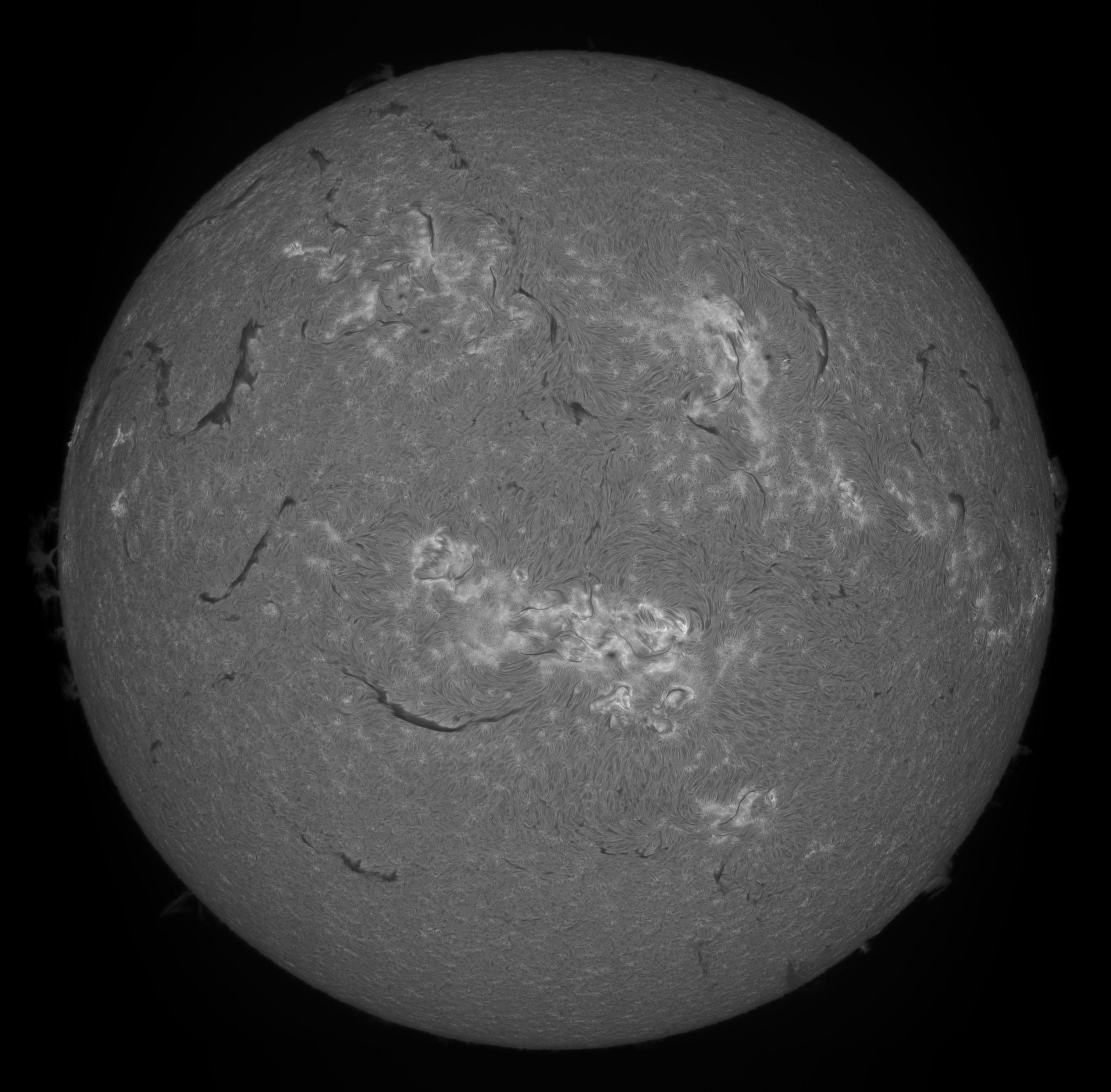
Click on the image for full resolution–and “make sure you look using a large desktop monitor,” says Schrantz. “The sunspot complex centered on AR3645 has lots of fine detail.”
A spectroheliograph is a special telescope which can photograph the sun at a single narrow wavelength of light–in this case, the “H-alpha” wavelength emitted by solar hydrogen. Schrantz’s spectroheliograph image reveals not only a large number of sunspots, but also an even larger number of filaments–magnetic tubes filled with dense hydrogen snaking across the solar disk. These filaments can erupt to produce solar flares and CMEs much like sunspots do; they significantly boost the odds of solar activity. Solar flare alerts: SMS Text
 Synchronicity is the Source of Consciousness
