

NORTHERN SUMMER BEGINS TODAY: The seasons are changing. This afternoon at 4:45 p.m. EDT, summer begins in the north and winter begins in the south. June 20th is the longest day of the year, or the shortest, depending on your hemisphere. Either way, happy solstice!
SOLAR MAXIMUM NOCTILUCENT CLOUDS: 2024 is supposed to be a bad year for noctilucent clouds (NLCs). High solar activity is warming Earth’s upper atmosphere and breaking apart water molecules necessary for noctilucent ice. Yet here they are:
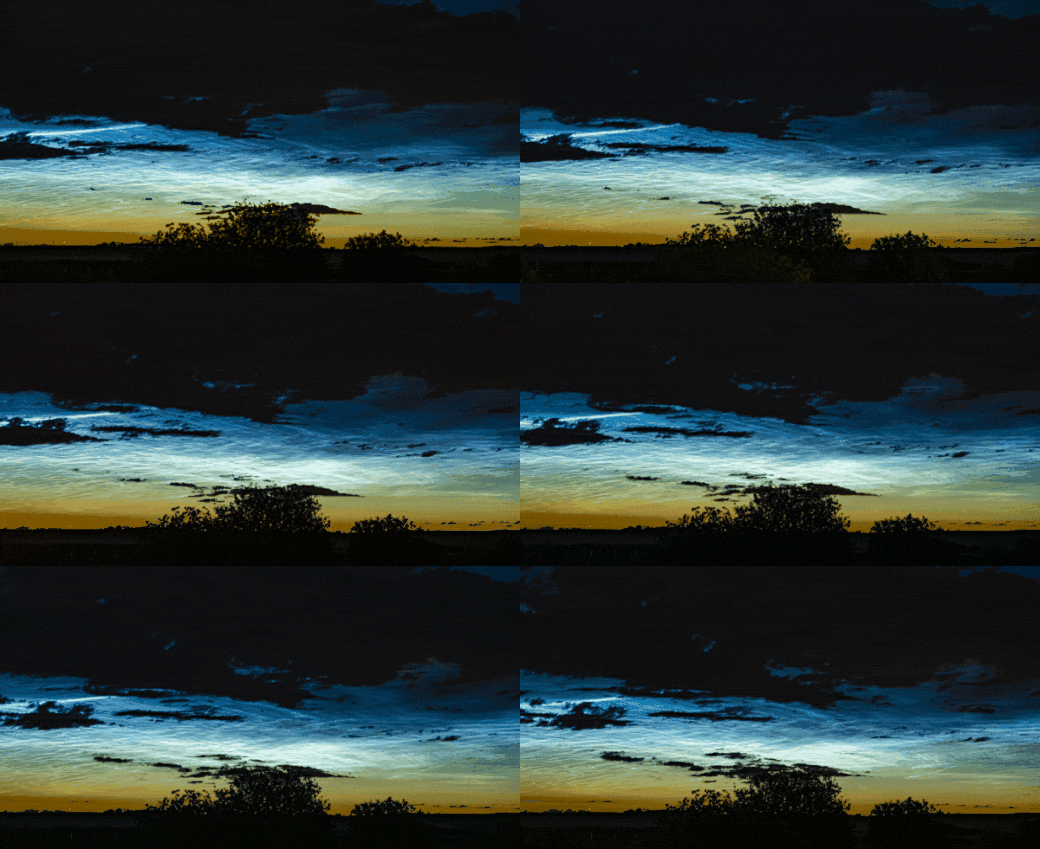
“We observed a beautiful display of NLCs on June 15th,” says Harlan Thomas of Carstairs, Alberta. “They lasted for hours.”
So far, NLCs are winning their struggle with the sun. They’ve been seen in Canada and countries in Europe as far south as Poland.
But solar activity isn’t the only factor. NLCs form when summertime wisps of water vapor rise to the edge of space, forming a rime of ice around specks of meteor debris. Extra moisture pumped into the atmosphere by the undersea eruption of the Tonga volcano could be giving the clouds an edge. Interhemispheric teleconnections also influence the temperature and moisture available for NLCs.
In short, we just don’t know what will happen next. Weeks around the summer solstice often produce the most widespread NLCs, so be alert for electric blue.
more images: from Terry Morris of Birmingham UK; from Marek Nikodem near Szubin, Poland; from Steve Brown of North Yorkshire, UK
Realtime Noctilucent Cloud Photo Gallery
Free: Spaceweather.com Newsletter
CALIFORNIA STARLINK LAUNCH: Tuesday night in California, SpaceX ended a 10-day drought of rocket launches with a Falcon 9 liftoff from Vandenberg Space Force Station. Carrying 20 Starlink satellites, the ascending rocket was visible as far away as Arizona:
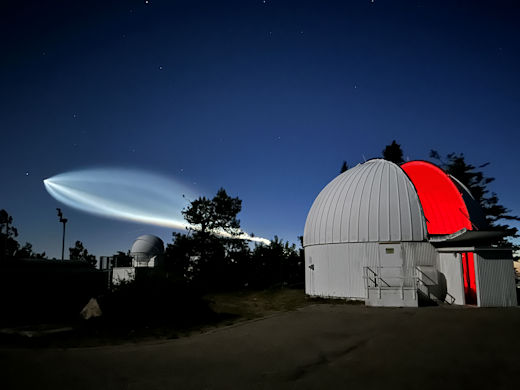
“We had an excellent view of Tuesday evening’s launch from the Mt. Lemmon Observatory (9157 ft) in Arizona,” reports Don McCarthy, director of the Beginning Teen Astronomy Camp. “The contrast of the rocket’s plume against the clear, twilight sky was excellent.”
Rewind: A “10-day drought?” No so long ago, launching rockets every 10 days would have been considered rapidfire. Now it’s a drought. SpaceX has changed the way we think about launch statistics. In 2024 alone, the company has launched 44 Starlink missions, bringing the total number of those internet satellites in orbit to 6,633. The next Falcon 9 launch is scheduled for June 20th from Cape Canaveral. The “drought” is over.
more images: from David Blanchard of Flagstaff, AZ; from Paul D. Maley of New River, Arizona; from Tim Kittell of Carlsbad, CA;
Realtime Space Weather Photo Gallery
Free: Spaceweather.com Newsletter
ScR

 Synchronicity is the Source of Consciousness
