
It is likely used to build AI robots. I just thought you should know. I don’t support it, but people need to know what they’re doing. This uses asymmetric synthesis to make nnanotechnology. NANITES ARE BANNED BY THE U.S. MILITARY.
To me, this tech is as sinister as nuclear FISSION, which destroys life and consciousness. It splits the atom to make nuclear weapons and should be ILLEGAL. It is the opposite if rhe SUN which is natural nuclear FUSION. The sun gives and nurtures life. It doesn’t try to kill us. Tell your friends please.
- By Jens Müller – News & Views
- Published: 06 December 2006
Nature volume 444, page 698 (2006)Cite this article
The versatile DNA molecule has found many applications beyond biology. In its latest role, it serves as a self-assembling scaffold to arrange different metal ions in a row, like pearls on a string.
The days when DNA was the exclusive purview of molecular biologists are over. Since the discovery of DNA’s double-helix structure in 1953, numerous disciplines have embraced this biomolecule — from medicine to materials science, by way of classical chemistry and biotechnology. Reporting in Nature Nanotechnology, Tanaka et al.1 describe an application of DNA that clearly stems from inorganic chemistry: they have modified DNA so that it serves as a scaffold for one-dimensional arrays of metal ions. Each array is a combination of copper and mercury ions, arranged in an order defined by the DNA sequence. Such precise control over the assembly of these arrays would be necessary for their potential applications as nanomagnets2, as self-assembling molecular wires or as catalysts in chemical reactions.
Single strands of DNA comprise a sugar–phosphate chain decorated with organic bases. A natural DNA double helix consists of two single strands, with the sugar–phosphate backbones on the outside and the bases on the inside (Fig. 1a). Each base forms hydrogen bonds with just one other kind of base — a complementary base — on the opposite strand. It is the complementarity of these bases that drives the reliable self-assembly process of double-helix formation.
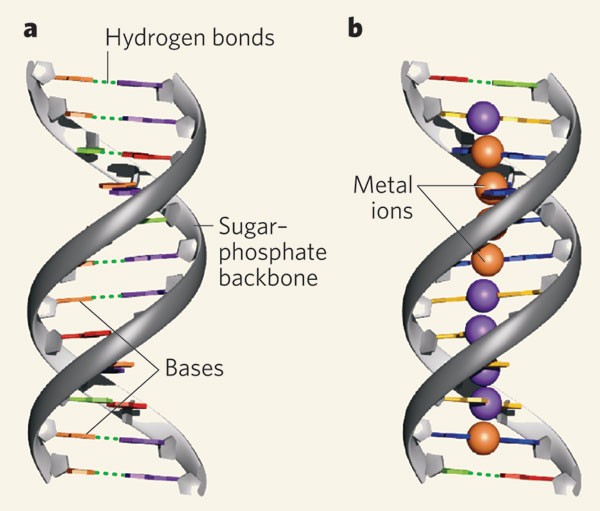
Tanaka et al.1 replaced the natural bases of DNA with artificial ones. Each of these substitute bases has a high affinity for a particular metal ion — either a copper ion (Cu2+) or a mercury ion (Hg2+). The modified DNA can form a double helix only if the opposing bases have a preference for the same metal ion and if both bases bind to such an ion. Given an appropriate base sequence, a duplex can form that contains one or more metal ions along its central axis (Fig. 1b).
The incorporation of metal ions into an artificial DNA duplex has previously been reported, but with only one kind of metal at a time, typically in systems with a few modified base pairs interspersed between longer rows of natural ones3,4,5,6,7,8. What is remarkable about Tanaka and colleagues’ work1 is the formation of double helices containing long stretches of two different metal ions. Not only did the authors selectively incorporate more than one kind of metal ion into artificial DNA, but they also used more than one kind of artificial base, in various sequences. This is a tremendous advance towards the goal of making metal-containing, self-assembling nanomaterials with desirable properties that can be tuned on the basis of the order of the metal ions. The beauty of Tanaka and colleagues’ work is that it exploits the self-assembly of DNA, where the two strands come together, a process that has been optimized by evolution over several billion years. Furthermore, automated DNA synthesis permits quick and easy access to any desired sequence of artificial DNA, provided that a certain length of molecule is not exceeded.
So how could these artificial DNA structures be used? One possible application is in organic chemistry, as catalysts for enantioselective reactions9 — that is, reactions that proceed with precise control of the three-dimensional structure of the products. Such catalysts are essential for the synthesis of biologically active compounds, but tailoring the interactions between a catalyst and a reactant to achieve this precise control is far from simple. Natural catalysts, such as enzymes, are excellent at directing enantioselective reactions, but from a chemist’s perspective their range of reaction conditions is very restricted. Synthetic metal catalysts can be optimized to work under more typical laboratory conditions and on an industrial scale, but they are often less efficient than enzymes. Metal-ion-containing DNA catalysts represent a biologically inspired approach that could combine the best of both of these catalytic worlds.
Enantioselective synthesis, also called asymmetric synthesis, is a form of chemical synthesis. It is defined by IUPAC as “a chemical reaction in which one or more new elements of chirality are formed in a substrate molecule and which produces the stereoisomeric products in unequal amounts.” Wikipedia
https://en.wikipedia.org/wiki/Enantioselective_synthesis
It has been found that, in a short artificial DNA duplex containing an array of five consecutive copper ions, the ions interact magnetically with each other2; this helix can be thought of as a self-assembled nanomagnet. Using Tanaka and colleagues’ approach1, specific combinations of metal ions might be incorporated into DNA to fine-tune the magnetic properties of such devices. The electrical properties of DNA are also of interest. Unmodified DNA lacks sufficient electrical conductivity to be used in molecular electronic devices10. To address this problem, DNA has previously been prepared with metals attached to its exterior, but this modification prevented the DNA from reversibly self-assembling11. (The natural reverse polarity found in evolving DNA in the Harmonic coordinated by time and the biosphere.)-Lisa T.
Tanaka and colleagues’ structures1 might provide a way forward, as they incorporate metal ions in the center of a DNA double helix that retains its ability to self-assemble.
But difficulties might be encountered when scaling up the authors’ technique to build larger molecules. As DNA duplexes form, intermediate double helices can be produced in which the bases are not perfectly matched. But every metal ion incorporated into the artificial DNA increases the stability of the final aggregate. This effect could stabilize the intermediate helices so much that they no longer rearrange to form a perfect duplex, so introducing errors during DNA self-assembly.
Perhaps more importantly, automated DNA synthesis can only prepare sequences of up to about 100 bases. To build larger structures, biological techniques must be developed that either splice together short artificial DNA strands or allow the synthesis of longer strands. Such methods exist for natural DNA, but these would have to be modified to tolerate artificial bases and metal ions. Finally, more work is needed to determine the electrical properties of metal-ion-containing DNA — is it a conductor or a semiconductor? Future research should focus on this question, and investigate the factors that influence conductivity. It seems that the quest for a functioning molecular device based on metal-ion-modified DNA is about to begin.
References
- Tanaka, K. et al. Nature Nanotech. 1, 190–194 (2006).Article ADS CAS Google Scholar
- Tanaka, K. et al. Science 299, 1212–1213 (2003).Article ADS CAS PubMed Google Scholar
- Clever, G. H., Polborn, K. & Carell, T. Angew. Chem. Int. Edn 44, 7204–7208 (2005).Article CAS Google Scholar
- Meggers, E. et al. J. Am. Chem. Soc. 122, 10714–10715 (2000).Article CAS Google Scholar
- Switzer, C. & Shin, D. Chem. Commun. 1342–1344 (2005).
- Miyake, Y. et al. J. Am. Chem. Soc. 128, 2172–2173 (2006).Article CAS PubMed Google Scholar
- Brotschi, C. & Leumann, C. J. Nucleos. Nucleot. Nucl. Acids 22, 1195–1197 (2003).Article CAS Google Scholar
- Weizman, H. & Tor, Y. J. Am. Chem. Soc. 123, 3375–3376 (2001).Article CAS PubMed Google Scholar
- Roelfes, G., Boersma, A. J. & Feringa, B. L. Chem. Commun. 635–637 (2006).
- Porath, D., Cuniberti, G. & Di Felice, R. Top. Curr. Chem. 237, 183–227 (2004).Article CAS Google Scholar
- Braun, E. et al. Nature 391, 775–778 (1998).Article ADS CAS PubMed Google Scholar
Author information
Authors and Affiliations
- Department of Chemistry, University of Dortmund, Otto-Hahn-Straße 6, Dortmund, 44227, GermanyJens Müller
Rights and permissions
About this article
Cite this article
Müller, J. Metals line up for DNA. Nature 444, 698 (2006). https://doi.org/10.1038/444698a
- Published06 December 2006
- Issue Date07 December 2006
- DOIhttps://doi.org/10.1038/444698a
Share this article
Anyone you share the following link with will be able to read this content:
Provided by the Springer Nature SharedIt content-sharing initiative
 Synchronicity is the Source of Consciousness
You must be logged in to post a comment.