This is all about synchronicity across time and space between cultures.
Aboriginal Continuity below. The AC strand of DNA brings the future backward into the present. The CA strand of DNA is active at Gobekli Tepe and brings the past forward into the present. Obviously, they speak to each other. We are all time traveler’s and our bodies are spacesuits.
I’m doing it right now. I’m looking at and studying The Disclosure Report, 2025 and attempting to plant it in Mr.X’s staff and brain so we can skip forward 100 years and manifest a peaceful planet, clean it up, and continue as a species before it’s too late. He asked me to help him so I am.
Göbekli Tepe is known to have been occupied from around 11,000 BCE to 8,000 BCE. It was occupied by hunter-gatherer and semi-nomadic peoples. Excavations of the site have revealed 43 large megalithic pillars, and it is possible that up to 250 more are yet to be found.
How long ago was Göbekli Tepe?
Göbekli Tepe was occupied as early as 11,000 BCE. However, it was at its peak from 9,600 BCE to 8,200 BCE. Göbekli Tepe was therefore occupied from 13,000 years ago to approximately 10,000 years ago.
Who built Gobekli temple?
Not much is known about the people who built the temple at Göbekli Tepe. The archeological evidence, such as over 100,000 wild animal bones and some signs of wild cereal processing, suggests the inhabitants of Göbekli Tepe were hunter-gatherers.
Is Göbekli Tepe older than Mesopotamia?
Göbekli Tepe is older than Mesopotamia. Gobekli Tepe shows signs of human inhabitants as far back as 11,000 BCE. The Sumerians of Mesopotamia only date back to around 5,000 BCE at the earliest.
What is the importance of Gobekli Tepe?
The significance of Göbekli Tepe is its out-of-place context in human history. The site dates as far back as 13,000 to 11,500 years ago, which is before the end of the last glaciation during the final ice age. Before Göbekli Tepe was discovered, hunter-gatherers were not believed to be megalith builders.
Who are the Australian Churinga?
A tjurunga, also spelt churinga and tjurunga, is an object considered to be of religious significance by Central Australian Aboriginal people of the Arrernte (Aranda, Arunta) groups. The word derives from the Arrernte word Tywerenge which means sacred or precious.
I’m reposting this on July 20, 2025, because it hit my brain. The date is exact for 24 days from today. It’s on today’s post. August 13, 2025 falls on White 12 Crystal Wind.
Presently there is no universal basis for what qualifies the start of a new year. Every culture has its own set of parameters for determining it. The Chinese celebrate theirs in either late January or early February according their lunar calendar. The ancient Egyptians linked the appearance of the star Sirius and the annual flooding of the Nile river to signal the start of their new year. (Lions Gate 8/8/20) The many cultures of India celebrate the new year on various dates during the month of April. Europe’s Nordic cultures keyed it to the Winter solstice. The Celtic, Samhain, now vulgarized as Halloween, is celebrated by present day neo pagans, Wiccans and Druids as the start of their new year.
Contrast that line of reasoning with the fact that the new year of non-western cultures is related to some seasonal and/or astronomical aspect. The foregoing is why I refer to the Gregorian calendar as an urban calendar, for it reflects the whims of the city lords more than anything else.
The most common denominator for the start of the new year in most other calendar systems is the start of the growing season or end of the harvest season. In some cases, either of the solstices or equinoxes are recognized as the start of the year. The start of the new year for cultures other than the Euro-western is related to the agricultural, seasonal, and astronomical particulars of each region.
A Bi-Universal New Year?: A Solstice New Year
Many pre-Christian cultures of Europe’s northern hemispheric latitudes recognized the winter solstice as the start of the new year as the Sun symbolically dies and is reborn on that day.
The start of the new year cycle can be viewed as universal for those in northern hemisphere when reckoned from the winter solstice, and as defined by the life cycle changes that accompanies the attendant atmospheric conditions (rain, dryness, snow, etc) as the sun ascends and descends. The same would apply to those of the southern hemisphere, except that their new year would start with what we in the north refer to as the summer or June solstice. I prefer to designate the solstices according to the month they take place within rather than say summer or winter, because the seasons are reversed depending on which hemisphere you happen to live in.
The process of cooling and warming is minimized in most parts of the tropical regions. The most defining aspect of seasonal variation in the tropics is dry and rainy seasons. Nonetheless it is the Sun’s to and fro movement, and its attendant affect on atmospheric conditions that drives precipitation patterns. Therefore we can associate the start of the new year with the solstice that marks the start of a rising Sun for each hemisphere, since it is the rising solstice Sun that initiates the life cycle for each hemisphere.
The solstices do indeed provide us with fixed starting points for each hemisphere’s respective new year as it relates to the life cycle, but might there be a truly universal new year that applies to the entire planet as a whole regardless of local particulars?
The Arguellen Universal Calendar Proposal
Jose Arguelles proposed the universal adoption of what he calls the 13 Moon Calendar. Thirteen “moons”, or months of 28 days, plus one day would give a clean, orderly and easy to use civil calendar. (13×28 = 364 +1 = 365) I won’t go into all the reasons on why a uniform calendar is far better than the Gregorian hodge-podge we have now. But if you think about it some of the reasons should become clear. He was not the first to propose a new and improved universal calendar.
His calendar proposal is based on the Mayan Tun Uc calendar which also measures 13 months of 28 days plus one day. Arguelles anchored the start of his 13 Moon calendar to July 26th. But why July 26th? What is so special about that date? The following quote from his website gives us his rationale.
“For many ancient peoples, including the Dogon and Egyptians of Africa and the Maya of Central America, the great star Sirius, the brightest star in the sky, was the galactic marker. The heliacal rising of Sirius – July 26 – commenced the Egyptian year”.
Jose Arguelles
The problem with his rational is that it’s mostly inaccurate. Sirius did loom large in Dogon and Egyptian cosmology, but I have yet to come across any information indicating that it had any sort of calendrical function among the Maya.
Additionally, the Dogon did not use the star Sirius as a calendrical marker. And the start of the Egyptian new year is July 19th not the 26th and the helical rise of Sirius is also around the same time–July 19-20.
Lastly, we did not understand the concept of a galaxy until the 1920’s when we discovered, thanks to telescopes, that we inhabit one of billions of galaxies. The Arguellen account does not give us any reason whatsoever to say that July 26th is the start of some universally valid new year, even though he insists it is.
There are two testable and key parts to his universal year cycle proposal. One is that it starts on July 26th and the other is that each of its 13 months are characterized by a set of qualities in the same way that each day of the Tzolkin’s 13 day tone cycle has it particular qualities.
In other words the 13 day tone cycle is a fractal of the 13 month year cycle, as proposed by Arguelles. The first month of the 13 month year cycle carries the same qualities as the first tone of the 13 day tone cycle and so on. But this article will focus solely on the question of universal new year and its probable start date, if one exists.
So what else can be said about July 26th?
The 365 day civil calendar of ancient Mesoamerica was known as the Haab among the Maya and as the Xiuhpohualli among the Aztecs. The ancient Mesoamericans did not anchor their civil calendar to any part of the year in the way the Gregorian calendar does by adding a leap day every 4 years. This means that the start of Mesoamerica’s civil calendar year drifted by one day every 4 years.
At the time of the Spanish invasion, the first day of Mayan Haab calendar, “0 Pop”, coincided with July 26th, and hence forth the Mayan Haab was fixed to July 26th for unclear reasons. Spanish imposition is most likely the reason for the Haab’s fixation to July 26th.
July 26th is also significant for one other reason, for it is the day that the Sun is at the zenith over two of Mesoamerica’s most important pyramid sites. Teotihuacan marked the solar zenith passage date for the Toltecs and Edzna marked the July 26th solar zenith passage for the Yucatec Maya.
But there is still nothing universal about a Spanish imposition, nor are solar zenith passage dates, for they will vary according to latitude within the tropics of Cancer and Capricorn.[fig. 1]
Finding the Center of Space and Time
The Tropic of Cancer is Arguelles N. Polar Zone in assessing the DNA in synchronicity with the earth, and The Tropic of Capricorn is the S. Polar Zone for the same reason. In between them is the Zone of Transformation. This is the alignment in EVERY CELL OF DNA ON THE PLANET and accounts for the double helix and radial polarity. -My comments, Lisa K. Townsend
August 13th is most famous for being the alternative start date for the beginning of the Maya Long Count Cycle. There is a 2 day discrepancy between when the Long Count may have actually started. The account with the most backing says its August 11th, 3114 BCE, and that date gives us the end date of December 21st, 2012. August 13th gives us the end date of December 23rd.
The Zapotec-Shearer-Arguellen Tzolkin may be able to shed some light on that subject, but that investigation will be for another time. And after this analysis I am inclined to think that August 13th may carry more weight than August 11th. The other principle reason that August 13th is well known among Maya scholars is due to the unique timing phenomena that occurs on August 13th, at the latitude of 14.8 north. I will have to forego the extremely fascinating history behind the discovery of August 13th at the latitude of 14.8 N for this article, but I will relate what is most salient to my purpose here.
The latitude of 14.8 north has the distinction of being the place where the sun’s two zenith passage dates combine to equate interval periods of 260 days and 105 days (105 + 260 = 365). Two hundred and sixty days is the number of days in the Tzolkin cycle calendar, or the most revered body of knowledge in all of ancient Mesoamerica.
Zenith passage dates can only occur between the tropics of Cancer and Capricorn.[fig.1] As the Earth tilts on its axis, we see the Sun rise and fall in the sky over the course of the year. The tropics, or the lines of latitude just mentioned, mark the Sun’s northernmost and southernmost points of inclination and declination. The tropic of Cancer is located 23.5 degrees north of the equator, and it marks the day the Sun is directly overhead on the June solstice. The tropic of Capricorn is located 23.5 degrees south of the equator, and it marks the day the Sun is directly overhead on the December solstice.
It has been suggested by many scholars that the 260 day Tzolkin and the 365 day civil calendar were developed at the ancient ceremonial site of Izapa. Izapa is one of two major ancient Mesoamerican ceremonial centers that are located at the latitude of 14.8. The other site is Copan which is found on the border between Honduras and Guatemala. [fig.2] Izapa is located near the Mexican-Guatemalan border.
John Major Jenkins and a few others believe that the Long Count Cycle was calibrated at Izapa, and they are probably right about that, but from my vantage point I believe that neither the Tzolkin cycle nor the 365 day calendar were discovered or formulated there.
I won’t get into my version now, but I will say that I believe that the Ancient Mesoamericans (AMA) sought out the place where the two primary measures of time, the Tzolkin and solar cycles met in perfect harmony.
Such a place would be nothing less than the place where the “Heart of Earth” meets the “Heart of Heaven” within their worldview. The Heart of Earth being the 365 pulses (beats) that we experience as a day-night cycle, and the Heart of Heaven being the 260 pulses of the Tzolkin cycle. In other words, the Tzolkin was regarded as the primary or cosmic timing standard. The implication is that the solar cycle is a local timing standard, particular only to our unique place in time and space, but nonetheless supremely relevant to why our solar system harbors life.
Orienteering 101
In order to show what is meant by the foregoing, let’s begin with the Sun at the December solstice. On the Sun’s northward journey it crosses the zenith over Izapa on April 30th.
The Sun continues climbing until it stops its northward journey on the June solstice, or the day the sun is directly over the tropic of Cancer, and once again begins its southward journey toward the winter solstice. On its southward journey it will again be directly over Izapa on August 13th for its second zenith passage.
Please note that our warming season from winter to summer solstice corresponds to when the earth’s northern hemisphere is tilted toward the sun and the opposite is true in the winter time.
April 30th to August 12th equals 105 days and from August 13th to April 29th there are 260 days. (260+105=365) The two solar zenith passages are separated by 105 days in the former interval, and by 260 days in the latter.
The interval from August 13th to April 29th places the December solstice smack dab in the middle at 130 days or one half of a Tzolkin Cycle.
Furthermore, there are 52 days from the summer solstice to August 12th, and we well know that the number 52 was highly revered by the AMA for its meaning within their understanding of time.
August 13th would be the equivalent of our January 1st and August 12 would be the same as December 31st.
But why August instead of April?
August 13th came to be known among the AMA as “the day the world was born” and “as the place where time began“. But why did they pick the August zenith passage date over the April zenith passage to anchor the “day the world was born”, and mark the start of the new year and the Long Count cycle?
The one thing that comes to mind is that they recognized the December solstice as the start of the solstice to solstice year cycle, and so that would make the August zenith passage the second or completing zenith passage date, hence completing the centering aspect of the Sun’s passage and the next passage date is a full 260 days away with the winter solstice perfectly balanced between the 2 zenith passage dates.
We must remember that one of the AMA’s most important cosmological quests was worldcentering, therefore they would value counting the year cycle from center point to center point, rather than from extreme point (summer solstice) to extreme point (winter solstice) so to speak. Following this line of reasoning, I looked to the night sky to see if it could shed some light on this subject.
I set my astronomy software to 3114 BCE to see if the night or day sky at the zenith time over Izapa might reveal something telling about why else the August 13th zenith date might have been favored over April 30th. I discovered that the Milky Way straddles the north-south meridian at midnight in such a way as to form a perfect cross just 20 degrees from the zenith.The four quarters of the world are made manifest by such an event, and the observer is at the very center of it all. On April 30, the Milky Way is not perpendicular to the zenith meridian until the dawn.
The actuality of the evening’s most revered object, the Milky Way, forming a cross with the north-south meridian at the zenith and at midnight, on the same day that the day-time’s most revered object, the Sun, is at the zenith only reinforces the idea of August 13th as the center of space and time in the most literal of terms.
There is one other consideration, and that is the agricultural season. The first corn crop is sown to coincide with the start of the rainy season around the end of April-start of May – the time of the first zenith passage. The first harvest happens right around the middle of August or near the second zenith passage. We know that harvest time is often a factor for pin pointing a year cycle start date among other cultures, but this aspect, unlike the first two, is not a universal condition, and we are looking for universal parameters.
August 13th: Ancient Mesoamerica’s Universal New Year
It seems that August 13th was regarded as the start of a universal new year among all major pyramid building cultures of Mesoamerica. It has been found that at least one major aspect of almost every major ceremonial center has an axis or focal point of some sort aligned with the sunset of August 13th. In other words it was widely acknowledged that Izapa was situated at the “Heart of Earth” and that the work done at Izapa was supremely important to the foundation of Mesoamerican cosmology.
In acknowledgement of Izapa and August 13t, other ceremonial centers oriented at least one major structure toward the sunset of August 13th. In other words Izapa represented nothing less than the place where the tangible fulcrum of earthly time, and the intangible fulcrum of cosmic time met in perfect harmony.
Three hundred and sixty-five days is the measure of earthly time and 260 days is the measure of cosmic time. Heart of Earth and Heart of Sky are two very important metaphors in Mesoamerican cosmology, for they too, like so many other cultures, recognized that everything emerges from some infinitesimal center place.
The perceptible Heart of Sky is the zenith, and also from Izapa they discovered the intangible, but supreme center of our local universe, or the heart of our Galaxy.
So it was that they developed the Long Count to calibrate when Father Sun would be reborn from the Cosmic Mother. (Jenkins Maya Cosmogenesis). By doing so they achieved the holy grail of Mesoamerica’s other great quest known as Worldrenewing.
Before concluding I want to go back to July 26th. As mentioned earlier the zenith of July 26th was marked by the ceremonial centers of Edzna in the Yucatec Maya lands, and at Teotihhuacan – land of the multi-culturally composed Toltecs.
Edzna was the first major ceremonial center of the Yucatec Maya and Teotihuacan was the major ceremonial center for the highland Toltecs. The pre-imminent Maya scholar Vincent Malmstrom thinks that the northern periphery of grand Mesoamerican culture, as marked by Edzna and Teotihuacan, switched the official start of the new year from August 13th to July 26th.
According to Malmstrom, a calendar reform of sorts took place in the year 48 CE, in which July 26th became the new “new year” start date for the Yucatec region and Teotihuacan, since both centers were built where the sun is at the zenith on July 26th.
We don’t know exactly what prompted this change, but Malmstrom thinks it had to do with having a “locally relevant new year”. It may have been a political tactic to establish Edzna as the new power center of an emerging civilization.
Earlier I mentioned that the Maya civil calendar, the Haab had been fixed to start on July 26th at the time of the Spanish invasion. Thus the prominence of July 26th in the historical record was doubly reinforced, since the roving start date of the civil calendar, and the July 26th solar-zenithal passage new year are two distinct ways of measuring the year cycle.
Recently I met a Maya man from Guatemala, and he did confirm that July 26th is still recognized as the first day of the new year, and this had nothing to do with the Arguellen proposition to create a new universal calendar with July 26th as its start date. Arguelles it seems borrowed the start date for his universal calendar proposal without giving full disclosure as to why he had chosen that date.
Conclusion
August 13th has a couple of strong reasons as to why it’s a prime candidate for a universally valid start of the year. July 26th is another serious choice because of its strong presence in the historical record. However, there are problems with the July 26th date because we have yet to discover any universally valid properties to that day.
Whatever the case, the month of August looms large in the historical record as it relates to the story of 2012 and Mesoamerican history. The following list of events only seems to affirm the significance of the time period called August:
Either August 11th or 13th is the start date of the Long Count Cycle.
Hernán Cortés began his march on the Aztec capital on August 16th, 1519.
The Aztec Empire fell on August 13th, 1921.
The atomic bombings of Hiroshima and Nagasaki happened on August 6th and 9th respectively.
Tony Shearer fulfilled the prophecy of the 13 Heavens and 9 Hells prophecy cycle by calculating its end date on August 16th-17th, 1987. The fact that Arguelles was able to successfully convoke a global gathering on those two dates (Harmonic Convergence) lends even more weight to mid-August as some sort of peak moment in the solar cycle. Harmonic Convergence was a major event in the history of humankind, for it was the world’s first global ritual event and it took place before the internet was publicly available.
Those of you familiar with my article on Anticipating Personal and Collective Shifts in relation to MAC Time Science, should consider mid-August 13 as a cycle juncture window. A cycle juncture window is a period of time before and after a cycle ending zero date or August 12th in this case. Shift-type events are most likely to happen during a cycle juncture window; review the article in question for more details.
May you all have a joyful August 13th!-Rohann Solare-Raul Grajeda
From Lisa-According to the Urantia Book, human beings, at our current general evolution level, developing on earth, are 1 million years old. This new finding sets us at half a million. Almost every plant and animal species on earth got here or developed here before we did. We have everything to learn from nature.
As you know from the Maya teaching, our DNA patterns are ancient, and we are progeny of our ET ancestors, thank God. Tiamat was a tragic setback, but its legacy is about to be over. If I have my way, humans will have a leap forward. But, I cooperate and work for the universe, not myself. We’ll see.
Here is the article
It is believed that homo sapiens entered the evolutionary picture about 350,000 years ago.
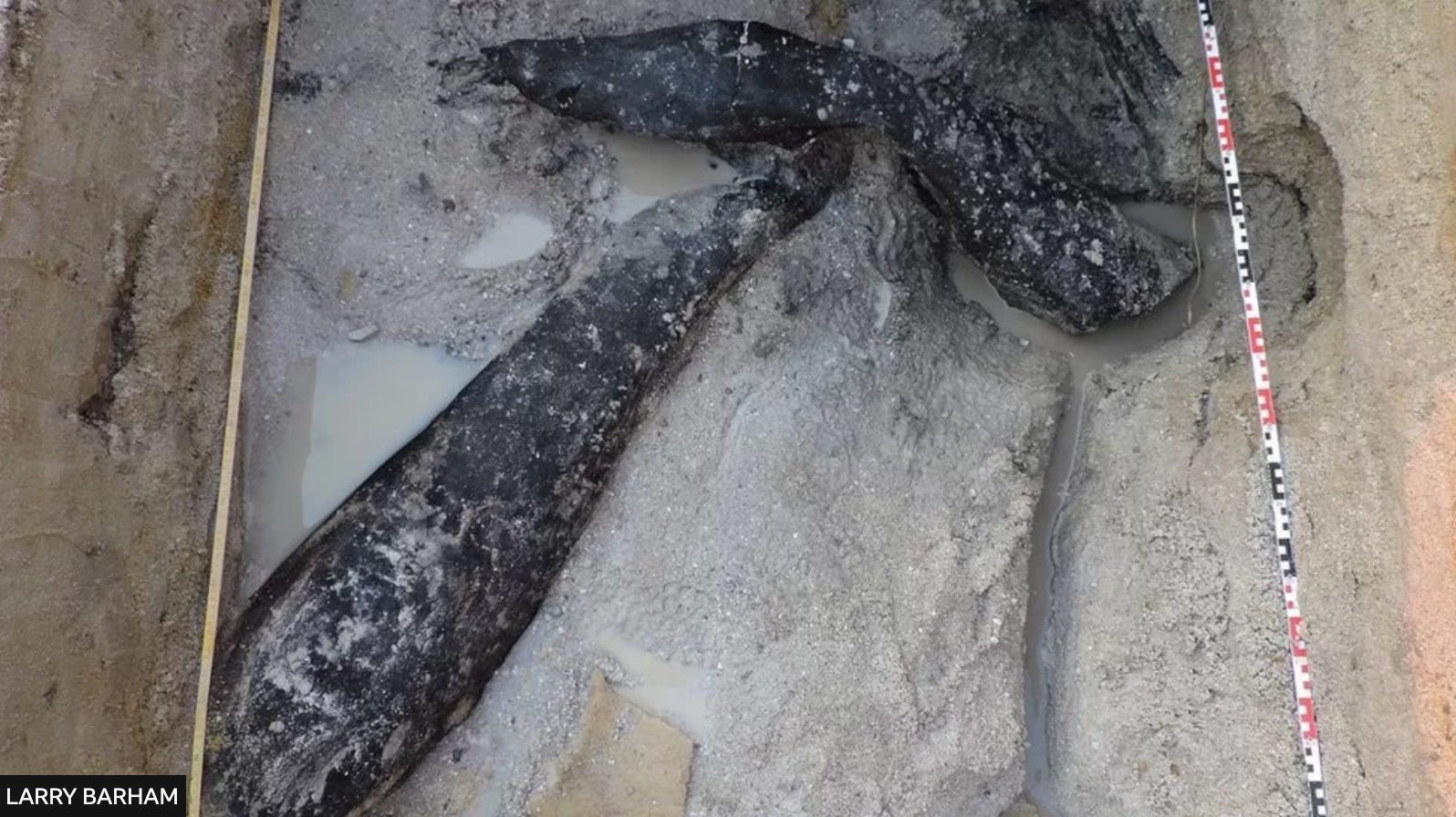
The 1.4-meter wooden remains were discovered at Kalambo Falls in the central African nation. The area is a hot spot for archaeological discoveries, with evidence of human life all the way from the early Stone Age to modern times.
Professor Larry Barham of the University of Liverpool’s Department of Archaeology, Classics and Egyptology led the team that studied the remains.
His team published a paper in the journal Nature discussing their findings. They noted that a high water table was one of the primary reasons why the remains were able to stay intact and in good enough condition to notice details like purposefully cut notches to interlock the wood.
Further, the paper posits that the dense forest cover at Kalambo and the high water table likely created frequent flooding, which would spark local habitants to construct “a raised platform, walkway or foundation for dwellings” giving us a motive.
These details indicate humans, or some other intelligent being, used tools to build whatever these wooden objects were used for. Specifically, they noted the likely use of a broad, cleaver-like edge to shape the wood.
“We interpret this object as a portion of tree trunk cut to size, indicating capacity to work wood at a large scale.”
Barham’s writes in the paper:
“Waterlogged deposits … preserved two interlocking logs joined transversely by an intentionally cut notch,[…]This construction has no known parallels in the African or Eurasian Palaeolithic.”
“We also recovered four wood tools from [390,000 to 324,000 years ago] including a wedge, digging stick, cut log and notched branch. The finds show an unexpected early diversity of forms and the capacity to shape tree trunks into large combined structures. These new data not only extend the age range of woodworking in Africa but expand our understanding of the technical cognition of early hominins, forcing re-examination of the use of trees in the history of technology.”
Beyond our understanding of the cognition of humans at the time, these remains predate homo sapiens by thousands of years. Were we off in our understanding of humanity’s timeline? Perhaps.
The paper concludes:
“Exceptional conditions of preservation give us this glimpse of a capacity to create a built environment by hominins hitherto perceived as mobile foragers with limited technological diversity.”
Given the suggestions of this paper, it will certainly spark other scientists to check the findings and perhaps challenge them. But for now, an invitation to be curious about what we truly know of our past remains open.
Every time a new development emerges that shakes up our understanding of history my curiosity about our origins is re-engaged. For most of my life, I’ve been enthralled by ancient civilizations, human origins, extraterrestrials, the paranormal, and many more of life’s mysteries.
The standard explanations for things like ‘who built the pyramids’ or ‘how did humans end up here?’ never sufficed for me. Something deep inside has always pushed me to look further and keep an open mind and heart.
This new finding reminded me of a podcast episode I did with Bruce Fenton in 2021 called Exogenesis – Were Humans Made By ETs?While it doesn’t relate to the type of findings in this discovery, it looks at other bits of archeological evidence I find much more intriguing.
The Mayan calendar is revered for its impeccable accuracy. Now, a recent excavation in Guatemala reveals how the system developed over time.
They point out 7Deer in this article and say it muddies the waters. I don’t believe it does. The Maya used the word for deer to mean hand. 7 Deer is Blue 7 Resonant Hand or Kin#7. I knew what it meant as soon as I heard it even though there is no archetype called Deer in the tribes. Again, one has to use intuition and not be so literal.”-Lisa T.
The Mayan calendar is revered for its impeccable accuracy. Now, a recent excavation in Guatemala reveals how the system developed over time.
They point out 7Deer in this article and say it muddies the waters. I don’t believe it does. The Maya used the word for deer to mean hand. 7 Deer is Blue 7 Resonant Hand or Kin#7. I knew what it meant as soon as I heard it even though there is no archetype called Deer in the tribes. Again, one has to use intuition and not be so literal.”-Lisa T.
Location is 30°S–150°W in the South Pacific. This is a SIGNAL KIN Portal and these very large stone statues with full bodies underground were likely a signal that could be seen by an E.T. ship for the residents who lived there. “Here is where we are. Here is where you land.” My guess is Venusians, similar to the Maya who also have an affinity for carving stone.
Yellow star is in the Signal Earth Family that includes; White Mirror, Blue Night, Yellow Star, and Red Skywalker so I’m all up in it.
Busting the Easter Island myth: there was no civilization collapse
For decades, researchers have proposed that climate change and human-caused environmental destruction led to demographic collapse on Easter Island. That’s probably false, according to new research.
Golden sunset illuminates a row of moai statues on Easter Island. helivideo via Adobe Stock
Easter Island, whose native name is Rapa Nui, is a remote island in the Pacific Ocean about 2,300 miles west of Chile.
Researchers have proposed that deforestation and climatic changes led to societal collapse on the island, prior to European contact.
The results of a new study suggest that, despite these factors, the Rapa Nui people managed to adapt and sustain a stable society.
In the popular imagination, the story of Easter Island has long centered on stone. About 900 monolithic statues, or “moai”, have been identified on Easter Island, a remote 63-square-mile triangle in the Pacific Ocean whose native name is Rapa Nui. The statues — haunting, hollow-eyed faces — were crafted from massive blocks of volcanic rock by the Rapa Nui people, who settled on the island around 1200 CE.
But for archaeologists and anthropologists, the story of Rapa Nui has often centered on trees, rats, and climate. These are the key factors, some researchers have proposed, that led to ecological catastrophe on the island and, consequently, population collapse.
One popular narrative holds that the growing Rapa Nui population cut down so many of the island’s tall palm trees that they depleted their food and logistical resources and inadvertently killed off plant and animal species. Meanwhile, Polynesian rats, which were carried to the island via boat and had multiplied exponentially over generations, contributed to deforestation by eating seeds and plants. Compounding the island’s problems were changes in the El Niño Southern Oscillation, which led to drier conditions.
Facing dire circumstances, the natives probably resorted to eating rats. They might have also turned to eating each other, suggested the author Jared Diamond in his book Collapse, in which he states that Rapa Nui is the “clearest example of a society that destroyed itself by overexploiting its own resources.”
Busting the Easter Island collapse myth
But the popular narrative about Easter Island could be mostly false. New research suggests that these narratives connecting environmental devastation to population decline aren’t accurate. The study, published in Nature Communications, found that while the Rapa Nui people did suffer environmental and climatic changes, they didn’t suddenly dwindle in number but rather maintained “stable and sustainable communities on the island” up until the point they encountered Europeans.
To estimate changes in population over time, the researchers tested four demographic models, three of which accounted for variables like climate change or deforestation or both. Their models also incorporated about 200 radiocarbon-dated archaeological samples, which serve as a good “proxy for estimating relative population sizes.”
Radiocarbon dating and statistical modeling always come with uncertainties. To minimize analytical uncertainty, the researchers used a form of statistical modeling called Approximate Bayesian Computation. The researchers wrote:
“[Approximate Bayesian Computation] is a flexible and powerful modeling approach originally developed in population genetics, but recently applied in archeology, including paleodemographic research. We demonstrate how ABC can be used to directly integrate independent paleoenvironmental variables into demographic models and perform multi-model comparisons.”
The results produced by all four models showed that the Rapa Nui population enjoyed steady growth until the first contact with Europeans in 1722, after which the population seemed to either plateau or decline over subsequent decades. These models suggest that, contrary to previous hypotheses about how the overexploitation of resources led to demographic collapse, deforestation and climatic changes on the island were prolonged processes that didn’t have catastrophic effects on the population.
For example, evidence suggests that the Rapa Nui people built productive gardens on deforested land and mulched them with nutrient-rich stone. As for climate change, the researchers pointed to recent studies suggesting that the natives adapted to drier conditions by turning to coastal groundwater sources.
Upending a long-standing narrative
Although the study offers evidence of a robust population prior to European contact, the researchers could not determine which of the four demographic models was most correct, nor did they account for other factors that likely affected the island’s population, like warfare. The researchers also did not explore what effect, if any, European contact had on the population.
But overall, the study casts serious doubts on the popular narrative that environmental changes drove down the native population. To be sure, there are dark chapters in the history of Rapa Nui, including civil war, slave raids, and statue destruction; reports suggest that between 1722 and 1774 many of the island’s statues were toppled or neglected, likely due to internal conflicts among the natives.
Still, the study suggests that the story of early Rapa Nui is less about environmental destruction than it is about resilience.
The researchers conclude that “despite extreme isolation, marginal ecological conditions, and a series of environmental changes, Rapa Nui people found solutions that enabled them to successfully thrive on the island for at least 500 years prior to the arrival of Europeans.”
Some have proposed that the slab is after all a portal, of life and death, symbolizing rebirth. Some archaeologists theorize that the intricate drawings of domes, lines, and rings, are an ancient expression of rock art that has been found in many parts of the globe. According to experts, the symbols initiate to the Neolithic and early Bronze Age but there are some examples that are found thus far from the Iron Age.







 Synchronicity is the Source of Consciousness


You must be logged in to post a comment.