It’s creepy that the doctors tell us not to eat sodium or to buy potassium supplements. People tend to be low on both and then end up in the ER which fills their pocketbooks of course.
We know that the amino acid proteins are the building blocks of our 3D flesh, and the symbols for the 20 Mayan tribes represent them, but the electrolyte minerals charge our ELM field that makes up our etheric body.
Sodium and potassium must be gotten in our food, or you’ll get sick and die. The demonization of sodium and potatoes by sick care is incorrect. They are both important electrolytes for good health.
If you eat a whole food diet and not processed food, which is overloaded with sodium because it’s bad food, you won’t get enough.
In comes Mercury with its odd tail made of sodium, raising our amplitude. (See article below) Mercury mediates White Dog~Red moon, which we just passed, and rules communication in our brains. That requires sodium, especially in our conscious state, when our eyes are open with alpha brainwaves. The universe is working hard to keep us awake and evolving gradually.
CHANCE OF FLARES TODAY: NOAA forecasters say there is a 40% chance of M-class solar flares today. The most likely source is fast-growing sunspot AR3280, which has an unstable ‘beta-gamma’ magnetic field and is almost directly facing Earth. Solar flare alerts:SMS Text.
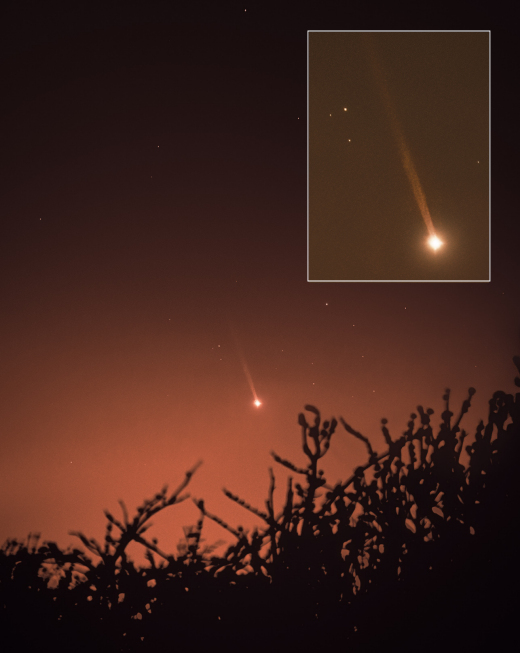
THE SODIUM TAIL OF MERCURY: Astronomy used to be so simple. Comets had tails, and planets did not. Mercury is making things complicated. When Dr. Sebastian Voltmer of Spicheren, France, photographed the planet this week, it exhibited a magnificent plume of gas flowing behind it:
“Mercury is NOT a comet, but it sure looks like one,” says Voltmer. “Solar wind and micro-meteorites hitting the planet eject sodium atoms from Mercury’s surface. This creates a yellow-orange tail of sodium gas that is around 24 million kilometers long.”
First predicted in the 1980s, Mercury’s tail was discovered in 2001. The gaseous plume is made of many elements from Mercury’s rocky surface, not only sodium. Sodium, however, dominates the scattering of sunlight and gives the tail its striking yellow hue.
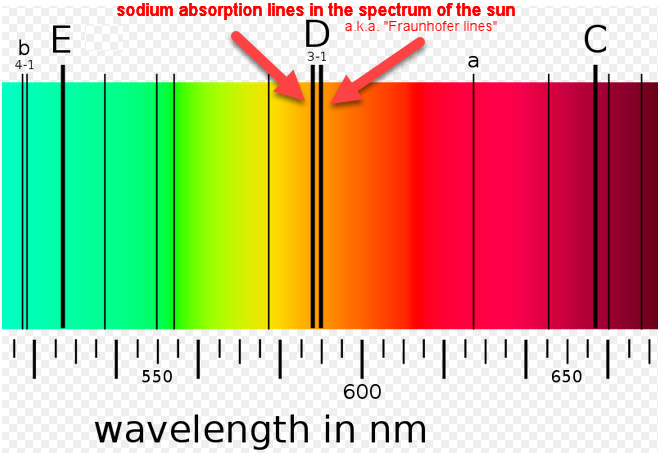
People watching Mercury climb up the evening sky this month may be wondering “why didn’t I see a tail?” Answer: A special filter is required. “I used a 589 nanometer filter tuned to the yellow glow of sodium,” says Voltmer. “Without such a filter, Mercury’s tail is almost invisible to the naked eye.”
Mercury’s tail waxes and wanes in brightness as it orbits the sun. The predictable pattern is shown in this movie from NASA’s MESSENGER spacecraft, which spent years observing Mercury’s tail from close range:
For reasons having to do with the Doppler shift of sodium absorption lines in the solar spectrum, Mercury’s tail is most luminous when the planet is ±16 days from perihelion (closest approach to the sun).
This means the tail’s maximum luminosity is only a few days away. Mercury will be 16 days past perihelion on Monday, April 17th, located in the sunset sky almost directly below Venus. If you have a sodium filter, take a look!
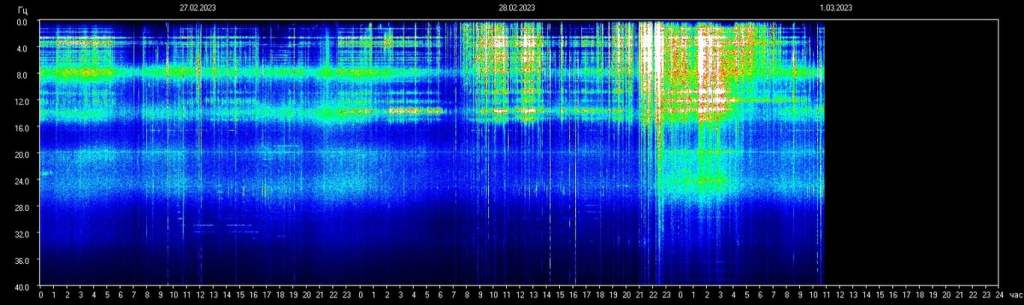
The Psi Bank is the magnetosphere monitored by the scientists in Russia. They call it the Schumann Resonance or ScR for short.
NASA found the Psi Bank in August 2012, very synchronous timing with the ending and beginning of the new 26,000 year cosmic cycle on December 21, 2012. We are only about 10 years into the new 26,000 year cycle, so I’ll probably be back to Earth a few times trying to teach this.
The distance from us to the galactic center is 26,000 light years, where a supermassive black hole known as “Sagittarius A*” is located.
This is the approximate location of the Sun in the Milky Way. The distance from us to the galactic center is 26,000 light years, where a supermassive black hole known as "Sagittarius A*" is located. pic.twitter.com/kXnSunYFbj
No one has said this, but I am going to. The poles of Earth are shifting, and the ringing in my brain is off-putting.
Keep in mind that as you look at the Tzolkin, the red light-time, 52-day cycle comes first, and the green light-time cycle 52-day cycle comes LAST.
We are currently in the red light cycle, but the green light hovers over all of the 5gdorce kin for now. I post that daily.
Spaceweather.com
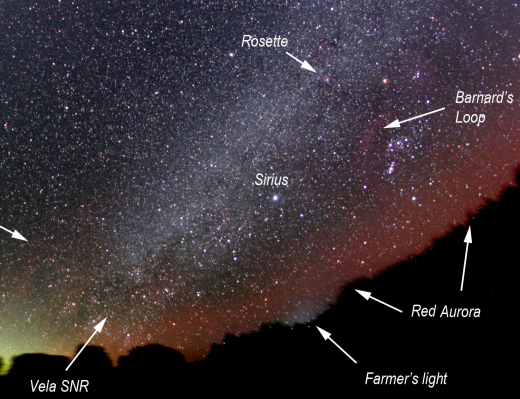
RED AURORAS OVER FLORIDA (AND ELSEWHERE): This hasn’t happened in nearly 20 years. On March 24th, auroras descended all the way to Florida. Bill Williams photographed their red glow from the Chiefland Astro Village:
What in the world? Normally, we have a very dark horizon looking out over the Suwannee River Basin and Gulf of Mexico,” says Williams. “But my 26-minute exposure taken to capture the Winter Milky Way showed an unusual red glow.”
“The mystery was solved the next day as Spaceweather.com described a severe geomagnetic storm well-seen in the U.S. As far as I know, at 29.4 degrees north latitude, we are the farthest south this aurora has been witnessed, and is the first I have seen here in Florida since 2003 and 1989!”
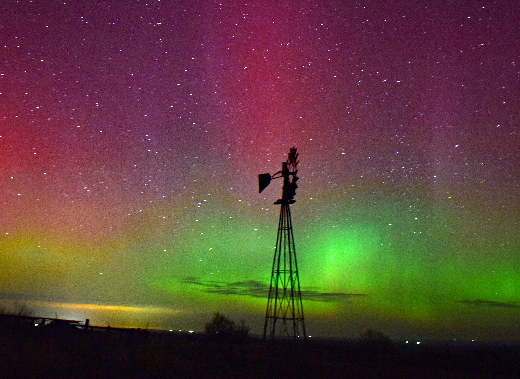
Most auroras are green, yet when auroras spread to low latitudes, the sightings are almost always red. There’s a simple reason. Ordinary green auroras come from oxygen atoms about 150 km above Earth’s surface. Red auroras are also caused by oxygen, but much higher up, between 150 km and 500 km.
This picture taken the same night by Dean Cosgrove of Curtis, Nebraska, (+40.6N) nicely illustrates the red-on-green altitude structure:
From far-south places like Florida, the greens are eclipsed by the northern horizon, leaving the higher reds to dominate the display.
Other notable sightings of low-latitude red auroras during last week’s storm include New Mexico (+32.8N), North Carolina (+36.5N), Colorado (+40.4N), and California (+39.7N).
Did *you* see red? Submit your photos here. Aurora alerts:SMS Text.
Note: Unrelated to auroras, another red glow called “airglow” can also be seen sometimes at low latitudes. Indeed, on any other night, airglow would be a leading explanation for what Williams photographed. But on March 24, 2023, during an extreme geomagnetic storm, with other red auroras being seen only a few degrees away, auroras are the most likely explanation.
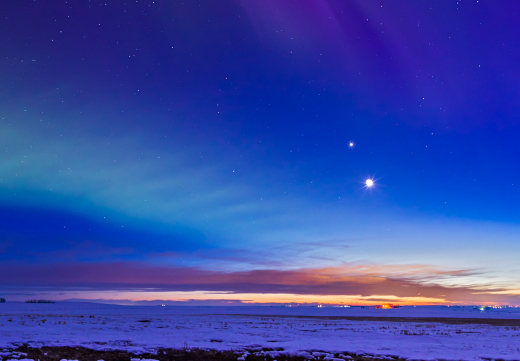
AURORA DUNES SEEN DURING EXTREME STORM: Lots of unusual things were seen during last week’s extreme geomagnetic storm. Alan Dyer of Gleichen, Alberta, photographed one of them, shown here in a deep twilight photo at te onsett of the storm:
“I captured some ‘aurora dunes,'” Dyer says. “They are the horizontal green ripples to the left of Venus and the Moon.”
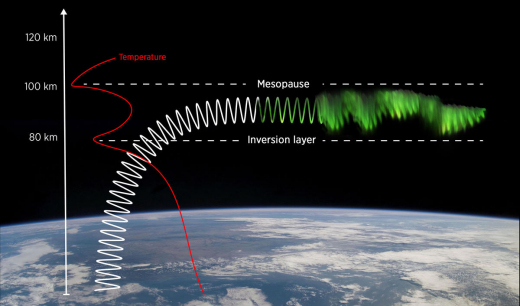
Aurora dunes are a recently identified form of Northern Lights named after their resemblence to ripples in desert sand. Researchers first explained them in a paper published only a few years ago. The dunes are a “mesospheric bore,” a type of atmospheric gravity wave that springs up from Earth’s surface and gets caught in a thermal waveguide ~100 km high. When solar wind particles rain down on the bore, they illuminate its rippling structure.
Sky watchers in the Arctic have been seeing dunesfor years without understanding what they were. A breakthrough came on Oct. 7, 2018, when multiple groups photographed dunes from widely separated locations in Finland. Triangulation revealed the dunes to be ~100 km high with a pure, monochromatic wavelength of about 45 km.
This is a new field of study with potential for discovery. Monitoring aurora dunes may reveal previously hidden waves and waveguides at the boundary between Earth and space. If you see any, submit your photos here.
BREAKING🚨: A massive 'hole' 30 times Earth's size has just opened on the Sun, blasting solar winds that'll hit our planet by end of this week https://t.co/0Z40SzLXx3
Today is the Spring Equinox, White 7 Resonant World Bridger, March 20, 2023. Resonant, reverberating, circling change/death to improve conditions on Earth for all life. Change is sacred and good in evolution. Things stay the same at the galactic center but not here. Spiritual ascension to the galactic center is a slow process.
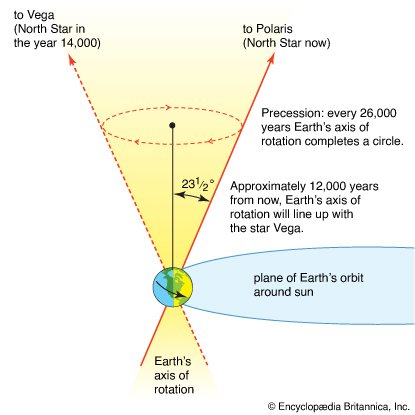
Every 26,000 years, Earth’s axis of rotation, or PROCESSION, completes a circle. It is a Tzolkonic cycle in agreement with the ancient Maya.
Exactly 13,000 years from now, Earth’s axis of rotation will line up with the star Vega. 4D is exact. 3D is approximate and follows 12;60. That means the calculations will be off unless 3D calculations take into account 4D math, which is vigesimal and based on 13:20.
The solar process of approximately 365 earth kin in space, manifested in 3D, processing around The Sun is an AXIAL PROCESSION or a solar year.
The 260-day cycle in time or 4D is a galactic spin because our true context is the Milky Way galaxy, not just Earth. Within the 260-day cycle, we have 5 52-day cycles made of 65, 4-day harmonics, and 20 13-day Wavespells. That creates the coordinate 13:20, which is vigesimal and exponential. It is true time, not approximate.
The medial point between 260 and 365 is 13. There are 13 full moon lunar cycles of 28 days each in a 365-day solar year. 13 x 28=364. Taking into consideration that there are 64 harmonics, not 65, governed by the 3D I Ching, it is an exact alignment of spacetime. Jose had not achieved that part of organizing the IChing with the Tzolkin. I figured it out. It’s in my book, “Time is DNA.” His work helped me see it.
The difference between 364 and 260 is 104 or 2, 52-day cycles. So the ultimate difference between the 364-day solar year and the 260-day Time cycle is 7 vs 5 which comes to 2 or duality. There are 7 52-day cycles in 364 and 5 52-day cycles in 260. The difference is 2. So the purpose of 12:60 has been to keep us level in duality but still evolving after the accident or indolence of blowing up Tiamat living on the 13:20 cycle and thus having to move us back to the slower, 3D focused 12:60 timing cycle for our own good.
This is all changing polarity, though, because the sun’s ELM, electromagnetic orientation has changed polarity from north to south. It’s a NATURAL 11.5 year solar cycle. The planet’s poles don’t change polarity every 11.5 years, but gradually, they do.
NCEI scientists with the Cooperative Institute for Research in Environmental Sciences (CIRES) at the University of Colorado Boulder calculated the movement of both the North and South Magnetic Poles from 1590 to 2025 (435 years) using two models: gufm1 and IGRF. Gufm1 incorporates thousands of magnetic observations taken by mariners engaged in merchant and naval shipping.
The link above
Both Corey Goode and Ben Davidson live in Boulder, CO. They’re buddies. And why the year 2025? Corey mentioned it as the year when the GGLN will be able to come into our system and secure a major star gate that is right next to us. At that point, the C#$%^ will be exiled, so he said. I guess we’ll see. I won’t hold my breath and use my own intuition.
Geomagnetic pole reversals have happened throughout Earth’s history. The last one occurred 780,000 years ago. Though they sound scary, pole flips can take a long time to occur and pose no immediate threat.
The NOAA link above
NOAA doesn’t seem to want us focused on a coming cataclysm or the belief that “we’re all going to die.” 🤷♀️ Whatever habitual emotions and thoughts you run are creating your frequency, and it goes into every cell of your body. Law of Attraction. Like attracts like. We create our situation individually first and then en masse.
780,000 is 3, 260,000 year cycles, so we are definitely at the beginning of a new evolutionary cycle but not a new 780,000 year cycle. 780,000 x 2 is 1,560,000. We are 3 cycles into it, so we have 520,000 years to go before Earth’s poles reverse, IMO.
If the poles reversed 780,000 years ago, then we have another 780.000 years from that point forward before it happens again.
The Maya were Sun Worshipers. But it is still a good idea to honor and respect the Sun since the Earth was born out of the Sun, Our star.
Our connection to our Higher Self from the astral plane up to 13th density comes right into the eyes through the sun. All 13 chakras or our Lightbody are activated by The Sun.
We must absorb sunlight to grow just like plants with photosynthesis. The sun also activates or makes Vitamin D that is already in our bodies. It cures a myriad of ills. We are no different. We need soil, grounding in the earth, water, and sunlight to be mentally and physically balanced. We are natural beings like trees and always will be.
We don’t necessarily need much food at all or social with others especially if they are toxic and projecting, doing transference, and offloading because they are not aware of God in them. I’m sensitive to people who are unloving or using food all the time to feed themselves instead of energy. I start to feel sick or drained around them.
They’re using others in all types of relationships to create a surrogate parent or they unconsciously vampire energy off of others because they don’t know how to create their own. It just creates chaos and is not spiritual at all but childish. We are in a time now where that will have to end if you are to come into your own light body, your Higher Self.
When this goes up do you have white noise, a very low whirring sound in your ears? It’s louder than usual now. Usually, I don’t notice it but I know it’s there when amplitude is normal. When this goes up my brain buzzes at a medium frequency.
The Frequency is 7.52 @7:30The amplitude power is 70!Watch your brain and heart. Take it easy. When the ScR goes up we need to go down and rest so our etheric bodies can go through the paces.
White Dog Time Portal is a polar kin. All White Dog kin, people, generate TIME from the N. pole. Not physically, ASTRALLY, in their Astral body which is 4D and just as literal, maybe more so than the very fast-moving, dense flesh body. We are visible because our cells, and our brains are spinning at a dizzying speed, thus we appear still. It’s ironic and it’s physics.