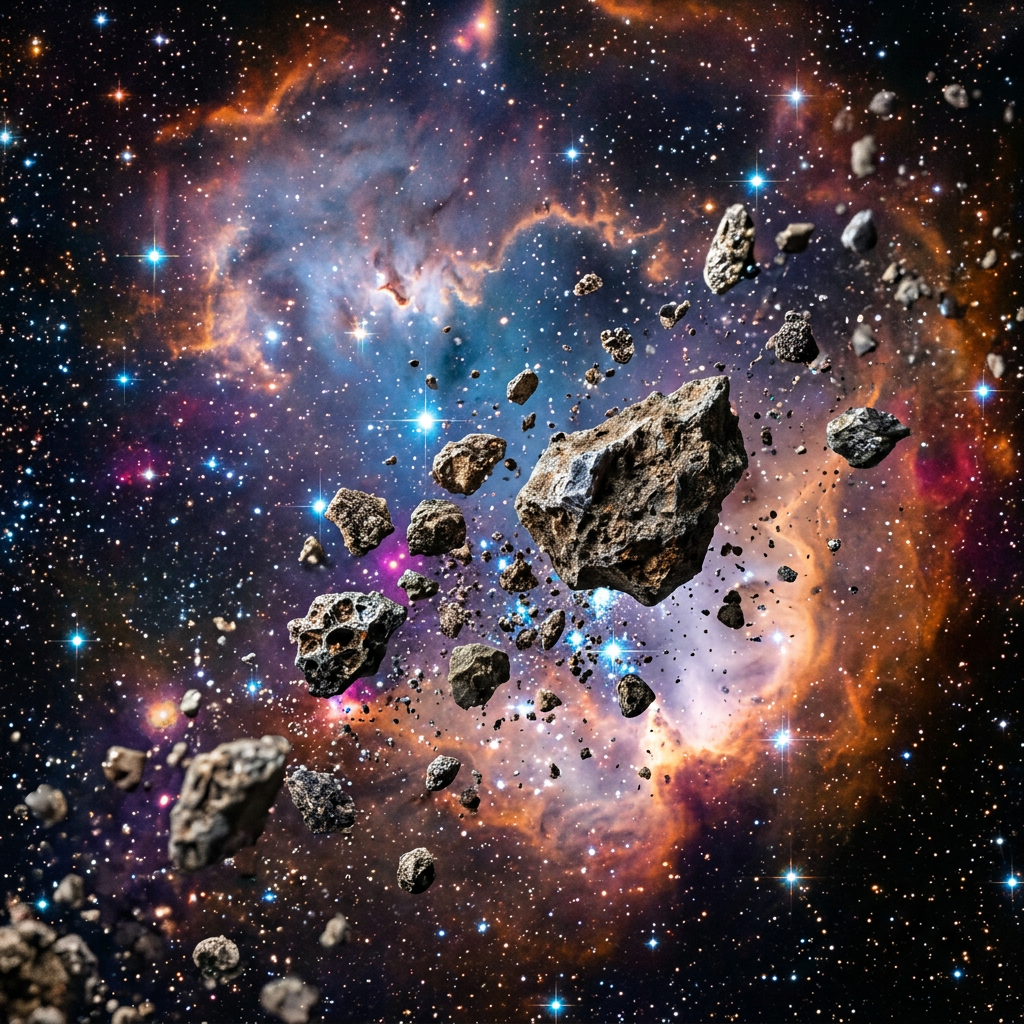
Studies of rock and dust from asteroid Bennu delivered to Earth by NASA’s OSIRIS-REx (Origins, Spectral Interpretation, Resource Identification and Security–Regolith Explorer) spacecraft have revealed molecules that, on our planet, are key to life, as well as a history of saltwater that could have served as the “broth” for these compounds to interact and combine.
Detailed in the Nature Astronomy paper, among the most compelling detections were amino acids – 14 of the 20 that life on Earth uses to make proteins – and all five nucleobases that life on Earth uses to store and transmit genetic instructions in more complex terrestrial biomolecules, such as DNA and RNA, including how to arrange amino acids into proteins.
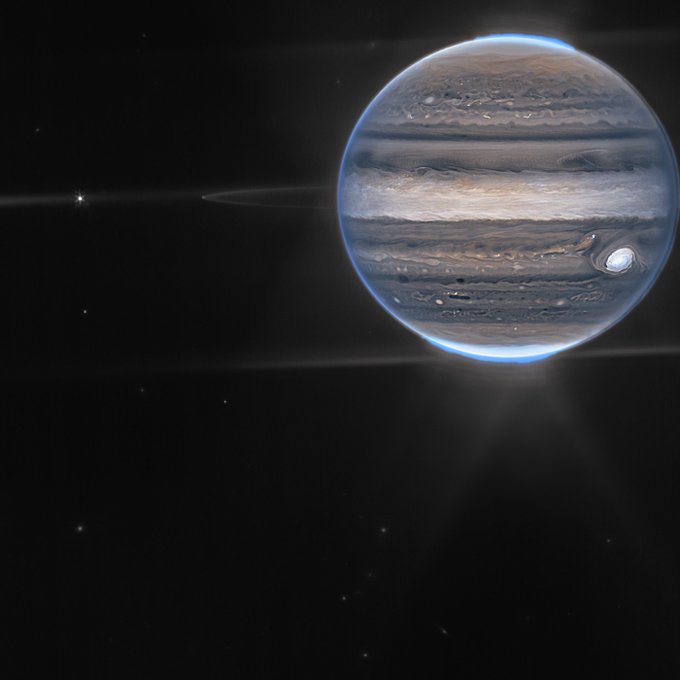
I LOVE this. And look at the hexagonal storm at the N.Pole. Space is very cool.😎
Saturn and Jupiter had to pick up some slack for the human species when the Maldekians blew up Tiamat and blew off one side of Mars. It is believed that somehow, the human race was genetically expanded by the 13 Tones of Creation. The 20 tribes of time had already existed . I’m researching this […]
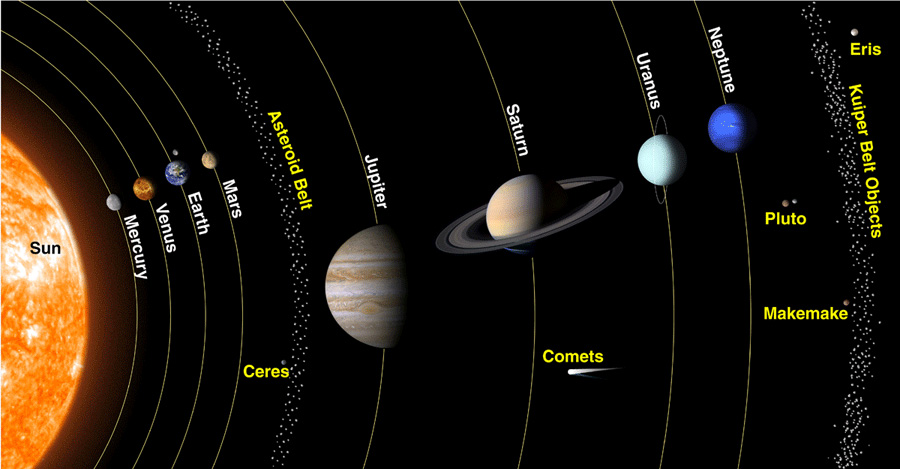
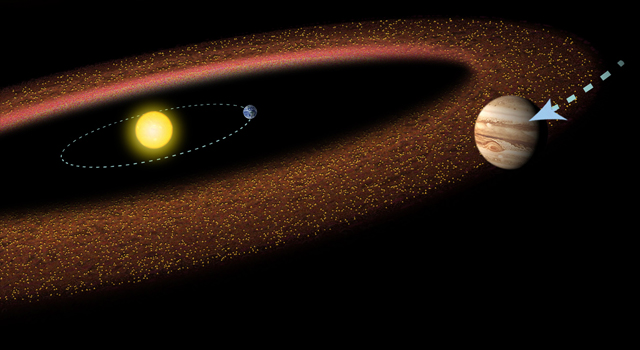
This is the asteroid belt between Mars and Jupiter
I was in an XSpaces discussion last month, March. The host said, “the fucking sun” in the context of human augmentation. They spoke as though the sun is our enemy. Humans have blamed their own mistakes of timing on the sun. However, it’s our own fault for being foolish about our use of power with others. That’s what happened on Tiamat which is now the asteroid belt. It was a timing mistake, an accident that could have been avoided.
The Sun synchronizes the timing frequencies for all of the planets. It has created the harmonic as a type of software program. This keeps synchronicity aligned for our local system. It’s our problem if we pay no heed to the organization of our local system. Ignoring this can create a cataclysm. We did this, and the result is now the remnants of a planet—the asteroid belt. We are living through the karma of blowing up our old home planet due to patriarchal hubris.
An overall genetic flaw was found on Tiamat. This flaw, which is a mindset, led humans to a predisposition for unnecessary early death. In no way is early death part of the truth for any other species in our systems. I’m here to help shift that mindset.
Thank God the ET shut down government nuclear warheads. They are not allowed on this planet, and this agreement can not be overridden. The hack of HF33 was stopped on February 28 and 29, 2024. They are toothless.
Our Sun is Amazing. Like the earth, it pulses WITH us.
Once again my intuition leads me to ask these questions that most people would answer, “Of course not. It doesn’t have a body and isn’t conscious.” Yes, it does and yes it is. Second, having a body like we do and being conscious as we are doesn’t dictate DNA. How very cool. I’m in a good mood now.
“Solar nitrogen is very different from that of meteorites or the Earth. Science reached this conclusion after analyzing samples of solar wind collected by the Genesis space mission launched by NASA in 2001. They succeeded in determining the isotopic composition of the Sun, its “DNA”, which reflects the composition of the cloud of gas and dust that gave rise to the solar system.”-Science Daily,, Jul 6, 2011
The sun is composed of hydrogen, helium, and some nitrogen. Note that the main component of water is Hydrogen…and it’s on the Sun. Meditate on that.
This is the asteroid belt between Mars and Jupiter
I was in an XSpaces discussion last month, March. The host said, “the fucking sun” in the context of human augmentation. They spoke as though the sun is our enemy. Humans have blamed their own mistakes of timing on the sun. However, it’s our own fault for being foolish about our use of power with others. That’s what happened on Tiamat which is now the asteroid belt. It was a timing mistake, an accident that could have been avoided.
The Sun synchronizes the timing frequencies for all of the planets. It has created the harmonic as a type of software program. This keeps synchronicity aligned for our local system. It’s our problem if we pay no heed to the organization of our local system. Ignoring this can create a cataclysm. We did this, and the result is now the remnants of a planet—the asteroid belt. We are living through the karma of blowing up our old home planet due to patriarchal hubris.
An overall genetic flaw was found on Tiamat. This flaw, which is a mindset, led humans to a predisposition for unnecessary early death. In no way is early death part of the truth for any other species in our systems. I’m here to help shift that mindset.
Thank God the ET shut down government nuclear warheads. They are not allowed on this planet, and this agreement can not be overridden. The hack of HF33 was stopped on February 28 and 29, 2024. They are toothless.
In the Maya Harmonic, we move from the North Polar Zone 5 kin to the Zone of Transformation 15 kin to the South Polar Zone 5 kin every 20 days. But the onus of alpha and omega points keeps moving with the 375 day solar year as the Harmonic calibrated True Time or Haab.
This is more proof that the time patterns I have figured out over 30 years are accurate in alignment with the sun and the rest of our local system. People need to put their thinking caps on and belly up to my table so they can know the time changes coming. Please share.
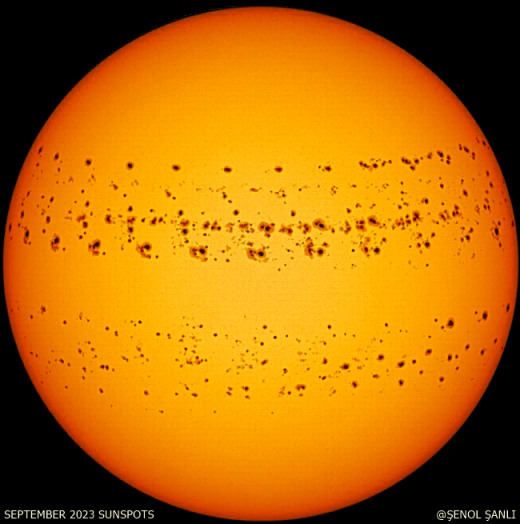
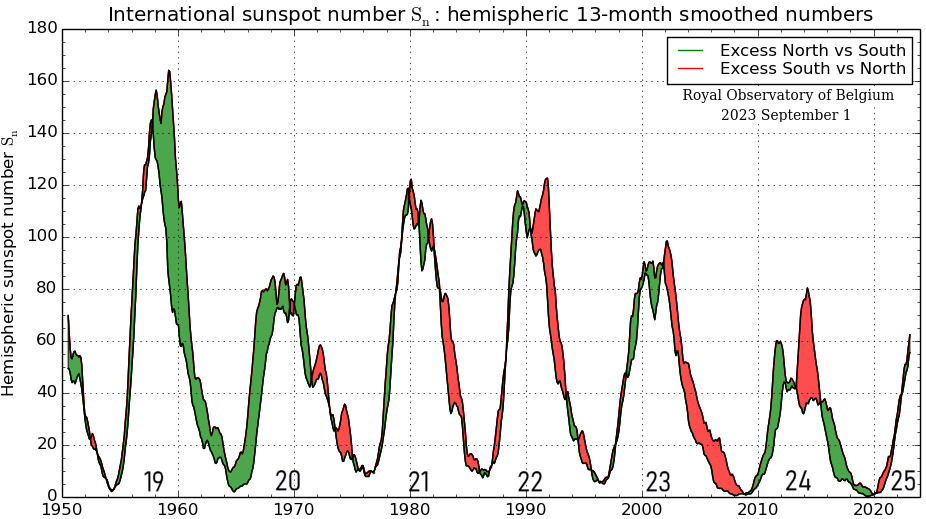
THE NORTHERN HEMISPHERE OF THE SUN IS IN CHARGE: For the second month in a row, sunspot counts in the sun’s northern hemisphere are more than double the south. The assymetry is obvious in this summary of September’s sunspots compiled by astronomer Senol Sanli using data from NASA’s Solar Dynamics Observatory:
According to the Royal Observatory of Belgium’s Solar Influences Data Analysis Center, in September the monthly sunspot number for the sun’s northern hemisphere was 90, the southern hemisphere was only 44; that’s a ratio of 2-to-1 in favor of the north. August was about the same. Looking back over an entire year, the north is leading the south by an average of 50%.
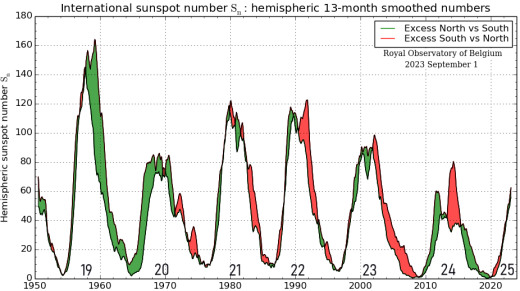
What’s going on? In fact, it’s not unusual for the sun’s northern and southern hemispheres to be out of synch. As long ago as the 19th century, solar cycle pioneers Spoerer (1889) and Maunder (1890) noted that there were often long periods of time when most sunspots were found preferentially in one hemisphere and not the other. This plot from the Royal Observatory of Belgium shows assymetries throughout the last 6 solar cycles:
Until recently, Solar Cycle 25 was pretty evenly matched, north vs. south. Sunspot counts from August and September, however, suggest that the northern hemisphere may be seizing control–at least temporarily. This has happened during the upslope of all four previous solar cycles (21-24).
One possible explanation for this phenomenon may be that the two hemispheres of the sun have their own solar cycles, one out of phase with the other by about a year. Indeed, Solar Max is often double peaked. You can see it in the hemispheric sunspot plot. In the three most recent cycles (22-24), north peaked before south, creating two surges of solar activity separated by a “Gnevyshev gap.” Solar Cycle 25 might continue this trend.
A complete discussion of sunspot asymmetries is included in David Hathaway’s excellent review article “The Solar Cycle.”
Are they building a new LOC since Orion Group trashed the old one? We certainly need a new cosmic neutral zone, which is what the last one was. Remember Corey saying he couldn’t imagine the LOC being attacked? I’ll find the post.
I am hoping to have new briefings soon. After the LOC went fully off line for the SSP Alliance, information has had to come through other sources – mostly ET allies.
Right now our Solar System is in the most pivotal phases of choosing our timelines. As I stated prior, each star or planet is its own sphere of time that flows differently than all others. On Earth, Humanity is in a fever pitch battle to decide between timelines. This battle is being made even more difficult to fight due to the energetic changes that are affecting Humanity. The energies ramped up slowly over decades so that Humanity didn’t notice… Even now, people are in the midst of stress induced mental psychosis yet don’t realize that they are acting as crazy as everyone else. Humanity has a tall order… overcoming our collective Karma while going through this energetic process is the only way we will earn a positive timeline.
What is happening on Earth is the biggest show in the Galaxy right now. We have many civilizations that are observing us and rooting for us to win this battle. The Orion Group and Human Cabal is extremely worried that we will come together and choose a reality free of their prison disguised as a civilization… This is why the powers that be have completely divided every group possible on a global level. They take advantage of the end times madness that is supposed to be a catalyst to push us to evolve and turn it into a weapon of fear and control. How many of us are able to snap out of our current way of thinking and burry the hatchet with the groups we are battling — realizing that the division was caused by our common enemy?
It appears my next briefings won’t occur until sometime in June. I was told they will be pretty comprehensive and mostly have to do with the cleanup of the Galaxy of the Orion Group and their allies. They are mostly forced back to a few solar systems that they have beach heads in – including our own solar system. The Orion Group is cornered but not fully defeated… but soon will be. While the various ETs and some Human groups are out fighting the last vestiges of the Orion Group… They are counting on us to do our part here on Earth by choosing a positive timeline and entering a new era of evolution and ascension. Are you up for the challenge?
It’s creepy that the doctors tell us not to eat sodium or to buy potassium supplements. People tend to be low on both and then end up in the ER which fills their pocketbooks of course.
We know that the amino acid proteins are the building blocks of our 3D flesh, and the symbols for the 20 Mayan tribes represent them, but the electrolyte minerals charge our ELM field that makes up our etheric body.
Sodium and potassium must be gotten in our food, or you’ll get sick and die. The demonization of sodium and potatoes by sick care is incorrect. They are both important electrolytes for good health.
If you eat a whole food diet and not processed food, which is overloaded with sodium because it’s bad food, you won’t get enough.
In comes Mercury with its odd tail made of sodium, raising our amplitude. (See article below) Mercury mediates White Dog~Red moon, which we just passed, and rules communication in our brains. That requires sodium, especially in our conscious state, when our eyes are open with alpha brainwaves. The universe is working hard to keep us awake and evolving gradually.
CHANCE OF FLARES TODAY: NOAA forecasters say there is a 40% chance of M-class solar flares today. The most likely source is fast-growing sunspot AR3280, which has an unstable ‘beta-gamma’ magnetic field and is almost directly facing Earth. Solar flare alerts:SMS Text.
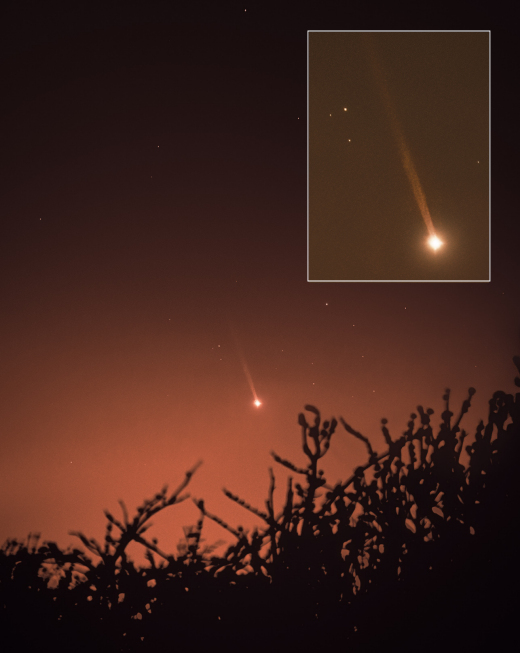
THE SODIUM TAIL OF MERCURY: Astronomy used to be so simple. Comets had tails, and planets did not. Mercury is making things complicated. When Dr. Sebastian Voltmer of Spicheren, France, photographed the planet this week, it exhibited a magnificent plume of gas flowing behind it:
“Mercury is NOT a comet, but it sure looks like one,” says Voltmer. “Solar wind and micro-meteorites hitting the planet eject sodium atoms from Mercury’s surface. This creates a yellow-orange tail of sodium gas that is around 24 million kilometers long.”
First predicted in the 1980s, Mercury’s tail was discovered in 2001. The gaseous plume is made of many elements from Mercury’s rocky surface, not only sodium. Sodium, however, dominates the scattering of sunlight and gives the tail its striking yellow hue.
People watching Mercury climb up the evening sky this month may be wondering “why didn’t I see a tail?” Answer: A special filter is required. “I used a 589 nanometer filter tuned to the yellow glow of sodium,” says Voltmer. “Without such a filter, Mercury’s tail is almost invisible to the naked eye.”
Mercury’s tail waxes and wanes in brightness as it orbits the sun. The predictable pattern is shown in this movie from NASA’s MESSENGER spacecraft, which spent years observing Mercury’s tail from close range:
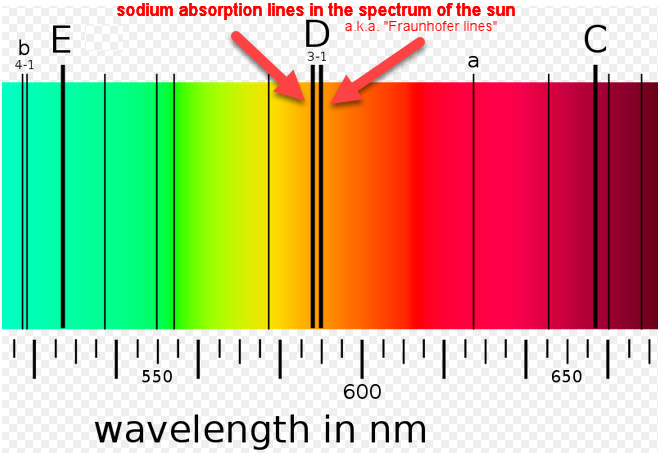
For reasons having to do with the Doppler shift of sodium absorption lines in the solar spectrum, Mercury’s tail is most luminous when the planet is ±16 days from perihelion (closest approach to the sun).
This means the tail’s maximum luminosity is only a few days away. Mercury will be 16 days past perihelion on Monday, April 17th, located in the sunset sky almost directly below Venus. If you have a sodium filter, take a look!
The Psi Bank is the magnetosphere monitored by the scientists in Russia. They call it the Schumann Resonance or ScR for short.
NASA found the Psi Bank in August 2012, very synchronous timing with the ending and beginning of the new 26,000 year cosmic cycle on December 21, 2012. We are only about 10 years into the new 26,000 year cycle, so I’ll probably be back to Earth a few times trying to teach this.
The distance from us to the galactic center is 26,000 light years, where a supermassive black hole known as “Sagittarius A*” is located.
This is the approximate location of the Sun in the Milky Way. The distance from us to the galactic center is 26,000 light years, where a supermassive black hole known as "Sagittarius A*" is located. pic.twitter.com/kXnSunYFbj
Today is the Spring Equinox, White 7 Resonant World Bridger, March 20, 2023. Resonant, reverberating, circling change/death to improve conditions on Earth for all life. Change is sacred and good in evolution. Things stay the same at the galactic center but not here. Spiritual ascension to the galactic center is a slow process.
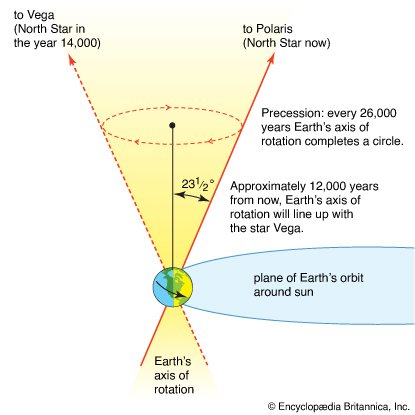
Every 26,000 years, Earth’s axis of rotation, or PROCESSION, completes a circle. It is a Tzolkonic cycle in agreement with the ancient Maya.
Exactly 13,000 years from now, Earth’s axis of rotation will line up with the star Vega. 4D is exact. 3D is approximate and follows 12;60. That means the calculations will be off unless 3D calculations take into account 4D math, which is vigesimal and based on 13:20.
The solar process of approximately 365 earth kin in space, manifested in 3D, processing around The Sun is an AXIAL PROCESSION or a solar year.
The 260-day cycle in time or 4D is a galactic spin because our true context is the Milky Way galaxy, not just Earth. Within the 260-day cycle, we have 5 52-day cycles made of 65, 4-day harmonics, and 20 13-day Wavespells. That creates the coordinate 13:20, which is vigesimal and exponential. It is true time, not approximate.
The medial point between 260 and 365 is 13. There are 13 full moon lunar cycles of 28 days each in a 365-day solar year. 13 x 28=364. Taking into consideration that there are 64 harmonics, not 65, governed by the 3D I Ching, it is an exact alignment of spacetime. Jose had not achieved that part of organizing the IChing with the Tzolkin. I figured it out. It’s in my book, “Time is DNA.” His work helped me see it.
The difference between 364 and 260 is 104 or 2, 52-day cycles. So the ultimate difference between the 364-day solar year and the 260-day Time cycle is 7 vs 5 which comes to 2 or duality. There are 7 52-day cycles in 364 and 5 52-day cycles in 260. The difference is 2. So the purpose of 12:60 has been to keep us level in duality but still evolving after the accident or indolence of blowing up Tiamat living on the 13:20 cycle and thus having to move us back to the slower, 3D focused 12:60 timing cycle for our own good.
This is all changing polarity, though, because the sun’s ELM, electromagnetic orientation has changed polarity from north to south. It’s a NATURAL 11.5 year solar cycle. The planet’s poles don’t change polarity every 11.5 years, but gradually, they do.
NCEI scientists with the Cooperative Institute for Research in Environmental Sciences (CIRES) at the University of Colorado Boulder calculated the movement of both the North and South Magnetic Poles from 1590 to 2025 (435 years) using two models: gufm1 and IGRF. Gufm1 incorporates thousands of magnetic observations taken by mariners engaged in merchant and naval shipping.
The link above
Both Corey Goode and Ben Davidson live in Boulder, CO. They’re buddies. And why the year 2025? Corey mentioned it as the year when the GGLN will be able to come into our system and secure a major star gate that is right next to us. At that point, the C#$%^ will be exiled, so he said. I guess we’ll see. I won’t hold my breath and use my own intuition.
Geomagnetic pole reversals have happened throughout Earth’s history. The last one occurred 780,000 years ago. Though they sound scary, pole flips can take a long time to occur and pose no immediate threat.
The NOAA link above
NOAA doesn’t seem to want us focused on a coming cataclysm or the belief that “we’re all going to die.” 🤷♀️ Whatever habitual emotions and thoughts you run are creating your frequency, and it goes into every cell of your body. Law of Attraction. Like attracts like. We create our situation individually first and then en masse.
780,000 is 3, 260,000 year cycles, so we are definitely at the beginning of a new evolutionary cycle but not a new 780,000 year cycle. 780,000 x 2 is 1,560,000. We are 3 cycles into it, so we have 520,000 years to go before Earth’s poles reverse, IMO.
If the poles reversed 780,000 years ago, then we have another 780.000 years from that point forward before it happens again.
I just watched The Cosmic Secret again. There were pieces I missed.
We need to chill with the end of the cycle. Apocalypse means the great revealing. We are all children of God. Any secrets that have been withheld will come forward.
I feel we need to REMAIN in our community of choice where we feel safe and loved. Be ethical in your community. Be a Lightworker wherever you are. Get training if you need to BE OF SERVICE TO OTHERS, honor yourself, and see each person as a child of God.
I know I post on gender inequity a lot and I believe there are a few men out there who can deal with their feelings and be connected to their soul, I just haven’t met one yet. But I do believe they are out there.
In my holistic practice, I can’t help the fact that the women who come in have suffered, been punched, been disrespected and used, and more, and my work and example as an independent single woman give them hope. I don’t need a man…for anything. It’s up to each woman to stand on her own feet and refuse to be victimized by the patriarchal system. Same for the men. It’s the same system oppressing all of humanity. I see that.
I’ve also had male patients who were vets or hurt in work accidents or were hurt in prison! This is a rough planet and my patients all have stories. I minister to each one of them equally, for 23 years now. Everyone gets Reiki. Everyone can feel it. It’s real.
Do take a look at this movie again. It’s fascinating how our perception can change in 4 years. I think it’s dated 2019! The Cosmic Secret.