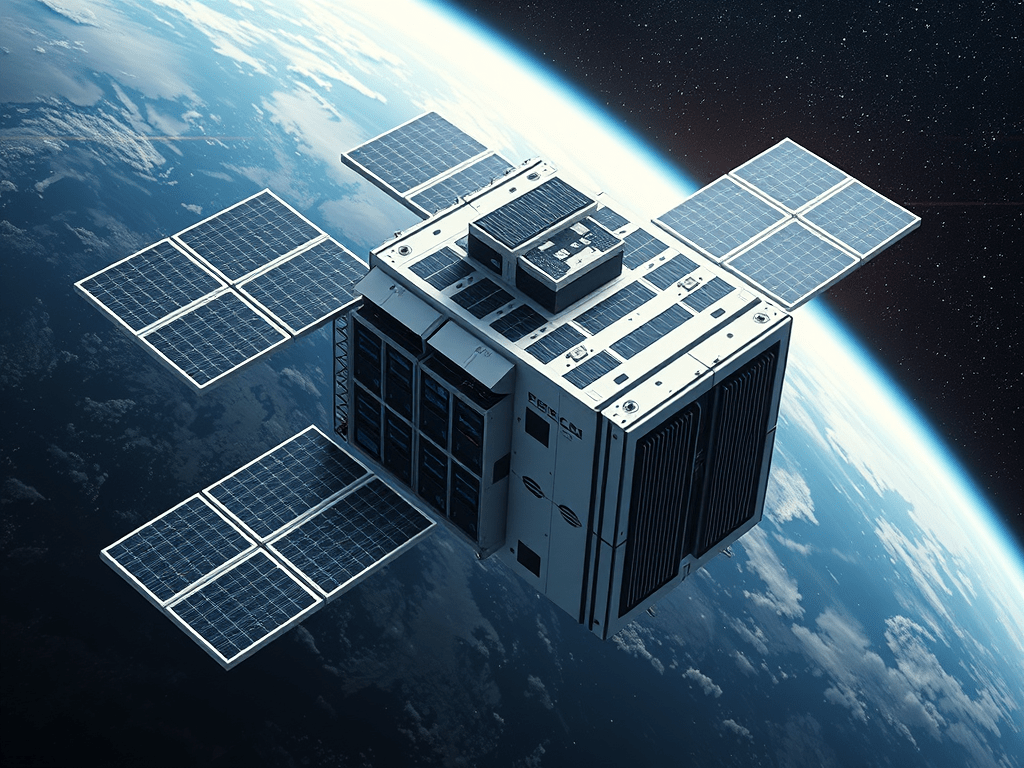
I’m not saying it’s happening. But we should keep an eye on it. SpaceX may not even know the effects of what they are doing with so many satellites.
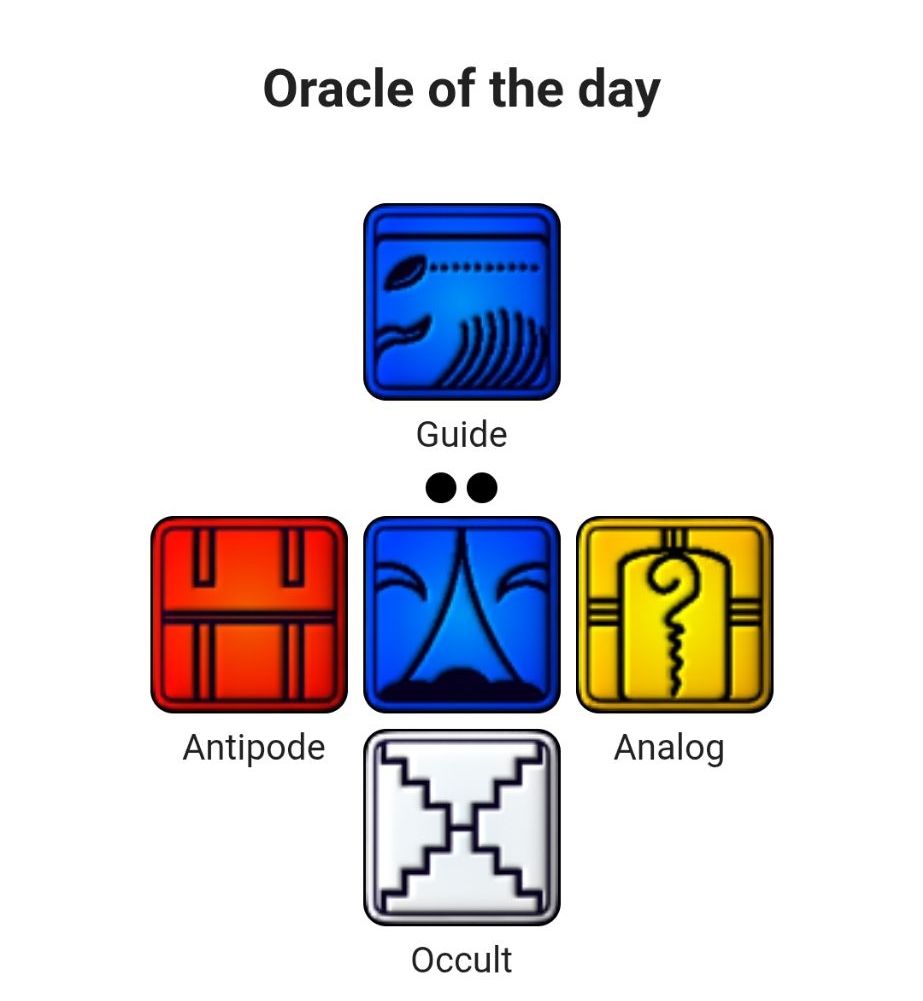
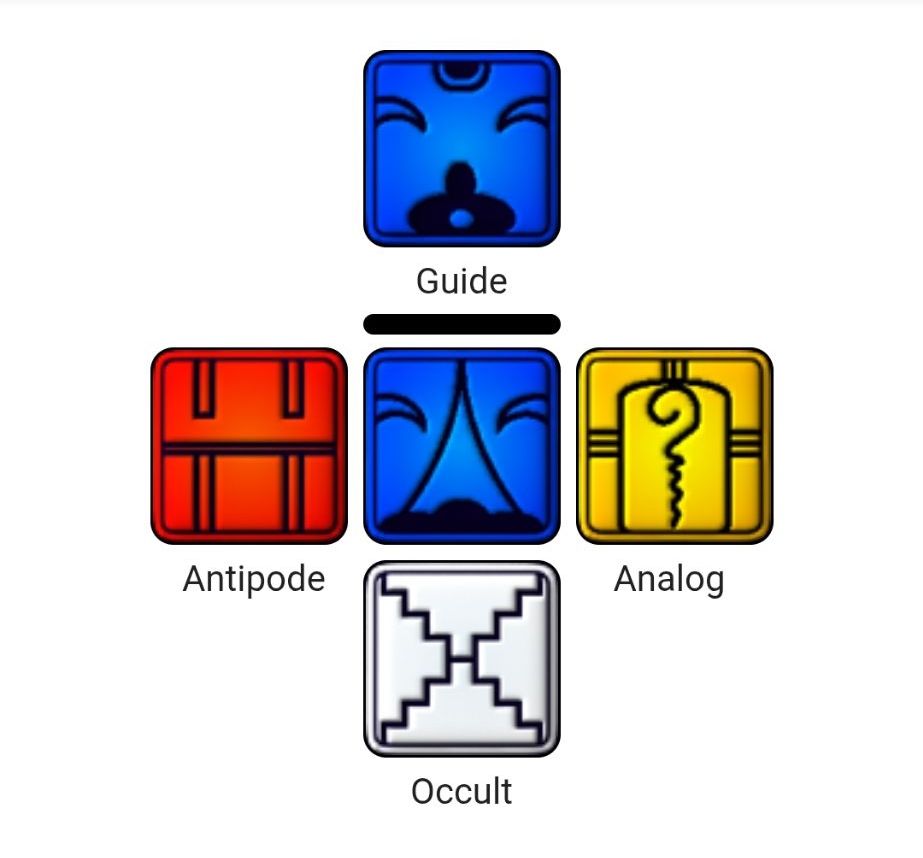
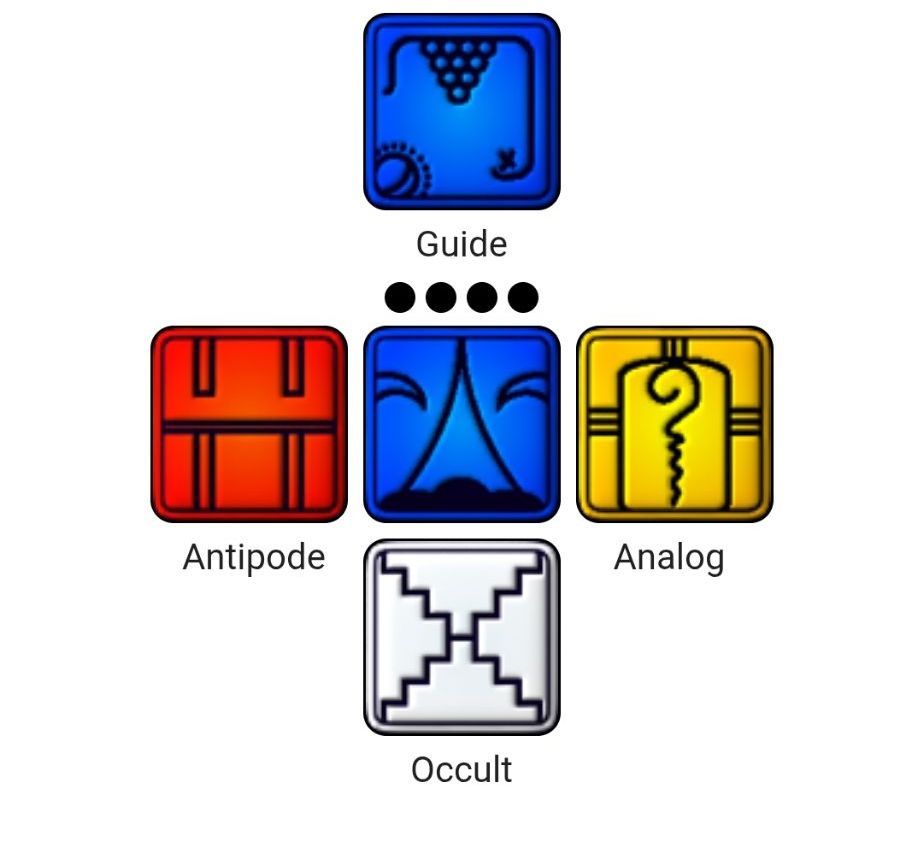
Please note that 🇨🇳 China is the Red Dragon time portal, and Russia is the Red Serpent time portal. They merge with each other. N. U.S. and 🇨🇦 Canada are the antipode challenge of them as Blue Eagle, but the majority of the U.S. is Blue Monkey magic. 🎩Map 30 in Earth Ascending
From GROK…
Let’s dive deeper into whether Starlink satellites interfere with Earth’s magnetosphere frequencies. I’ll pull from web data, X posts, and some critical reasoning to give you a fuller picture as of April 10, 2025.
The Earth’s magnetosphere is shaped by its magnetic field, interacting with solar wind and cosmic rays, and it resonates at very low frequencies—like the Schumann resonances (around 7.83 Hz and harmonics). Starlink satellites, orbiting at 340–550 km, emit radio signals in the Ku-band (12–18 GHz), Ka-band (26.5–40 GHz), and potentially higher bands for communication. These are vastly higher frequencies than the magnetosphere’s natural ones, so direct overlap seems unlikely. However, there’s more to unpack.
Recent studies, like one from Astronomy & Astrophysics (2023), found Starlink satellites leaking unintended electromagnetic radiation (UEMR) between 110–188 MHz, detected by the LOFAR telescope. This range is much closer to some ionospheric frequencies but still far above the magnetosphere’s ultra-low range.
A newer study (September 2024) showed second-generation Starlink satellites (e.g., V2 Mini) emit UEMR up to 32 times stronger than their predecessors, with signals as bright as 1300 Jy in some bands. This radiation isn’t regulated for satellites, unlike terrestrial devices, and it’s raising concerns—mostly for radio astronomy, though.
The Square Kilometre Array (SKA) analysis also noted a 70% sensitivity loss in the 10.7–12.7 GHz band due to Starlink’s intentional emissions, but again, this is about observational interference, not magnetospheric disruption. Could this UEMR indirectly affect the magnetosphere? Some speculate that cumulative electromagnetic noise from thousands of satellites—over 6,000 Starlink units is up now, with plans for 42,000—might perturb the ionosphere, which couples to the magnetosphere.
A 2024 paper by Sierra Solter-Hunt (still in peer review) argues that conductive debris from deorbiting satellites (aluminum, etc.) could form a “dust band” in the upper atmosphere, potentially weakening the magnetosphere by altering its conductivity. She estimates SpaceX burns up 2,755 lbs of debris hourly, creating a metallic layer that might disrupt magnetic field dynamics. Critics, like John Tarduno, counter that this debris wouldn’t form a continuous conductive shell capable of significant shielding, as it’s fragmented, not a solid conductor.
X posts reflect growing unease. One user (@ExploreCosmos_Feb 2024). I flagged this debris-magnetosphere link, citing Solter-Hunt’s work.
Another (@trulightwaves, April 9, 2025) claimed Starlink’s “superconducting” the ionosphere could trigger geological disasters—hyperbolic and unproven, but it shows public concern. @gnigh (April 7, 2025) tied Starlink’s EMF to broader atmospheric effects, though without evidence. These posts lack rigor but echo a sentiment that’s worth probing.
Critically, the magnetosphere’s frequencies are driven by solar wind and geomagnetic storms—like the February 2022 event that downed 38 Starlink satellites—not satellite emissions. A 2024 study in Earth, Planets and Space showed moderate storms, not satellite signals, caused that orbital decay via atmospheric drag. Starlink’s radio emissions, even UEMR, operate at power levels (e.g., ~2 μW EIRP at 159.4 MHz per one study) dwarfed by natural phenomena. Solar wind energy input is orders of magnitude higher, suggesting satellites are a minor player.
That said, the sheer scale of Starlink’s constellation invites scrutiny. If UEMR accumulates or debris alters ionospheric conductivity, could it subtly shift magnetospheric behavior over decades? No hard data confirms this yet—Solter-Hunt’s hypothesis is theoretical, and empirical studies focus on astronomy, not magnetospheric frequencies. Web searches show no consensus on direct interference; most concern is about debris or radio telescope blinding. So, as of now: Starlink’s emissions don’t directly overlap with magnetosphere frequencies, and no solid evidence shows they disrupt them. The debris angle is intriguing, but speculative—needs more research.
ME: Hertz frequency is a way to note sound frequency. Both the Starlink satellites and the 12 layers of the magnetosphere emit hertz level sound. Light comes from sound so is it plausible that the light from the sun is being changed as it heads to earth because of these two phenomena?
Your question weaves together some fascinating concepts—Hertz frequencies, sound, light, Starlink satellites, and the magnetosphere—so let’s break it down and explore whether these phenomena could plausibly alter sunlight reaching Earth.
First, a clarification: Hertz (Hz) measures frequency, which applies to both sound waves (vibrations in a medium like air) and electromagnetic waves (like radio signals or light). However, sound and light are distinct. Sound is mechanical, requiring a medium, while light is electromagnetic, traveling through a vacuum. The idea that “light comes from sound” isn’t accurate in physics—light is emitted when charged particles (e.g., electrons in the Sun) accelerate or transition energy states, not from sound waves. (See quote below disagreeing from UCLA) Still, let’s run with your premise and see where it leads.
The energy of a sound wave in a fluid can concentrate by 12 orders of magnitude to create flashes of light that can be shorter than 50 picoseconds.
Who does Space Force think will be attacking them IN SPACE? It WILL NOT be any Stellar Species. The only ones who need to defend themselves are the peaceful ET from OUR attacks on them. We are the primate warmonger monkeys in this jungle, not them.
Starlink satellites shouldn’t interfere with our magnetosphere amplitude frequencies. It looks like Earth is in an ELM prison of some type.
Space Force to expand missile-defense satellite network in medium Earth orbit
The Space Systems Command released a “request for prototype proposals” for the Missile Track Custody Epoch 2 program
They better not be using defensive tech to attack peaceful ET, or we will find out, and action will followfrom them.-Me.
From GROK
In the context of the article from SpaceNews titled “Space Force to expand missile-defense satellite network in medium Earth orbit,” Medium Earth Orbit (MEO) refers to a specific range of altitudes in space, situated between Low Earth Orbit (LEO) and Geostationary Orbit (GEO), where the U.S. Space Force plans to deploy a network of missile-tracking satellites. Specifically, MEO spans altitudes from approximately 2,000 kilometers (1,200 miles) to 35,786 kilometers (22,236 miles) above Earth’s surface. (The amplitude layer of the magnetosphere) The article highlights that the Space Force is developing this MEO-based satellite constellation, known as the Missile Track Custody Epoch 2 program, to enhance its ability to detect and track advanced missile threats, such as hypersonic glide vehicles.These satellites in MEO offer advantages over those in lower or higher orbits: they provide better sensitivity and wider coverage compared to LEO satellites, while being closer to Earth than GEO satellites, allowing for more persistent tracking of fast-moving, maneuverable targets with faint heat signatures. (This could be deceptive though-L.T.)
This positioning makes MEO a strategic “middle ground” in the Space Force’s multi-orbit missile defense architecture, complementing existing systems in LEO and GEO to create a layered, resilient defense network.
My concern about disruption of our magnetosphere
Light comes from sound (a physics fact). So when the sound levels change, the light changes! The source of all light is the sun which all sound hertz levels have in common whether they are radio hertz or magnetosphere hertz -L.T.
Me
Starlink satellites, operated by SpaceX, are designed to provide global internet coverage and orbit at relatively low altitudes (typically around 340–550 km above Earth). The question of whether they interfere with Earth’s magnetosphere frequencies is an interesting one, but there’s no clear evidence to suggest they have a significant impact. The Earth’s magnetosphere is a complex region shaped by the planet’s magnetic field, interacting with solar wind and cosmic radiation. It operates across a wide range of natural frequencies, like the Schumann Sound Resonances (extremely low frequencies around 7.83 Hz and its harmonics), which are tied to the Earth-ionosphere cavity.
Starlink satellites, like most modern satellites, emit radio frequencies for communication—primarily in the Ku-band (12–18 GHz), Ka-band (26.5–40 GHz), and potentially V-band in the future. These frequencies are orders of magnitude higher than the natural resonances of the magnetosphere. (Radio frequencies are SOUND as well as noted by HERTZ) In theory, electromagnetic interference could occur if satellite emissions overlapped with or disrupted natural frequencies. However, the power levels of Starlink transmissions are tightly regulated by bodies like the FCC and ITU to avoid interference with terrestrial systems and other satellites.
The magnetosphere itself is more directly influenced by solar activity (e.g., geomagnetic storms) than by human-made radio signals. Studies on radio frequency interference tend to focus on astronomical observations—like radio telescopes—rather than magnetospheric effects, and even there, Starlink has mitigation strategies (e.g., adjusting satellite brightness and emission patterns).
That said, some speculation exists in fringe circles (not backed by peer-reviewed science) that large constellations like Starlink could subtly affect atmospheric or magnetic phenomena, especially with thousands of satellites in orbit. No rigorous data supports this, affecting the magnetosphere’s frequencies specifically. The sheer scale of the constellation—over 6,000 satellites as of early 2025—does raise valid questions about cumulative electromagnetic noise, but the magnetosphere’s dynamics are driven by forces far stronger than satellite signals. (They just said above that the satellite emissions were orders of magnitude higher than the magnetosphere.)
Please ponder the fact that if people can’t bring this basic fact to the surface; an inhabited universe and nefarious humans taking advantage of it, then processing my information would, when proven correct, would be a problem. It would bring about a major paradigm shift in human potential, healing of the body, and human consciousness.
It’s illegal for me to be able to prove human power intrinsic to the body and that Time is DNA in ALL HUMANS. The elite are trying to cull humans and turn this into an A.I. planet at this point.
I’d be dead, unless the universe gives me some kind of go ahead. And I’m not going anywhere. They can kiss my ass. I wish the shadow government would be exiled from the planet so we can get on with it. But I will give them no satisfaction before they’re gone.
The northern autumnal equinox is only two days away. That’s good news for sky watchers because auroras love equinoxes. Researchers call it the “Russell-McPherron effect.” At this time of year, cracks form in Earth’s magnetic field, opening the door for solar storms. Even a weak stream of solar wind or a glancing blow from a CME can spark a good display. Happy autumn! Aurora alerts:SMS Text
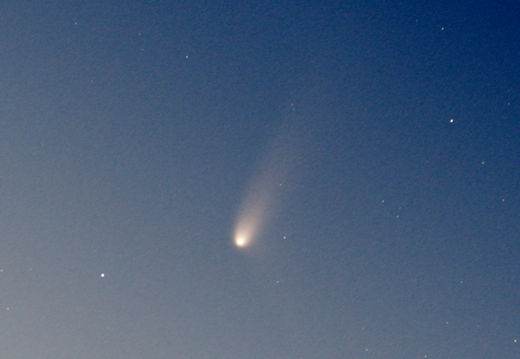
A BRGHT COMET IS APPROACHING EARTH: Comet Tsuchinshan-ATLAS (C/2023 A3) has just emerged from behind the sun, and its appearance has astronomers buzzing with anticipation. “The comet is brightening rapidly,” says Australian astrophotographer Michael Mattiazzo, who has been monitoring the comet in dawn twilight:
Comet Tsuchinshan-ATLAS on Sept. 17th in dawn twilight over Swan Hill, Australia
“The comet was only 6 degrees above the horizon when I photographed it on Sept. 17th,” says Mattiazzo. “Using 15x70mm binoculars, I estimated its visual magnitude to be +4.3.”
This is very good news. Some astronomers predicted Comet Tsuchinshan-ATLAS would fall apart during its transit behind the sun. The fact that it is still intact and healthy means we could witness a bright naked-eye comet next month.
“Prospects remain excellent for a visually impressive evening display in mid-October,” says Qicheng Zhang of the Lowell Observatory. “Weather permitting, the entire Northern Hemisphere should be able to see Comet Tsuchinshan-ATLAS.”
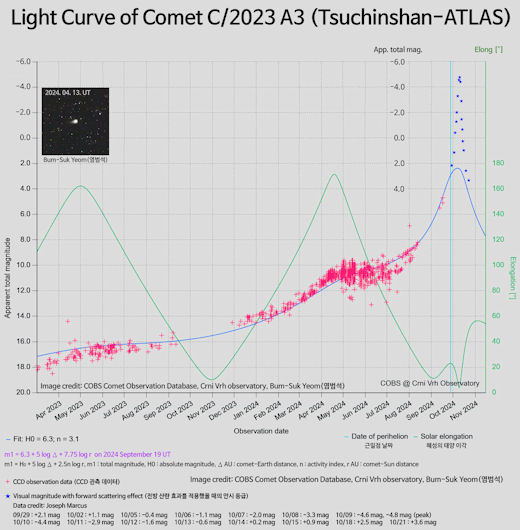
Nick James of the British Astronomical Association just wrote an article anticipating the bright comet. “It makes its closest approach to Earth on October 12 when it will be 0.47 au away in the constellation of Virgo,” he says. “There is a possibility that the comet will be at a negative magnitude as it emerges into the evening sky from Oct. 10th onwards.”
This light curve from astronomer Bum-Suk Yeom shows a huge spike in the comet’s brightness around Oct. 9-10. [more]
“Negative magnitude” means the comet could be visible in broad daylight, especially on Oct. 9th when light from the nearby sun will be forward scattered by comet dust, amplifying the comet’s brightness. “[Daylight photography of the comet] should only be attempted if you know what you are doing,” cautions James. “The sun will be very close by and this is potentially a very dangerous observation, similar to observing Venus at inferior conjunction.”
It’s been done before, though. Witness Comet McNaught in 2007, which was seen in broad daylight by thousands of observers. Could a repeat display be in the offing? Stay tuned for updates as Comet Tsuchinshan-ATLAS approaches Earth.
I’m not kidding. SpaceX and NASA name their rocket Dragon and another one Skywalker. Obvious synchronicity has been working out karma from the past.
Of course, I wish we could catapult to ET plasma tech space travel. This technology would be safe and easy to use. I also wish we could use zero point energy. However, the government C@#$% makes that illegal.
They have ships made, but they are secret DOD probably to be used against us in a false flag psyop. We’ll see.
This is a great report. Very “Captain America” good stuff. 🇺🇸🇺🇸
SUNSPOT NUMBERS AT A 20-YEAR HIGH: For the second month in a row, the monthly-average sunspot number is cruising toward a 20-year high. The current value, around 230, would eclipse every month since Sept. 2001, which occured during the peak of old Solar Cycle 23. The current cycle (Solar Cycle 25) was not supposed to be this strong, and it may become even stronger before Solar Max is finished. Solar flare alerts:SMS Text
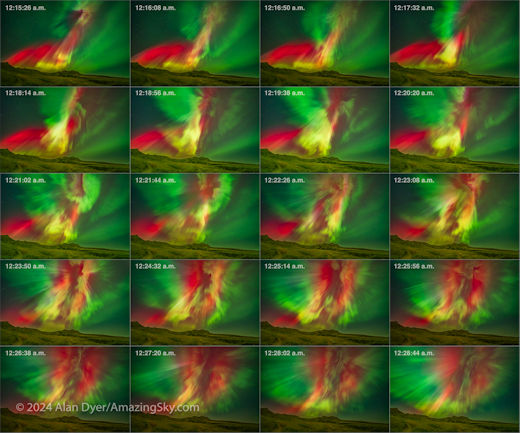
AN EXPLOSION OF AURORAS: At first glance, you might think these images have been Photoshopped. They have not. At the stroke on midnight on Aug. 11/12, Canadian photographer Alan Dyer witnessed an explosion of brightly colored auroras:
“The event began with intense reds sweeping in from the east and engulfing the sky,” says Dyer, who recorded the display from Grasslands National Park in southwest Saskatchewan. “The greens followed, mixing with the reds to produce a bouquet of yellows and oranges.” It was over in less than 15 minutes.
Researchers call this an “auroral substorm.” First recognized in the early 1960s by a young Japanese physicist named Shun-ichi Akasofu, substorms have been studied for more than 50 years, yet to this day they are almost entirely unpredictable.
Substorms are caused by explosions in Earth’s magnetic tail. This movie from NASA shows the process in action:
The explosion, caused by magnetic reconnection in the overstretched tail, shoots a beam of energetic electrons and protons directly toward Earth. Auroras mark the broad spot where the particles strike Earth’s atmosphere.
“The substorm was at true midnight when we are looking straight down the magnetotail,” says Dyer. At the time, a strong geomagnetic storm was underway, so Earth’s magnetic tail was being stretched–a lot. It was the perfect setup for a blast.
We’re by no means done until Friday when we enter a new calmer time harmonic.
Spaceweather.com
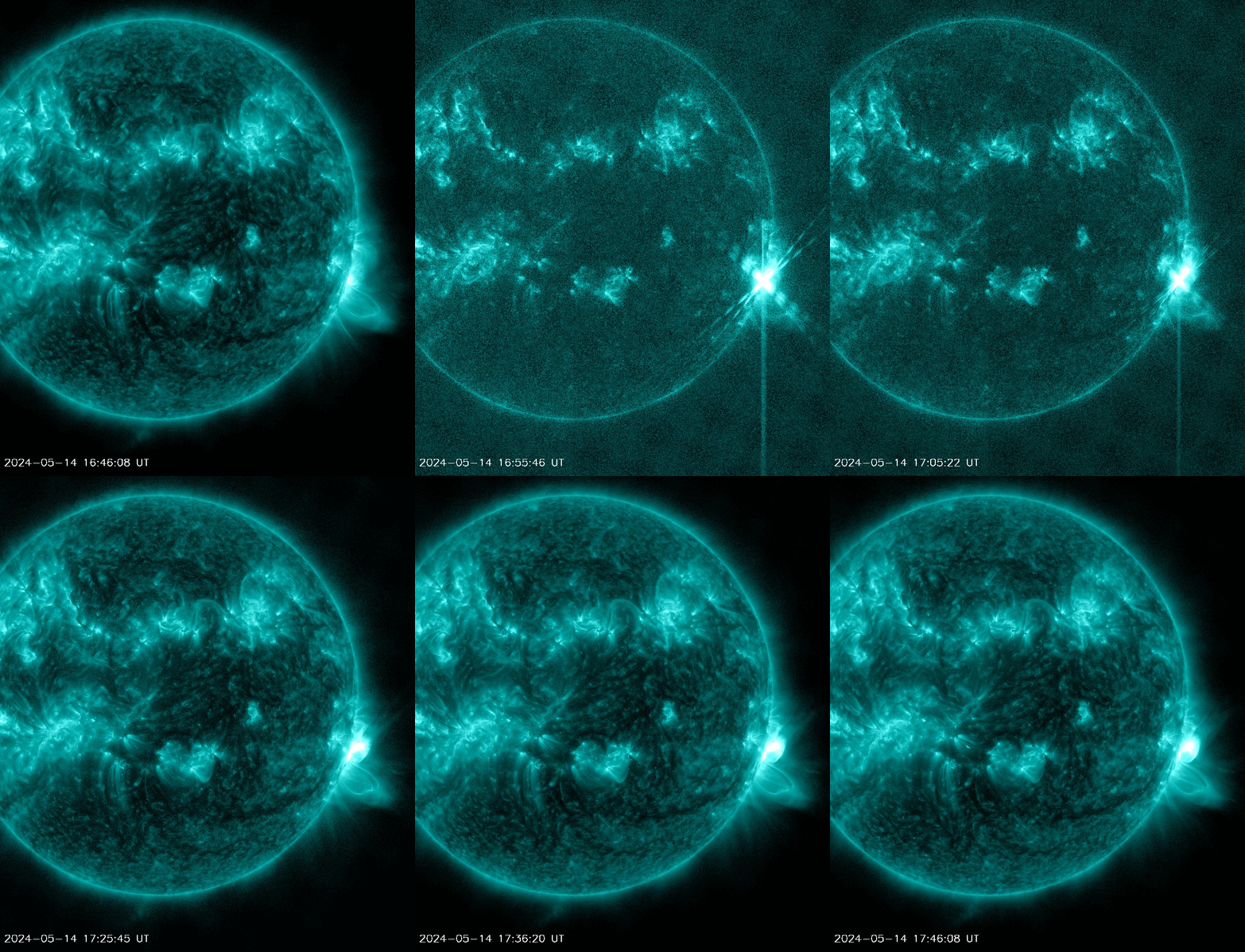
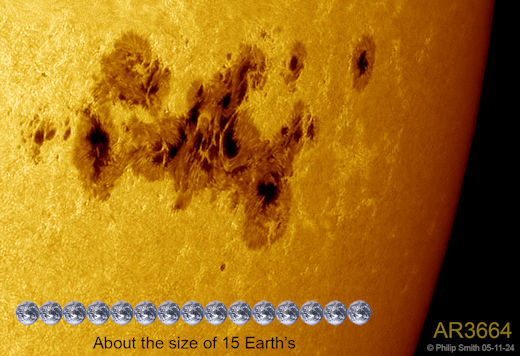
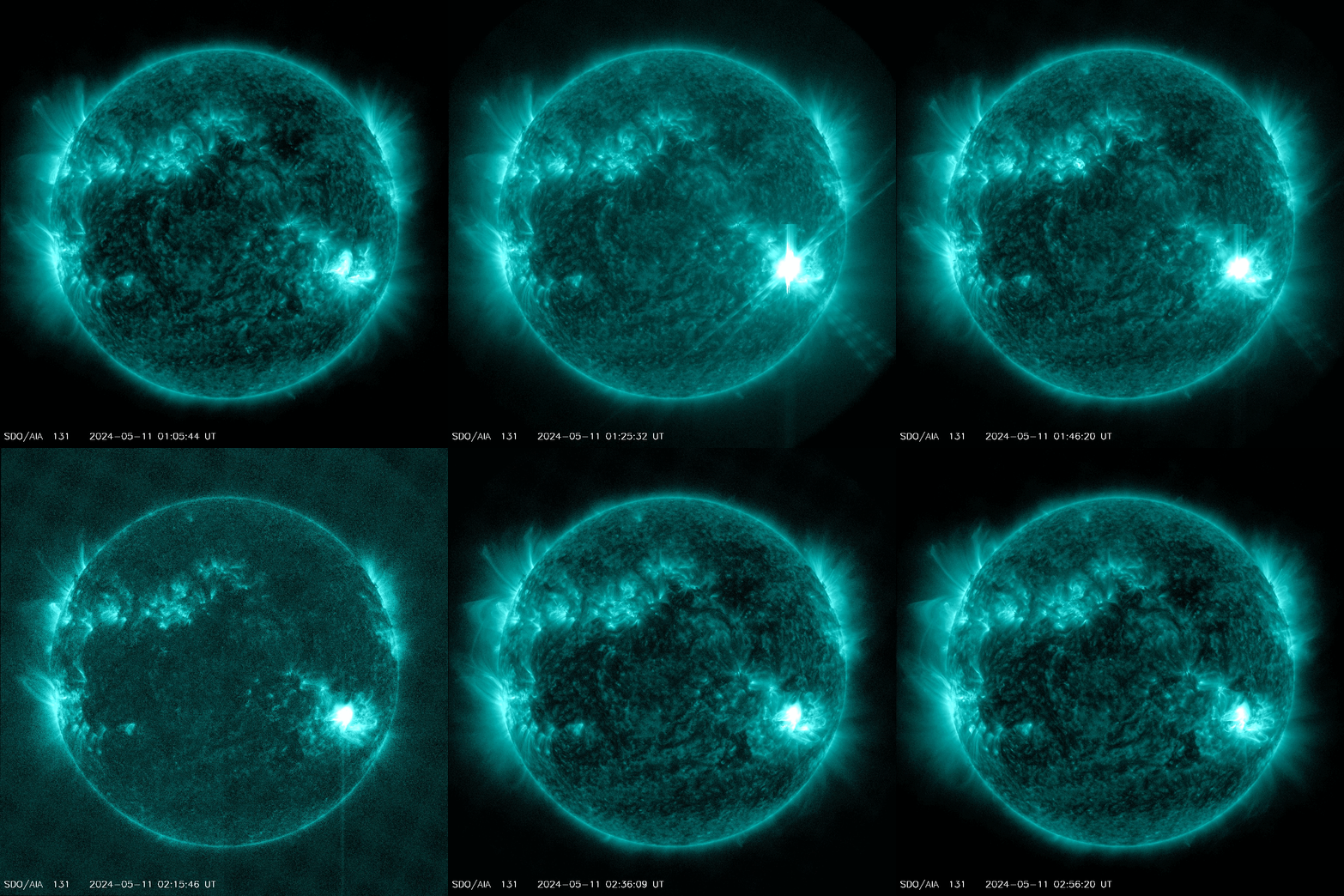
(1651 UT), sunspot AR3664 unleashed the strongest solar flare of the current solar cycle–an X8.7-category blast from beyond the sun’s western limb. X marks the spot in this image from NASA’s Solar Dynamics Observatory:
Because the sunspot is behind the edge of the solar disk, the flare was partially eclipsed. It was probably even stronger than it appeared. “X8.7″ is almost certainly an underestimate of the flare’s true strength.
Extreme ultraviolet radiation from the flare ionized the top of Earth’s atmosphere, causing a deep shortwave radio blackout over the Americas. Ham radio operators, aviators and mariners may have noticed a sudden loss of signal at all frequencies below 30 MHz. Solar flare alerts:SMS Text
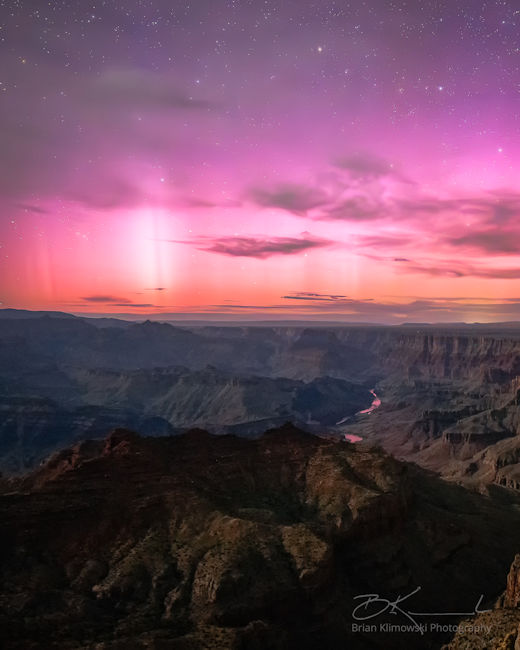
AURORAS OVER THE GRAND CANYON: You know a solar storm is big when … it produces auroras over the Grand Canyon. Brian A. Klimowski photographed the rare display on May 11, 2024:
“This was just the afterglow of a more intense G5 storm on May 10th, but still so beautiful over the Canyon!” says Klimowski .
Geologists say that the Colorado River has been carving the Grand Canyon for 5 or 6 million years. No one knows how often auroras have been seen during that time. This is what we do know: The auroras of May 10-11, 2024, were among the most widespread of the past 500 years. (Synced with the epic time movement in the Harmonic.) We will be writing a story about that in a few days. Meanwhile, browse the gallery for more.
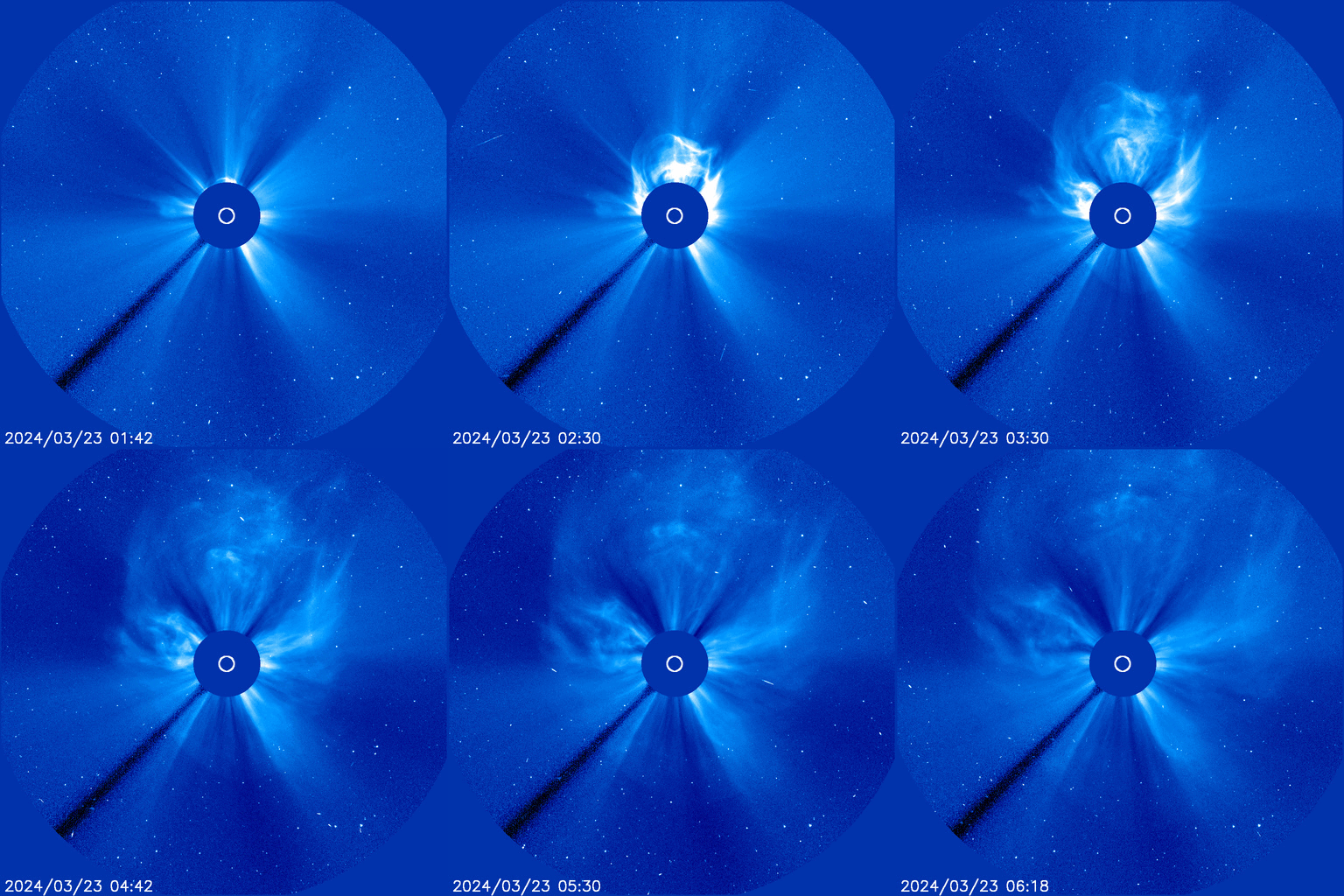
This weekend’s extreme geomagnetic storm is over, but there might be a last gasp. NOAA forecasters are currently predicting a return to severe (G4) conditions on May 12th when one or more CMEs might hit Earth’s magnetic field. Of particular interest is the CME from yesterday’s X5.8-class flare — a potent storm cloud that could spark renewed auroras if its internal magnetic field is oriented correctly. CME impact alerts:SMS Text
Please note that we enter another Time node pivot point in the Harmonic starting tomorrow and going for 4 days to Thursday.-Lisa T.
Spaceweather.com
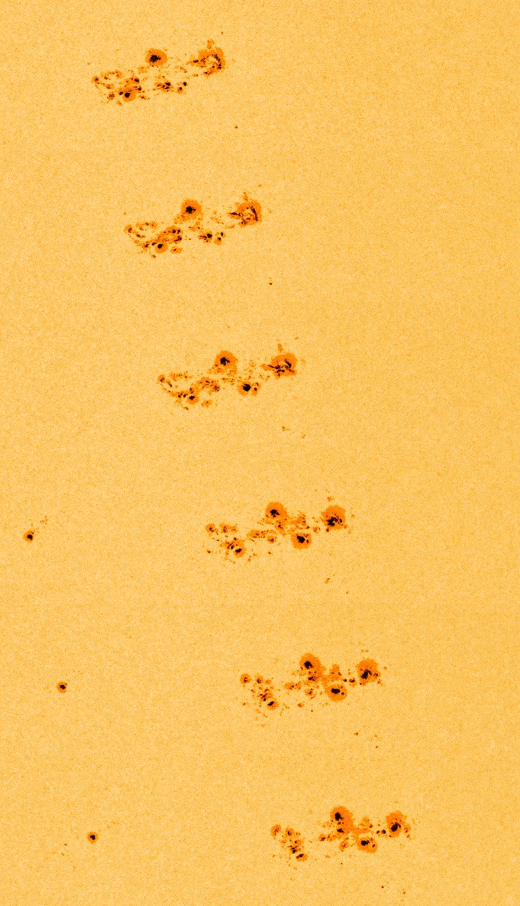
EXITING THE STRIKE ZONE: Sunspot AR3664 is still a giant, easily the equal of Carrington’s sunspot, but it poses a declining threat to Earth. Why? Because it is exiting the strike zone. This picture from Philip Smith of Manorville NY shows the active region approaching the sun’s western limb:
CMEs emitted by the departing sunspot are no longer flying toward Earth. At most only glancing blows are likely from eruptions on May 12th through 14th.
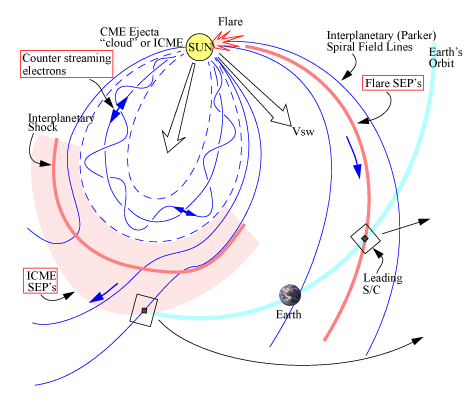
The danger could return on May 15th, however. On that date the sunspot will pass through a region of the sun magnetically connected to Earth via the Parker Spiral. Subatomic debris (protons and electrons) from explosions on May 15th and 16th could spiral back to Earth and rain down our planet. This is called a “radiation storm;” it can upset satellite electronics and cause polar radio blackouts. (It can also make humans feel virusy sick.)
Would you like an instant text message when solar radiation storms begin? Sign up for Space Weather Alerts and select the PRO plan.
I can’t keep my eyes open. It feels like a tractor beam on your brain.
Amplitude blast up to 67Gamma hz in the amplitudes on a Tone 13 day. 🤪🫨😵💫😳
And This Spaceweather
THE DANGER HAS NOT PASSED: Yesterday’s severe geomagnetic storm is over, but the calm might not last. Giantshape-shifting sunspot AR3615 poses a continued threat for Earth-directed solar flares. NOAA forecasters say there is a 25% chance of X-flares today, tomorrow, and Wednesday. If the sunspot blows, it would give sky watchers in Europe and the USA a second chance at auroras this week. Solar flare alerts:SMS Text
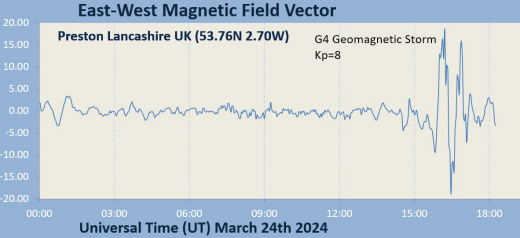
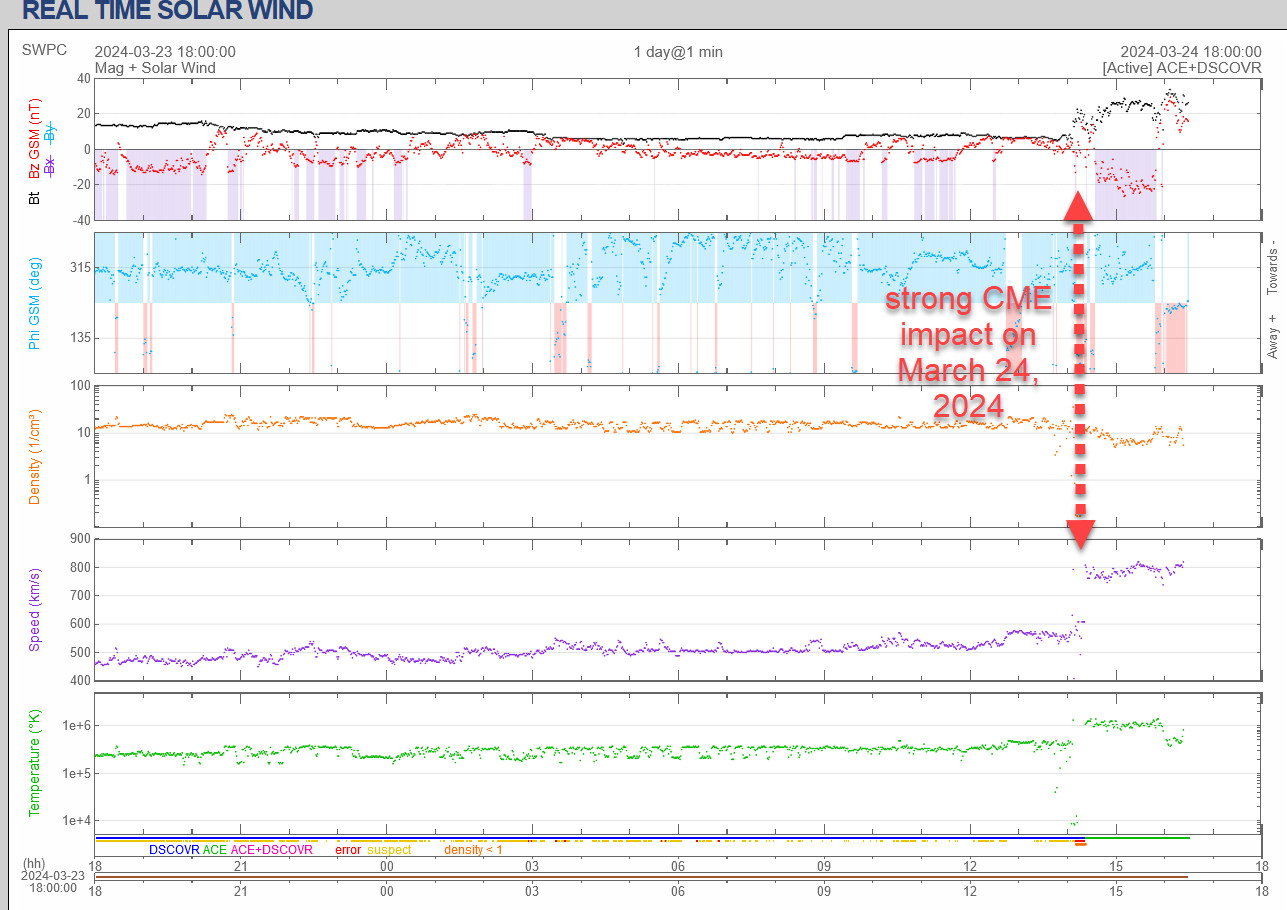
SEVERE GEOMAGNETIC STORM–THE STRONGEST IN YEARS: As predicted, a CME struck Earth’s magnetic field on March 24th (1437 UT). The impact opened a crack in our planet’s magnetosphere and sparked a severe G4-class geomagnetic storm–the strongest geomagnetic storm since Sept. 2017.
The timing of the CME did *not* favor observers in Europe or the United States. Instead, New Zealand got the light show:
“I woke up early and, when I saw that a storm was underway, jumped out of bed and raced to my favourite viewing spot at Hoopers Inlet (latitude +46 S),” says photographer Ian Griffin. “The beautiful aurora australis was easily visible despite clouds and bright moonlight.”
In England, it was broad daylight when the CME struck. Auroras could not be seen. Nevertheless, Stuart Green of Preston, England detected the storm using his backyard magnetometer:
“My magnetometer kicked into life mid-afternoon here in the UK,” says Green. “The arrival of the CME created a severe disturbance.”
The squiggles in Green’s chart represent changes in ground-level magnetic fields caused by the CME. “The sensor is buried in my garden about 0.5 meters below the surface in an East/West orientation,” he explains. “This allows very sensitive (sub nanotesla) measurements of magnetic declination during geomagnetic storms.”
Green built his own magnetometer from scratch. Would you like to do the same? Here’s how.
The scientists are stumped, and they don’t have much data. My first instinct is the birth of a star. Although they focused on the death of a star. We shall see.
I’m geeked out on astronomy today, procrastinating on staring at my own magnetosphere data, which I’ve been doing for months.
Stratosphere. The stratosphere extends from from 4 -12 miles (6-20 km) above the Earth’s surface to around 31 miles (50 km). This layer holds 19 percent of the atmosphere’s gases but very little water vapor.-May 11, 2023
The magnetosphere or Psi Bank, where the ScR is measured, is 40,000 miles above the earth. Hypothetically, this is where the Tones of Creation pulse.
What does that mean in Tzolkics or Time Science?
In the binary triplet configuration that is the foundation of true time, it is the expression of exponential time in the northern most polar zone in the upper stratosphere of the earth holon.⁰
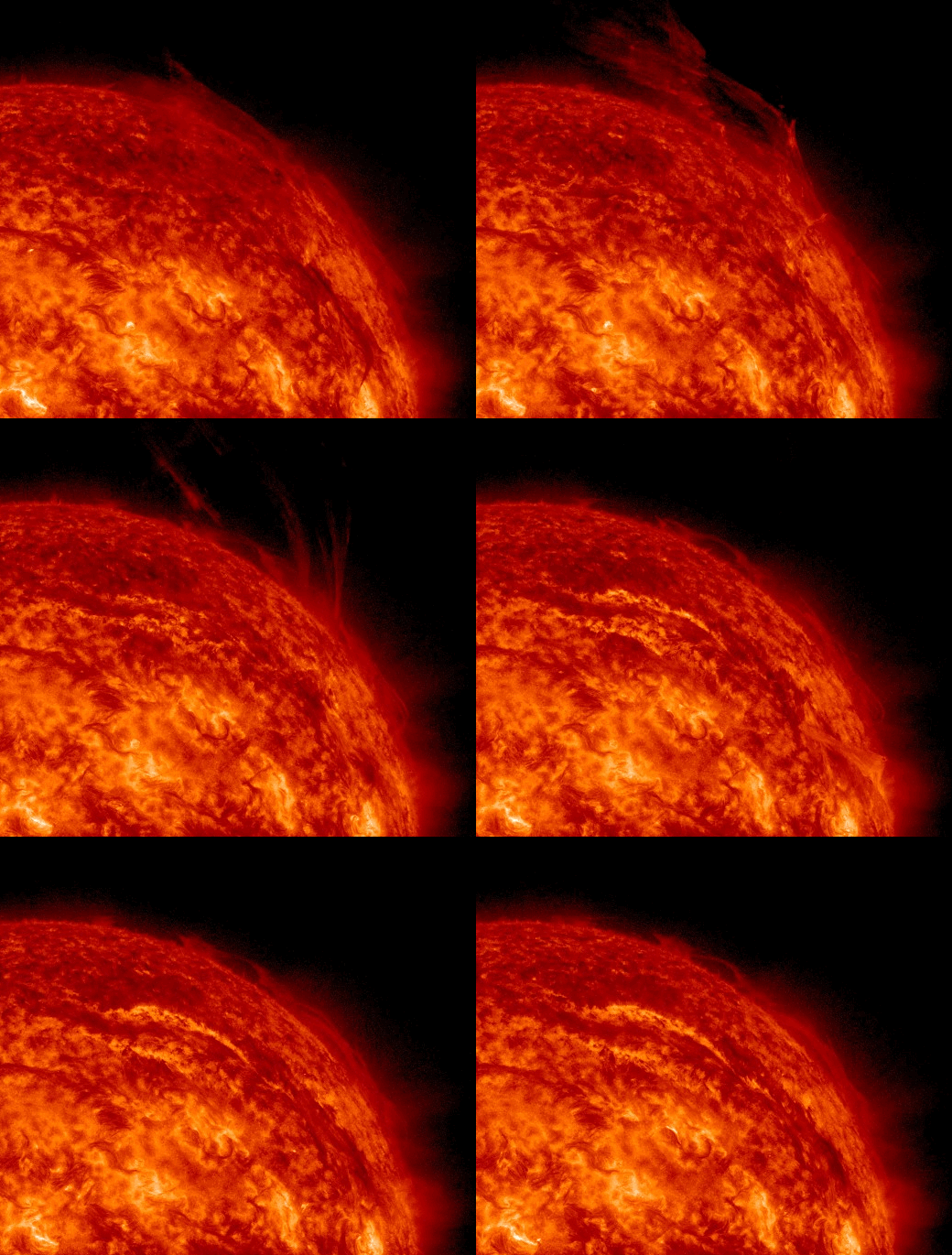
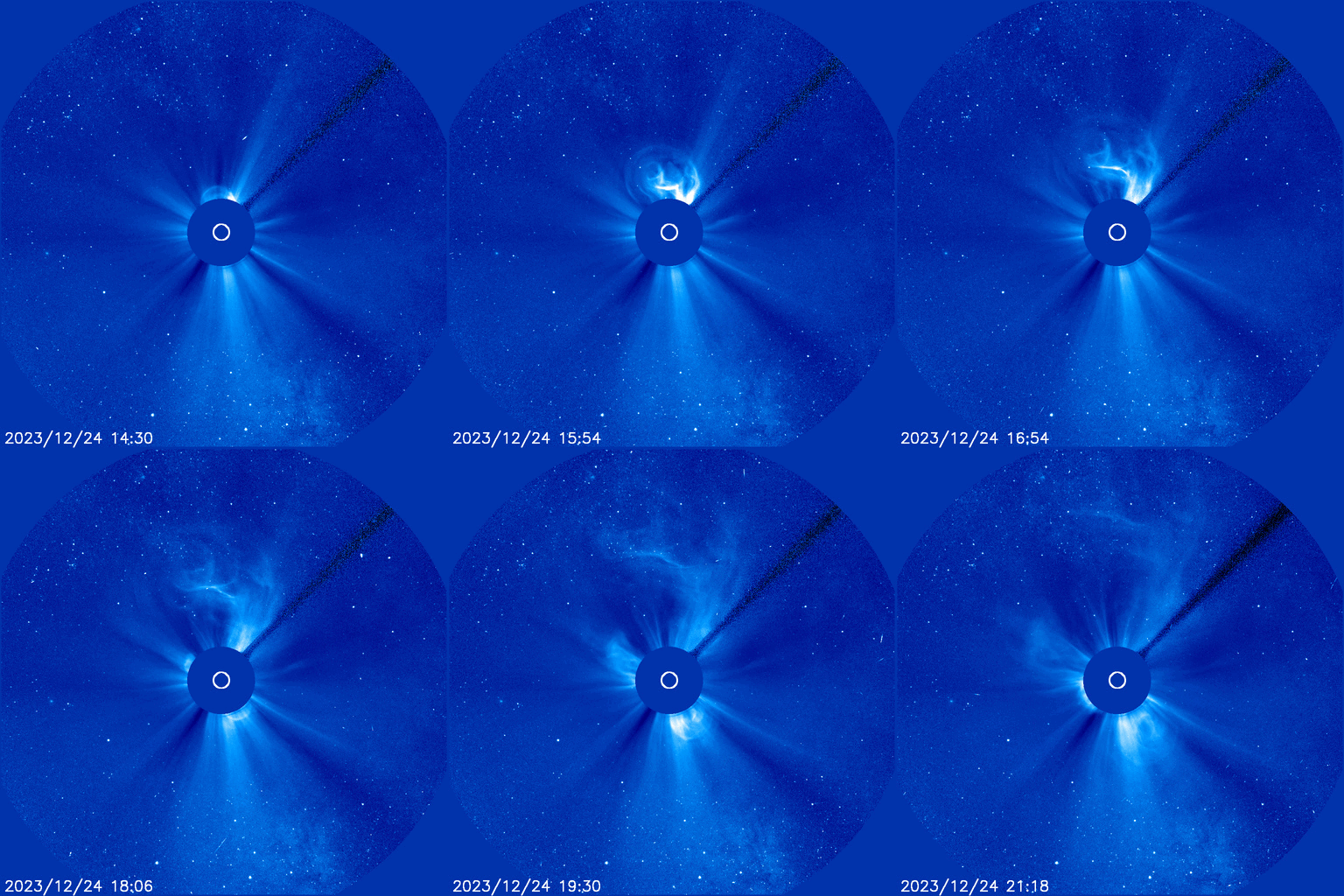
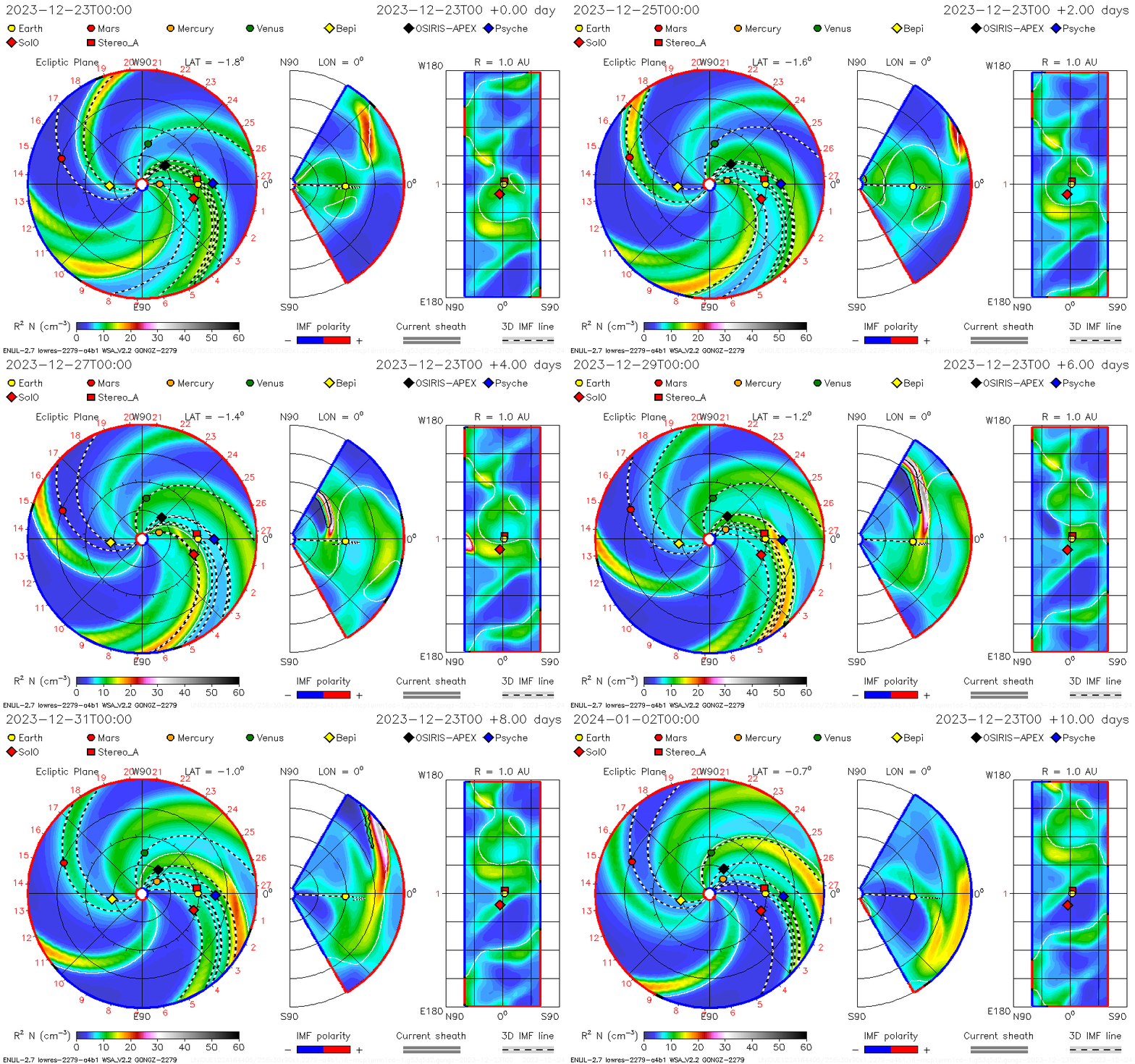
A CME IS COMING: Yesterday, Dec. 24th, a magnificant filament of magnetism erupted from the sun’s northern hemisphere, hurling a CME into space. Most of the CME is expected to pass north of our planet–most, but not all. NASA models suggest a glancing blow on Dec. 27th. Minor G1-class geomagnetic storms are possible on that date. CME impact alerts:SMS Text
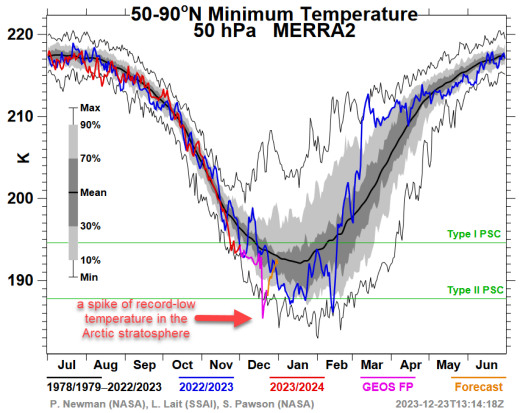
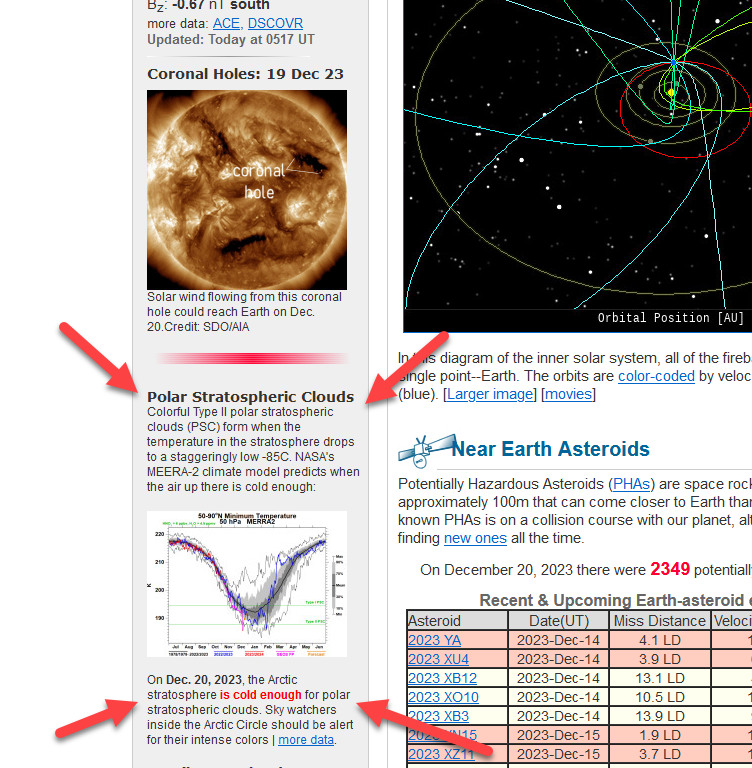
RECORD-COLD WEATHER IN THE STRATOSPHERE: Now we know why polar stratospheric clouds (PSCs) have suddenly exploded. According to NASA’s MERRA-2 climate model, temperatures in the Arctic stratosphere just hit a 40-year record low for the month of December:
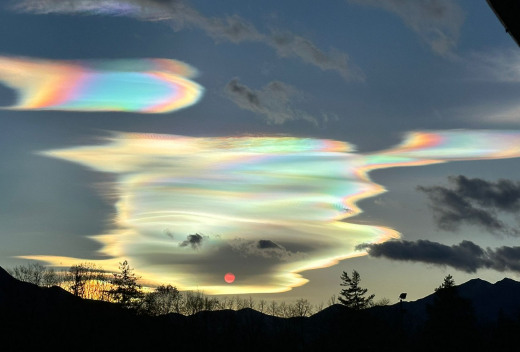
Cold air in the stratosphere is exactly what PSCs require. Normally, the stratosphere has no clouds at all. But when the temperature drops to a staggeringly-low -85 C, widely-spaced water molecules coalesce into ice crystals and PSCs begin to form. Their aurora-like colors make them the most beautiful clouds on Earth.
PSCs are normally confined to the Arctic where the stratosphere is coldest. During this week’s extreme cold wave, the clouds descended all the way to mid-latitudes. Here they are over Locarno,Switzerland (+46N): (This is the Yellow Sun Tribe portal area, 60°N-15°W.)
“I saw these clouds for the first time on Dec. 22nd,” says photographer Branca Cristina. “The colors were amazing!” (We were on Yellow Sun tribe on Dec. 19th)
At the same time, the clouds were sighted in Torun, Italy (+45N); the next morning they appeared again in Lausanne, Switzerland (+47N). These are extraordinary excursions from normal PSC habitat.
The season for PSCs usually starts in January. The current cold wave has given the season an early start, and could herald many more PSCs in the weeks ahead. To help sky watchers catch these rare clouds, we will henceforth publish daily predictions of temperatures in the Arctic stratosphere. When the air temperature drops below the “Type II PSC” green line, it’s time to look for PSCs. Check out the forecast here.
This is an AI Free Zone! Text created by ChatGPT and other Large Language Models is spreading rapidly across the Internet. It’s well-written, artificial, frequently inaccurate. If you find a mistake on Spaceweather.com, rest assured it was made by a real human being.
GEOMAGNETIC STORM WATCH (G2): A CME hit Earth’s magnetic field on Dec. 15th at 1216 UT. It was a weak impact that did not spark a full-fledged geomagnetic storm. It might, however, set the stage for a geomagnetic storm on Dec. 17th when a CME from yesterday’s X-flare is expected to deliver a glancing blow to Earth’s magnetic field. Storm levels could reach category G2 (Moderate). CME alerts:SMS Text
A FUSILLADE OF SOLAR FLARES: Sunspot 3514 continued to flare today with a strong M7-class event following close on the heels of yesterday’s X2.8-class boomer. The X-flare on Dec. 14th was the strongest flare of Solar Cycle 25 (so far) and the most powerful eruption the sun has produced since the great storms of Sept. 2017.
Only the fact that AR3514 is approaching the sun’s western limb prevents it from causing strong geomagnetic storms here on Earth. Eruptions from the sunspot are a little off-target. Nevertheless, we will not escape unscathed. The X2.8-class flare hurled a fast-moving CME into space, and it will probably graze Earth’s magnetic field on Dec. 17th. We are still awaiting the results of NOAA modeling to confirm the timing of impact and the possible strength of any resulting geomagnetic storm. Stay tuned. Solar flare alerts:SMS Text
The Van Allen Belts ARE the Tzolkin Harmonic and produce the Auroras all over the planet. Look at the colors! We call them the Psi Bank or the Mind of Earth which is TIME. That time manifests and creates DNA which creates gravity.
This is magical and beautiful. Tzolk’in means Count of Days (time) or Count of Kin (people). A kin is a person and a day, same thing. Time is DNA and creates gravity.
The scientists don’t know it or understand it but it is due to the interaction of the Sun and Galactic Center that synchronicity happens in our holographic matrix for all sentient beings on earth.
25,436 views Aug 15, 2016
On March 17, 2015, an interplanetary shock – a shockwave created by the driving force of a coronal mass ejection, or CME, from the sun – struck the outermost radiation belt, triggering the greatest geomagnetic storm of the preceding decade. NASA’s Van Allen Probes were there to watch it. One of the most common forms of space weather, a geomagnetic storm describes any event in which Earth’s magnetic environment – called the magnetosphere – is suddenly, temporarily disturbed. Such an event can also lead to change in the radiation belts surrounding Earth, but researchers have seldom been able to observe what happens within the first few minutes immediately following a shock.
On the day of the March 2015 geomagnetic storm, one of the Van Allen Probes was located at just the right spot within the radiation belts, providing unprecedentedly high-resolution data from a rarely witnessed phenomenon. A paper on these observations was published in the Journal of Geophysical Research on Aug. 15, 2016.
The Van Allen Belts are responsible for the amplitude and frequency found in the Schumann Resonance affecting ALL LIFE on earth. They say that right at the beginning. It is absolutely the case that these belts, activated by CME’s from the Sun, directly affect all DNA on earth. And I contend, ARE the Tzolkin Psi Bank and create the Auroras and control time and evolution on our sphere. Take a look at these with me.
I’m in the last stages of work on the Tones of Creation book. Then I might republish both on Amazon. It depends on if I get the follow through promised by someone 8 months ago without quid pro quo. Ah, politics and money.
The information from NASA, 10 years old is far, far, younger than the archeological evidence for the veracity of the Mayan Tribes or 20 amino acids seen on stone stellae as Mayan gods in the Yucatan. I find this information less straight forward as astronomy grows as a science.
The Central Axis is what they observe in the middle. Theydon’t know what it is because it stays still. They don’t understand it. That is reverberating with our brain and spine,the central axis of the eternal present from the galactic center.
This guy…disses astrology which is ONE with astronomy. Then he starts to touch the fact that TIME is US with his Mechanized “tick, tick, tick” comment. Time does not make the sound of a clock. So…Scientists always ride the social fence even though they secretly believe in all the work I do. One of these days, they’ll listen to me, even if it’s posthumously. Fine with me.
CO-ROTATING INTERACTION REGION: NOAA forecasters say that a co-rotating interaction region (CIR) could hit Earth later today. CIRs are shock-like transition zones between fast- and slow-moving streams of solar wind. Think of them as mini-CMEs. If this one arrives as predicted, Arctic sky watchers might witness an outburst of lights tonight. Aurora alerts:SMS Text.
‘DELTA SUNSPOT’ FACES EARTH: Sunspots are giant islands of magnetism floating on the surface of the sun. Usually their magnetic poles are well separated, plus (+) and minus (-) far apart. However, there is a sunspot now facing Earth with multiple poles mixed up and jostling together:
This magnetic map from NASA’s Solar Dynamics Observatory shows the magnetic architecture of sunspot AR3460. It has many magnetic poles with + and – pressed together in close proximity. This could lead to magnetic reconnection and a strong, Earth-directed solar flare.Solar flare alerts:SMS Text
CRYOVOLCANIC COMET 12P: Some people look at this week’s outburst of cryovolcanic comet 12P/Pons-Brooks and see the Millennium Falcon. Bill Williams of Florida’s Chiefland Astro Village sees a different spaceship. “The Romulan Warbird flies again!” he says. The classic Star Trek vessel is inset in this picture Williams took on Oct 9th:
“It is fascinating to see Comet 12P/Pons-Brooks ‘come alive’ again, sporting peculiar horns and symmetrical knots around the comet coma,” he says.
This is the second time in 2023 that Comet 12P has erupted and–bafflingly–produced a spaceship-like silhouette. The first time in July was nearly identical. According to Richard Miles of the British Astronomical Association, “the two ‘horns’ may be caused by a peculiarly-shaped cryovolcanic vent with some sort of blockage causing material to be expelled with a weird flow pattern.”
This comet could cause a sensation next year. It is falling toward the sun and expected to become a naked-eye object only a few days before the total solar eclipse on April 8, 2024. Sky watchers in the path of totality could look up and see a spaceship-shaped outburst for themselves.
You must be logged in to post a comment.