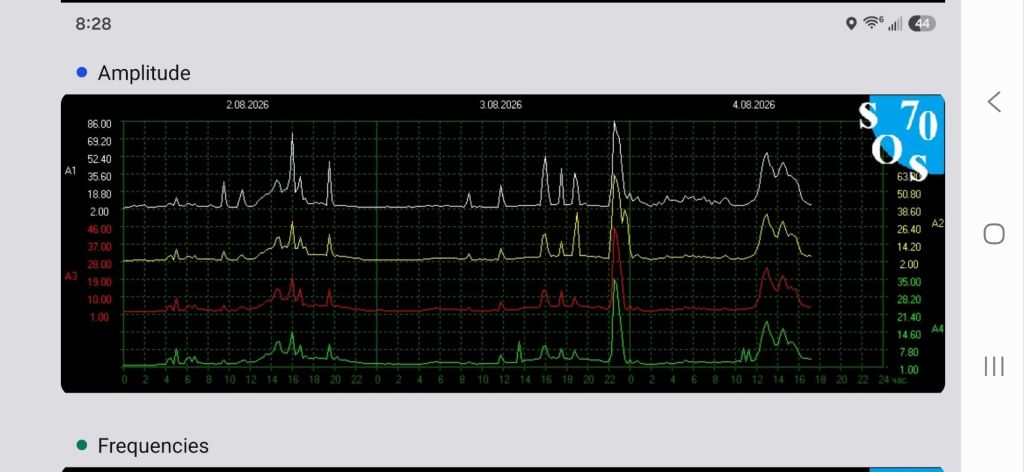
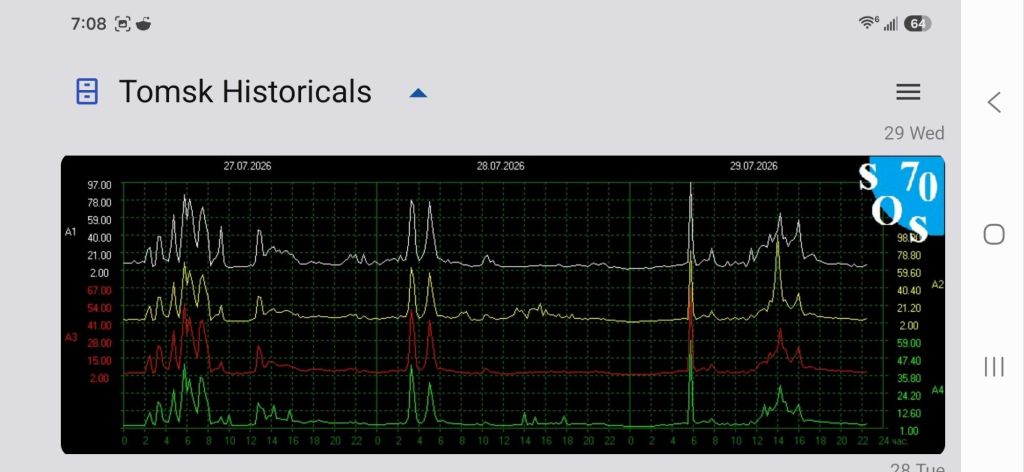
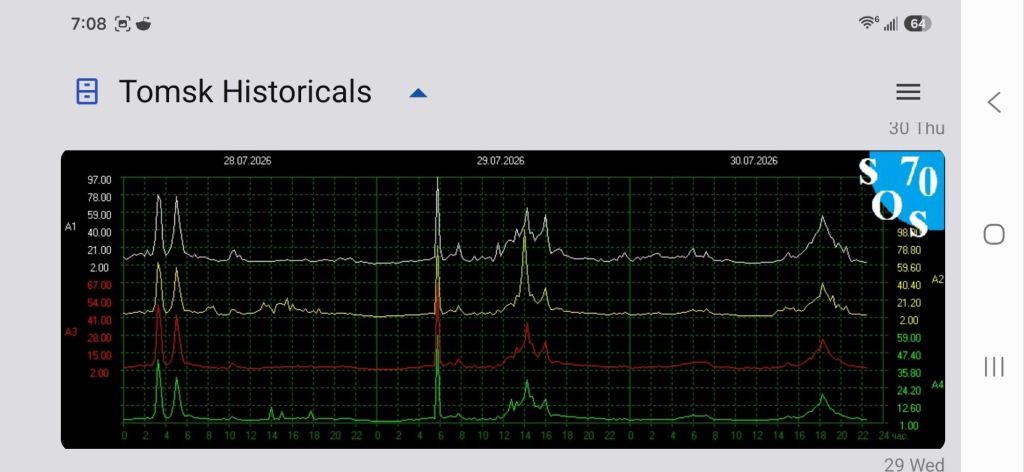
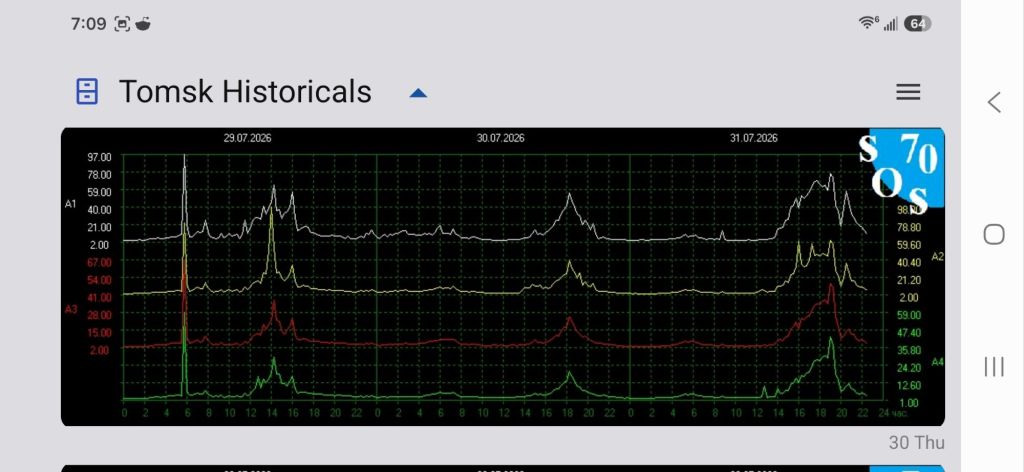
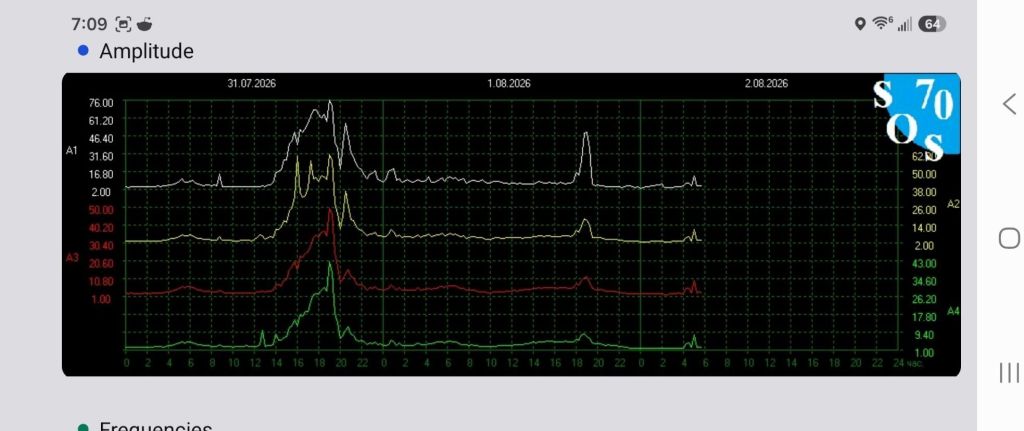
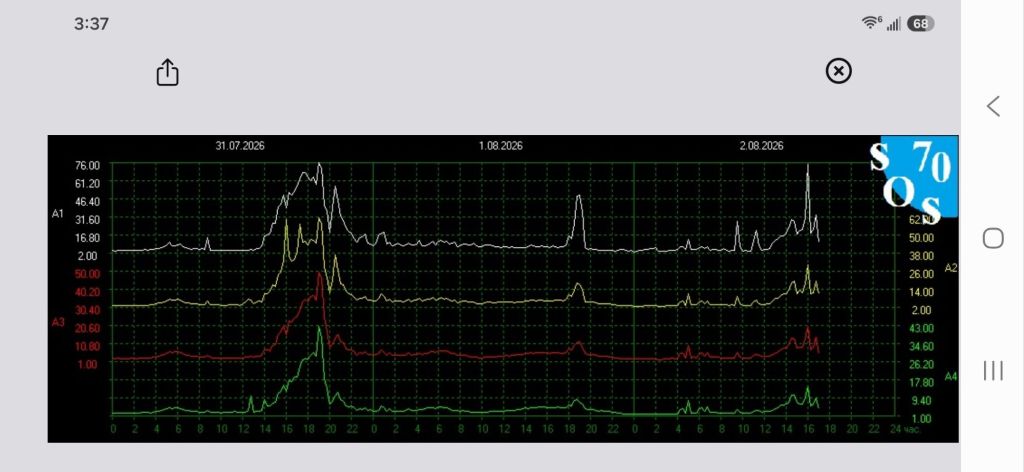
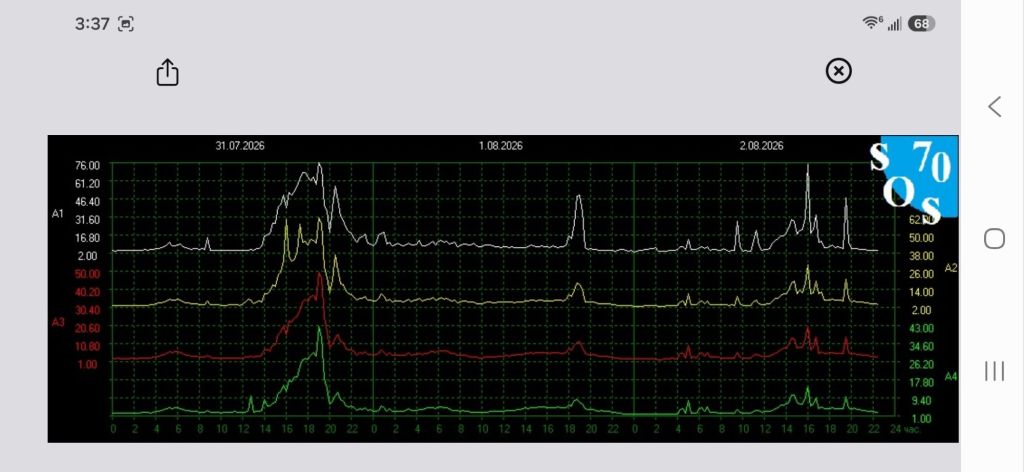
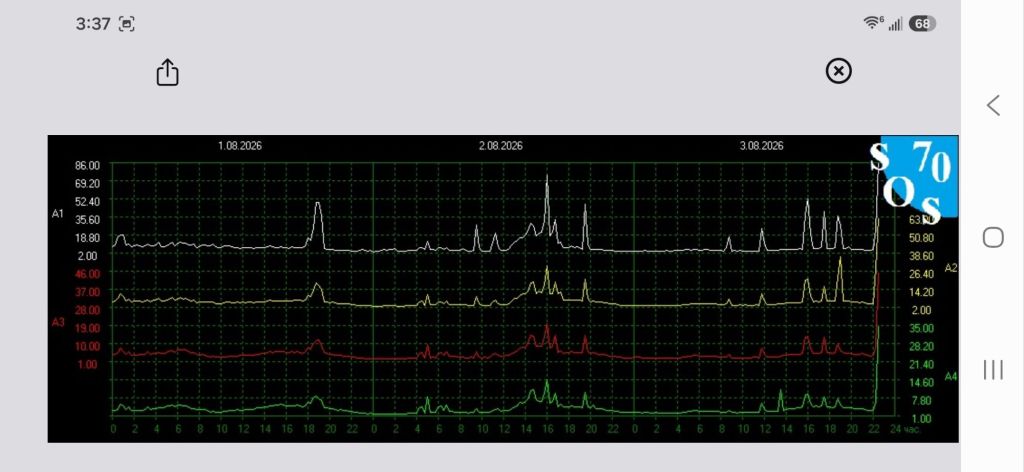
It’s up in gamma hz at 6pm Tomsk time again. I’ve seen it rise at midnight often over 5 years. It does that too. But these gamma pulses at 6am and 6pm daily are from something sentient. It started on July 26, 2026, the Mayan New Year. Huge synchronicity. 🤩😍
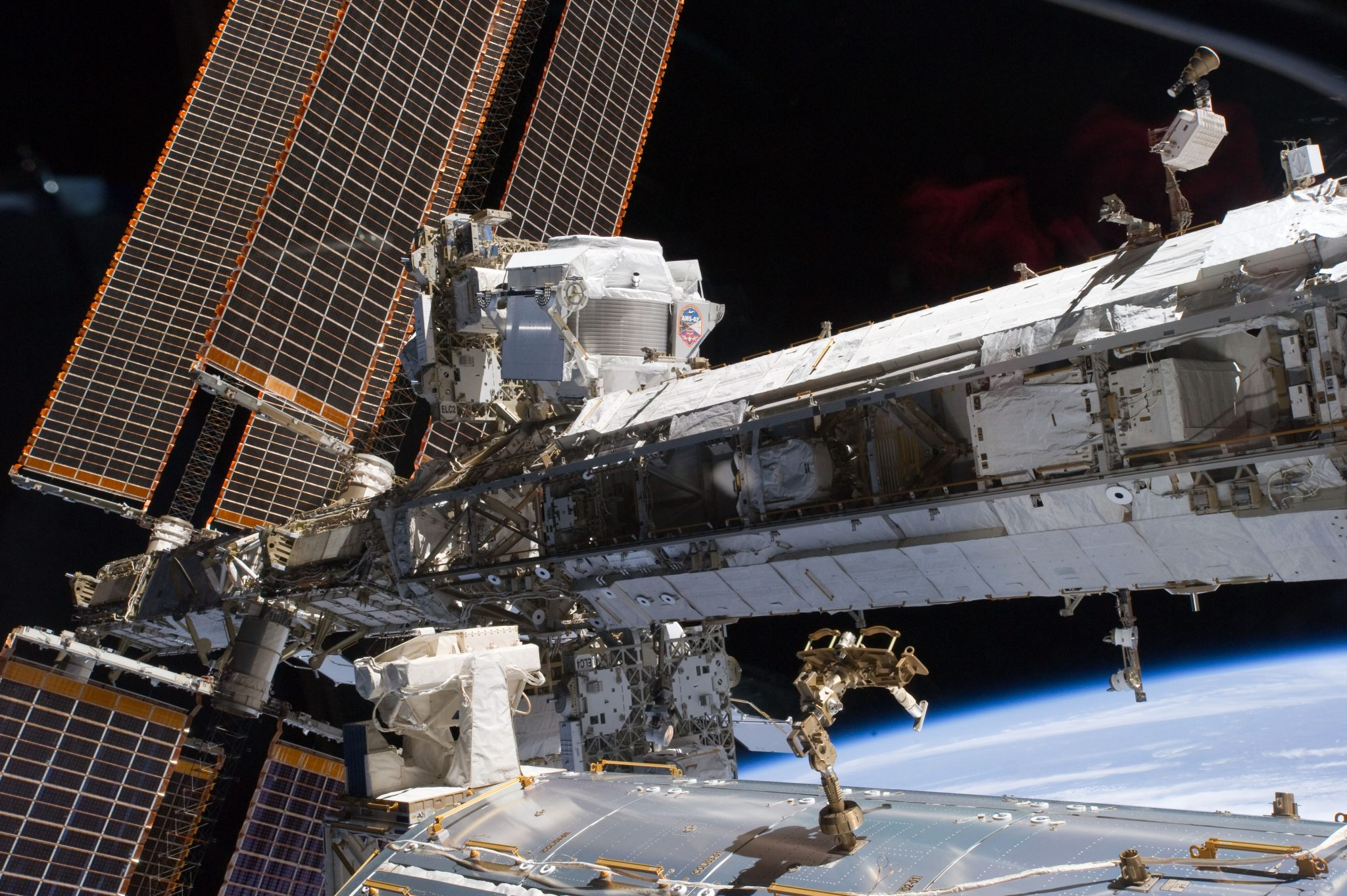
Fixed to the International Space Station (ISS) as it speeds around Earth, the Alpha Magnetic Spectrometer (AMS) is constantly measuring high-energy particles that stream from across the Universe, known as cosmic rays. In a recent paper published in Physical Review Letters, the AMS Collaboration reports its first measurements of five heavy elements found amongst these particles.
Since it was installed on the ISS in 2011, AMS has collected data from over 200 billion cosmic rays using technology adapted from the much larger particle detectors found at CERN. This unique dataset helps researchers build a clearer picture of how cosmic rays are produced, accelerate, and travel through space.
The recent paper from the AMS Collaboration describes precise measurements of the heavy elements phosphorous, chlorine, argon, potassium and calcium, bringing the total number of elements studied by AMS to twenty.
Traditionally, cosmic rays have been divided into two main categories. Primary cosmic rays mostly come from exploding stars, while secondary cosmic rays are produced by interactions between primary cosmic rays and the gas and radiation of space.
Previous results from AMS revealed that, unexpectedly, primary cosmic rays could be divided into two distinct classes. Elements were sorted into these classes based on how their flux, which is proportional to the number of particles, varied with their rigidity – the extent to which that element is deflected by magnetic fields.
The recent paper describes flux measurements taken of the additional five heavy elements over 13.5 years from approximately one million cosmic rays, in the gigavolt to teravolt rigidity range. Taken together with previous AMS results, this data allowed researchers to also divide secondary cosmic rays into two categories, bringing the total number of distinct classes to four.
Some elements are found in both primary and secondary cosmic rays, so belong to two categories. Researchers therefore also studied what fraction of different elements were found in primary and secondary rays. Of the elements covered in the recent paper, those with an even number of protons were found to have a larger proportion of particles from a primary cosmic ray than elements with an odd number of protons.
“AMS provides orders of magnitude improvement in precision over previous detectors. None of its results agree with current theory, necessitating the development of new models of cosmic rays,” explained AMS spokesperson Samuel Ting.
“This disagreement arises because models were developed when flux uncertainties were as large as 100%. AMS improving precision to 1% means commensurate improvement in theoretical predictions are needed to explain AMS measurements,” said Sunil Gupta, President-Designate of the International Union of Pure and Applied Physics, who was not involved in this research. “The presence of secondary components in primary cosmic rays hints that a sizable production of elements that are important for life on Earth could have occurred in cosmic-ray interactions in our Galaxy, rather than only during nucleosynthesis inside stars, as is commonly accepted.”
The study continues on 8/3/26. This will be ongoing. I believe the stellar species are giving us a red flag. The earth is going to be allowed to HEAL and balance ITSELF.
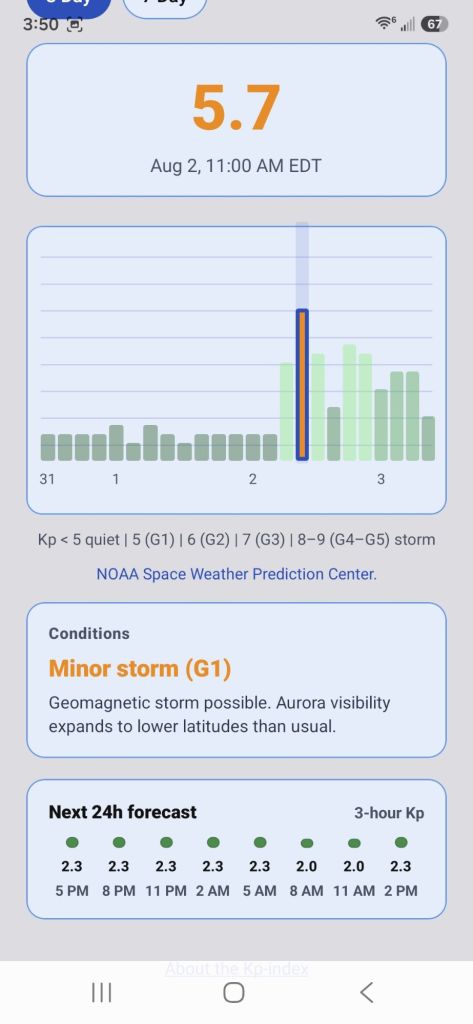
We have had a minor geomagnetic storm as of yesterday.
The Gamma pulses are not coming from the sun. 🤫🤫
This is how the Mayan New Year started. I had no idea the gamma ray hertz pulses would do this.
I’ve tracked Schumann Resonance Layers for at least 5 years DAILY, several times a day and I have never seen week long Gamma hertz pulses ABSENT SOLAR IMPETUS. The astronomy is quiet. GROK doesn’t understand it either and says it’s probably lightning in the ionosphere. ⚡️⚡️⚡️Maybe. At exact intervals though? 🤔
Time to study the facts. The dates are across the top. This phenomenon started on the Mayan New Year, 7/26/26, right after the RESET in our Tzolkin model, the DAY OUT OF TIME. I call it synchronicity.
July 26, 27, 28
85 gamma hz at 6pm on 7/26-Saturday Mayan New Year
FARSIDE SOLAR ACTIVITY: A flurry of CMEs observed by SOHO on June 17th appears to be due to farside activity. Helioseismic echoes suggest there are at least two big sunspots capable of producing flares and CMEs on the farside of the sun. Mars, Venus and Mercury are in the crosshairs of these active regions, but Earth is not. Solar flare alerts: SMS Text
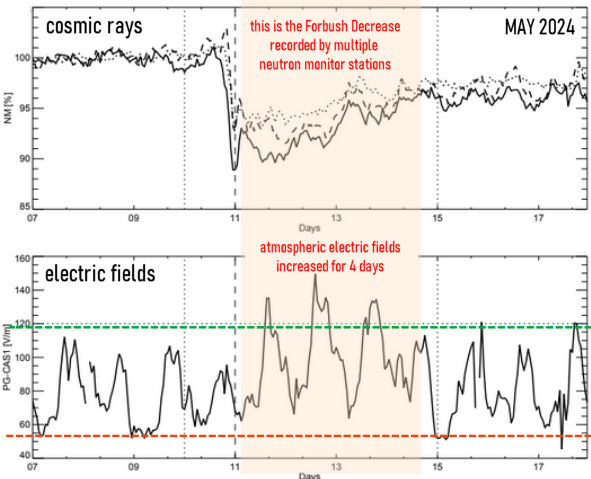
SUPERSTORM ZAPS GLOBAL ELECTRIC CIRCUIT: The geomagnetic superstorm of May 10, 2024, did more than spark some of the best auroras in 500 years. It also electrified our planet.
“Our sensors measured a significant change in atmospheric electricity,” reports Gang Li, a space physicist at the University of Alabama. “Earth’s entire global electrical circuit was affected by the storm.”
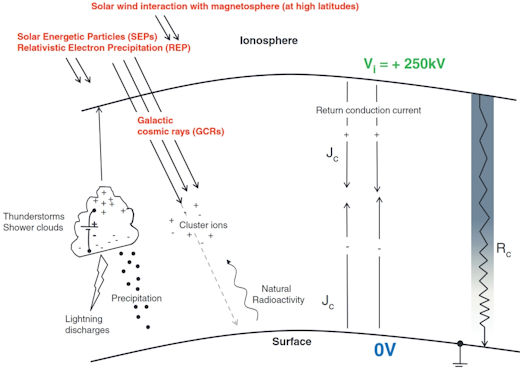
Credit: K. A. Nicoll’s 2014 review paper “Space Weather influences on Atmospheric Electricity”
Yes, Earth has a “global electrical circuit.” It is created by thunderstorms, which build up a charge difference between the ground and the ionosphere 50 km overhead. (It’s far more than that-L.T.).
There are about 40,000 thunderstorms per day all over the Earth, and we can think of them as batteries pumping the electricity to the top of the atmosphere. The resulting voltage drop is a staggering 250,000 volts.
On its own, air is not a great conductor of electricity. However, cosmic rays from deep space ionize our atmosphere, creating just enough conductivity for currents to flow in response to those 250,000 volts. The very air you breath is thus electrified.
In April 2024, Li and colleagues published a paper in the journal Space Weather about solar storms and the global electric circuit. They described how CMEs approaching Earth can sweep aside cosmic rays. This is called a “Forbush Decrease” named after American physicist Scott Forbush who studied cosmic rays in the early 20th century. During a Forbush Decrease, fewer cosmic rays are available to ionize Earth’s atmosphere which, in turn, changes the conductivity of the entire global electrical circuit.
The CME that hit Earth on May 10, 2024, caused a very large Forbush Decrease. “It was a boon to our research,” says Li.
Li and colleagues checked two electric field monitoring stations at the CASLEO observatory in Argentina–a site they had previously used to monitor the global electrical circuit. During the superstorm, electric fields jumped 10% to 15%, an increase that lasted for more than four days. “This is in good accord with what we would have predicted based on our paper,” he says.
Such changes in atmospheric electricity can affect many things, ranging from the probability of rain and lightning to the flight paths of ballooning spiders, which ride electric fields through the air. Indeed, arachnids may have known of this link all along, but humans are only learning about it now. 😳 Read Li’s original research here.