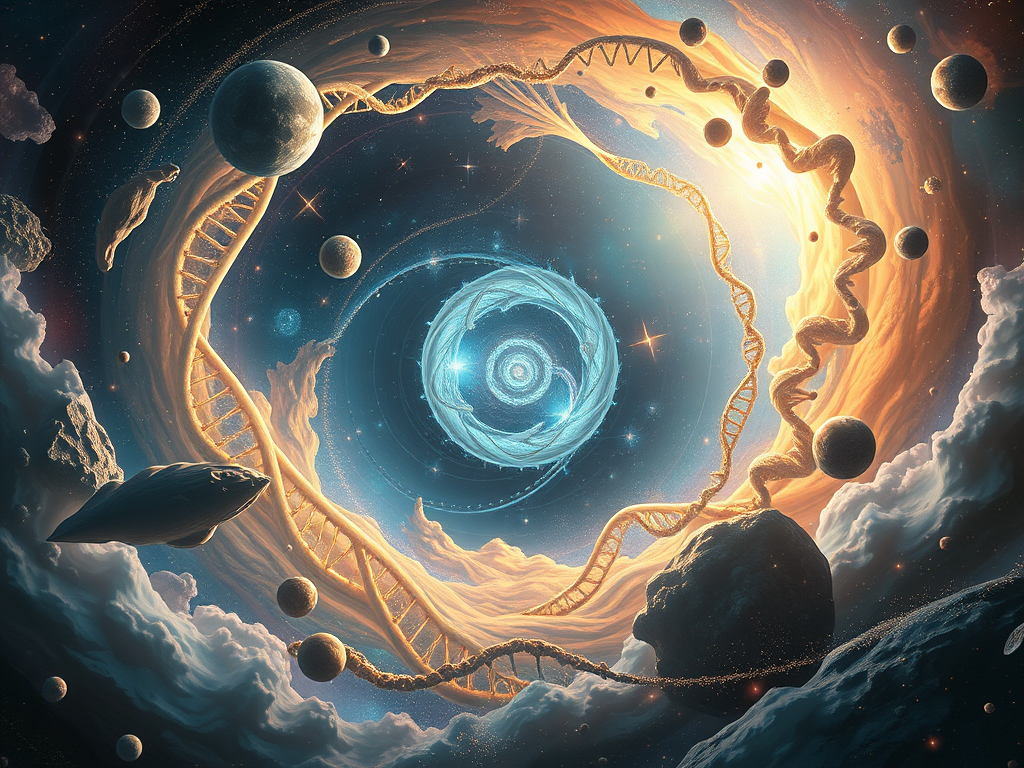
There is no such thing as linear time. I can’t believe science is still lost on that. Time spirals with nature and DNA.
I read the Urantia Book at urantia.org and the physical book. Answers to these questions are in Part 1 – The Central and Superuniverses. They are also in Part 2 – The Local Universe. But they are more about the PERSONALITIES, the thousands of entities responsible for Creation. I’m not sure scientists are interested in Universe Personalities, which is why we keep going over a cliff. It’s about WHO, not what is involved in Creation.
In Part I,Paper 12-The Universe of Universes has more science in it with which they would have fun. Page 128
On page 141, it says that all forms of force-energy—material, mindal, or spiritual—are alike prone to those grasps. These are the universal presences which we call gravity. The whole section is about what gravity is.
In Part II, we have the truth of 100 constellations that have 100 inhabited worlds. They are all evolutionary. It goes on until page 637.
In Part III, we have the story of the birth of the Androvover Nebula. This nebula is where Earth resides. disgorged from the sun 987,000 000 000 billion years ago. Our sun was born 6 billion years ago. Then, it narrates how our solar system was born and when. Earth was just born, with no life on it about 3 billion years ago. We are a baby planet full of baby species.
At 25.00, they start talking about the Urantia Book, which I’ve read through. I found it in the 1990s through my ex-husband Jason, who was White 3 Dog (JC’s birth gateway).
I find it highly readable. He’s correct about Part IV. It’s profound. Makes me weep. Christ is the deal.
All the angels and universe worlds are in there. They are stellar species.
57:5.1 (655.6) 5,000,000,000 (billion) years ago your sun was a comparatively isolated blazing orb, having gathered to itself most of the near-by circulating matter of space, remnants of the recent upheaval which attended its own birth.
57:5.2 (655.7) Today, your sun has achieved relative stability, but its eleven and one-half year sunspot cycles betray that it was a variable star in its youth. In the early days of your sun the continued contraction and consequent gradual increase of temperature initiated tremendous convulsions on its surface. These titanic heaves required three and one-half days to complete a cycle of varying brightness. This variable state, this periodic pulsation, rendered your sun highly responsive to certain outside influences which were to be shortly encountered.
57:5.3 (655.8) Thus was the stage of local space set for the unique origin of Monmatia, that being the name of your sun’s planetary family, the solar system to which your world belongs. Less than one percent of the planetary systems of Orvonton have had a similar origin.
57:5.4 (655.9) 4,500,000,000 years ago the enormous Angona system began its approach to the neighborhood of this solitary sun. The center of this great system was a dark giant of space, solid, highly charged, and possessing tremendous gravity pull.
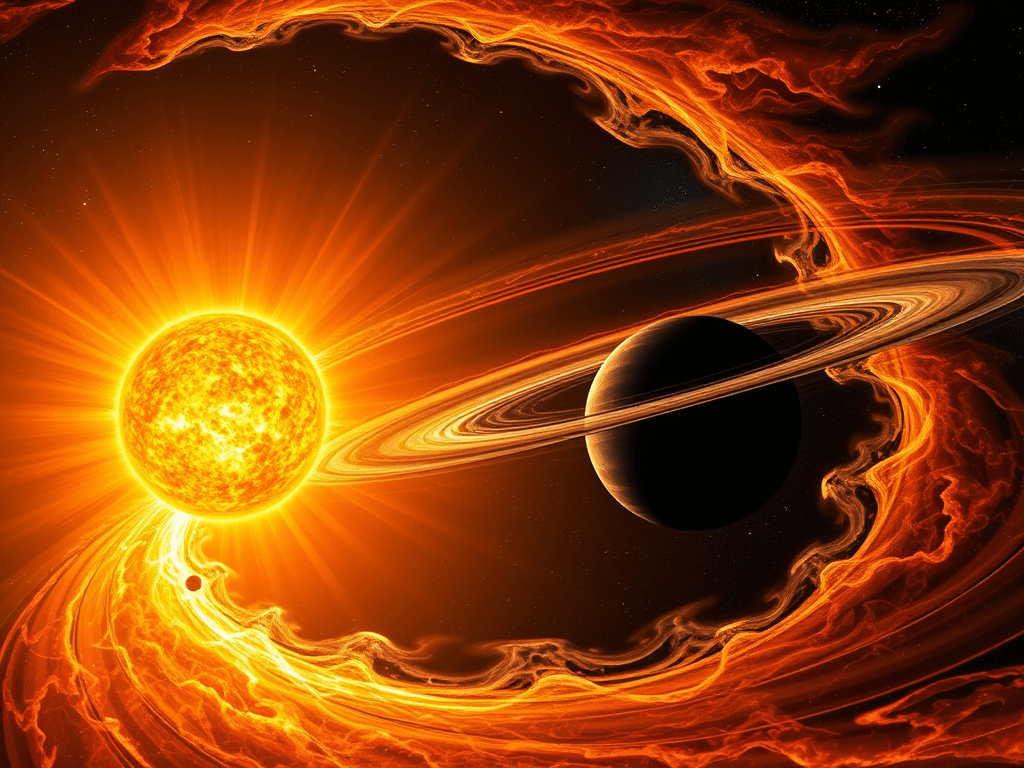
57:5.5 (656.1) As Angona more closely approached the sun, at moments of maximum expansion during solar pulsations, streams of gaseous material were shot out into space as gigantic solar tongues. At first these flaming gas tongues would invariably fall back into the sun, but as Angona drew nearer and nearer, the gravity pull of the gigantic visitor became so great that these tongues of gas would break off at certain points, the roots falling back into the sun while the outer sections would become detached to form independent bodies of matter, solar meteorites, which immediately started to revolve about the sun in elliptical orbits of their own.
57:5.6 (656.2) As the Angona system drew nearer, the solar extrusions grew larger and larger; more and more matter was drawn from the sun to become independent circulating bodies in surrounding space. This situation developed for about five hundred thousand years until Angona made its closest approach to the sun; whereupon the sun, in conjunction with one of its periodic internal convulsions, experienced a partial disruption; from opposite sides and simultaneously, enormous volumes of matter were disgorged. From the Angona side there was drawn out a vast column of solar gases, rather pointed at both ends and markedly bulging at the center, which became permanently detached from the immediate gravity control of the sun.
57:5.7 (656.3) This great column of solar gases which was thus separated from the sun subsequently evolved into the twelve planets of the solar system. The repercussional ejection of gas from the opposite side of the sun in tidal sympathy with the extrusion of this gigantic solar system ancestor, has since condensed into the meteors and space dust of the solar system, although much, very much, of this matter was subsequently recaptured by solar gravity as the Angona system receded into remote space.
57:5.8 (656.4) Although Angona succeeded in drawing away the ancestral material of the solar system planets and the enormous volume of matter now circulating about the sun as asteroids and meteors, it did not secure for itself any of this solar matter. The visiting system did not come quite close enough to actually steal any of the sun’s substance, but it did swing sufficiently close to draw off into the intervening space all of the material comprising the present-day solar system.
57:5.9 (656.5) The five inner and five outer planets soon formed in miniature from the cooling and condensing nucleus’s in the less massive and tapering ends of the gigantic gravity bulge which Angona had succeeded in detaching from the sun, while Saturn and Jupiter were formed from the more massive and bulging central portions. The powerful gravity pull of Jupiter and Saturn early captured most of the material stolen from Angona as the retrograde motion of certain of their satellites bears witness.
57:5.10 (656.6) Jupiter and Saturn, being derived from the very center of the enormous column of superheated solar gases, contained so much highly heated sun material that they shone with a brilliant light and emitted enormous volumes of heat; they were in reality secondary suns for a short period after their formation as separate space bodies. These two largest of the solar system planets have remained largely gaseous to this day, not even yet having cooled off to the point of complete condensation or solidification.
57:5.11 (656.7) The gas-contraction nucleuses of the other ten planets soon reached the stage of solidification and so began to draw to themselves increasing quantities of the meteoric matter circulating in near-by space. The worlds of the solar system thus had a double origin: nucleuses of gas condensation later on augmented by the capture of enormous quantities of meteors. Indeed they still continue to capture meteors, but in greatly lessened numbers.
57:5.12 (657.1) The planets do not swing around the sun in the equatorial plane of their solar mother, which they would do if they had been thrown off by solar revolution. Rather, they travel in the plane of the Angona solar extrusion, which existed at a considerable angle to the plane of the sun’s equator.
57:5.13 (657.2) While Angona was unable to capture any of the solar mass, your sun did add to its metamorphosing planetary family some of the circulating space material of the visiting system. Due to the intense gravity field of Angona, its tributary planetary family pursued orbits of considerable distance from the dark giant; and shortly after the extrusion of the solar system ancestral mass and while Angona was yet in the vicinity of the sun, three of the major planets of the Angona system swung so near to the massive solar system ancestor that its gravitational pull, augmented by that of the sun, was sufficient to overbalance the gravity grasp of Angona and to permanently detach these three tributaries of the celestial wanderer.
57:5.14 (657.3) All of the solar system material derived from the sun was originally endowed with a homogeneous direction of orbital swing, and had it not been for the intrusion of these three foreign space bodies, all solar system material would still maintain the same direction of orbital movement. As it was, the impact of the three Angona tributaries injected new and foreign directional forces into the emerging solar system with the resultant appearance of retrograde motion. Retrograde motion in any astronomic system is always accidental and always appears as a result of the collisional impact of foreign space bodies. Such collisions may not always produce retrograde motion, but no retrograde ever appears except in a system containing masses which have diverse origins.
6. The Solar System Stage—The Planet-Forming Era
57:6.1 (657.4) Subsequent to the birth of the solar system a period of diminishing solar disgorgement ensued. Decreasingly, for another five hundred thousand years, the sun continued to pour forth diminishing volumes of matter into surrounding space. But during these early times of erratic orbits, when the surrounding bodies made their nearest approach to the sun, the solar parent was able to recapture a large portion of this meteoric material.
57:6.2 (657.5) The planets nearest the sun were the first to have their revolutions slowed down by tidal friction. Such gravitational influences also contribute to the stabilization of planetary orbits while acting as a brake on the rate of planetary-axial revolution, causing a planet to revolve ever slower until axial revolution ceases, leaving one hemisphere of the planet always turned toward the sun or larger body, as is illustrated by the planet Mercury and by the moon, which always turns the same face toward Urantia.
57:6.3 (657.6) When the tidal frictions of the moon and the earth become equalized, the earth will always turn the same hemisphere toward the moon, and the day and month will be analogous—in length about forty-seven days. When such stability of orbits is attained, tidal frictions will go into reverse action, no longer driving the moon farther away from the earth but gradually drawing the satellite toward the planet. And then, in that far-distant future when the moon approaches to within about eleven thousand miles of the earth, the gravity action of the latter will cause the moon to disrupt, and this tidal-gravity explosion will shatter the moon into small particles, which may assemble about the world as rings of matter resembling those of Saturn or may be gradually drawn into the earth as meteors.
57:6.4 (658.1) If space bodies are similar in size and density, collisions may occur. But if two space bodies of similar density are relatively unequal in size, then, if the smaller progressively approaches the larger, the disruption of the smaller body will occur when the radius of its orbit becomes less than two and one-half times the radius of the larger body. Collisions among the giants of space are rare indeed, but these gravity-tidal explosions of lesser bodies are quite common.
57:6.5 (658.2) Shooting stars occur in swarms because they are the fragments of larger bodies of matter which have been disrupted by tidal gravity exerted by near-by and still larger space bodies. Saturn’s rings are the fragments of a disrupted satellite. One of the moons of Jupiter is now approaching dangerously near the critical zone of tidal disruption and, within a few million years, will either be claimed by the planet or will undergo gravity-tidal disruption. The fifth planet of the solar system of long, long ago traversed an irregular orbit, periodically making closer and closer approach to Jupiter until it entered the critical zone of gravity-tidal disruption, was swiftly fragmentized, and became the present-day cluster of asteroids.
57:6.6 (658.3) 4,000,000,000 years ago witnessed the organization of the Jupiter and Saturn systems much as observed today except for their moons, which continued to increase in size for several billions of years. In fact, all of the planets and satellites of the solar system are still growing as the result of continued meteoric captures.
57:6.7 (658.4) 3,500,000,000 years ago the condensation nucleuses of the other ten planets were well formed, and the cores of most of the moons were intact, though some of the smaller satellites later united to make the present-day larger moons. This age may be regarded as the era of planetary assembly.
57:6.8 (658.5) 3,000,000,000 years ago the solar system was functioning much as it does today. Its members continued to grow in size as space meteors continued to pour in upon the planets and their satellites at a prodigious rate.
57:6.9 (658.6) About this time your solar system was placed on the physical registry of Nebadon and given its name, Monmatia.
57:6.10 (658.7) 2,500,000,000 years ago the planets had grown immensely in size. Urantia was a well-developed sphere about one tenth its present mass and was still growing rapidly by meteoric accretion.
57:6.11 (658.8) All of this tremendous activity is a normal part of the making of an evolutionary world on the order of Urantia and constitutes the astronomic preliminaries to the setting of the stage for the beginning of the physical evolution of such worlds of space in preparation for the life adventures of time.
It’s all on line in multiple languages at urantia.org



 Synchronicity is the Source of Consciousness
You must be logged in to post a comment.