THE HIGHEST SUNSPOT NUMBER IN 22 YEARS: The average sunspot number for May 2024 was 172, the highest value in 22 years. So far, June is even higher at 200. If this continues for the rest of the month, June could log the highest sunspot counts since Dec. 2001, rivaling the peak of potent Solar Cycle 23. Solar flare alerts:SMS Text
A NOVA WILL EXPLODE THIS SUMMER (PROBABLY): The night sky is about to get a new star. Sometime this summer, astronomers believe, a nova will explode in the constellation Corona Borealis (the Northern Crown). The exploding star will be bright enough to see with the naked eye even from light-polluted cities.
A NASA artist’s concept of the T CrB binary star system
“It’s a once-in-a-lifetime event,” says Rebekah Hounsell of NASA’s Goddard Space Flight Center. “I believe it will create a lot of new astronomers out there.”
T Coronae Borealis (T CrB) is a binary system 3,000 light-years from Earth. It consists of a white dwarf orbiting an ancient red giant. Hydrogen from the red giant is being pulled down onto the surface of the white dwarf, accumulating toward a critical mass. Eventually, it will trigger a thermonuclear explosion.
The last time T CrB exploded was in 1946. About a year before that blast, the system suddenly dimmed–a pattern astronomers called the “pre-eruption dip.” In 2023, T CrB dipped again, heralding a new eruption. If the 1946 pattern repeats itself, the nova should occur between now and September 2024.
A sky map showing the location of T CrB (red circle)
The outburst will be brief. Once it erupts, the nova will be visible to the naked eye for a little less than a week – but Hounsell is confident it will be quite a sight to see. The expected magnitude is between +2 and +3, similar to stars in the Big Dipper.
“Typically, nova events are faint and far away,” says Elizabeth Hays, chief of the Astroparticle Physics Laboratory at NASA Goddard. “This one will be really close, with a lot of eyes on it. We can’t wait to get the full picture of what’s going on.”
Solar Cycle 25 is intensifying, and this is reflected in the number of cosmic rays entering Earth’s atmosphere. Neutron counts from the University of Oulu’s Sodankyla Geophysical Observatory show that cosmic rays reaching Earth are slowly declining–a result of the yin-yang relationship between the solar cycle and cosmic rays.
The average sunspot number for May 2024 was 172, the highest value in 22 years. So far, June is even higher at 200. If this continues for the rest of the month, June could log the highest sunspot counts since Dec. 2001, rivaling the peak of potent Solar Cycle 23. Solar flare alerts:SMS Text
THE LASER-LIKE ANTI-TAIL OF COMET 12P: Today, Earth is passing through the orbital plane of comet 12P/Pons-Brooks. “This is causing it to develop a laser-like anti-tail,” reports astronomer Ian Griffin, who sends this photo from Otago, New Zealand:
“It was an amazing display,” says Griffin.
In Griffin’s photo, the anti-tail is the very sharp line pointing toward the upper right. It’s “anti” because it points directly opposite the comet’s regular gas tail (lower left).
What is this anti-tail? It’s an optical illusion. Anti-tails appear when Earth passes through a comet’s orbital plane. During the crossing, the sharp edge of the comet’s fan-shaped dust tail narrows to a laser-like line and appears to point toward the sun.
This phenomenon will be visible for the next few days. Southern hemisphere astronomers can find the comet in the constellation Lepus ~20 degrees below the celestial equator. With a magnitude of +7, the comet is an easy target for amateur telescopes. Submit your photos here.
GEOMAGNETIC STORM WATCH–CONTINUED: NOAA forecasters remain confident that a CME will graze Earth’s magnetic field on June 1st. It was hurled into space by an X1.4-flare on May 29th. The glancing blow could cause G2-class geomagnetic storms. CME impact alerts:SMS Text
YET ANOTHER X-FLARE: Sunspot AR3664 (a.k.a. AR3697) has decayed, but it is still potent. On May 31st it emitted another X-flare (X1.1), the third this week. NASA’s Solar Dynamics Observatory captured the extreme ultraviolet flash:
Radiation from the flare ionized the top of Earth’s atmosphere, briefly causing a shortwave radio blackout over the Pacific side of North America. Signals below 30 MHz faded for as much as 30 minutes after the flare’s peak (May 31st @ 2203 UT).
The flare, while intense, was too brief to lift a significant CME out of the sun’s atmosphere. SOHO coronagraph images show no solar storm clouds heading for Earth.
What makes a decaying sunspot like AR3664 so active? This magnetic map provides the answer:
Within the sunspot’s primary core, two oppositely-signed magnetic poles are crowded together, + vs. -. (Just like the Tzolkin Harmonic and our DNA-same thing) When this happens, magnetic recombination(Tone 1 in the magnetosphere QFactor Layer) can cause very powerful explosions even from a sunspot that’s falling apart. NOAA forecasters estimate a 35% chance of X-flares and a 75% chance of M-flares on June 1st. Solar flare alerts:SMS Text
SPACE WEATHER BALLOON DATA: Almost once a week, Spaceweather.com and the students of Earth to Sky Calculus fly space weather balloons to the stratosphere over California. These balloons are equipped with sensors that detect secondary cosmic rays, a form of radiation from space that can penetrate all the way down to Earth’s surface. Our monitoring program has been underway without interruption for 7 years, resulting in a unique dataset of in situ atmospheric measurements.
Latest results (July 2022): Atmospheric radiation is decreasing in 2022. Our latest measurements in July 2022 registered a 6-year low:
What’s going on? Ironically, the radiation drop is caused by increasing solar activity. Solar Cycle 25 has roared to life faster than forecasters expected. The sun’s strengthening and increasingly tangled magnetic field repels cosmic rays from deep space. In addition, solar coronal mass ejections (CMEs) sweep aside cosmic rays, causing sharp reductions called “Forbush Decreases.” The two effects blend together to bring daily radiation levels down.
.Who cares? Cosmic rays are a surprisingly “down to Earth” form of space weather. They can alter the chemistry of the atmosphere, trigger lightning, and penetrate commercial airplanes. According to a study from the Harvard T.H. Chan school of public health, crews of aircraft have higher rates of cancer than the general population. The researchers listed cosmic rays, irregular sleep habits, and chemical contaminants as leading risk factors. A number of controversial studies (#1, #2, #3, #4) go even further, linking cosmic rays with cardiac arrhythmias and sudden cardiac death.
(So when you see reports saying that solar activity and the hertz ELM levels in the magnetosphere won’t affect you physically, they are lying. NASA I think, says they don’t. NOAA is not the same as NASA. They work together but basically, NASA is the Feds and they keep secrets from humanity big time. NOAA doesn’t.)
Technical notes: The radiation sensors onboard our helium balloons detect X-rays and gamma-rays in the energy range 10 keV to 20 MeV. These energies span the range of medical X-ray machines and airport security scanners.
Data points in the graph labeled “Stratospheric Radiation” correspond to the peak of the Regener-Pfotzer maximum, which lies about 67,000 feet above central California. When cosmic rays crash into Earth’s atmosphere, they produce a spray of secondary particles that is most intense at the entrance to the stratosphere. Physicists Eric Regener and Georg Pfotzer discovered the maximum using balloons in the 1930s and it is what we are measuring today.
What do birds and bees, worms and wolves, fruit flies and fish all have in common? The answer: a magnetic sense that helps them navigate. Now it seems we might do as well.
Joseph Kirschvink at the California Institute of Technology in the US and colleagues found that altering the directions of nearby magnetic fields caused temporary changes in human brain activity.
While sitting still in a dark room, participants’ brain activity was recorded using electroencephalography (EEG), while electromagnetic coils were used to create magnetic fields.
The experiment mimicked the magnetic field changes we are subject to when we move about in the real world, says Kirschvink.
The direction and intensity of Earth’s magnetic field varies by geographical location. For example, at the magnetic north pole, one of two poles where the magnetic field is the strongest, the direction of the field points vertically downwards, into the ground.
In the wider northern hemisphere, this vertical angle changes but the magnetic field is always skewed downwards – meaning that when you hold a compass horizontally, the end pointing north is slightly pulled down. The south-pointing end of some compasses in the northern hemisphere are weighted to compensate for the pull.
Brain change
When the team exposed people to a downward-pointing magnetic field, they saw changes in brain wave patterns when they rotated the field horizontally in a counterclockwise direction .
The team measured alpha waves – present when we are awake but relaxed and with closed eyes – before and after a 100 millisecond change in magnetic field, and found a drop in amplitude in the waves in some people following the rotation.
But no participants showed brain changes when the magnetic field was rotated clockwise, a finding the researchers can’t explain.
Rotating an upwards-pointing magnetic field didn’t cause a change either, which the team speculates may be because the participants’ brains were attuned to the magnetic field of the northern hemisphere, where they conducted the study. Earth’s magnetic field always points up in the southern hemisphere.
“One interesting way to test this hypothesis would be to reproduce our experiment in the southern hemisphere,” says team member Isaac Hilburn.
Claims that humans can detect magnetic fields has long been a source of controversy, but other researchers are cautiously optimistic about the new work.
The team’s approach parallels studies of magnetoreception in animals, says Nathan Putman at LGL, an ecological research firm based in Bryan, Texas. Putman, who studies marine animals including turtles, says the strongest evidence for a magnetic sense is when animals change their direction of travel in response to an altered field.
The possibility that humans could have a magnetic sense is exciting, but the results will need to be replicated, he says. “A sceptic could argue that there’s a lot of reasons why brain waves might change and it may not have anything to do with orientation.”
It is possible the EEGs could have picked up disruptions from the surrounding environment, says Can Xie at Peking University in China, although the study tried to eliminate this, he says. “It is hard to interpret the EEG signal precisely, which makes it difficult to further explore the underlying molecular mechanism at this stage.”
If the results hold up, it may mean that a magnetic sense played a role in the nomadic lives of our hunter-gatherer ancestors, says Hilburn.
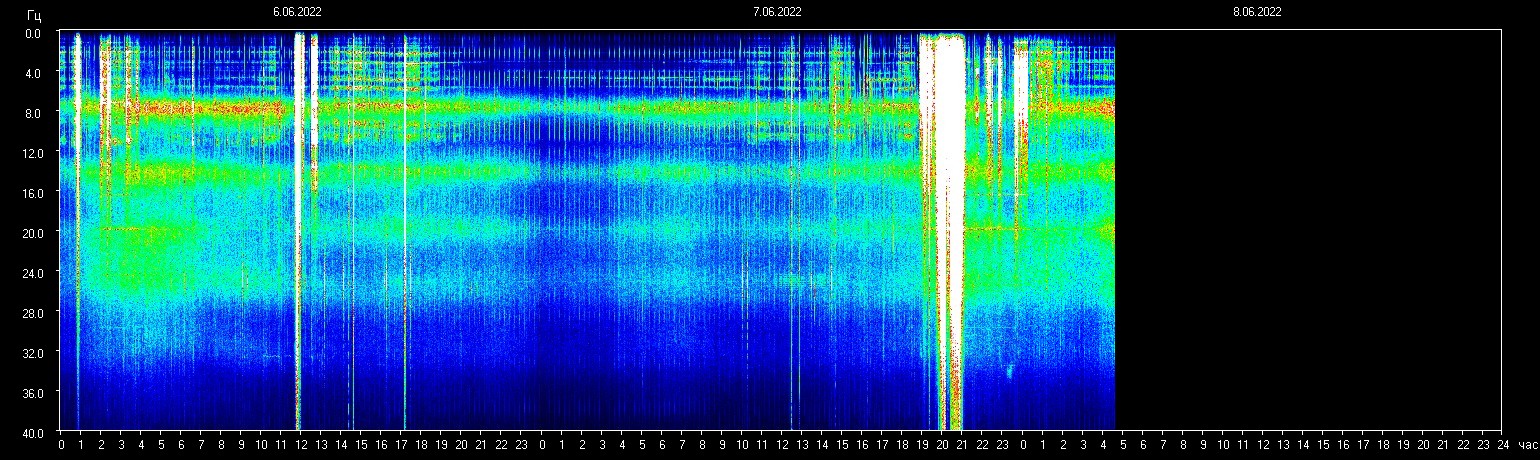
Mercury retrograde, which occurs three times a year for about three weeks each time, is interpreted particularly strongly. Mental pursuits and connections break down.
The Mercury retrograde period is best used as a time for inner reflection. (White Mirror 13-day cycle). It is not a good time for making new decisions or new business plans, but it is ideal for reflecting on your current situation.
It is best to quietly observe your inner process during Mercury retrograde, and to carry forward with your preexisting plans. Ask yourself: Where am I heading in my life at this particular juncture? Then try to move forward with new directions only after Mercury has gone direct, and perhaps even a fortnight beyond, when Mercury has left its retrograde shadow.
She discovered pulsars which are very pertinent to the movement of the amino acids in the Tzolkin theme-plex’s. So far, I believe a local system planetary pulsar moves the Tone of Creation that precedes the amino acid. That will be in Part 3. The pulsing we know of right now is between tones 1-13 and […]
Here it is. Once again, I posted this twice giving warning. THE MAGNETOSPHERE IS THE PSI BANK. There is a chapter in my book about it if you want to know more.
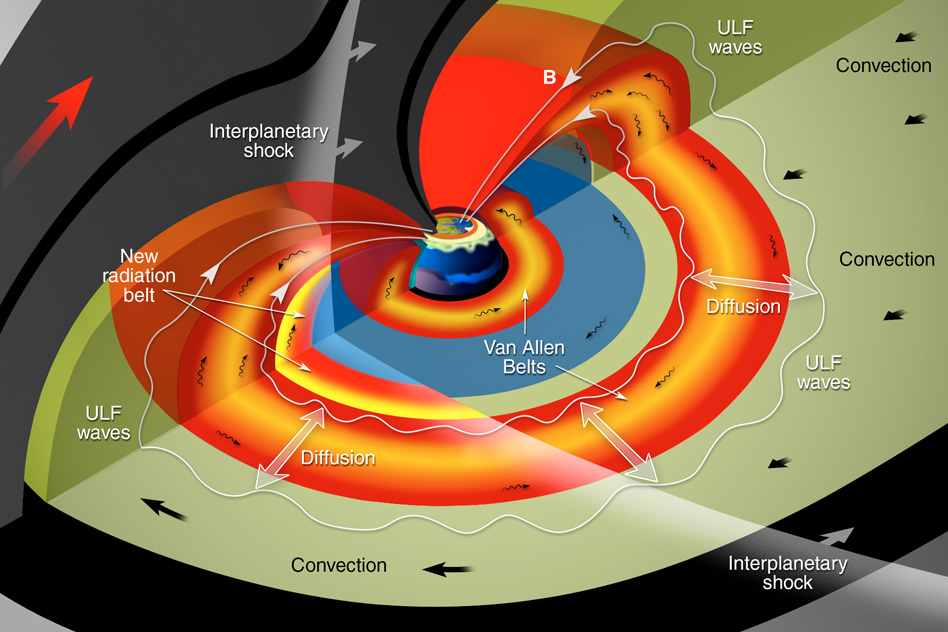
These probes are in the Earth’s ionosphere which is also the magnetosphere. In Tzolkonics it’s called the Psi Bank or Noosphere. The ScR measures its frequency and amplitude but it’s so complex that scientists struggle to decipher it.
As usual, humans who are very attuned to fluctuations in the EMF can feel the changes and how they affect the higher mind, especially Reiki practitioners. Reiki energy is real and people who have had Reiki can feel it. It is also used in hospitals now as well. However it’s better done in private practice as the vibe in a hospital is not known for being positive or healing at all, unfortunately.
The Van Allen Belts are a topic in my book, “Time is DNA.”
Jupiter is well-known for being the biggest planet in our solar system, and it’s also home to the biggest storm. It’s called the Great Red Spot, an enormous vortex that has been swirling for centuries. It’s bigger than our own planet, and yet we don’t know much about it. Until now, scientists could only observe the spot from afar. But thanks to a NASA spacecraft launched a decade ago, we’re finally getting a look inside Jupiter’s storm.
The Great Red Spot is like a storm here on Earth, but supersized. “It’s basically clouds,” says Paul Byrne, a planetary scientist at Washington University in St. Louis. Really, “it’s not all that dissimilar to the kinds of things we know as cyclones or hurricanes or typhoons on Earth.”
At 10,000 miles across, the Great Red Spot is the largest storm in our solar system and has been continually observed for around 200 years, but it’s been around for much longer. (Compare that with big storms on Earth, which generally last a few days or weeks at most.)
“We believe this thing is really old,” says Scott Bolton, principal investigator of NASA’s Juno mission. “How it lasts that long is a mystery.”
Before Juno, scientists could only observe the storm from afar. Even from a distance, they noticed it was changing shape and actually shrinking.
This illustration depicts Juno in an elliptical, polar orbit around Jupiter.
NASA
NASA’s Juno mission launched from Cape Canaveral Space Force Station in Florida back in 2011 and arrived at Jupiter in 2016. In 2019, the spacecraft changed course slightly and passed over the Great Red Spot twice.
Bolton and his team used microwave sensors to slice into the depths of the storm, getting the first 3D model of the Great Red Spot. “It’s a pancake because it’s so wide at the top. But the depth of that pancake is much thicker than what we would have anticipated.”
The microwave observations show these storms on Jupiter, called vortices, extend below the cloud deck of the planet. In the case of the Great Red Spot, it extends at least 200 miles into the clouds of Jupiter, beyond the depths of where clouds form and water condenses.
“That’s very different than the way we think Earth’s atmosphere works, which is largely driven by water, clouds, condensation, and sunlight,” says Bolton. “How that works is going to require new models and new ideas to explain.”
Measuring the Great Red Spot’s gravity
During its 2019 pass over the Great Red Spot, the Juno spacecraft buzzed the planet at a blistering 130,000 miles per hour. The storm is so massive that its gravity field actually jostled the spacecraft during its flyby.
“The local gravity tends to pull and push away the spacecraft as it flies over the vortex, and this creates a sort of bump in the road for Juno,” says Marzia Parisi, a Juno scientist from NASA’s Jet Propulsion Laboratory in Southern California and lead author of a paper in the journal Science on gravity overflights of the Great Red Spot.
Scientists here on Earth could see the effect of these gravitational “bumps.” That’s because every time they jostled Juno, they nudged the spacecraft closer to or farther from Earth. That changing distance caused the radio waves sent back to Earth some 400 million miles away to be subtly squeezed and stretched, a phenomenon known as a Doppler shift. Using this effect, the spacecraft could pick up tiny jostles as small as 0.01 millimeters per second.
“The precision required to get the Great Red Spot’s gravity during the July 2019 flyby is staggering,” says Parisi. The findings from the gravity observations complemented Bolton’s earlier microwave measures, concluding the storm penetrates some 300 miles into Jupiter’s atmosphere.
The shrinking spot
Observations of the Great Red Spot show that it’s shrinking. For nearly a century and a half, the iconic spot has been getting smaller and it’s unclear just how long it will last.
Juno is taking a closer look at this phenomenon. “What we’re doing is seeing up close what’s happening while that shrinking has happened,” says Bolton.
The spacecraft is observing flecks of the storm getting caught up in neighboring clouds. The storm itself also appears to be trapped by powerful conveyor belts of wind on the planet that is stabilizing the storm.
“I don’t think the theory is very far advanced to the sense where we can connect all of that to the changes in the size,” said Bolton.
Data from Juno will help scientists predict what could possibly happen to the Great Red Spot.
“Understanding what’s happening with the storm now allows scientists to make much more sophisticated models to simulate what we see and then make predictions for what will happen in the future, including up to perhaps when the Great Red Spot may eventually go away,” says planetary scientist Paul Byrne.
Understanding other Jupiter-like planets
The findings from the Juno spacecraft are shedding light on the early formation of giant planets like Saturn, Uranus, and Neptune — and even planets beyond our own solar system.
“When we get up close, and this is the first planet we’ve actually been able to open up and look inside, this is going to tell us a lot about how giant planets work throughout the galaxy,” says Bolton.
The JunoCam imager aboard NASA’s Juno spacecraft captures a Jovian cyclone known as a barge type in a polar jet stream called “Jet N4.”
NASA/JPL-Caltech/SwRI/MSSS. Image processing: Gerald Eichstädt CC BY
To date, astronomers have identified thousands of exoplanets — planets that orbit a star other than our sun. These planets are far away, with the closest one around 10.5 light-years from Earth. That makes observing what’s happening on the surface difficult.
Around 1,400 of these exoplanet candidates are thought to be gas giants, much like Jupiter. Understanding what happens on Jupiter can help scientists get a better sense of what’s happening beyond our solar system.
“By understanding the physics and the processes that go into shaping Jupiter,” says Byrne, “we’ll get a better understanding of not just Jupiter, but of these kinds of worlds.”
Corey Goode posted this article on LinkedIn this morning.
“Who else thinks this sounds a lot like my 20-and-Back testimony from my movie ABOVE MAJESTIC where I described how the Galactic Portal System worked? These electromagnetic filaments ultimately connect to the Cosmic Web. CG:
Wild New Paper Claims Earth May Be Surrounded by a Giant Magnetic Tunnel -“
From sciencealert.com
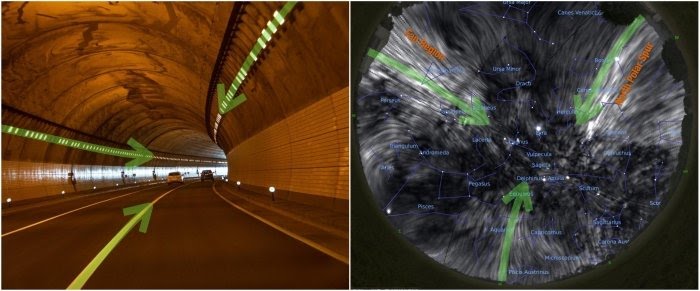
Left: what the tunnel would look like; right: what the sky does look like. (Image Credit Below)
MICHELLE STARR 15 OCTOBER 2021
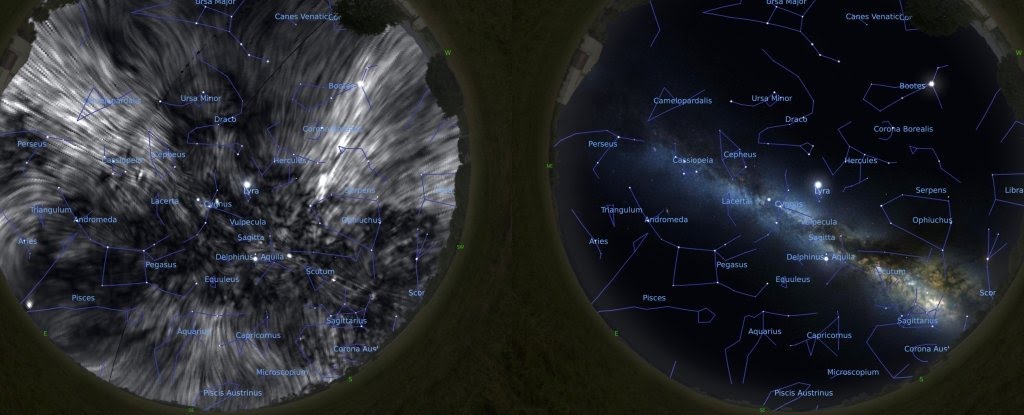
Mysterious structures in the sky that have puzzled astronomers for decades might finally have an explanation – and it’s quite something. The North Polar Spur and the Fan Region, on opposite sides of the sky, may be connected by a vast system of magnetized filaments. These form a structure resembling a tunnel that circles the Solar System, and many nearby stars besides.
“If we were to look up in the sky,” said astronomer Jennifer West of the University of Toronto in Canada, “we would see this tunnel-like structure in just about every direction we looked – that is, if we had eyes that could see radio light.”
We’ve known about the two structures for quite some time – since the 1960s, in fact – but they have been difficult to understand. That’s because it’s really hard to work out exactly how far away they are; distances have ranged from hundreds to thousands of light-years away. However, no analysis had ever linked the two structures together.
West and her colleagues were able to show that the two regions, and prominent radio loops in the space between them, could be linked, solving many of the puzzling problems associated with both. Comparison with a real tunnel showing orientation. (Left: Pixabay/wal_172619/J. West; Right: Dominion Radio Astrophysical Observatory/Villa Elisa telescope/ESA/Planck Collaboration/Stellarium/J. West)
“A few years ago, one of our co-authors, Tom Landecker, told me about a paper from 1965, from the early days of radio astronomy. Based on the crude data available at this time, the authors (Mathewson & Milne), speculated that these polarized radio signals could arise from our view of the Local Arm of the galaxy, from inside it,” West explained. “That paper inspired me to develop this idea and tie my model to the vastly better data that our telescopes give us today.”
Using modelling and simulations, the researchers figured out what the radio sky would look like, if the two structures were connected by magnetic filaments, playing with parameters such as distance to determine the best fit. From this, the team was able to determine that the most likely distance for the structures from the Solar System is around 350 light-years, consistent with some of the closer estimates. This includes an estimate for the distance of the North Polar Spur earlier this year based on Gaia data, which found that almost all of the spur is within 500 light-years.
The entire length of the tunnel modeled by West and her team is around 1,000 light-years. Light intensity of the North Polar Spur (top) and Fan Region (bottom). (West et al., arXiv, 2021) This model is in agreement with a wide range of observational properties of the North Polar Spur and Fan Region, including the shape, the polarization of the electromagnetic radiation (that is, how the wave is twisted), and the brightness.
“This is extremely clever work,” said astronomer Bryan Gaensler of the University of Toronto. “When Jennifer first pitched this to me, I thought it was too ‘out-there’ to be a possible explanation. But she was ultimately able to convince me! Now I’m excited to see how the rest of the astronomy community reacts.”
More work is needed to first confirm the findings, and then model the structure in greater detail. But doing so may help to solve an even bigger mystery: the formation and evolution of magnetic fields in galaxies, and how these fields are maintained. It could also, the researchers said, provide context for understanding other magnetic filament structures found around the galaxy. The team is planning to perform more complex modelling; but, they suggest, more sensitive, higher-resolution observations would help reveal hidden details that show how the structure fits into the broader galactic context.
“Magnetic fields don’t exist in isolation. They all must connect to each other. So a next step is to better understand how this local magnetic field connects both to the larger-scale galactic magnetic field, and also to the smaller scale magnetic fields of our Sun and Earth,” West said. “I think it’s just awesome to imagine that these structures are everywhere, whenever we look up into the night sky.” The research is due to appear in The Astrophysical Journal, and is available on arXiv.
Jocelyn Bell discovered pulsars which are very pertinent to the movement of the amino acids in the Tzolkin theme-plex’s. So far, I believe a local system planetary pulsar moves the Tone of Creation that precedes the amino acid. That will be in Part 3.
The pulsing we know of right now is between tones 1-13 and it does so in increments of 4. Whichever string of tones your personal tone is in, you are related to all the others. As you evolve you’ll pulse up to vibrate with the next tone in line. In addition, you’ll feel an affinity with kin you meet in your line just as you feel affinity with those in your birth theme-plex.
1, 5, 9, 13 (magnetic, radiant, solar, and cosmic)
2, 6, 10 (polar, rhythmic, and planetary)
3, 7, 11 (electric, resonant, and spectral)
4, 8, 12 (self-existing, galactic, and crystal)
The attributes of those tones are very telling. Each group of tones has their vibratory focus and can’t necessarily relate to the other ones.
The first group tends to be very philosophical and experienced on the planet.
The second group really push the third dimensional energy for the rest of us who have our heads in the clouds.
The third group push things to the edge until they fall apart. Think of how electricity can ramp up as lightning!
The fourth group is ascended to a mastery level ON THE PLANET. They aren’t necessarily lightworkers which is more group one who are likely humanoid. Group 4 meets humans where they are currently and shows them how to work together for the good of all even though we’re in polarizing dualism. The crystal tone 12 kin are very helpful.
This is making my Saturday. Our solar system is so amazing. Cassini did a fantastic job for humanity. I am grateful.
Saturn mediates alanine and histidine in our evolving bodies; Blue Night (today) and Yellow Warrior. Saturn is the ruling planet of Capricorn in astrology.
Energy = mass x the speed of light squared The speed of light in a vacuum is 186,282 miles per second (299,792 kilometers per second), and in theory nothing can travel faster than light.
In miles per hour, light speed is, well, a lot: about 670,616,629 mph. If you could travel at the speed of light, you could go around the Earth 7.5 times in one second. It’s pretty simple to plug in numbers. Let’s do it backwards so we come up with the sum of E (energy) at the end.
150 pounds (mass) x 186,282mps (the speed of light)^2 = 6.11502737 × 10¹⁸ joules of energy (E) which is about 6.1 trillion joules of energy. We could just say 6.1 trillion photons or particles of light. I wonder if a gamma ray has 6.1 trillion photons?
The joule is a derived unit of energy in the International System of Units. It is equal to the energy transferred to an object when a force of one newton acts on that object in the direction of the force’s motion through a distance of one meter. So the energy of a 150 pound woman traveling at the speed of light around the earth is 6.1 trillion particles of light.
Now let’s plug it in. 6.1 trillion light particles = 150 pounds x 186,282mps ^2 E = m c 2
How are you going to get your bod to go at the speed of light? Go to the time portal on the planet that lines up with your DNA and time travel to your destination?
My hypothetical equation is E=mtd^2.
Energy = 3DMass of your body (density x volume = mass) x speed of time (DNA)^2.
Time is the quantity of light particle motion. Is DNA the quantity of light particle motion? Or is DNA the outcome of a certain quantity and formation of light particle motion that ends up looking like us? Our quantity of Energy as light came out to 6.1 trillion mps.
I don’t know. I’m just goofing around. I really do think the Theory of Relativity applies directly to the movement of our DNA AS Time. Einstein’s theory of special relativity says that time slows down or speeds up depending on how fast you move relative to something else. The effects of gravity, as well as the satellites’ increased speed above the Earth relative to observers on the ground (who are made of DNA) made the unadjusted clocks gain 38 microseconds.
We need to think in a new way about the nature of Time and DNA and check it in the lab. I’m looking for someone to help me with that.
It says in this article that the super-liminal gamma ray jets may be responsible for time-reversal. OR…is change of direction of TIME responsible for the existence of the super-liminal gamma ray jets?
NOTE: Superliminal means of or pertaining to, or involving, conscious awareness; above the threshold of the subconscious.
This article just came out today. This post ties directly the one I wrote RIGHT BEFORE IT. I was pondering the contents of that post a month ago, before this came out yesterday. The gist is, I thought that it was possible to go faster than the speed of light in a vacuum also.
I thought of this and wrote it two weeks ago.
If the dimensions are unified then the curvature of space could change the speed of light which would change the speed of time. Hypothetically the speed of time could go faster than the speed of light because the dimensions are unified, and the curvature of space-time allows for a shortcut, thus time travel.
Time dilation. Time is relative to the position of the DNA form. A kin is a person and a day. What we really are is pure Mind focused with intention not just a blob of DNA.
This came out yesterday; I quote the article below.
NOTE**Gamma-ray bursts are extremely energetic explosions that have been observed in distant galaxies. They are the brightest and most energetic electromagnetic events known to occur in the universe. Bursts can last from ten milliseconds to several hours.
Astrophysicists propose that gamma-ray bursts may exceed the speed of light.
The superluminal jets may also be responsible for time-reversibility.
The finding doesn’t go against Einstein’s theory because this effect happens in the jet medium not a vacuum.
According to Einstein’s theory of general relativity, nothing can travel faster than the speed of light in a vacuum. Yet in space many strange things happen, including a new proposal by two astrophysicists that blasts creating bursts of gamma rays may be able to speed up faster than light, going superluminal. Yet, this research by the astrophysicists Jon Hakkila of the College of Charleston and Robert Nemiroff of the Michigan Technological University is not going against Einstein’s theory. What the scientists found is that while these bursts surpass the speed of light in surrounding gas clouds, that only happens in the jet mediums, not in a vacuum. The astrophysicists also think that these superluminal jets can create the time-reversibility that can be observed in gamma-ray burst light curves.
Black-hole-powered galaxies called blazars are the most common sources detected by NASA’s Fermi Gamma-ray Space Telescope. Jon Hakkila likens what they found to skipping stones across the pond. If someone was to throw such a stone into the water towards you, the stone would go through the air in between hops faster than the waves that it causes are moving through the water. As it gets closer, you will see the waves that are produced by each skip in reverse order. The most recently created ones will get to you first and those from the early skips along the water would come last. “Standard gamma-ray burst models have neglected time-reversible light curve properties,” Hakkila explained. “Superluminal jet motion accounts for these properties while retaining a great many standard model features.”
Check out the new paper here, published in The Astrophysical Journal.
You must be logged in to post a comment.