Protected: Time Innovation: Decoding the Harmonic Time Cycles of the Sun
Subscribe to continue reading
Become a paid subscriber to get access to the rest of this post and other exclusive content.
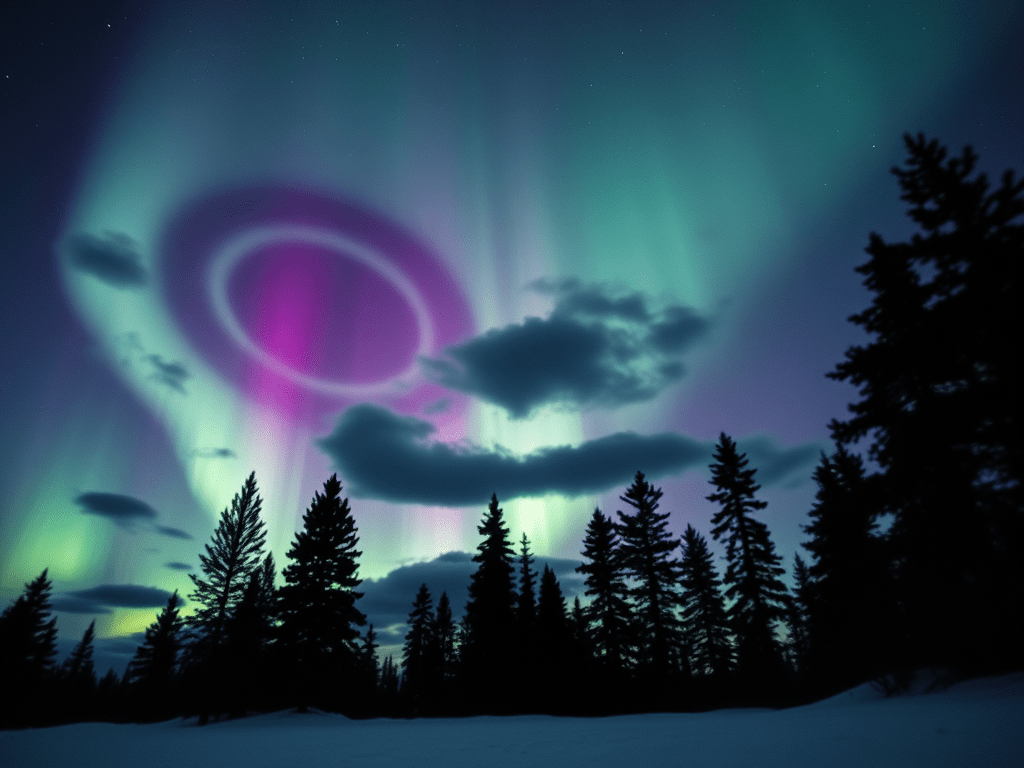
Time Innovation: What are Black Auroras? Anti-Auroras Explained
On Nov. 22, Yellow 10 Sun, End of the Central Axis. Electrons went up into Space Backward. Read the explanation below. They are called anti-auroras. That is exact synchronicity with HF35. The IChing is 49-Revolution, Molting, where we landed on November22-23.
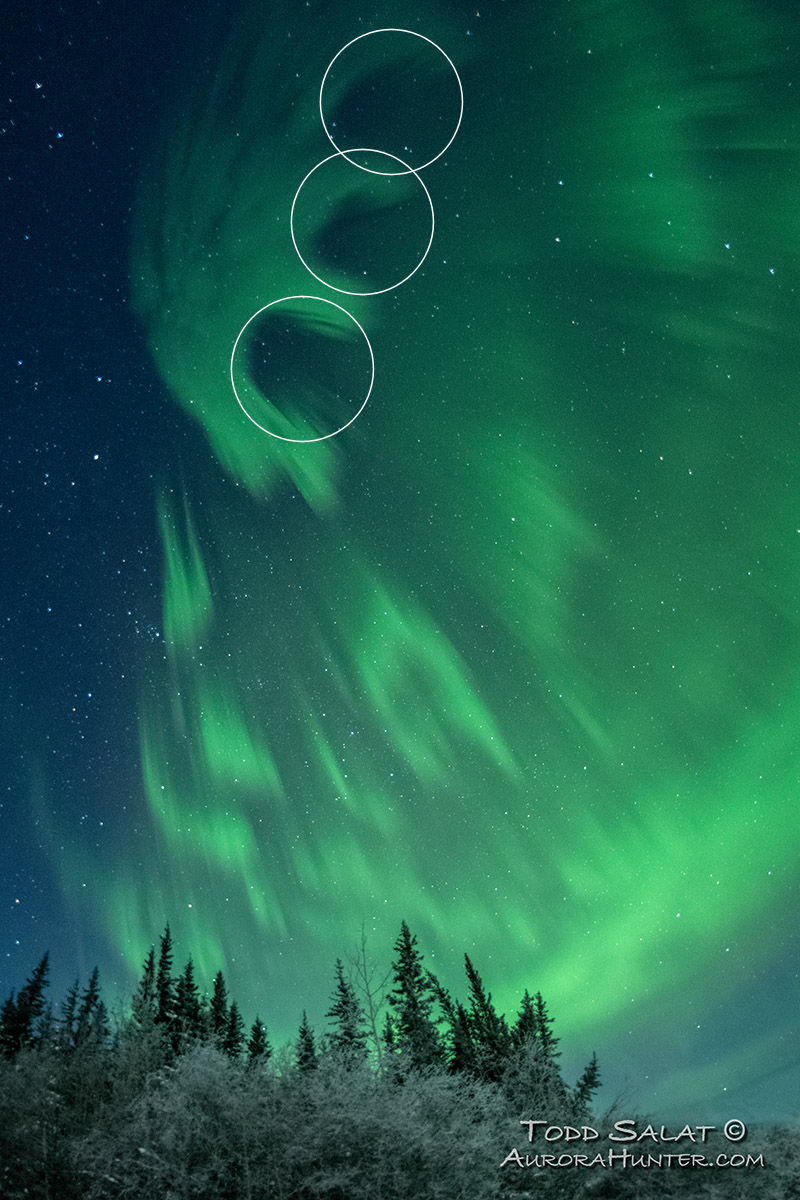
BLACK AURORAS OVER ALASKA? Todd Salat is a veteran photographer of auroras in Alaska. For years he has chased the lights and seen most of what Mother Nature has to offer. But even he was puzzled on Nov. 22nd when these strangely-shaped auroras appeared overhead:
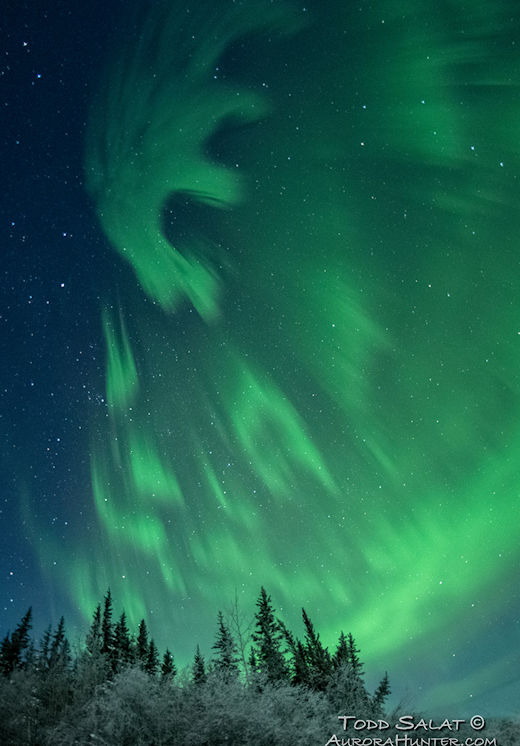
“I saw these bizarre auroras drift over south central Alaska around 4 am last Friday morning,” says Salat. “It came up from the northwest and I was like, whoa! It looked like the letter E to me.”
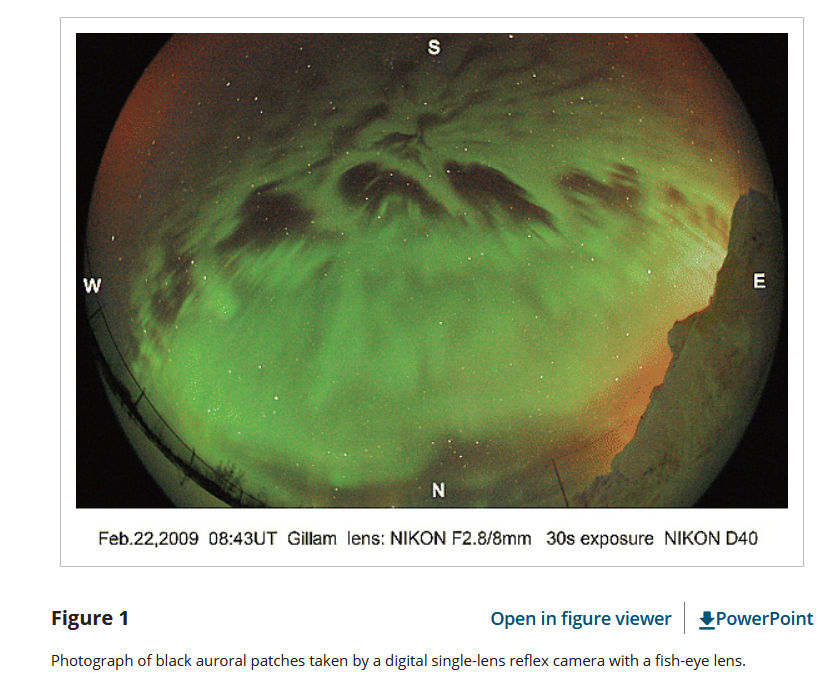
Salat may have witnessed an episode of ‘black auroras.’ They are dark rings or black blobs that sometimes appear in an otherwise ordinary expanse of aurora light. For example, look at Figure 1 in this research paper on the topic. Some researchers call them “anti-auroras.” The black auroras in Salat’s photo are circled here.
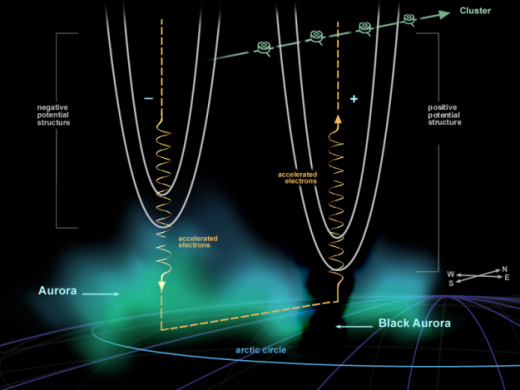
Ordinary auroras are caused by electrons raining down from space. Black auroras are the opposite. Instead of electrons raining down, electrons are propelled upwards back into space. Europe’s fleet of Cluster spacecraft flew over a black aurora on Jan. 14, 2001, and saw the process in action:
(The next day was Red 11 Spectral Dragon in HF36. This was THE OMEGA POINT or ending point. The I Ching was 33 or RETREAT. I wrote in my Tzolkin that it pulses to 1 Mirror, Bohm’s holographic plate in HF30 for holomovement. This synchronicity of astronomical movement is EXACT.)
Sensors onboard the spacecraft detected strong positive electric fields in the black aurora zone. These fields reversed the normal downward rain of aurora-causing electrons.
The study of black auroras is still in its infancy. Forecasters cannot yet predict when or where they might appear. Aurora watchers, the next time a geomagnetic storm erupts, be alert for black. Aurora alerts: SMS Text.
Realtime Space Weather Photo Gallery
Free: Spaceweather.com Newsletter
Daily Oracle:Triboluminescence: The Blue Avalanche Phenomenon
Nice synchronicity with Crystal Tone 12 today on the Blue Avalanche article.
SOMETHING FLARE-Y THIS WAY COMES: Yesterday, a sunspot hidden behind the sun’s northeastern limb produced an M9-(almost-X)-class solar flare. Today, the same sunspot is revealing itself, right here. It is clearly capable of strong explosions, which may become geoeffective as the sunspot turns toward Earth later this week. Solar flare alerts: SMS Text
BLUE AVALANCHE LIGHTS IN CHINA: This might be something new. On the night of Oct. 27th, Chinese astrophotographer Shengyu Li set up his camera to record star trails over Mount Xiannairi in Sichuan, China. The long exposure had just begun when an icy serac broke free from a hanging glacier. Note the blue flashes within the ensuing avalanche:
“We have not found any previously documented cases of such an event. This discovery is thrilling for us. It is also intriguing,” says Li. “Our initial hypothesis is that the luminescence may result from friction-induced lighting during the fragmentation of ice.”
The phenomenon is called “triboluminescence.” Legendary physicist Richard Feynman describes it effectively. He said, “Take a lump of sugar. Crush it with a pair of pliers in the dark. You can see a bluish flash.”Some other crystals do that too. Nobody knows why.” You can create triboluminescent flashes yourself by smashing Lifesavers.
The avalanche Li witnessed was rich in ice. “A blocky serac started it,” says Carson Reid, a mountaineer who analyzed Li’s movie. “It randomly calved from a glacier near the mountain’s peak.” “The serac would have fragmented as it tumbled down and smashed into natural obstacles.” The most significant “smash points” seem to have produced the most blue light.
Li shared his movie with other astrophographers in China. One of them found a similar blue flash in footage of a completely different mountain in Xinjiang, China three weeks earlier:
“This is a timelapse video taken by Ms. Lu Miao on Oct. 3rd,” says Li. “It also shows a blue flash during an avalanche.” The mountain is Muztagh Ata, which means “Iceberg Father” in English.
“None of us photographers noticed the blue light with our naked eyes. We discovered it later when reviewing the photos,” says Li. “However, I asked some friends who frequently photograph snow-capped mountains. One of them mentioned seeing blue light with the naked eye during an avalanche. They didn’t capture it on camera.”
Readers, are you aware of this phenomenon? We would welcome references to earlier sightings and/or documented research. Let us know!
Realtime Space Weather Photo Gallery
Free: Spaceweather.com Newsletter