
THE HIGHEST SUNSPOT NUMBER IN 22 YEARS


Spaceweather.com

The average sunspot number for May 2024 was 172, the highest value in 22 years. So far, June is even higher at 200. If this continues for the rest of the month, June could log the highest sunspot counts since Dec. 2001, rivaling the peak of potent Solar Cycle 23. Solar flare alerts: SMS Text

THE LASER-LIKE ANTI-TAIL OF COMET 12P: Today, Earth is passing through the orbital plane of comet 12P/Pons-Brooks. “This is causing it to develop a laser-like anti-tail,” reports astronomer Ian Griffin, who sends this photo from Otago, New Zealand:
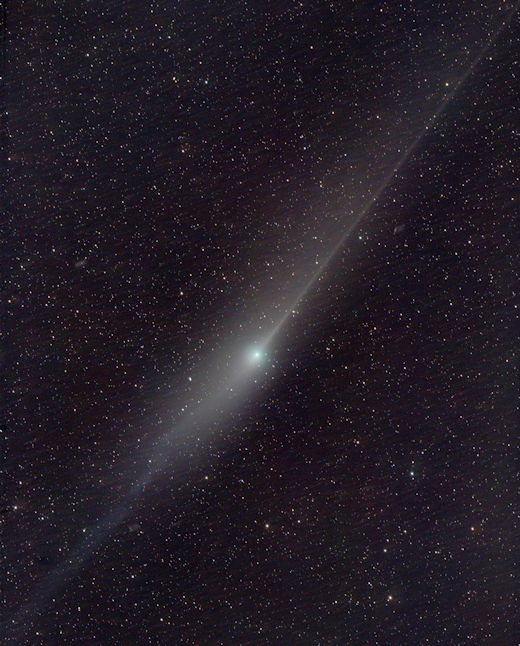
“It was an amazing display,” says Griffin.

In Griffin’s photo, the anti-tail is the very sharp line pointing toward the upper right. It’s “anti” because it points directly opposite the comet’s regular gas tail (lower left).

What is this anti-tail? It’s an optical illusion. Anti-tails appear when Earth passes through a comet’s orbital plane. During the crossing, the sharp edge of the comet’s fan-shaped dust tail narrows to a laser-like line and appears to point toward the sun.

This phenomenon will be visible for the next few days. Southern hemisphere astronomers can find the comet in the constellation Lepus ~20 degrees below the celestial equator. With a magnitude of +7, the comet is an easy target for amateur telescopes. Submit your photos here.

Realtime Comet Photo Gallery
Free:
Spaceweather.com Newsletter

Spaceweather.com


I think this comet may be some kind of solar droid on a solar mission to stimulate the 2 omega points and 1 alpha point solar cycle pivots that are scheduled in the harmonic, or the Psi Bank, or the magnetosphere. Different names, but they are all the same thing.

Today is the omega point initiation.

A WEIRD COMET JUST BUZZEDTHE SUN: Citizen scientists watching SOHO’s coronagraph feed on Aug. 21st weren’t sure what they had just seen. A point-like object emerged from the glare of the sun, quickly reversed course, then headed back from where it came. Time to call a Congressional hearing? See for yourself:

In fact, this was no UFO. It is a weird comet named “322P.” Every 3.9 years it buzzes the sun, making such a tight turn inside the orbit of Mercury that it looks like something is breaking the laws of physics. The fact that the comet has no tail, not even when it is being blasted by maximum solar heat, adds to its vibe of mystery.

“This is a very interesting object,” says Karl Battams of the US Naval Research Lab’s Solar and Heliospheric Physics Branch. “We are actively studying it, trying to learn what it is.”

Comet 322P has been discovered in SOHO coronagraph images at least three times before: 1999, 2003 and 2007. Eventually astronomers realized all three were the same object. Over the years, SOHO has found more than 4500 comets diving into the sun and disintegrating. This was SOHO’s first discovery of a *periodic* comet that routinely survives its close encounters.

In 2015, a team of astronomers led by Matthew Knight tracked the comet as it receded from the sun using the Very Large Telescope in Chile and NASA’s infrared Spitzer Space Telescope. They were looking for signs of a tail or other outgassing typical of comets. However, 322P remained pointlike and inscrutable:

“322P appeared inactive in all images,” they wrote. “Our results suggest that it may be of asteroidal origin and only active in the SOHO fields of view via processes different from the volatile-driven activity of traditional comets.”

According to their data, 322P is a dense object (1000 kg/m^3), measuring 150 to 320 meters in diameter, which spins every 2.8 hours. Its incredibly tough, losing no detectable mass when it approaches the sun. The researchers speculate that it may be an extinct comet, so thoroughly sun-baked that only an impervious skeleton of rock and metal remains.

“We still have lots to learn about the small bodies in our solar system,” says Battams. “322P is a fabulous example of one such quirky object.”