
I don’t know about the quality of this. YouTube is probably censoring me because I’m talking about empowerment and being positive. That certainly goes against the narrative right now. But maybe you’ll see this clearly. I decided to do this spur of the moment.
The E.T. Are Heavily Monitoring Countries With Nukes
I feel it very strongly. They are enforcing the agreement with the Earth Keepers that was agreed to when humans came here as refugees from Maldek. I believe this tension between the government, their people, and the E.T. are raising the Schumann Resonance.
No nuclear weapons allowed again. The GGLN (Global Galactic League of Nations) has the authority to shut them down to protect the Cosmic Web. They’ve already done it previously.
Frankly, most G7 countries have no reason for being on earth if they can’t play with their bombs, decimate the planet, enslave the human race, eat humans as Reptilian snack, and turn it into a machine world. I think it’s time for them to leave so we can clean things up and have a life…WITHOUT THEM.
Ciao baby…anytime now.
The Cosmic Web Orchestrates the Progression of Galaxies
by Sarah Perrin, Ecole Polytechnique Federale de Lausanne
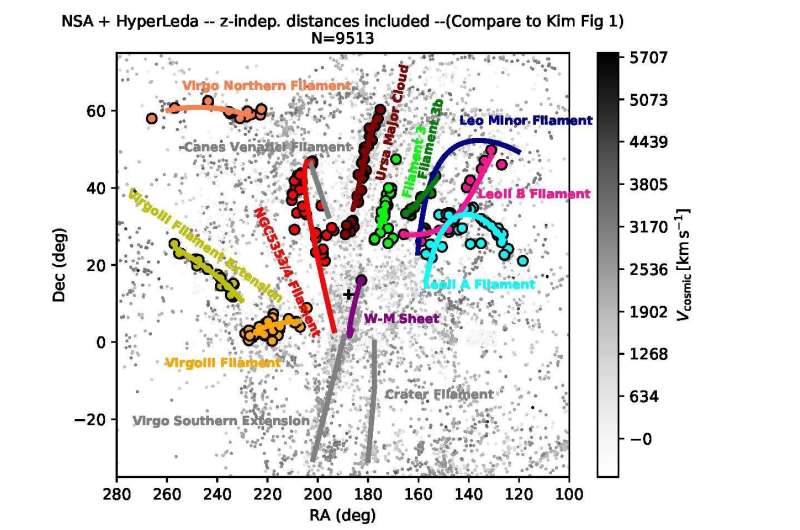
The shape of galaxies and how they evolve depending on a web of cosmological filaments that run across the universe. According to a recent study headed by EPFL’s Laboratory of Astrophysics, this cosmic web plays a much bigger role than previously thought.
Across the universe, galaxies are distributed along what’s called the cosmic web, a complex network of filaments made up of ordinary and dark matter. And where those filaments intersect, galaxy clusters—collections of hundreds or even thousands of galaxies bound to each other by the force of gravity—tend to form. They are the biggest and densest clusters in the universe and are the subject of much research by astrophysicists. But precisely how filaments contribute to galactic evolution is still poorly understood.
To get deeper insight, an international team of scientists led by Prof. Pascale Jablonka and Gianluca Castignani from EPFL’s Laboratory of Astrophysics (LASTRO) examined the vast environment surrounding Virgo, a representative cluster in the local universe. It contains some 1,500 galaxies and is located around 65 million light-years away from our own galaxy, the Milky Way. The team’s findings have been published in two articles: one appearing in Astronomy & Astrophysics this past January and the other in Astrophysical Journal last fall.
“Many properties of galaxies, like their morphology, gas content, and star formation rate, are directly influenced by their environment,” says Jablonka. “We know that galaxies form fewer stars in very dense environments and adopt a more elliptical shape. But the exact role that filaments play in this transformation is still not clear. That’s what we wanted to investigate with our research.”
The scientists analyzed the properties of galaxies located around the Virgo cluster, across a region spanning 12 times the radius of the main cluster. Theirs is the largest study conducted to date on this topic and covers a sample size of some 7,000 galaxies, including 250 that are big enough for scientists to be able to precisely estimate their gas content—and especially the amount of cold, dense atomic hydrogen that stars are made out of. Measurements were taken using the decametric radio telescope in Nançay, France, and the IRAM-30m telescope in Pico Veleta, Spain.
A transitional environment
By combining the new data they collected with measurements from the literature, the scientists found that the properties of galaxies—namely, their shape, star formation rate, gas content, and the age and metal content of their stars—clearly change as the galaxies progress from more isolated positions towards filaments and eventually into clusters.
Filaments, therefore, seem to serve as a transitional environment where galaxies are pre-processed before falling into a cluster. In this environment, star formation slows or even stops altogether, elliptical shapes appear more frequently, and there is less atomic and molecular hydrogen, indicating that the galaxies are reaching the end of their active life. The scientists observed that a galaxy’s evolution through its life cycle corresponds to the local galaxy density: galaxies producing few or no stars made up less than 20% of the sample of isolated galaxies, but they accounted for 20–60% of galaxies in the filaments and some 80% of galaxies in the Virgo cluster. These findings open up new avenues of research on theories to explain galaxy formation and how galaxies evolve in tandem with major cosmic bodies.
Journal information: Astrophysical Journal , Astronomy & Astrophysics
Provided by Ecole Polytechnique Federale de Lausanne
Protected: The Cosmic Web Orchestrates the Progression of Galaxies-Ed Level Advanced
Astronomers Have Evidence That Our Solar System is a Magnetic Tunnel
Corey Goode told us this 6 years ago from observing off-planet portal systems and the cosmic web.
SPACE Wild New Paper Claims Earth May Be Surrounded by a Giant Magnetic Tunnel
Corey Goode posted this article on LinkedIn this morning.
“Who else thinks this sounds a lot like my 20-and-Back testimony from my movie ABOVE MAJESTIC where I described how the Galactic Portal System worked? These electromagnetic filaments ultimately connect to the Cosmic Web. CG:
Wild New Paper Claims Earth May Be Surrounded by a Giant Magnetic Tunnel -“
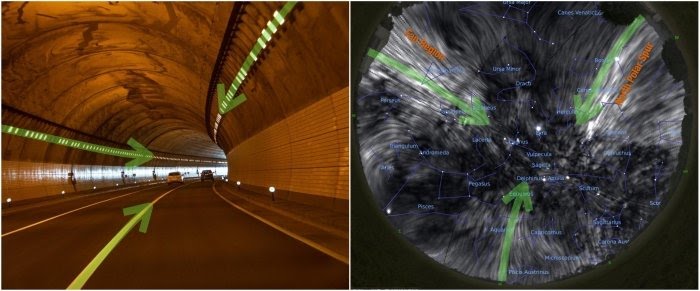
Left: what the tunnel would look like; right: what the sky does look like. (Image Credit Below)
MICHELLE STARR 15 OCTOBER 2021
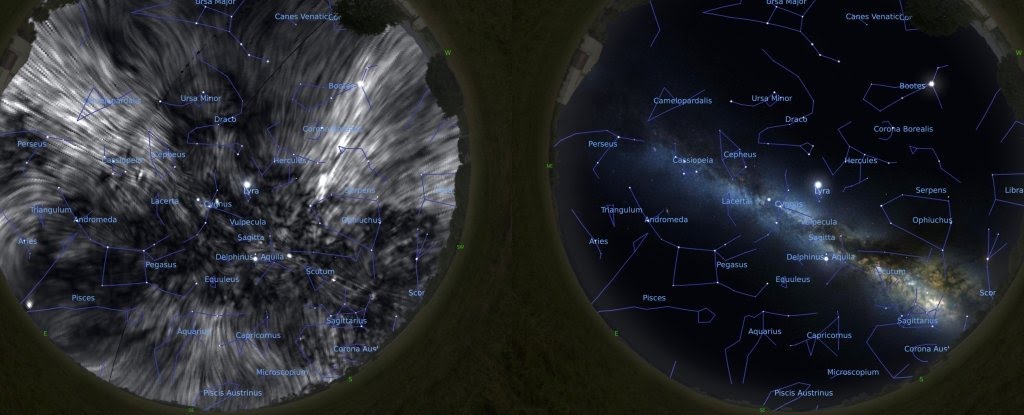
Mysterious structures in the sky that have puzzled astronomers for decades might finally have an explanation – and it’s quite something. The North Polar Spur and the Fan Region, on opposite sides of the sky, may be connected by a vast system of magnetized filaments. These form a structure resembling a tunnel that circles the Solar System, and many nearby stars besides.
“If we were to look up in the sky,” said astronomer Jennifer West of the University of Toronto in Canada, “we would see this tunnel-like structure in just about every direction we looked – that is, if we had eyes that could see radio light.”
We’ve known about the two structures for quite some time – since the 1960s, in fact – but they have been difficult to understand. That’s because it’s really hard to work out exactly how far away they are; distances have ranged from hundreds to thousands of light-years away. However, no analysis had ever linked the two structures together.
West and her colleagues were able to show that the two regions, and prominent radio loops in the space between them, could be linked, solving many of the puzzling problems associated with both. Comparison with a real tunnel showing orientation. (Left: Pixabay/wal_172619/J. West; Right: Dominion Radio Astrophysical Observatory/Villa Elisa telescope/ESA/Planck Collaboration/Stellarium/J. West)
“A few years ago, one of our co-authors, Tom Landecker, told me about a paper from 1965, from the early days of radio astronomy. Based on the crude data available at this time, the authors (Mathewson & Milne), speculated that these polarized radio signals could arise from our view of the Local Arm of the galaxy, from inside it,” West explained. “That paper inspired me to develop this idea and tie my model to the vastly better data that our telescopes give us today.”
Using modelling and simulations, the researchers figured out what the radio sky would look like, if the two structures were connected by magnetic filaments, playing with parameters such as distance to determine the best fit. From this, the team was able to determine that the most likely distance for the structures from the Solar System is around 350 light-years, consistent with some of the closer estimates. This includes an estimate for the distance of the North Polar Spur earlier this year based on Gaia data, which found that almost all of the spur is within 500 light-years.
The entire length of the tunnel modeled by West and her team is around 1,000 light-years. Light intensity of the North Polar Spur (top) and Fan Region (bottom). (West et al., arXiv, 2021) This model is in agreement with a wide range of observational properties of the North Polar Spur and Fan Region, including the shape, the polarization of the electromagnetic radiation (that is, how the wave is twisted), and the brightness.
“This is extremely clever work,” said astronomer Bryan Gaensler of the University of Toronto. “When Jennifer first pitched this to me, I thought it was too ‘out-there’ to be a possible explanation. But she was ultimately able to convince me! Now I’m excited to see how the rest of the astronomy community reacts.”
More work is needed to first confirm the findings, and then model the structure in greater detail. But doing so may help to solve an even bigger mystery: the formation and evolution of magnetic fields in galaxies, and how these fields are maintained. It could also, the researchers said, provide context for understanding other magnetic filament structures found around the galaxy. The team is planning to perform more complex modelling; but, they suggest, more sensitive, higher-resolution observations would help reveal hidden details that show how the structure fits into the broader galactic context.
“Magnetic fields don’t exist in isolation. They all must connect to each other. So a next step is to better understand how this local magnetic field connects both to the larger-scale galactic magnetic field, and also to the smaller scale magnetic fields of our Sun and Earth,” West said. “I think it’s just awesome to imagine that these structures are everywhere, whenever we look up into the night sky.” The research is due to appear in The Astrophysical Journal, and is available on arXiv.
Cover image credit: Dominion Radio Astrophysical Observatory/Villa Elisa telescope/ESA/Planck Collaboration/Stellarium/J. West © ScienceAlert US LLC. All rights reserved
The Life Sciences Exist in the Cosmic Web
Time is the strands of past and future in our DNA, not the hands of time on a clock




 Synchronicity is the Source of Consciousness
You must be logged in to post a comment.