Protected: Time Innovation: Sound to Light-A Section From “The Tones of Creation”; The Psi Bank


Synchronicity is the Source of Consciousness
Time is the strands of past and future in our DNA, not the hands of time on a clock
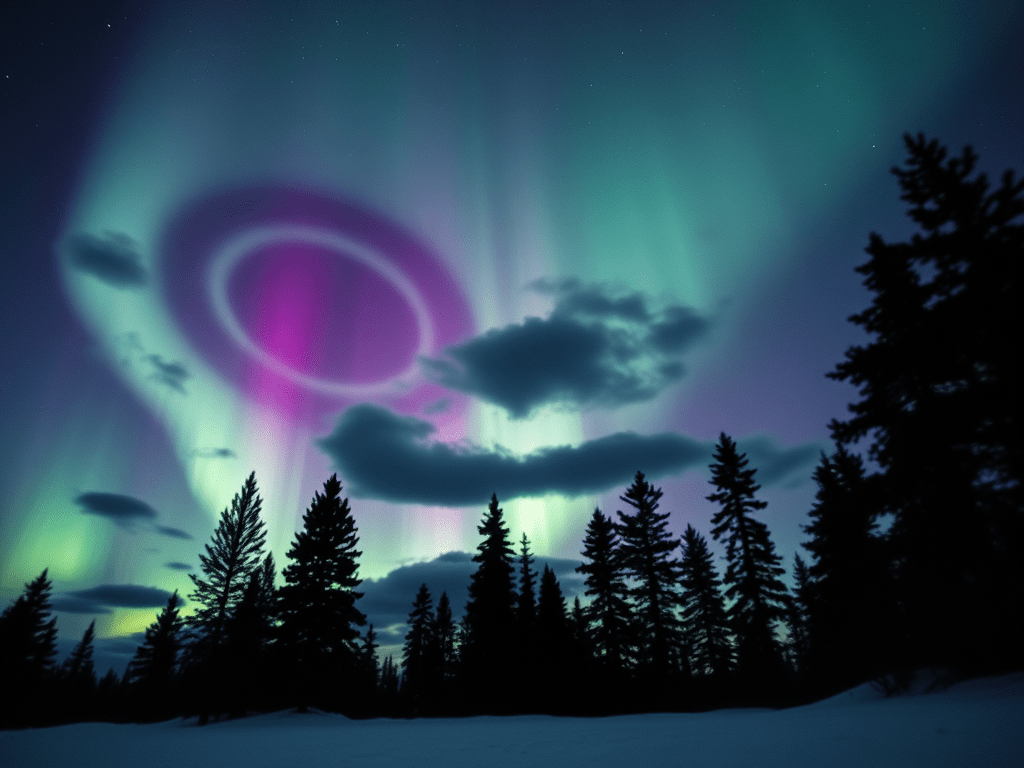
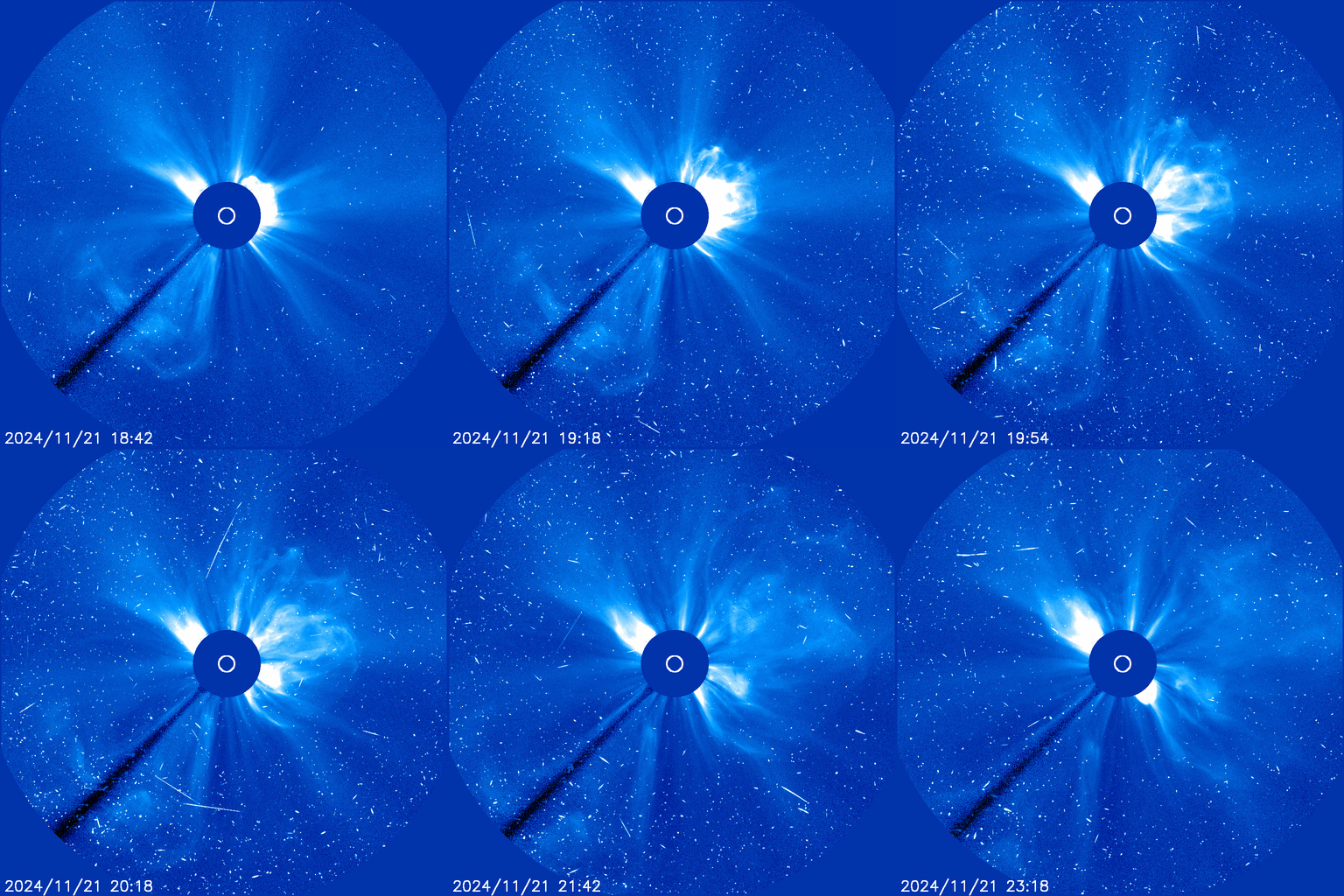
On Nov. 22, Yellow 10 Sun, End of the Central Axis. Electrons went up into Space Backward. Read the explanation below. They are called anti-auroras. That is exact synchronicity with HF35. The IChing is 49-Revolution, Molting, where we landed on November22-23.
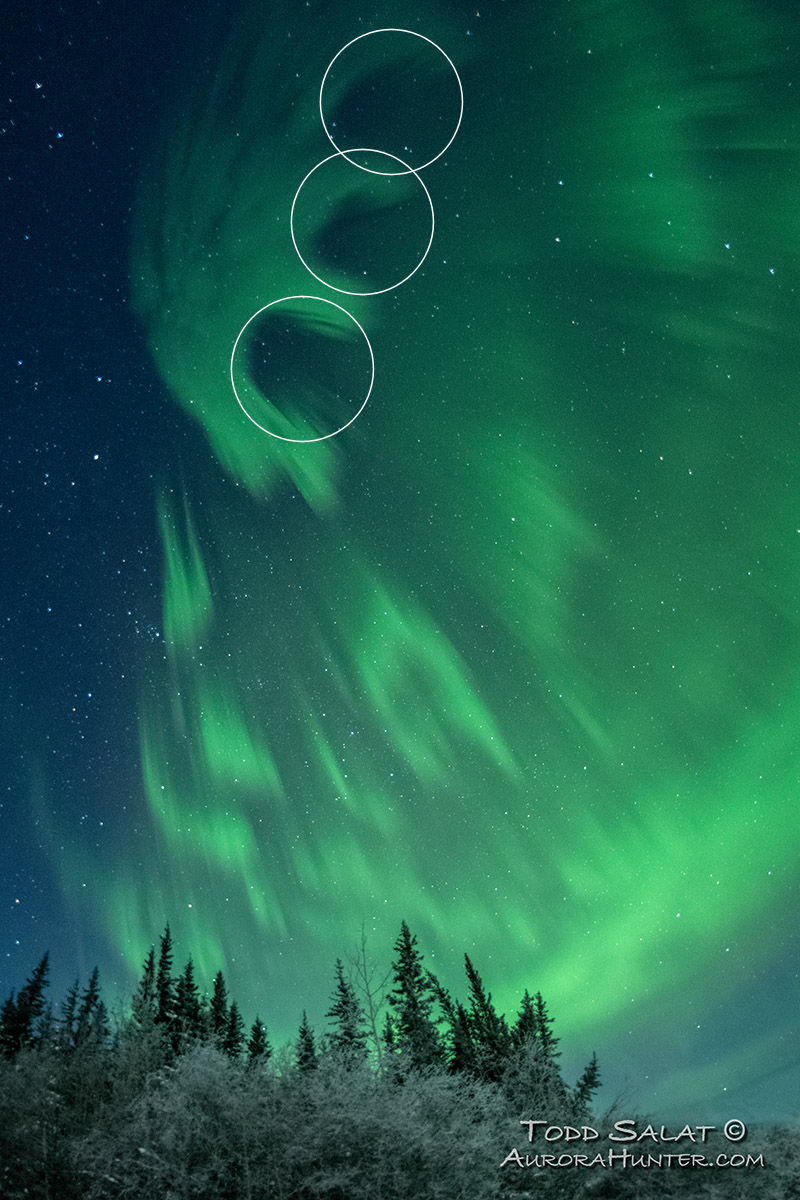
BLACK AURORAS OVER ALASKA? Todd Salat is a veteran photographer of auroras in Alaska. For years he has chased the lights and seen most of what Mother Nature has to offer. But even he was puzzled on Nov. 22nd when these strangely-shaped auroras appeared overhead:
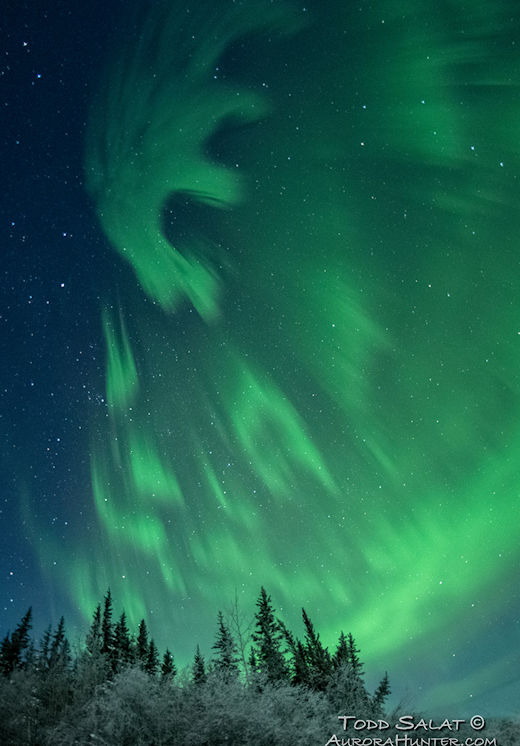
“I saw these bizarre auroras drift over south central Alaska around 4 am last Friday morning,” says Salat. “It came up from the northwest and I was like, whoa! It looked like the letter E to me.”
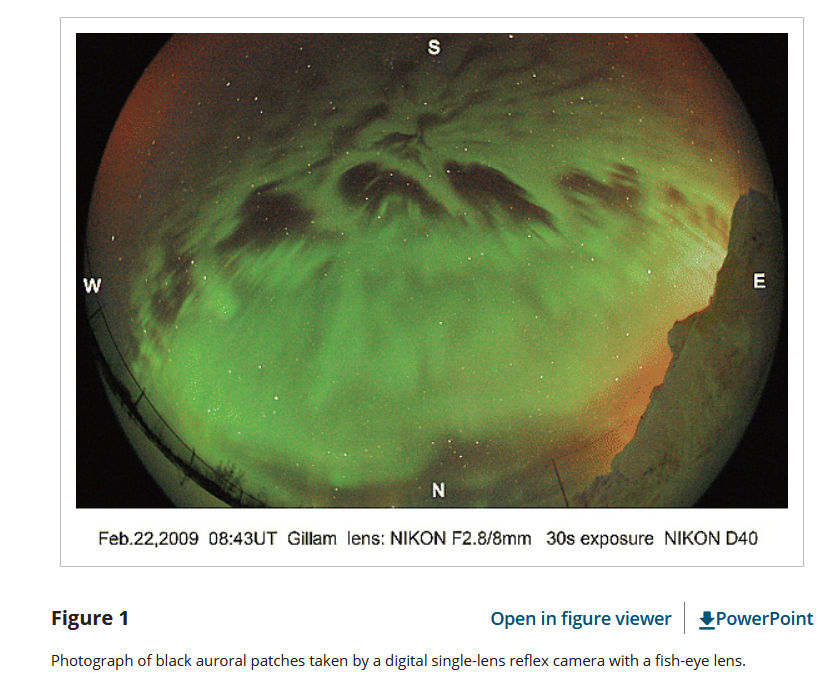
Salat may have witnessed an episode of ‘black auroras.’ They are dark rings or black blobs that sometimes appear in an otherwise ordinary expanse of aurora light. For example, look at Figure 1 in this research paper on the topic. Some researchers call them “anti-auroras.” The black auroras in Salat’s photo are circled here.
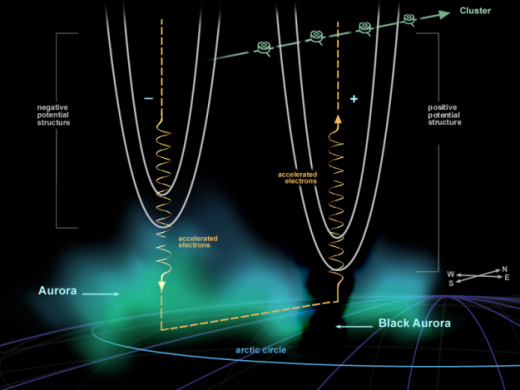
Ordinary auroras are caused by electrons raining down from space. Black auroras are the opposite. Instead of electrons raining down, electrons are propelled upwards back into space. Europe’s fleet of Cluster spacecraft flew over a black aurora on Jan. 14, 2001, and saw the process in action:
(The next day was Red 11 Spectral Dragon in HF36. This was THE OMEGA POINT or ending point. The I Ching was 33 or RETREAT. I wrote in my Tzolkin that it pulses to 1 Mirror, Bohm’s holographic plate in HF30 for holomovement. This synchronicity of astronomical movement is EXACT.)
Sensors onboard the spacecraft detected strong positive electric fields in the black aurora zone. These fields reversed the normal downward rain of aurora-causing electrons.
The study of black auroras is still in its infancy. Forecasters cannot yet predict when or where they might appear. Aurora watchers, the next time a geomagnetic storm erupts, be alert for black. Aurora alerts: SMS Text.
Realtime Space Weather Photo Gallery
Free: Spaceweather.com Newsletter
That means all life on the surface was affected by the sun, it stands to reason. This is a no-brainer. Unless you don’t consider yourself alive, even though you are. Humans are electromagnetic inherently.-L.T.
(In my office, my QI pen won’t operate unless I have my hand on the patient’s body while holding the pen. That proves it. We all have natural electromagnetism in our bodies, give it off and draw it in when it’s rife in the ambient air around us as it was during the solar storm.)
Across the USA on May 10th and 11th, sky watchers marveled at bright displays of aurora borealis during the biggest geomagnetic storm in decades. Little did they know, something was also happening underfoot. (Not just underfoot. Why would it just be underfoot?)
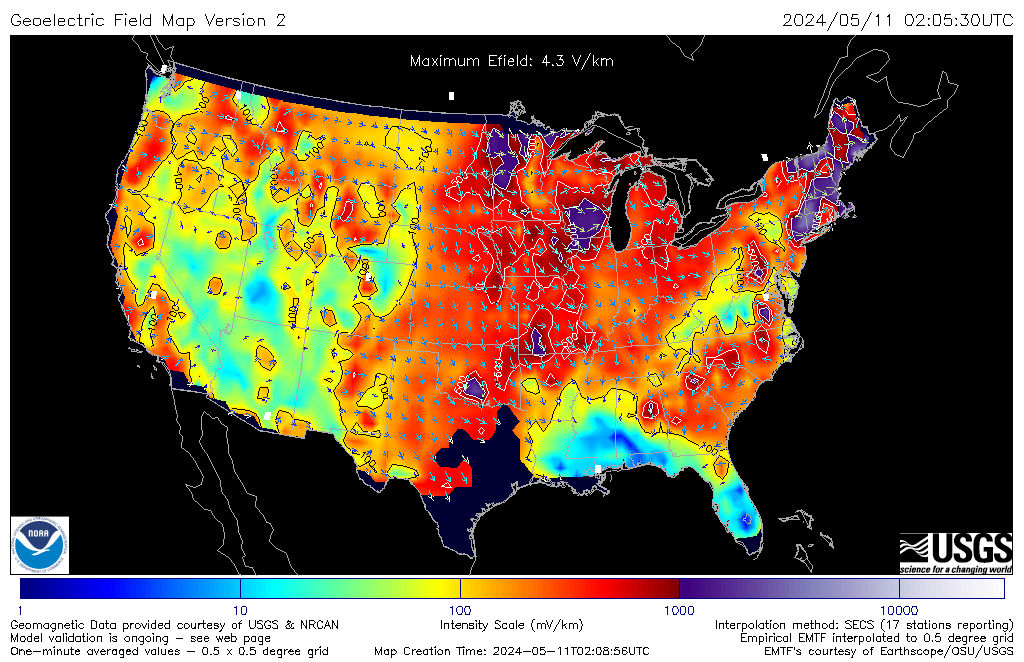
Strong electrical currents were surging through rocks and soil (all life if you bother to check). The biggest voltages along the US eastern seaboard and in the Midwest were as much as 10,000 times normal. A map from NOAA and the US Geological Survey shows some of the ‘hot spots’ during the early hours of May 11th:
Back in March 1989, voltages only a little stronger than the ones shown above brought down the entire Hydro-Québec power system. The resulting Great Québec Blackout plunged millions of Canadians into darkness.
This time, however, power grids stayed up. “We haven’t heard of any serious problems so far,” reports Christopher Balch of NOAA’s Space Weather Prediction Center.
Balch leads an effort at NOAA to model geoelectric fields during solar storms. The map, above, is a snapshot from a real-time display that takes into account the 3D conductivity of the Earth and ongoing geomagnetic activity. A computer at the Space Weather Prediction Center crunches the data to produce minute-by-minute estimates of electricity in the ground.
“I started working on this in 2011 after a NOAA Space Weather Workshop where representatives from the power industry asked for a geoelectric field model,” recalls Balch. “It’s a collaboration between NOAA, the US Geological Survey and others; we now have a version that covers much of Canada and the United States.”
A power blackout (left) and transformer damage (right) during the March 1989 storm.
When researchers talk about geoelectric fields they use units of volts per km (V/km). Earth’s crust naturally contains quiet-time fields measuring as little as 0.01 V/km. During geomagnetic storms, these values skyrocket.
“On May 10-11, geoelectric amplitudes exceeded 10 V/km in Virginia and 9 V/km in the upper Midwest,” says Jeffrey Love, a key member of the collaboration at the USGS. “These are very high. For comparison, we estimate that geoelectric amplitudes reached almost 22 V/km in Virginia during the March 1989 storm.”
This means the May 2024 storm was, electrically speaking, about half as intense as the storm that blacked out Québec 35 years ago. That’s too close for comfort. “Although power companies have taken measures to improve the resilience of their systems, no one would welcome another storm as intense as that of March 1989,” says Love.
Real time electric field maps are published 24/7 on the NOAA website. During the next geomagnetic storm, click here to see what’s happening underfoot!
THESE RED LIGHTS ARE NOT AURORAS: Last Sunday, March 3rd, a CME hit Earth’s magnetic field. The surprisingly strong impact sparked a G2-class geomagnetic storm with bright auroras around the Arctic Circle. Upon closer inspection, however, not all of those lights were auroras. Some were “SAR arcs”:
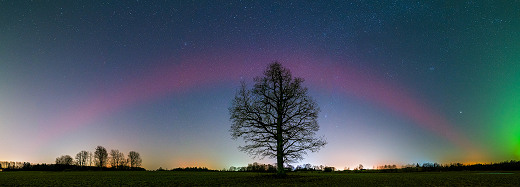
During the storm, Märt Varatu photographed this red ‘bow over Kiia küla, Estonia. “It was a strong SAR arc,” he says.
SARs were discovered in 1956 at the beginning of the Space Age. Researchers didn’t know what they were and unwittingly gave them a misleading name: “Stable Auroral Red arcs” or SARs. In fact, they are not auroras.
Auroras appear when charged particles rain down from space, hitting the atmosphere and causing it to glow like the picture tube of an old color TV. SARs form differently. They are a sign of heat energy leaking into the upper atmosphere from Earth’s ring current system, a donut-shaped circuit carrying millions of amps around our planet. During the geomagnetic storm of March 3rd, this ring current sprang a significant leak. (That is the AMPLITUDE layer of the ScR. It could be supporting the C1 Cosmic layer to appear that pluses with Tone13.-LT)
The same red arcs were widely observed from Latvia to eastern Russia. Vladimir Nerush photographed this fragment just east of Moscow:
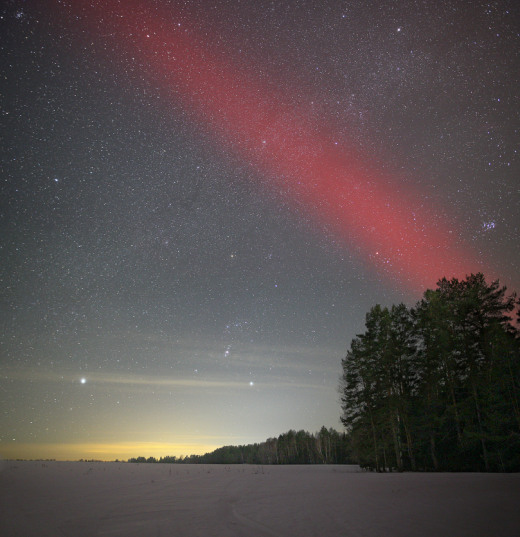
“It emerged from the trees and passed right by the Pleiades,” says Nerush. “The red color was so pure.”
Indeed, SAR arcs are among the reddest things in the sky, with a monochromatic glow at 6300 Å that comes from atomic oxygen in the upper atmosphere. The human eye is relatively insensitive to light at this wavelength; we have a hard time seeing SAR arcs. Cameras catch them easily, though. Pro tip for photographers: Use a 6300 Å filter.
more images: from Juris Seņņikovs of Dobele, Latvia; from Ilgonis Vilks of Jurmala, Latvia
This was Nov. 8, 2023-same thing
Earth’s Ring Current System Just Sprang a Leak
 Synchronicity is the Source of Consciousness