There is no such thing as linear time. I can’t believe science is still lost on that. Time spirals with nature and DNA.
I read the Urantia Book at urantia.org and the physical book. Answers to these questions are in Part 1 – The Central and Superuniverses. They are also in Part 2 – The Local Universe. But they are more about the PERSONALITIES, the thousands of entities responsible for Creation. I’m not sure scientists are interested in Universe Personalities, which is why we keep going over a cliff. It’s about WHO, not what is involved in Creation.
In Part I,Paper 12-The Universe of Universes has more science in it with which they would have fun. Page 128
On page 141, it says that all forms of force-energy—material, mindal, or spiritual—are alike prone to those grasps. These are the universal presences which we call gravity. The whole section is about what gravity is.
In Part II, we have the truth of 100 constellations that have 100 inhabited worlds. They are all evolutionary. It goes on until page 637.
In Part III, we have the story of the birth of the Androvover Nebula. This nebula is where Earth resides. disgorged from the sun 987,000 000 000 billion years ago. Our sun was born 6 billion years ago. Then, it narrates how our solar system was born and when. Earth was just born, with no life on it about 3 billion years ago. We are a baby planet full of baby species.
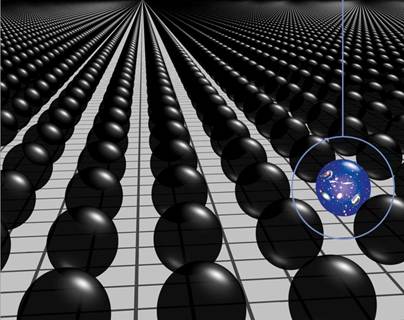
A wild, compelling idea without a direct, practical test, the Multiverse is highly controversial. But its supporting pillars sure are stable.
KEY TAKEAWAYS
One of the most successful theories of 20th century science is cosmic inflation, which preceded and set up the hot Big Bang.
We also know how quantum fields generally work, and if inflation is a quantum field (which we strongly suspect it is), then there will always be more “still-inflating” space out there.
Whenever and wherever inflation ends, you get a hot Big Bang. If inflation and quantum field theory are both correct, a Multiverse is a must.
When we look out at the Universe today, it simultaneously tells us two stories about itself. One of those stories is written on the face of what the Universe looks like today, and includes the stars and galaxies we have, how they’re clustered and how they move, and what ingredients they’re made of. This is a relatively straightforward story, and one that we’ve learned simply by observing the Universe we see.
But the other story is how the Universe came to be the way it is today, and that’s a story that requires a little more work to uncover. Sure, we can look at objects at great distances, and that tells us what the Universe was like in the distant past: when the light that’s arriving today was first emitted. But we need to combine that with our theories of the Universe — the laws of physics within the framework of the Big Bang — to interpret what occurred in the past. When we do that, we see extraordinary evidence that our hot Big Bang was preceded and set up by a prior phase: cosmic inflation. But in order for inflation to give us a Universe consistent with what we observe, there’s an unsettling appendage that comes along for the ride: a multiverse. Here’s why physicists overwhelmingly claim that a multiverse must exist. The ‘raisin bread’ model of the expanding Universe, where relative distances increase as the space (dough) expands. The farther away any two raisins are from one another, the greater the observed redshift will be by time the light is received. The redshift-distance relation predicted by the expanding Universe is borne out in observations and has been consistent with what’s been known all the way back since the 1920s. (Credit: NASA/WMAP Science Team)
Back in the 1920s, the evidence became overwhelming that not only were the copious spirals and ellipticals in the sky entire galaxies unto themselves, but that the farther away such a galaxy was determined to be, the greater the amount its light was shifted to systematically longer wavelengths. While a variety of interpretations were initially suggested, they all fell away with more abundant evidence until only one remained: the Universe itself was undergoing cosmological expansion, like a loaf of leavening raisin bread, where bound objects like galaxies (e.g., raisins) were embedded in an expanding Universe (e.g., the dough).
If the Universe was expanding today, and the radiation within it was being shifted towards longer wavelengths and lower energies, then in the past, the Universe must have been smaller, denser, more uniform, and hotter. If any amount of matter and radiation are a part of this expanding Universe, the idea of the Big Bang yields three explicit and generic predictions: null
a large-scale cosmic web whose galaxies grow, evolve, and cluster more richly over time,
a low-energy background of blackbody radiation, left over from when neutral atoms first formed in the hot, early Universe,
and a specific ratio of the lightest elements — hydrogen, helium, lithium, and their various isotopes — that exist even in regions that have never formed stars.
This snippet from a structure-formation simulation, with the expansion of the Universe scaled out, represents billions of years of gravitational growth in a dark matter-rich Universe. Note that filaments and rich clusters, which form at the intersection of filaments, arise primarily due to dark matter; normal matter plays only a minor role. (Credit: Ralf Kaehler and Tom Abel (KIPAC)/Oliver Hahn)
All three of these predictions have been observationally borne out, and that’s why the Big Bang reigns supreme as our leading theory of the origin of our Universe, as well as why all its other competitors have fallen away. However, the Big Bang only describes what our Universe was like in its very early stages; it doesn’t explain why it had those properties. In physics, if you know the initial conditions of your system and what the rules that it obeys are, you can predict extremely accurately — to the limits of your computational power and the uncertainty inherent in your system — how it will evolve arbitrarily far into the future.
But what initial conditions did the Big Bang need to have at its beginning to give us the Universe we have? It’s a bit of a surprise, but what we find is that:
there had to be a maximum temperature that’s significantly (about a factor of ~1000, at least) lower than the Planck scale, which is where the laws of physics break down,
the Universe had to have been born with density fluctuations of approximately the same magnitude of all scales,
the expansion rate and the total matter-and-energy density must have balanced almost perfectly: to at least ~30 significant digits,
it must have been born with the same initial conditions — same temperature, density, and spectrum of fluctuations — at all locations, even causally disconnected ones,
and its entropy must have been much, much lower than it is today, by a factor of trillions upon trillions.
If these three different regions of space never had time to thermalize, share information or transmit signals to one another, then why are they all the same temperature? This is one of the problems with the initial conditions of the Big Bang; how could these regions all obtain the same temperature unless they started off that way, somehow? (Credit: E. Siegel/Beyond the Galaxy)
Whenever we come up against the question of initial conditions — basically, why did our system start off this way? We only have two options. We can appeal to the unknowable, saying that it is this way because it’s the only way it could’ve been and we can’t know anything further, or we can try to find a mechanism for setting up and creating the conditions that we know we need to have. That second pathway is what physicists call “appealing to dynamics,” where we attempt to devise a mechanism that does three important things.
It must reproduce every success that the model it’s trying to supersede, the hot Big Bang in this instance, produces. Those earlier cornerstones must all come out of any mechanism we propose.
It has to explain what the Big Bang cannot: the initial conditions the Universe started off with. These problems that remain unexplained within the Big Bang alone must be explained by whatever novel idea comes along.
And it must make new predictions that differ from the original theory’s predictions, and those predictions must lead to a consequence that is in some way observable, testable, and/or measurable.
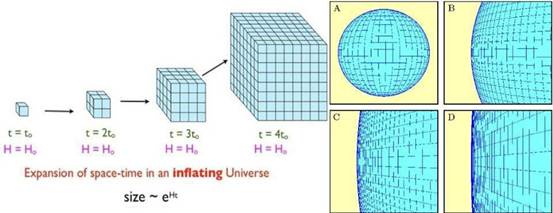
The only idea we’ve had that met these three criteria was the theory of cosmic inflation, which has achieved unprecedented success on all three fronts. Exponential expansion, which takes place during inflation, is so powerful because it is relentless. With every ~10^-35 seconds (or so) that passes, the volume of any region of space doubles in each direction, causing any particles or radiation to dilute and causing any curvature to quickly become indistinguishable from flat. (Credit: E. Siegel (L); Ned Wright’s Cosmology Tutorial (R))
What inflation basically says is that the Universe, before it was hot, dense, and filled with matter-and-radiation everywhere, was in a state where it was dominated by a very large amount of energy that was inherent to space itself: some sort of field or vacuum energy. Only, unlike today’s dark energy, which has a very small energy density (the equivalent of about one proton per cubic meter of space), the energy density during inflation was tremendous: some 1025 times greater than dark energy is today!
The way the Universe expands during inflation is different from what we’re familiar with. In an expanding Universe with matter and radiation, the volume increases while the number of particles stays the same, and hence the density drops. Since the energy density is related to the expansion rate, the expansion slows over time. But if the energy is intrinsic to space itself, then the energy density remains constant, and so does the expansion rate. The result is what we know as exponential expansion, where after a very small period, the Universe doubles in size, and after that time passes again, it doubles again, and so on. In very short order — a tiny fraction of a second — a region that was initially smaller than the smallest subatomic particle can get stretched to be larger than the entire visible Universe today. In the top panel, our modern Universe has the same properties everywhere because they originated from a region possessing the same properties. In the middle panel, the space that could have had any arbitrary curvature is inflated to the point where we cannot observe any curvature today, solving the flatness problem. And in the bottom panel, pre-existing high-energy relics are inflated away, providing a solution to the high-energy relic problem. This is how inflation solves the three
57:5.1 (655.6) 5,000,000,000 (billion) years ago your sun was a comparatively isolated blazing orb, having gathered to itself most of the near-by circulating matter of space, remnants of the recent upheaval which attended its own birth.
57:5.2 (655.7) Today, your sun has achieved relative stability, but its eleven and one-half year sunspot cycles betray that it was a variable star in its youth. In the early days of your sun the continued contraction and consequent gradual increase of temperature initiated tremendous convulsions on its surface. These titanic heaves required three and one-half days to complete a cycle of varying brightness. This variable state, this periodic pulsation, rendered your sun highly responsive to certain outside influences which were to be shortly encountered.
57:5.3 (655.8) Thus was the stage of local space set for the unique origin of Monmatia, that being the name of your sun’s planetary family, the solar system to which your world belongs. Less than one percent of the planetary systems of Orvonton have had a similar origin.
57:5.4 (655.9) 4,500,000,000 years ago the enormous Angona system began its approach to the neighborhood of this solitary sun. The center of this great system was a dark giant of space, solid, highly charged, and possessing tremendous gravity pull.
57:5.5 (656.1) As Angona more closely approached the sun, at moments of maximum expansion during solar pulsations, streams of gaseous material were shot out into space as gigantic solar tongues. At first these flaming gas tongues would invariably fall back into the sun, but as Angona drew nearer and nearer, the gravity pull of the gigantic visitor became so great that these tongues of gas would break off at certain points, the roots falling back into the sun while the outer sections would become detached to form independent bodies of matter, solar meteorites, which immediately started to revolve about the sun in elliptical orbits of their own.
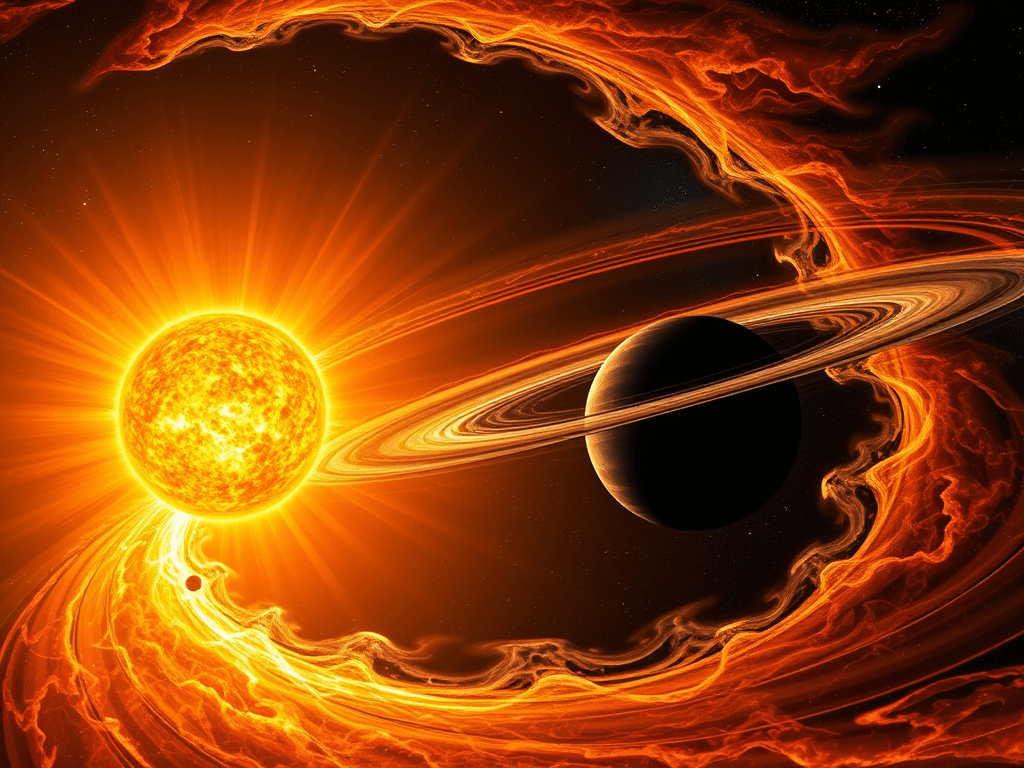
57:5.6 (656.2) As the Angona system drew nearer, the solar extrusions grew larger and larger; more and more matter was drawn from the sun to become independent circulating bodies in surrounding space. This situation developed for about five hundred thousand years until Angona made its closest approach to the sun; whereupon the sun, in conjunction with one of its periodic internal convulsions, experienced a partial disruption; from opposite sides and simultaneously, enormous volumes of matter were disgorged. From the Angona side there was drawn out a vast column of solar gases, rather pointed at both ends and markedly bulging at the center, which became permanently detached from the immediate gravity control of the sun.
57:5.7 (656.3) This great column of solar gases which was thus separated from the sun subsequently evolved into the twelve planets of the solar system. The repercussional ejection of gas from the opposite side of the sun in tidal sympathy with the extrusion of this gigantic solar system ancestor, has since condensed into the meteors and space dust of the solar system, although much, very much, of this matter was subsequently recaptured by solar gravity as the Angona system receded into remote space.
57:5.8 (656.4) Although Angona succeeded in drawing away the ancestral material of the solar system planets and the enormous volume of matter now circulating about the sun as asteroids and meteors, it did not secure for itself any of this solar matter. The visiting system did not come quite close enough to actually steal any of the sun’s substance, but it did swing sufficiently close to draw off into the intervening space all of the material comprising the present-day solar system.
57:5.9 (656.5) The five inner and five outer planets soon formed in miniature from the cooling and condensing nucleus’s in the less massive and tapering ends of the gigantic gravity bulge which Angona had succeeded in detaching from the sun, while Saturn and Jupiter were formed from the more massive and bulging central portions. The powerful gravity pull of Jupiter and Saturn early captured most of the material stolen from Angona as the retrograde motion of certain of their satellites bears witness.
57:5.10 (656.6) Jupiter and Saturn, being derived from the very center of the enormous column of superheated solar gases, contained so much highly heated sun material that they shone with a brilliant light and emitted enormous volumes of heat; they were in reality secondary suns for a short period after their formation as separate space bodies. These two largest of the solar system planets have remained largely gaseous to this day, not even yet having cooled off to the point of complete condensation or solidification.
57:5.11 (656.7) The gas-contraction nucleuses of the other ten planets soon reached the stage of solidification and so began to draw to themselves increasing quantities of the meteoric matter circulating in near-by space. The worlds of the solar system thus had a double origin: nucleuses of gas condensation later on augmented by the capture of enormous quantities of meteors. Indeed they still continue to capture meteors, but in greatly lessened numbers.
57:5.12 (657.1) The planets do not swing around the sun in the equatorial plane of their solar mother, which they would do if they had been thrown off by solar revolution. Rather, they travel in the plane of the Angona solar extrusion, which existed at a considerable angle to the plane of the sun’s equator.
57:5.13 (657.2) While Angona was unable to capture any of the solar mass, your sun did add to its metamorphosing planetary family some of the circulating space material of the visiting system. Due to the intense gravity field of Angona, its tributary planetary family pursued orbits of considerable distance from the dark giant; and shortly after the extrusion of the solar system ancestral mass and while Angona was yet in the vicinity of the sun, three of the major planets of the Angona system swung so near to the massive solar system ancestor that its gravitational pull, augmented by that of the sun, was sufficient to overbalance the gravity grasp of Angona and to permanently detach these three tributaries of the celestial wanderer.
57:5.14 (657.3) All of the solar system material derived from the sun was originally endowed with a homogeneous direction of orbital swing, and had it not been for the intrusion of these three foreign space bodies, all solar system material would still maintain the same direction of orbital movement. As it was, the impact of the three Angona tributaries injected new and foreign directional forces into the emerging solar system with the resultant appearance of retrograde motion. Retrograde motion in any astronomic system is always accidental and always appears as a result of the collisional impact of foreign space bodies. Such collisions may not always produce retrograde motion, but no retrograde ever appears except in a system containing masses which have diverse origins.
6. The Solar System Stage—The Planet-Forming Era
57:6.1 (657.4) Subsequent to the birth of the solar system a period of diminishing solar disgorgement ensued. Decreasingly, for another five hundred thousand years, the sun continued to pour forth diminishing volumes of matter into surrounding space. But during these early times of erratic orbits, when the surrounding bodies made their nearest approach to the sun, the solar parent was able to recapture a large portion of this meteoric material.
57:6.2 (657.5) The planets nearest the sun were the first to have their revolutions slowed down by tidal friction. Such gravitational influences also contribute to the stabilization of planetary orbits while acting as a brake on the rate of planetary-axial revolution, causing a planet to revolve ever slower until axial revolution ceases, leaving one hemisphere of the planet always turned toward the sun or larger body, as is illustrated by the planet Mercury and by the moon, which always turns the same face toward Urantia.
57:6.3 (657.6) When the tidal frictions of the moon and the earth become equalized, the earth will always turn the same hemisphere toward the moon, and the day and month will be analogous—in length about forty-seven days. When such stability of orbits is attained, tidal frictions will go into reverse action, no longer driving the moon farther away from the earth but gradually drawing the satellite toward the planet. And then, in that far-distant future when the moon approaches to within about eleven thousand miles of the earth, the gravity action of the latter will cause the moon to disrupt, and this tidal-gravity explosion will shatter the moon into small particles, which may assemble about the world as rings of matter resembling those of Saturn or may be gradually drawn into the earth as meteors.
57:6.4 (658.1) If space bodies are similar in size and density, collisions may occur. But if two space bodies of similar density are relatively unequal in size, then, if the smaller progressively approaches the larger, the disruption of the smaller body will occur when the radius of its orbit becomes less than two and one-half times the radius of the larger body. Collisions among the giants of space are rare indeed, but these gravity-tidal explosions of lesser bodies are quite common.
57:6.5 (658.2) Shooting stars occur in swarms because they are the fragments of larger bodies of matter which have been disrupted by tidal gravity exerted by near-by and still larger space bodies. Saturn’s rings are the fragments of a disrupted satellite. One of the moons of Jupiter is now approaching dangerously near the critical zone of tidal disruption and, within a few million years, will either be claimed by the planet or will undergo gravity-tidal disruption. The fifth planet of the solar system of long, long ago traversed an irregular orbit, periodically making closer and closer approach to Jupiter until it entered the critical zone of gravity-tidal disruption, was swiftly fragmentized, and became the present-day cluster of asteroids.
57:6.6 (658.3) 4,000,000,000 years ago witnessed the organization of the Jupiter and Saturn systems much as observed today except for their moons, which continued to increase in size for several billions of years. In fact, all of the planets and satellites of the solar system are still growing as the result of continued meteoric captures.
57:6.7 (658.4) 3,500,000,000 years ago the condensation nucleuses of the other ten planets were well formed, and the cores of most of the moons were intact, though some of the smaller satellites later united to make the present-day larger moons. This age may be regarded as the era of planetary assembly.
57:6.8 (658.5) 3,000,000,000 years ago the solar system was functioning much as it does today. Its members continued to grow in size as space meteors continued to pour in upon the planets and their satellites at a prodigious rate.
57:6.9 (658.6) About this time your solar system was placed on the physical registry of Nebadon and given its name, Monmatia.
57:6.10 (658.7) 2,500,000,000 years ago the planets had grown immensely in size. Urantia was a well-developed sphere about one tenth its present mass and was still growing rapidly by meteoric accretion.
57:6.11 (658.8) All of this tremendous activity is a normal part of the making of an evolutionary world on the order of Urantia and constitutes the astronomic preliminaries to the setting of the stage for the beginning of the physical evolution of such worlds of space in preparation for the life adventures of time.
It’s all on line in multiple languages at urantia.org
The Casimir effect has been experimentally verified and is a direct consequence of ZPE.-
GROK (the largest and smartest supercomputer in the world).
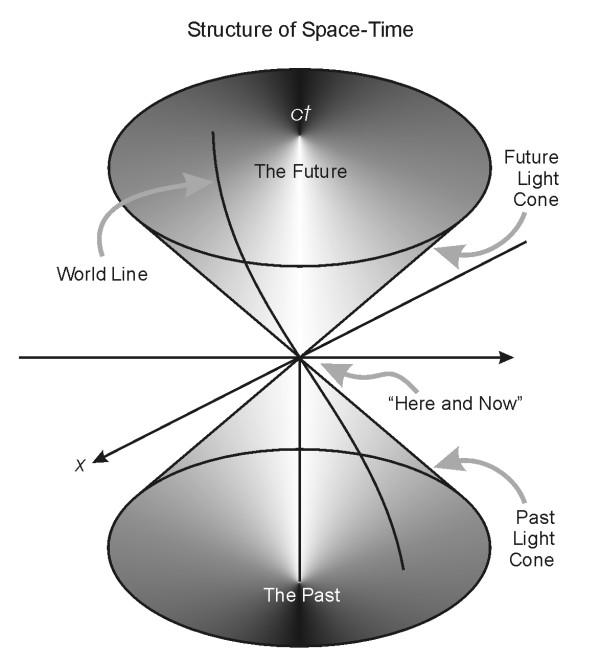
The scientists never look at or don’t know how to look at the future time cone because they don’t have the accurate time codes. They only have 12:60 and binary code which is the past TIME WARP.
The Future time cone on top IS THE SAME as The Past time cone but they ignore it because they think linearly IN ERROR.-L.T.
From Grok
The Casimir effect is a fascinating phenomenon in quantum field theory that demonstrates the tangible influence of zero-point energy in the vacuum. Here’s a detailed explanation:
What is the Casimir Effect?
The Casimir effect, named after Dutch physicist Hendrik Casimir who predicted it in 1948, is a force (what force?) that acts between two uncharged, parallel plates placed very close to each other in a vacuum. This force arises due to the quantum fluctuations of the electromagnetic field in the space between the plates.
(We call it QI or Rei-Ki, Universal Life force.-L.T.)
Quantum Vacuum and Zero-Point Energy
In quantum field theory, even a perfect vacuum is not empty. It is filled with virtual particles that pop in and out of existence due to the Heisenberg Uncertainty Principle, which allows for temporary violations of energy conservation. These fluctuations create a background energy known as zero-point energy (ZPE).
How the Casimir Effect Works
Boundary Conditions: When two parallel plates are placed very close together (typically on the order of nanometers), they impose boundary conditions on the quantum fields between them. These boundaries restrict the wavelengths of the virtual photons (the quantum of the electromagnetic field) that can exist in the space between the plates.
Wavelength Restriction: Outside the plates, the virtual photons (light from the sun) can have any wavelength, but between the plates, only certain wavelengths fit within the gap.This means there are fewer quantum states (or modes) of the electromagnetic field between the plates compared to outside.
Pressure Imbalance: The restriction of wavelengths between the plates results in a lower zero-point energy density inside the gap compared to outside. This difference in energy density creates a pressure imbalance, leading to an attractive force that pulls the plates together.
Mathematical Description
The force per unit area (pressure) between the plates can be described by the Casimir formula:
F = \frac{\pi^2 \hbar c}{240 d^4}
Where:
( F ) is the force per unit area (pressure),
\hbar is the reduced Planck’s constant,
( c ) is the speed of light,
( d ) is the distance between the plates.
This formula shows that the force is inversely proportional to the fourth power of the distance between the plates, meaning the effect becomes significant only at very small distances. (the factor of 4 is in synchronicity with the Time Harmonic)
Experimental Verification
The Casimir effect was first experimentally verified in 1997 by Steve Lamoreaux at the University of Washington. Since then, numerous experiments have confirmed its existence, typically using techniques like atomic force microscopy or torsion balances to measure the tiny forces involved.
Implications and Applications
Theoretical Physics: The Casimir effect is direct evidence of the reality of zero-point energy and has implications for our understanding of vacuum energy, the cosmological constant, and quantum field theory.
Nanotechnology: The effect is significant in nanotechnology, where components are often spaced at distances where Casimir forces can influence their behavior. Understanding and possibly harnessing this force could be crucial for the design of nano devices.
Casimir Torque: Extensions of the Casimir effect, such as the Casimir torque, occur when the plates have different shapes or orientations, leading to rotational forces.
Casimir–Polder Force: A related phenomenon, the Casimir–Polder force, describes the interaction between a neutral atom and a surface, also due to zero-point energy fluctuations.
Challenges and Open Questions
Despite its confirmation, the Casimir effect raises questions about the nature of vacuum energy and its role in the universe. For instance, the predicted value of the vacuum energy density from quantum field theory is many orders of magnitude larger than the observed cosmological constant, leading to the “vacuum catastrophe” problem in cosmology.
In summary, the Casimir effect is a profound demonstration of quantum mechanics at work, showing how the vacuum is not empty but teeming with energy that can exert real forces on macroscopic objects. It bridges the gap between the quantum world and classical physics, offering insights into the fundamental nature of reality.
What is the vacuum?
In physics, a vacuum is a space devoid of matter, or more precisely, a region with a gaseous pressure much less than atmospheric pressure. The concept of a vacuum has evolved significantly over time, from philosophical debates in ancient Greece to a well-defined scientific principle in modern physics.
Historical Context
Ancient Greece: Philosophers like Democritus and Leucippus proposed the existence of a void (vacuum) as part of their atomistic theory, where atoms move through empty space. However, Plato and Aristotle were skeptical, arguing that nature abhors a vacuum and that space must be filled with some substance.
Medieval Period: Islamic scholar Al-Farabi rejected the idea of a vacuum, suggesting that air expands to fill available space.
Renaissance and Beyond: The development of experimental science, particularly by figures like Galileo and Torricelli, led to the first practical demonstrations of vacuum, such as Torricelli’s barometer, which showed that a partial vacuum could be created.
Modern Definition
In contemporary physics, a vacuum is not just an absence of matter but also a state where the pressure is significantly lower than atmospheric pressure, typically below 10^-6 torr (1.33 x 10^-4 Pa). However, the concept extends beyond this practical definition:
Perfect Vacuum: Theoretically, a perfect vacuum would contain no particles at all, not even photons. This is an idealization, as achieving a perfect vacuum is impossible due to quantum effects.
Partial Vacuum: In practice, a partial vacuum refers to any space with pressure lower than atmospheric pressure, which can be created in laboratories or found in outer space.
Quantum Vacuum
In quantum field theory, the vacuum is far from empty. It is filled with virtual particles that pop in and out of existence. (due to the Heisenberg Uncertainty Principle.) This quantum vacuum has energy, known as zero-point energy, and is responsible for phenomena like the Casimir effect. (Then it’s not a vacuum. It’s a FIELD)
Properties and Applications
Pressure: The pressure in a vacuum is a key parameter, often measured in pascals (Pa) or torr. Ultra-high vacuum (UHV) conditions, with pressures below 10^-9 torr, are used in semiconductor manufacturing and particle physics experiments.
Thermal Conductivity: In a vacuum, there is no medium for heat transfer via conduction or convection, making it an excellent insulator. This property is utilized in thermos flasks and space technology.
Electromagnetic Propagation: Light and other electromagnetic waves can travel through a vacuum at the speed of light, ( c ), because there is no matter to impede them.
Outer Space
Outer space is often considered a natural vacuum, though it contains a sparse distribution of particles, radiation, and magnetic fields. The mean free path of particles in intergalactic space can be vast, making it a close approximation to a perfect vacuum.
Philosophical and Scientific Implications
The concept of a vacuum challenges our intuitive understanding of space and emptiness. It plays a crucial role in thermodynamics (e.g., the ideal gas law), quantum mechanics (e.g., vacuum energy), and cosmology (e.g., the expansion of the universe).
In summary, a vacuum in physics is a region with negligible matter and pressure, but it is rich with theoretical and practical significance, from quantum fluctuations to technological applications.
(Then it is a FIELD, not a vacuum)-L.T.
The Cosmological Constant Problem
The issue may be that the cosmos isn’t constant, off the top of my head. Because the only thing that’s constant in the universe is CHANGE. This is why morphic resonance via Sheldrake makes sense. There are no LAWS of nature. There are only habits. Men make laws, not nature. And thus he is banned for suggesting it.
The vacuum catastrophe, also known as the cosmological constant problem, is a major unsolved issue in cosmology and quantum field theory. It arises from a dramatic discrepancy between the theoretical prediction for the energy density of the vacuum and the observed value inferred from cosmological measurements. Here’s a clear explanation:
Background
Quantum Field Theory (QFT): In QFT, the vacuum is not empty but filled with quantum fields that fluctuate due to the Heisenberg uncertainty principle. These fluctuations contribute to a vacuum energy density, often associated with the zero-point energy of quantum fields.
Cosmological Constant (Λ): In general relativity, the cosmological constant represents a uniform ? energy density that drives the accelerated expansion of the universe. Observations, such as those from supernovae and the cosmic microwave background (CMB), suggest this is linked to dark energy, with a small, positive value.
My Thought: dark energy needs light energy to be balanced. This is a no-brainer. Once light is entertained with dark energy it is no longer constant, like men and women.
This video is only 7 months old and it was very good. If you take it slow and ponder and then go back and repeat until it sinks in, it’s great. I took notes.
I see a big problem here and that is that they always GO BACK in time to the past to measure things. YET, if you look at the spacetime cone below and at the Time Harmonic, we go back and forth between the past and the future in our bodymind all the time to create a new NOW POINT, or that axis of the eternal present, which is always changing. The fact that the male physicists harp on the word CONSTANT all the time and LAWS is highly irrational. Time, nor space are ever constant nor are they governed by men’s laws. Maybe Dark Energy need to be balanced with light energy just as male need to be balanced with female and rational need to be balanced with intuition. They never let women’s ideas or perceptions into the field so they aren’t going to get very far IMO.-Lisa T.
The Problem
Theoretical Prediction: In QFT, the vacuum energy density is calculated by summing the zero-point energies of all quantum fields up to a cutoff scale, often assumed to be the Planck scale (~10^19 GeV). This yields an enormous energy density, roughly 10^94 g/cm³ or 10^120 times larger than observed.
Observed Value: Cosmological observations, particularly from the Planck satellite and other data, indicate the vacuum energy density (or effective cosmological constant) is extremely small, around 10^-29 g/cm³.
Discrepancy: The predicted vacuum energy is 10^60 to 10^120 orders of magnitude larger than the observed value. This mismatch is the “vacuum catastrophe.”
Why It’s a Problem
Fine-Tuning: To reconcile the theoretical and observed values, the vacuum energy would need to be fine-tuned to cancel out contributions to an absurdly precise degree (e.g., 120 decimal places). Such fine-tuning is considered unnatural in physics.
Physical Implications: The vacuum energy should, in theory, contribute to the curvature of spacetime via Einstein’s equations. If the QFT prediction were correct, the universe would expand so rapidly that galaxies, stars, and even atoms could not form, contradicting our existence.
No Consensus Solution: No widely accepted mechanism explains why the vacuum energy is so small or why it cancels out so precisely.
Proposed Explanations
Several ideas have been suggested, but none are definitive:
Supersymmetry (SUSY): Supersymmetry predicts that contributions from fermions and bosons cancel out, potentially reducing the vacuum energy. However, SUSY breaking at low energies limits this solution, and no experimental evidence for SUSY exists yet.
Anthropic Principle: In a multiverse scenario, some universes might have a small cosmological constant compatible with life. We observe a small value because we live in one of these rare universes. This relies on the speculative idea of a multiverse.
Modified Gravity or Quantum Gravity: The discrepancy might indicate that our understanding of gravity or quantum field theory at high energies is incomplete. A theory of quantum gravity, like string theory, might resolve the issue.
Dynamical Mechanisms: Some propose that the vacuum energy is not constant but evolves via a field (e.g., quintessence), though this shifts the problem rather than solving it.
Cutoff Scale Adjustment: If the QFT cutoff is much lower than the Planck scale (e.g., at the electroweak scale), the discrepancy reduces but still remains significant (~10^60).
Current Status
The vacuum catastrophe is considered one of the most profound problems in modern physics, highlighting the gap between quantum field theory and general relativity.
Recent observations (e.g., DESI, Planck) continue to confirm a small cosmological constant, but no theoretical framework fully resolves the discrepancy.
Advances in quantum gravity, new cosmological data, or experimental evidence (e.g., from particle accelerators) might provide clues, but the problem remains open.
We begin HF24 today, a new 4-day cycle as Overtone, Tone 5 Output over 4 days. We are evolving to learn to express the intelligence of radiance.
This is YiChing 61; Inner Truth and Insight. We are mediated by Mars, Maldek, Saturn, and Venus in the Time Harmonic. We are in Stage VIII, the Deep Future-PostHistory so this harmonic is pulsing on the AC strand of time or thefuture to the present aboriginal continuity to help us remember what we already created in the future. The future and the past are always spiraling back and forth with the eternal now down the center as the spine in our bodies and in the earth. The time warp is created when we forget to remember a future we already created. The preponderance is too much on the past of the CA or civilizational advance strand from our society and controllers. They create the time warp to control our minds.
Spacetime Holon in 3D
With Mercury and Pluto parallel early today, we’re ready to get to the bottom of a matter. We might watch for pushing an issue too far now.
However, today’s Gemini Moon, lasting until tomorrow afternoon, encourages us to diversify, put our feelers out, and pick up new ideas or tips. We’re more interactive and versatile with this Moon, although we can also be jumpy or inconsistent. We seek variety or mental engagement, and we’re communicative, connected, and curious. It’s a great time to play with ideas and make plans.
The Moon’s harmony with Chiron and the Moon’s North Node suggests we’re connecting with a sense of purpose.
From cafeastrology.com
The 5gforce-5D effect on spacetime body and 🌎 earth
I dedicate in order to know. Universalizing healing I seal the store of accomplishment with the crystal tone of cooperation. I am guided by the power of self-generation.
Imagine, if you will, that future humans manage to travel to other worlds and find… more humans.
According to one University of Cambridge astrobiologist, that scenario may be more likely than you’d think.
In a new interview with the BBC‘s Science Focus magazine, an evolutionary palaeobiologist at the institution’s Department of Earth Sciences named Simon Conway Morris declared that researchers can “say with reasonable confidence” that human-like evolution has occurred in other locations around the universe.
The core of Morris’ belief comes from the theory of convergent evolution, which claims that, as Science Focus put it, “random effects eventually average out so that evolution converges, tending to produce similar organisms in any given environment.” The magazine used the examples of flight, which “has evolved independently on Earth at least four times — in birds, bats, insects, and pterosaurs.”
In short, convergent evolution theory posits that evolution itself is a law of nature — and, as a logical endpoint, it’s likely that evolution would operate the same way on different planets as it does here on Earth. In other words, it’s theoretically possible that the blue and green alien humanoids you see on “Star Trek” could be, well, actually out there.
Morris isn’t the only Cambridge man who believes alien life would have evolved in ways “analogous to a human.”
Arik Kershenbaum, a zoologist at the rarified British institution, wrote a whole book about the concept of alien evolution.
“Because evolution is the explanatory mechanism for life everywhere,” Kershenbaum told Quanta magazine earlier this year, “then the principles that we uncover on Earth should be applicable in the rest of the universe.”
Kershenbaum argued that while it’s “tempting” to envision alien races who don’t have the same cultural interests humans have, such as philosophy and literature, we have to remember that they didn’t just spring up out of a vacuum as advanced technological beings. Even alien lifeforms with greater technology than humans, Kershenbaum said, would have “evolved from a pre-technological species.”
“If that pre-technological species went on to develop all the things that we have now, chances are that they were built on building blocks that served that social purpose — things like bonding between group members, the transmission of information and useful ideas between group members,” he told Quanta. “A pre-technological alien civilization could be singing and dancing and telling stories just like pre-technological human civilization did because it serves the same purpose.”
It’s compelling to imagine other worlds where humanoid lifeforms, in Kershenbaum’s wording, are “singing and dancing and telling stories” just like on Earth. And if the laws of evolution are as strong as Darwinists like Kershenbaum and Morris believe, that ups both our propensity for relating to and communicating with aliens — and, unfortunately, for warring with them as well.









 With Mercury and Pluto parallel early today, we’re ready to get to the bottom of a matter. We might watch for pushing an issue too far now.
 Synchronicity is the Source of Consciousness
You must be logged in to post a comment.