

NOAA and NASA Spaceweather
An X level is the highest solar blast, and it’s hitting us May 5 and 6 and onward.
EARTH-DIRECTED CME–CONFIRMED: Today’s X-class solar flare (described below) did indeed produce a CME, and it has an Earth-directed component. NASA and NOAA forecast models suggest the southern flank of the CME will arrive on May 5th after 1800 UT. The impact could cause G1 to G2-class geomagnetic storms on May 5th and 6th. Aurora alerts: SMS Text
X-CLASS SOLAR FLARE (UPDATED): New sunspot AR3663 erupted this morning, May 3rd @ 0222 UT, producing an X1.6-class solar flare. NASA’s Solar Dynamics Observatory captured the extreme ultraviolet flash:

Radiation from the flare ionized the top of Earth’s atmosphere and caused a deep shortwave radio blackout over Australia, Japan, and much of China: map. Ham radio operators may have noticed loss of signal below 30 MHz for a half an hour after the flare’s peak.
Update: Shortly after the flare, the US Air Force reported a Type II solar radio burst, a type of natural radio signal emitted by shocked gas at the leading edge of a CME. Drift rates within the burst indicate a launch speed of 960 km/s (3.6 million mph). SOHO coronagraph images have since confirmed the existence of a CME. The bulk of the cloud will pass north of our planet, with its southern flank delivering a glancing blow late on May 5th. G1 to G2-class geomagnetic storms are possible when the CME arrives. CME alerts: SMS Text
Realtime Space Weather Photo Gallery
Free: Spaceweather.com Newsletter
SPACEX SPIRAL SIGHTED DURING GEOMAGNETIC STORM: Last night, sky watchers in Europe went outside to observe the fading glow of a strong (G3) geomagnetic storm. “I was looking for aurora borealis after sunset, when suddenly a bright yellow object appeared near Polaris,” reports Gabriel Murawski from Dusia Lake, Lithuania. It was a SpaceX spiral:
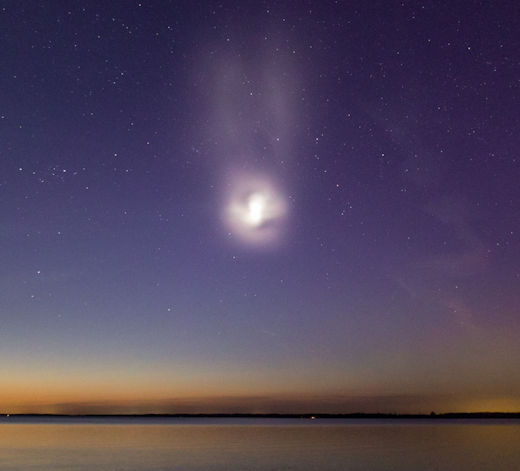
Earlier the same day, SpaceX launched a pair of Earth observation satellites from California onboard a Falcon 9 rocket (May 2nd @ 1836 UTC). After deploying the satellites, the Falcon 9’s second stage performed a de-orbit burn; a bit of spin twisted the exhaust into a glowing spiral.
“It looked amazing!” says Murawski. “The spiral gliding next to the violet aurora borealis made a spectacular scene.”
Spirals are an increasingly routine by-product of SpaceX operations, with many recent Falcon 9 launches creating them. Similar swirls have been photographed over Norway, New Zealand, east Africa, Hawaii, and most famous of all, this specimen over Alaska. If you haven’t seen one yet, it may be just a matter of time.
 Synchronicity is the Source of Consciousness




