People can sense Earth’s magnetic field, brain waves suggest


My followers should be all over this…I hope.

https://www.sciencenews.org/article/people-can-sense-earth-magnetic-field-brain-waves-suggest

The Amplitude Layer Today


The magnetosphere Psi Bank

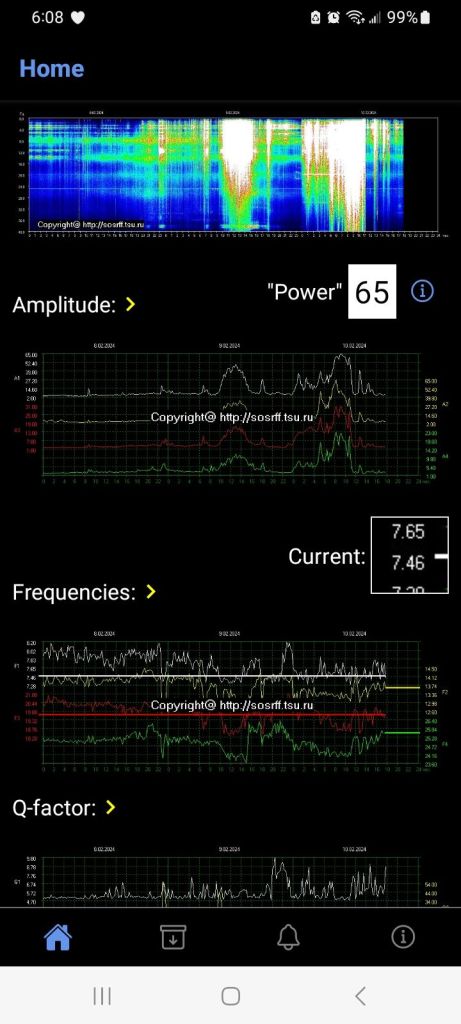
It was at 48 hz gamma this morning and will be again at midnight. In between it plummets.

If you’re challenged to keep your eyes open and brain functioning, this is why. When the amplitudes go into Gamma and then plummet into Delta, then go up alpha-beta before going gamma again, it’s a brain jolt.

The two most important things to do to be able to have your day are ice water and Refresh eye drops as much as you need. Those wake up your brain, not coffee. Coffee dehydrates. I’m trying to cut back.  Nutrition also but the water is more important.

Tomsk is still losing the signal or its being hidden from them. I’m glad I’m done tracking and am now finishing the book.

Good video on Jupiter by Space Matters


Jupiter is a powerhouse and called king of our local system and Earth’s cosmic guardian. Really?

Corey Goode says it’s home to the ICC, all about profiting from commerce in our local system  with no shortage of gold which they send to someone secretly on earth so that they have an unlimited amount of money while the rest of us deal with purposeful inflation for fun.🥳 ??

NASA has sent the Europa Clipper Satellite mission this year to make 50 orbits of this Moon. Jupiter has many Moon’s and rings.

Until we know more about its influence on earth and its role in the Tiamat debacle, I’m going to refrain from holding it in high esteem.

So, because Jupiter has this ginormous gravitational pull, it protects the earth from getting hit by comets. Ok. Thank you. But it also holds our 12:60 magnetosphere and Tiamat asteroid belt 12:60 magnetosphere in place. That needs to pivot now, and they need to let us get our time coordinates right.

They also know that we have an increased threat of asteroid hits because of the way Jupiter interacts with our sun. That is not favorable for us.

NASA has Juno satellite also.  This will go to 2025. We’ll get even more data when it does a  deep death dive into Jupiter.

I don’t trust this planet at all. Just sayin’.

CERN to test $4 billion accelerator on the day of the solar eclipse


CERN to test the world’s most powerful particle accelerator during April’s  solar eclipse  to search for ‘invisible’ matter that secretly powers our universe.

Right. Now they are up to something, too. They are trying to find a different time hack to control the matrix. They lost control on February 29, on leap day, because we had a double pulse on Blue 1 Monkey in HF33. On the 4 days in harmonic 33, there is no normal spacetime governance at all. We were in a twilight zone.

Our Watchers used it to close the back time gate that was a hack by the ICC and other time thieves in preparation for the powerful April 8 date.

As I posted, this a MAJOR time pivot and government and tech are hip to it to try to find another way into the HF33 implicate order with their shadow magic. The back door is closed. They’re looking for a window. No way, no how will they succeed. Time for karma dudes.

https://www.dailymail.co.uk/sciencetech/article-13249813/CERN-accelerator-smash-particles-solar-eclipse.html?ito=native_share_article-nativemenubutton

NASA on Eclipses


We have a Lunar Eclipse happening tomorrow and the solar eclipse on April 8. This is helpful information.

https://science.nasa.gov/moon/eclipses/#hds-sidebar-nav-6

“Andromedans, Come on Over”-Me


Spaceweather from NOAA, the federal level National Oceanic and Atmospheric Agency…who are pretty hip. They’ve seen stuff. Nor do they lie like other Feds.

A Comet feom Andromeda

GEOMAGNETIC STORM WATCH (G1): NOAA has issued a minor geomagnetic (G1-class) storm watch for March 9th when a stream of solar wind is expected to graze Earth’s magnetic field. Normally, this low-impact solar wind stream wouldn’t cause a magnetic storm. However, at this time of year, even a gentle gust of solar wind can do the job because of the equinox Russell-McPherron effect. Aurora alerts: SMS Text

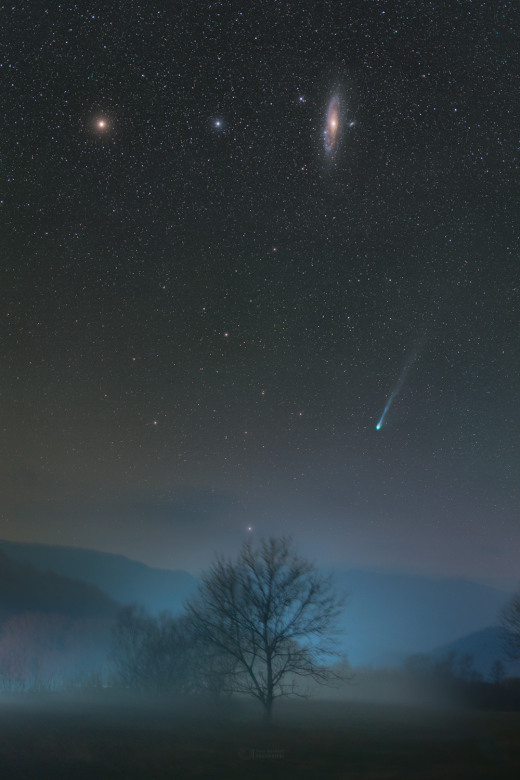
COMET 12P AND THE ANDROMEDA GALAXY: This week, cryovolcanic comet 12P/Pons-Brooks is passing by the Andromeda Galaxy in the western evening sky. Petr Horálek photographed the wide conjunction from Revúca, Slovakia:

“This was wild,” says Horálek. “On March 5th, I drove 300 km to Telgart, Slovakia, where the forecast predicted clear skies. But the forecast was wrong!

When I reached Telgart, the sky was hopelessly cloudy. I almost gave up and was returning home through truly thick fog when, abruptly, the sky cleared. I pulled into a field where the comet was low over the horizon and blindly took this exposure.”

It turned out pretty well.

Photographers, if you have clear skies, this is a good week to photograph Comet 12P/Pons-Brooks. It is about 10 degrees from the Andromeda Galaxy and bright enough to catch with a short nighttime exposure. The Andromeda Galaxy is magnitude +3.4 (visible to the naked eye on moonless nights); Comet 12P is not far behind at magnitude +5.5. Point your cameras here.

more images: from David Blanchard of Wupatki National Monument, Arizona; from Michael Jaeger of Karlstein Austria; from Malcolm Park of Harrowsmith, Ontario; from Graziano Ventre of Bellagio Via Lattea, Italy; from Lionel Majzik of Tápióbicske, Pest, Hungary; from Chris Schur of Happy Jack, AZ

The Andromedans

From Extraterrestrial Species Almanac by Craig Campobasso

Geek out on Blue Explosive LFBots


The scientists are stumped, and they don’t have much data. My first instinct is the birth of a star. Although they focused on the death of a star. We shall see.

I’m geeked out on astronomy today, procrastinating on staring at my own magnetosphere data, which I’ve been doing for months.

This is cool.

Solar Eclipse Coming on Earth and  other Planets


Good Astrum video.

Triton, Neptune’s Satellite is very odd


Neptune mediates Red Dragon~White Mirror. This is a beautiful video. Notice at 14:20 it talks about the beginning of life, which Red Dragon Cysteine is responsible. Neptune may be the womb of new life in our system.

Its polar caps are NITROGEN. It has 7 Moon’s.

Its orbit direction is retrograde or counterclockwise to the left.

There are 13 more satellites around Neptune.

Neptune is very cold and has 40 years of seasons. But I don’t think all life needs warmth to thrive.

Your Birth Tone Pulses Dynamically with the rest of your Birth Harmonic


It hit me an hour ago after doing an ScR frequency data deep dive. I had to scan each line because Excel doesn’t understand. Lol

I have the hertz ranges figured out for all 12 magnetosphere layers. Remember that each set of measurement, Amplitude, Frequency, and Qfactor is composed of 4 layers, so they are in exact sync with each 4 kin harmonic, 65 of them. 65 X 4 =260.

If you were born Tone 1-4, you pulse to the Qfactor layers but specifically to your birth harmonic, which begins with Tone 1. Today is Tone 1. If you are born White 1 Magnetic Mirror, you pulse EXACTLY to this entire 4-day harmonic family. Study it for destiny clues. But you also pulse to all other Tone 1s in the Tzolkin but less so.

I saw early on that all the magnetosphere layers affected each other, so in truth, all of Tone 1-13 affect each other, but their destinies are not necessarily closely intertwined.

For instance, if you were born Tone 5-9, you folks are holding the fort! Overtone, rhythmic, resonant, and galactic are the heavy lifters for the planet to keep souls circling on earths surface. Those sound layers are amazingly uniform.

I was previously looking at them individually, and that’s not how they pulse. They pulse in 4’s just like the harmonics and pulsars, although I need to examine the pulsars closer. Jose might not have had that right. Idk.

Today would be 1~5~9~13, for instance, and don’t always see that happening. I see the layers next to each joined at the hip just like our harmonics.

If you are Tone 1, you are totally connected to 1-4. If you are tone 5, you are totally connected to 5-8. If you are tone 10, you are totally connected to tones 9-12. All four kin pulse to each other just as they do in the magnetosphere. It’s fascinating to study.

I’ll post more later.

Tone 13, nobody sees us, hears us, or understands us. We are barely seen in the magnetosphere, but be assured that once Tones 9-12 blow the roof off the amplitude, it will establish a new cosmic spectrum. I’ll see it and let you know. We are still largely in 12:60 time warp.

Earth Holon is Pulsing High


I believe it’s due to the Xclass Solar flare.

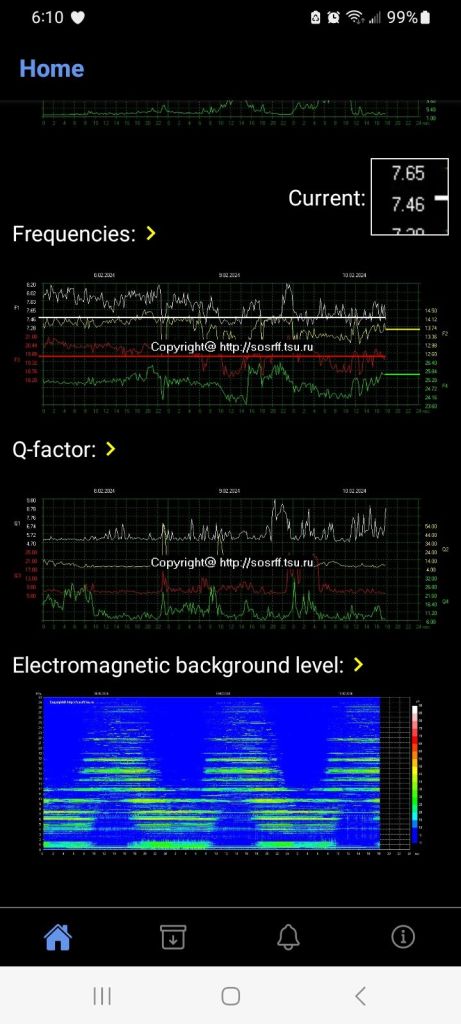
The frequencies are kept level on the surface no matter what the amplitudes do above the earth and the Qfactor in the earth

New Photo of Saturn from Mr. X


Outstanding. Crazy planet.

In the Magnetosphere, the huge ELM bands around the entire earth emit ELF and ULF waves


They are known to stimulate our cells, as mentioned in the video I posted on Baba. They suggest we need the ULF more, but I tend to believe we need both high and low. Maybe as we get closer to the third helix in our DNA we’ll need ULF more.

Extremely low frequency (ELF) is the ITU designation[1] for electromagnetic radiation (radio waves) with frequencies from 3 to 30 Hz, and corresponding wavelengths of 100,000 to 10,000 kilometers, respectively.[2][3] In atmospheric science, an alternative definition is usually given, from 3 Hz to 3 kHz.[4][5]

In the related magnetosphere science, the lower-frequency electromagnetic oscillations (pulsations occurring below ~3 Hz) are considered to lie in the ULF range, which is thus also defined differently from the ITU radio bands. Extremely low frequency Wavelength range 100,000 to 10,000 km, respectively

Spaceweather for 1/13 and 14, 2024


GEOMAGNETIC UNREST POSSIBLE THIS WEEKEND: NOAA forecasters say that geomagnetric unrest is possible on Jan. 13th in response to one or more passing CMEs. These are near-miss CMEs, not direct hits. The ripple effect of the passing clouds is likely to disturb Earth’s magnetic field without triggering full-fledged geomagnetic storms. Aurora alerts: SMS Text

COMET 12P VISITS THE CRESCENT NEBULA: Astronomers around the world have been waiting for a geyser to blow on cryovolcanic Comet 12P/Pons-Brooks. It’s overdue. Last night, the comet quietly passed by the Crescent Nebula (NGC 6888):

Michael Jäger photographed the conjunction from his backyard observatory in Austria. The picture is a 10-minute exposure through 4 independent color filters: R, G, B and Hydrogen-alpha. The H-alpha filter captured the red glow of hydrogen in the nebula, while the G filter picked up green light from diatomic carbon in the comet’s atmosphere–a beautiful contrast in hue.

Comet 12P is drifting away from the nebula now. It’s still worth monitoring, though. An icy geyser has been breaking through comet’s crust every 15 days or so, and pressure is building for a new blast. Look for it in the constellation Cygnus.

more images: from Georg Klingersberger of Kobernaußen Upper Austria; from Rok Palcic of Kamnik, Slovenia; from the Association Astronomique de l’Indre of Le Poinçonnet, Indre, Centre Val de Loire, France;

Realtime Space Weather Photo Gallery
Free:
Spaceweather.com Newsletter

SO MANY MAGNETIC FILAMENTS: Today, there are a dozen sunspot groups crossing the face of the sun. This spectroheliograph image reveals an even greater number of magnetic filaments:


Click to view the full-sized image

Francois Rouviere captured the image from Cannes, France. It shows the sun in the monochromatic wavelength of red light emitted by solar hydrogen. Each irregular dark line is a magnetic tube filled with dense hydrogen gas. These filaments are just as likely to erupt as the sunspots, more than doubling the chances of a flare today. Solar flare alerts: SMS Text

The Tones of Creation in the ScR-the Scumann Resonance


I woke up this morning and realized that it’s very possible that the hertz levels of the Qfactor, frequency, and amplitude are the levels of the 13 tones of creation.

The light of the auroras are the attributes and energies of the 5 color families X 5 are the tribes of time manifested as us.

To that end, I will be doing a scientific study and keeping a chart at 4 times every day of what the hertz frequencies are at each layer.

There are Q1, 2, 3, and 4 for tones 1, 2, 3, 4 deep in the earth. F1, 2, 3, 4 for tones 5, 6, 7, 8, and A1, 2, 3, 4 for tones 9, 10, 11, 12.

The 3rd belt that the scientists say comes and goes is Tone 13. It comes and goes because it has 4 pulsar tones, not three; 1, 5, 9, 13.

Pulsars

Tone 13 is a pulsar with Tones 1, 5, and 9. It’s the only one that has 4 in each of the sections; Qfactor, and Frequencies and Amplitudes.

The other pulsars are

  • 2, 6, 10, pulsar
  • 3, 7, 11, pulsar
  • 4, 8, 12 pulsar

No matter your birth tone, you pulse with the other frequencies in your pulsar.

This has been staring me in the face, and I just saw it. Typical. Doing science makes the scientist feel dumb. Nature lays it out right there, unlike human society, which is layers of secrets and lies.

Onward.

Black Hole Radiosonics SOUND


https://t.co/y34Ln6gWZn?s=09

May be a source of the Tomes of Creation.

Michigan MSU Physics Dept. help make a surprising discovery about the sun


MSU physicists were part of an international collaboration that has discovered the highest-energy light coming from the sun

https://t.co/SPlKeJlrWb?s=09

The First Director of NASA James Webb


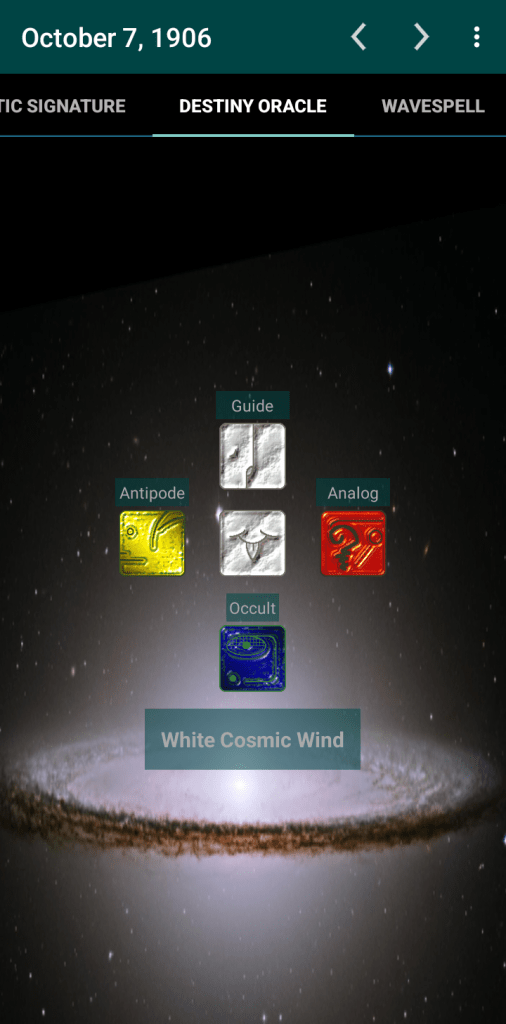
James Webb Birth gateway, October 7, 1906. He only dreamed of this telescope that manifested over 100 years later. The day the telescope traveled to its position was his EXACT analog on the right.
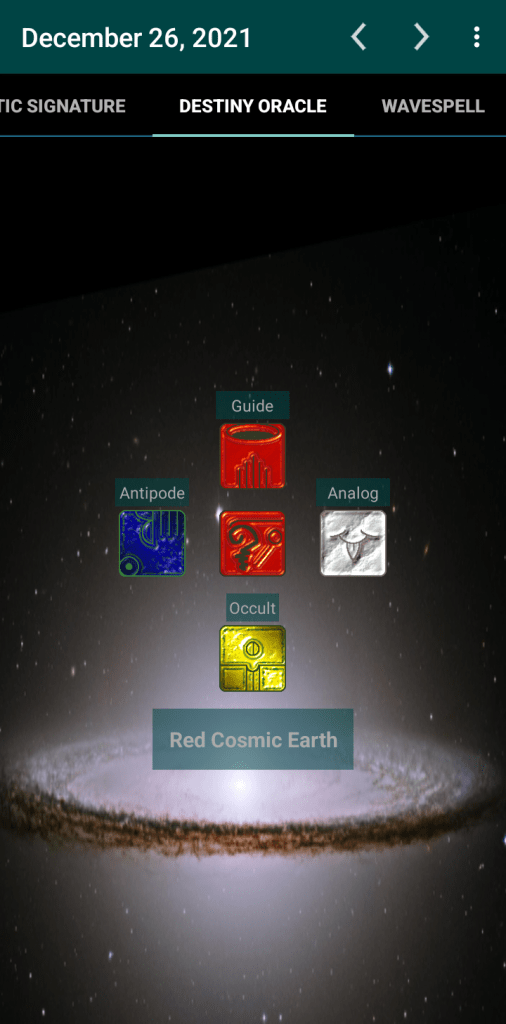
The day the telescope was on its way-12/26/21, Red 13 Cosmic Earth.
It launched on Yellow 12 Warrior, COLLECTIVE INTELLIGENCE AND QUESTIONING, FEARLESSNESS.

The travel day of James Webb Telescope 1M miles away from 🌎 Earth

Red 13 Earth is Cosmic Navigation and Synchronicity. It was exactly that for humanity. When you watch the movie, note that Yellow 12 Warrior, 12/25/21 is mediated by Saturn, the planet of the Hexagon. The mirrors on the mandala that is the telescope are HEXAGONS! Also, the Guide Power for the telescope is Red 13 Cosmic Dragon whose analog is White 13 Cosmic MIRROR. The telescope LITERALLY IS a COSMIC MIRROR reflecting back to us, our Source, who we are and where we came from; our cosmic family.

Go here for more info.

https://www.space.com/james-webb-space-telescope-12-amazing-discoveries

Look at the synchronicity of this. James Webb was White 13 Cosmic Wind. The telescope trip 1M miles away from earth was his direct analog support, Red 13 Cosmic Earth.

It’s totally amazing, not an accident. You MUST watch Netflix UNKNOWN COSMIC TIME MACHINE. The title isn’t so great, but I cried watching this unfold. Red 13 Cosmic Earth is my Guide Power. I love our universe and astronomy so much, and humanity.

There have been many mistakes made by wiser and older entities than us and I am here to tell you that earth and humanity have been endowed with a very special spirit of love and species cooperation that can HEAL all the error. We think we are minor, but our hearts and minds are ginormous. We have a special mission in our local universe. All eyes are on us right now. Do you best to bring your best self forward while we move into this paradigm shift as citizens of our local universe.

In Jupiter’s swirling Great Red Spot, NASA spacecraft finds hidden depths


November 9, 20215:45 AM ET Heard on Morning Edition

https://www.npr.org/2021/11/09/1052773575/in-jupiters-swirling-great-red-spot-nasa-spacecraft-finds-hidden-depths#:~:text=The%20shrinking%20spot,how%20long%20it%20will%20last.

BRENDAN BYRNE

Jupiter’s Red Storm is shrinking

This new perspective of Jupiter from the south makes the Great Red Spot appear as though it is in northern territory. This view is unique to Juno.

NASA/JPL-Caltech/SwRI/MSSS/Gerald Eichstäd/Seán Doran © CC NC SA

Jupiter is well-known for being the biggest planet in our solar system, and it’s also home to the biggest storm. It’s called the Great Red Spot, an enormous vortex that has been swirling for centuries. It’s bigger than our own planet, and yet we don’t know much about it. Until now, scientists could only observe the spot from afar. But thanks to a NASA spacecraft launched a decade ago, we’re finally getting a look inside Jupiter’s storm.

The Great Red Spot is like a storm here on Earth, but supersized. “It’s basically clouds,” says Paul Byrne, a planetary scientist at Washington University in St. Louis. Really, “it’s not all that dissimilar to the kinds of things we know as cyclones or hurricanes or typhoons on Earth.”

At 10,000 miles across, the Great Red Spot is the largest storm in our solar system and has been continually observed for around 200 years, but it’s been around for much longer. (Compare that with big storms on Earth, which generally last a few days or weeks at most.)

“We believe this thing is really old,” says Scott Bolton, principal investigator of NASA’s Juno mission. “How it lasts that long is a mystery.”

Before Juno, scientists could only observe the storm from afar. Even from a distance, they noticed it was changing shape and actually shrinking.

This illustration depicts Juno in an elliptical, polar orbit around Jupiter.

NASA

NASA’s Juno mission launched from Cape Canaveral Space Force Station in Florida back in 2011 and arrived at Jupiter in 2016. In 2019, the spacecraft changed course slightly and passed over the Great Red Spot twice.

Bolton and his team used microwave sensors to slice into the depths of the storm, getting the first 3D model of the Great Red Spot. “It’s a pancake because it’s so wide at the top. But the depth of that pancake is much thicker than what we would have anticipated.”

SPACE

Astronomers want NASA to build a giant space telescope to peer at alien Earth

The microwave observations show these storms on Jupiter, called vortices, extend below the cloud deck of the planet. In the case of the Great Red Spot, it extends at least 200 miles into the clouds of Jupiter, beyond the depths of where clouds form and water condenses.

“That’s very different than the way we think Earth’s atmosphere works, which is largely driven by water, clouds, condensation, and sunlight,” says Bolton. “How that works is going to require new models and new ideas to explain.”

Measuring the Great Red Spot’s gravity

During its 2019 pass over the Great Red Spot, the Juno spacecraft buzzed the planet at a blistering 130,000 miles per hour. The storm is so massive that its gravity field actually jostled the spacecraft during its flyby.

“The local gravity tends to pull and push away the spacecraft as it flies over the vortex, and this creates a sort of bump in the road for Juno,” says Marzia Parisi, a Juno scientist from NASA’s Jet Propulsion Laboratory in Southern California and lead author of a paper in the journal Science on gravity overflights of the Great Red Spot.

Scientists here on Earth could see the effect of these gravitational “bumps.” That’s because every time they jostled Juno, they nudged the spacecraft closer to or farther from Earth. That changing distance caused the radio waves sent back to Earth some 400 million miles away to be subtly squeezed and stretched, a phenomenon known as a Doppler shift. Using this effect, the spacecraft could pick up tiny jostles as small as 0.01 millimeters per second.

“The precision required to get the Great Red Spot’s gravity during the July 2019 flyby is staggering,” says Parisi. The findings from the gravity observations complemented Bolton’s earlier microwave measures, concluding the storm penetrates some 300 miles into Jupiter’s atmosphere.

The shrinking spot

Observations of the Great Red Spot show that it’s shrinking. For nearly a century and a half, the iconic spot has been getting smaller and it’s unclear just how long it will last.

Juno is taking a closer look at this phenomenon. “What we’re doing is seeing up close what’s happening while that shrinking has happened,” says Bolton.

SPACE

If NASA greenlights this interstellar mission, it could last 100 years

The spacecraft is observing flecks of the storm getting caught up in neighboring clouds. The storm itself also appears to be trapped by powerful conveyor belts of wind on the planet that is stabilizing the storm.

“I don’t think the theory is very far advanced to the sense where we can connect all of that to the changes in the size,” said Bolton.

Data from Juno will help scientists predict what could possibly happen to the Great Red Spot.

“Understanding what’s happening with the storm now allows scientists to make much more sophisticated models to simulate what we see and then make predictions for what will happen in the future, including up to perhaps when the Great Red Spot may eventually go away,” says planetary scientist Paul Byrne.

Understanding other Jupiter-like planets

The findings from the Juno spacecraft are shedding light on the early formation of giant planets like Saturn, Uranus, and Neptune — and even planets beyond our own solar system.

“When we get up close, and this is the first planet we’ve actually been able to open up and look inside, this is going to tell us a lot about how giant planets work throughout the galaxy,” says Bolton.

The JunoCam imager aboard NASA’s Juno spacecraft captures a Jovian cyclone known as a barge type in a polar jet stream called “Jet N4.”

NASA/JPL-Caltech/SwRI/MSSS. Image processing: Gerald Eichstädt CC BY

To date, astronomers have identified thousands of exoplanets — planets that orbit a star other than our sun. These planets are far away, with the closest one around 10.5 light-years from Earth. That makes observing what’s happening on the surface difficult.

Around 1,400 of these exoplanet candidates are thought to be gas giants, much like Jupiter. Understanding what happens on Jupiter can help scientists get a better sense of what’s happening beyond our solar system.

“By understanding the physics and the processes that go into shaping Jupiter,” says Byrne, “we’ll get a better understanding of not just Jupiter, but of these kinds of worlds.”