The last 12 days were truly epic as far as time change, all initiated by the solar eclipse last month. The sun is going berserk to be sure, and I’m very happy about it and tracking for you. Kudos to NASA AND NOAA, who I feel are my buddies now. I’m watching all the work they are doing daily and love it.
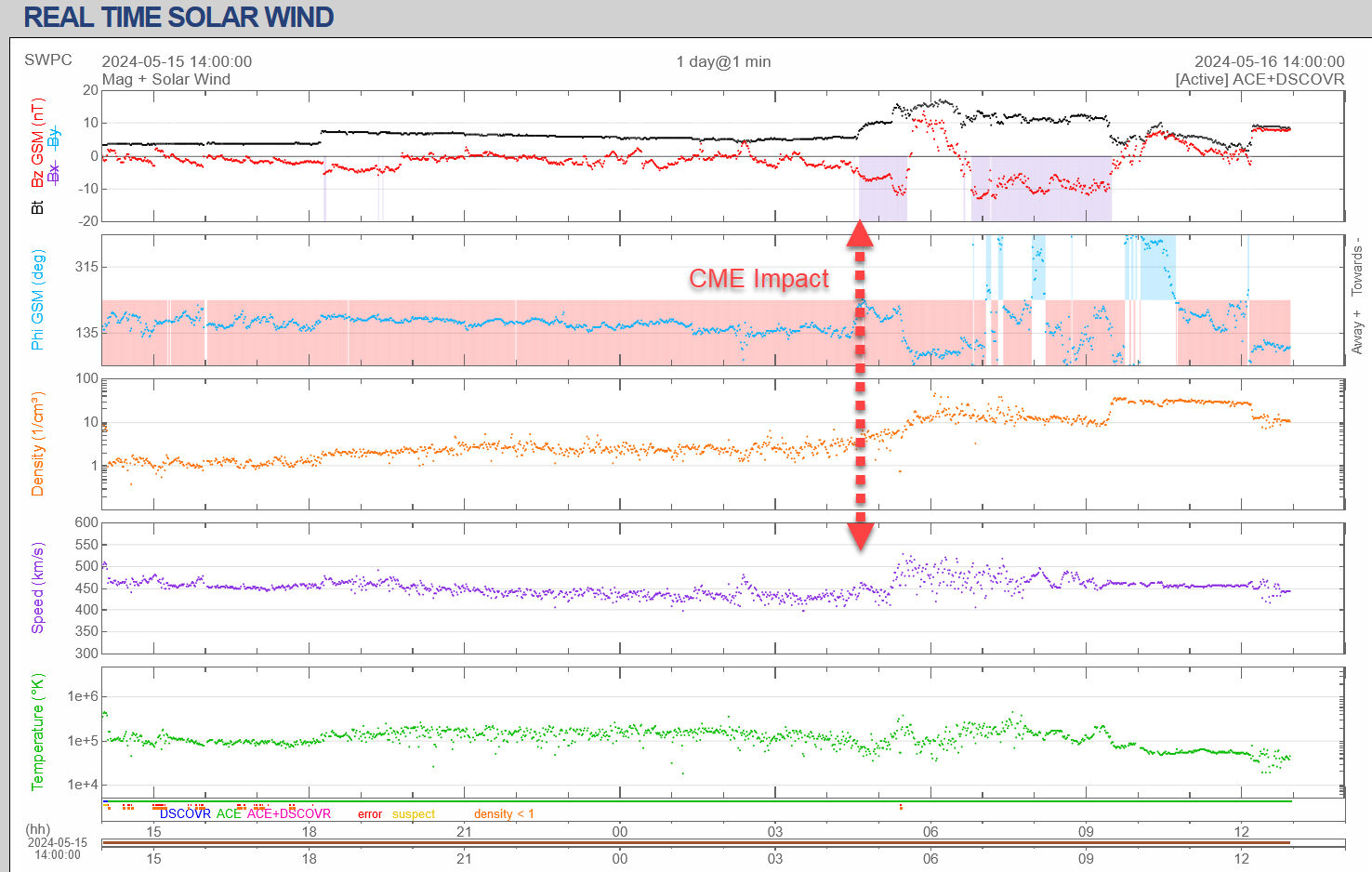
AURORAS IN COLORADO YESTERDAY: A CME hit Earth’s magnetic field on May 16th (0620 UT), sparking a moderate G2-class geomagnetic field. Aaron Watson witnessed the red afterglow of the CME’s impact from Colorado! The storm subsided a few hours after it began, and is over now. Aurora alerts: SMS Text
RARE SOUTH PACIFIC AURORAS CONFIRM ‘GREAT STORM’: On the south Pacific island of New Caledonia, no one expects to see auroras. Ever. Situated about halfway between Tonga and Australia, the cigar-shaped island is too close to the equator for Northern or Southern Lights. Yet on May 10, 2024, this happened:

“I have rarely been so happy when taking a photo!” says Frédéric Desmoulins, who photographed the display from Boulouparis in the island’s south province. “I could see the red color of the auroras with my naked eye. According to the New Caledonian Astronomy Society, these photos are the first for this territory.”
“The auroral visibility from New Caledonia is really unique and extremely valuable,” says Hisashi Hayakawa, a space weather researcher at Japan’s Nagoya University. “As far as we know, the last time sky watchers saw auroras in the area was during the Carrington Event of Sept. 1859, when auroras were sighted from a ship in the Coral Sea.”
Hayakawa specializes in historical studies of great auroral storms. He tries to go back in time as far as possible. The problem is, magnetometers and modern sensors didn’t exist hundreds or thousands of years ago. Instead, he looks for records of aurora sightings in old newspapers, diaries, ships logs, even cuneiform tablets. Great Storms are identified by their low latitude–anything with naked-eye auroras below 30° MLAT (magnetic latitude).
“May 10th was definitely a Great Storm,” declares Hayakawa. “Naked-eye auroras sightings in New Caledonia (MLAT = -26.4°) and Puerto Rico (MLAT = 27.2°) confirm this in both hemispheres.”
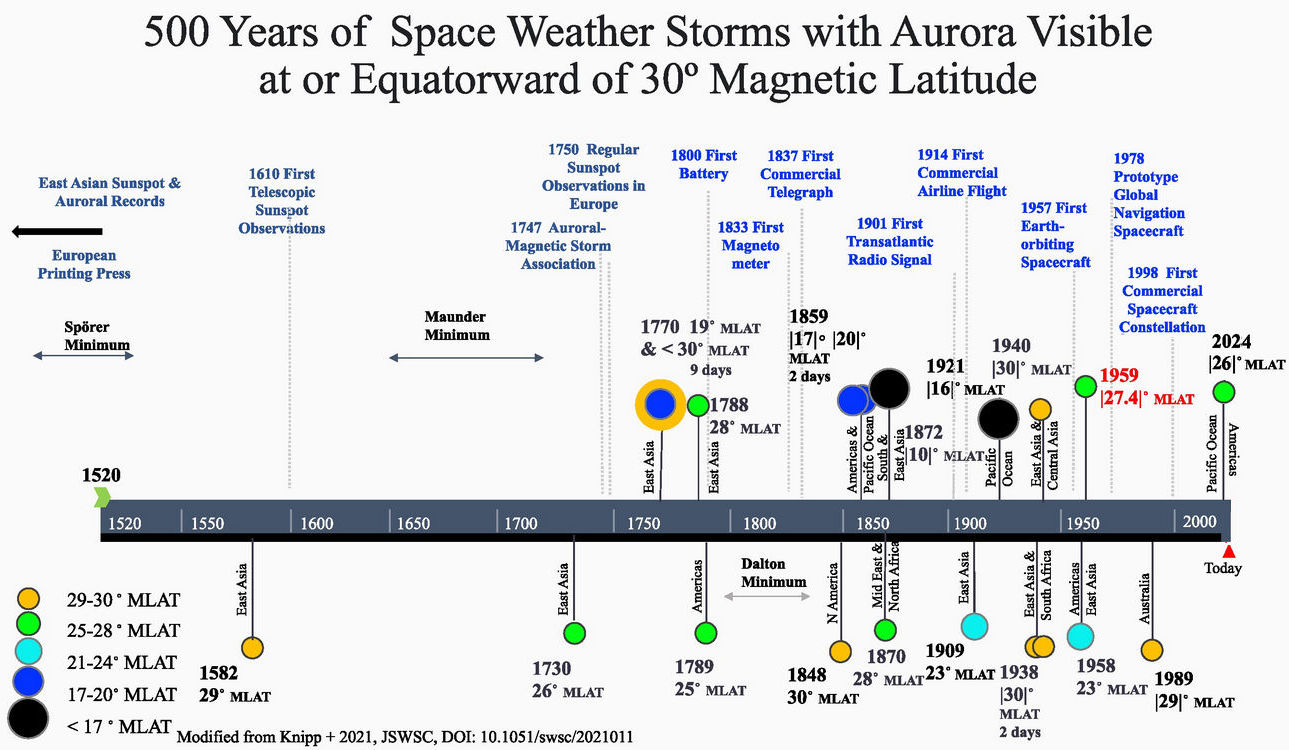
Note: This is a figure modified from Hayakawa et al. (2024).
In fact, it is among the top 20 Great Storms of the past 500 years. The above timeline from a research paper by Hayakawa has been modified to display the May 10th event. It is the green dot on the far-right end of the timeline.
This isn’t just an arcane historical curiosity. “We need to know about Great Storms of the past to understand how big storms might become today,” explains Hayakawa. “Our modern technological society depends upon it.”
Readers, if you witnessed auroras at low latitudes on May 10th, please submit your photos to our gallery and fill out this questionnaire from Hayakawa. Your observations may be included in a future research paper about this extreme storm.
Realtime Aurora Photo Gallery
Free: Spaceweather.com Newsletter
 Synchronicity is the Source of Consciousness