

You heard it here first. (Copyright my hypothesis)
FRIDAY THE 13TH AURORA WATCH: 😉
If NOAA forecasters are right, Friday the 13th could be a lucky day for some sky watchers. A slow CME is expected to graze Earth on June 13th. The glancing-blow could spark minor G1-class geomagnetic storms with high-latitude auroras. Aurora alerts: SMS Text
HALF SLINKY, HALF SPIRAL GALAXY: Astronomers at the Big Bear Solar Observatory had a new toy, and they *really* wanted to play with it.
In 2023, a team led by Dirk Schmidt developed a new adaptive optics system for the Goode Telescope in California’s Big Bear Lake. Theoretically, it should be capable of taking the best pictures ever of the sun’s atmosphere. With this in mind, the team started randomly patrolling the corona to see what they might find. Within minutes, they made a discovery. (YOU HAVE TO SEE THIS. I think it’s an infant RNA spiral, single strand. They rain down from the sun and create gravity. Then it turns into DNA through the time harmonic process of creating family groups from past and future time coordinates. You find your mother and father and are conceived and turned into a body via the loom of MAYA.-LT)
https://vimeo.com/1092604966
“We became astounded witnesses to a strange, short-lived object,” the team writes in a Nature Astronomy article published May 27th. “We call it a twisted plasmoid.”
The plasmoid is nothing like anyone has seen inside the sun’s atmosphere before. NASA’s Solar Dynamics Observatory was observing at the same time and saw almost nothing. The Big Bear adaptive optics system is so good at correcting the turbulent blur of Earth’s atmosphere that it outperforms space telescopes.
A movie of the plasmoid shows a narrow stream of plasma racing outward from an erupting prominence. The front of the stream “suddenly stopped and collided with its own rear half,” the researchers wrote. Visually, it seemed to be a TX wax half-slinky, half double-armed spiral galaxy.
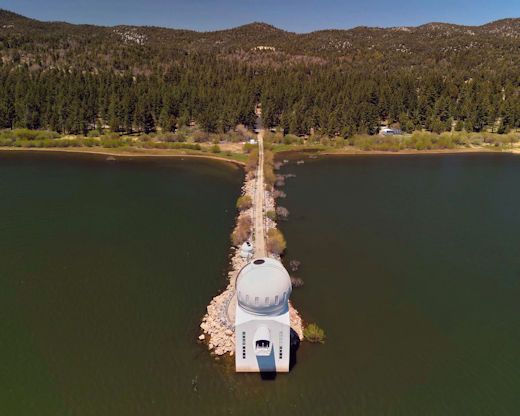
The 1.6-meter Goode Solar Telescope in Big Bear Lake. The steady temperature of the water surface helps keep the air around the telescope calm
It’s not clear whether this is a significant discovery or just something idiosyncratic and weird. We’ll soon find out. The researchers plan to install the same system on the giant Daniel K. Inouye Solar Telescope in Hawaii, where adaptive optics could reveal an even greater menagerie.
Let the plasmoid hunt begin!

