This is from NOAA and, in exact synchronicity with the Harmonic.


In the Maya Harmonic, we move from the North Polar Zone 5 kin to the Zone of Transformation 15 kin to the South Polar Zone 5 kin every 20 days. But the onus of alpha and omega points keeps moving with the 375 day solar year as the Harmonic calibrated True Time or Haab.

This is more proof that the time patterns I have figured out over 30 years are accurate in alignment with the sun and the rest of our local system. People need to put their thinking caps on and belly up to my table so they can know the time changes coming. Please share.

THE NORTHERN HEMISPHERE OF THE SUN IS IN CHARGE: For the second month in a row, sunspot counts in the sun’s northern hemisphere are more than double the south. The assymetry is obvious in this summary of September’s sunspots compiled by astronomer Senol Sanli using data from NASA’s Solar Dynamics Observatory:

According to the Royal Observatory of Belgium’s Solar Influences Data Analysis Center, in September the monthly sunspot number for the sun’s northern hemisphere was 90, the southern hemisphere was only 44; that’s a ratio of 2-to-1 in favor of the north. August was about the same. Looking back over an entire year, the north is leading the south by an average of 50%.

What’s going on? In fact, it’s not unusual for the sun’s northern and southern hemispheres to be out of synch. As long ago as the 19th century, solar cycle pioneers Spoerer (1889) and Maunder (1890) noted that there were often long periods of time when most sunspots were found preferentially in one hemisphere and not the other. This plot from the Royal Observatory of Belgium shows assymetries throughout the last 6 solar cycles:

Until recently, Solar Cycle 25 was pretty evenly matched, north vs. south. Sunspot counts from August and September, however, suggest that the northern hemisphere may be seizing control–at least temporarily. This has happened during the upslope of all four previous solar cycles (21-24).

One possible explanation for this phenomenon may be that the two hemispheres of the sun have their own solar cycles, one out of phase with the other by about a year. Indeed, Solar Max is often double peaked. You can see it in the hemispheric sunspot plot. In the three most recent cycles (22-24), north peaked before south, creating two surges of solar activity separated by a “Gnevyshev gap.” Solar Cycle 25 might continue this trend.

A complete discussion of sunspot asymmetries is included in David Hathaway’s excellent review article “The Solar Cycle.”

SpaceX Punched a hole in the Psi Bank


Is that like punching a hole in a wall because they’re giving you a hard time? I’m bugging him too much. 😆 lol. I’m sick of all the fake Elon unverified accounts following me. It was 10 a day, and now I directly tweeted to him, asking that everyone on there be required to be verified. I don’t have time for this. It’s very controversial but all the spam and grifters on there are wasting time and $.

SPACEX JUST PUNCHED A HOLE IN THE IONOSPHERE: On the evening of July 19th, SpaceX launched a Falcon 9 rocket from Vandenberg Space Force Base in California. Sky watchers from southern California to Arizona witnessed a magnificent exhaust plume. At the San Francisco Volcanic Field north of Flagstaff, photographer Jeremy Perez saw something extra:
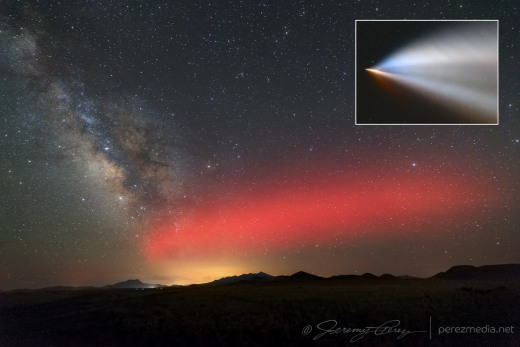
“After the rocket passed overhead, a red fluorescent glow expanded southward and crossed over the Milky Way,” says Perez. “It was visible for almost 20 minutes.”

The red glow is a sign that the rocket punched a hole in the ionosphere–something SpaceX and others have been doing for years. One famous example occured on August 25, 2017, when a Falcon 9 rocket carrying Taiwan’s FORMOSAT-5 satellite created a hole four times bigger than the state of California. On June 19, 2022, another Falcon 9 punched a hole over the east coast of the USA, sparking a display of red lights from New York to the Carolinas that many observers mistook for aurora borealis.

“This is a well studied phenomenon when rockets are burning their engines 200 to 300 km above Earth’s surface,” explains space physicist Jeff Baumgardner of Boston University. “The red glow appears when exhaust gasses from the rocket’s 2nd stage cause the ionosphere to recombine quickly.”

Rocket engines spray water (H2O) and carbon dioxide (CO2) into the ionosphere, quenching local ionization by as much as 70%. A complicated series of charge exchange reactions between oxygen ions (O+) and molecules from the rocket exhaust produce photons at a wavelength of 6300 Å–the same color as red auroras.
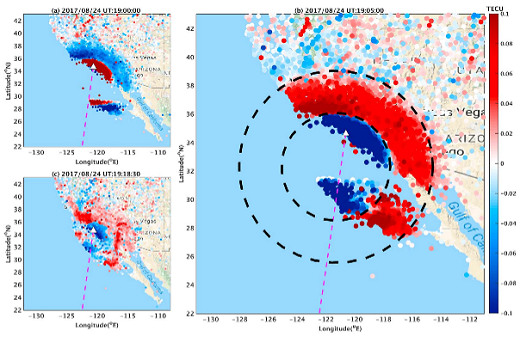

Above: Electron density maps show a hole in the ionosphere formed by a SpaceX rocket in 2017. [more]

“I reviewed footage from the July 19th launch,” says Baumgardner. “It shows the second stage engine burning at 286 km near the ionosphere’s F-region peak for that time of day. So, it is quite possible that an ionospheric ‘hole’ was made.”

Once rare, ionospheric “punch holes” are increasingly common with record numbers of rocket launches led by SpaceX sending Starlink satellites to low-Earth orbit. Ham radio operators may notice them when shortwave signals fail to skip over the horizon, shooting through holes instead of bouncing back to Earth. Sudden GPS errors can also result from the anomalies. These effects may be troublesome, but they are shortlived; re-ionization occurs as soon as the sun comes up again.

Readers, did you see a red glow from this week’s SpaceX launch? Submit your photos here.

more images: from David Blanchard of Flagstaff, AZ (he also saw the red glow); from Dennis Mammana of Borrego Springs, California; from Andrew Corkill of Riverside, California; from Chris Cook of Laguna Beach, California; from Art Brown of San Diego, California;

Realtime Space Weather Photo Gallery
Free:
Spaceweather.com Newsletter
Spaceweather.com


Nature does not have nor make laws. Humans do. Nature has HABITS.

Rupert Sheldrake, PhD mega brilliant natural biologist

CME IMPACT (THE FIRST OF TWO): A CME just hit Earth’s magnetic field (July 20th at 1651 UT): data. This is the first of two CMEs forecasters have been tracking en route to Earth. The second should reach our planet tomorrow, July 21st. The combined effect of these two CMEs could cause G1 to G2-class geomagnetic storms with high-latitude auroras. Aurora alerts: SMS Text

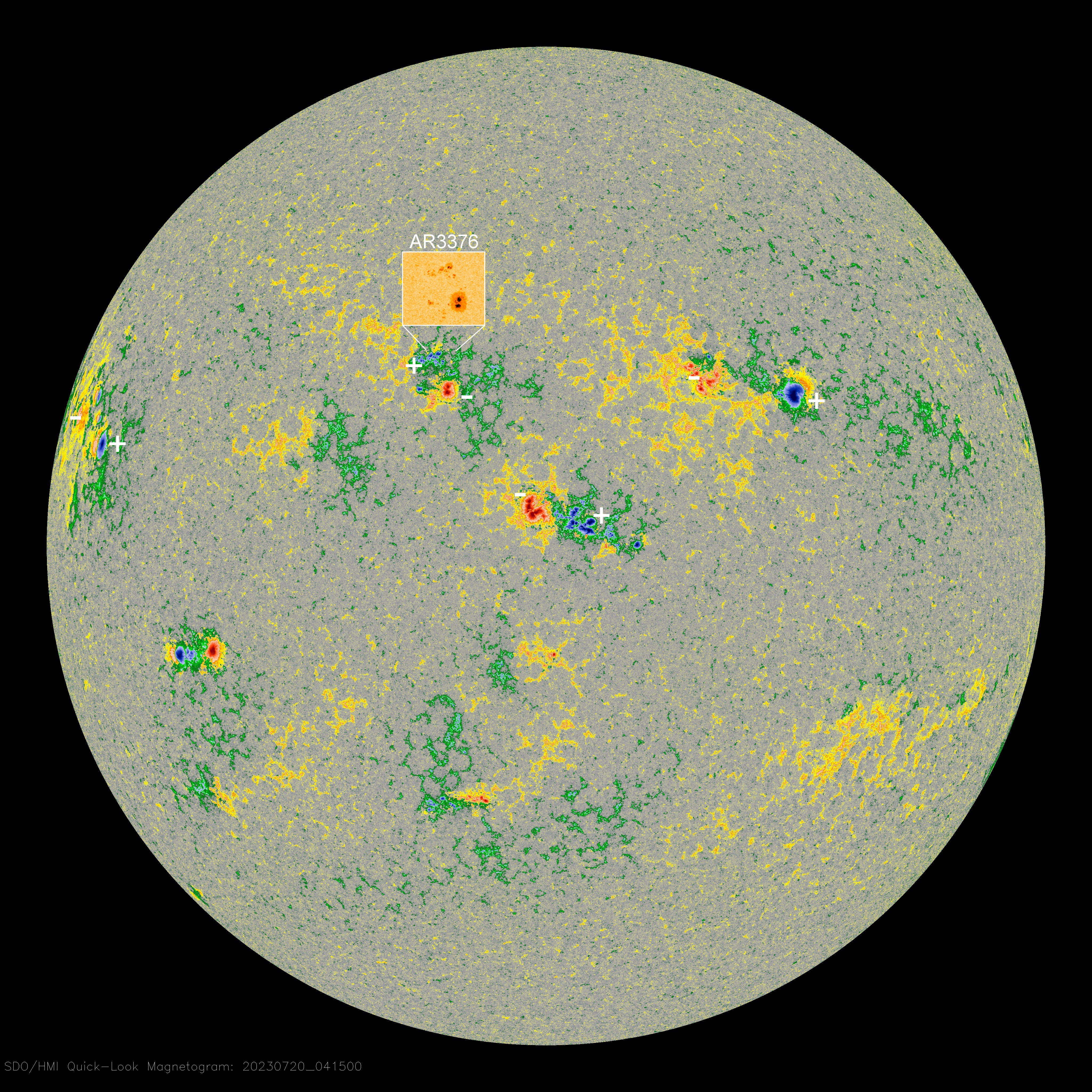
RARE REVERSED-POLARITY SUNSPOT: Sunspot AR3376 is breaking the law: Hale’s Law. Its magnetic polarity is reversed compared to other sunspots in the sun’s northern hemisphere:

(A sunspot can’t break the law. See above. It’s simply changing which nature DOES in evolution. Humans can’t control it, nor should they.)

According to Hale’s Law, Solar Cycle 25 sunspots in the sun’s northern hemisphere should have a -/+ polarity (negative on the left, positive on the right). AR3376 is reversed; its polarity is +/-.

Studies show that about 3% of all sunspots violate Hale’s Law. In most ways, reversed polarity sunspots are totally normal. They have about the same lifespan and size as ordinary sunspots. In one important way, however, they are different.

According to a 1982 survey by Frances Tang of the Big Bear Solar Observatory, reversed polarity sunspots are more than twice as likely to develop unstable magnetic fields in which + and – are mixed together. Reversed polarity sunspots are therefore more likely to explode.

Stay tuned for flares from AR3376. Solar flare alerts: SMS Text

Realtime Space Weather Photo Gallery
Free:
Spaceweather.com Newsletter
Earth is getting a Radiation Storm due to a massive explosion of a sunspot


It will hit Earth by July 20th. This a proton storm, positive charge in line with where we are in the binary polarity of the DNA harmomic, our evolution.

GEOMAGNETIC STORM WATCH: Intermittent G1-class geomagnetic storms are possible for the next 2 days as Earth’s magnetic field reverberates from a series of CME impacts and near misses since July 16th. The storms could intensify to category G2 or G3 on July 20th when a new and more potent CME arrives. See below. Aurora alerts: SMS Text

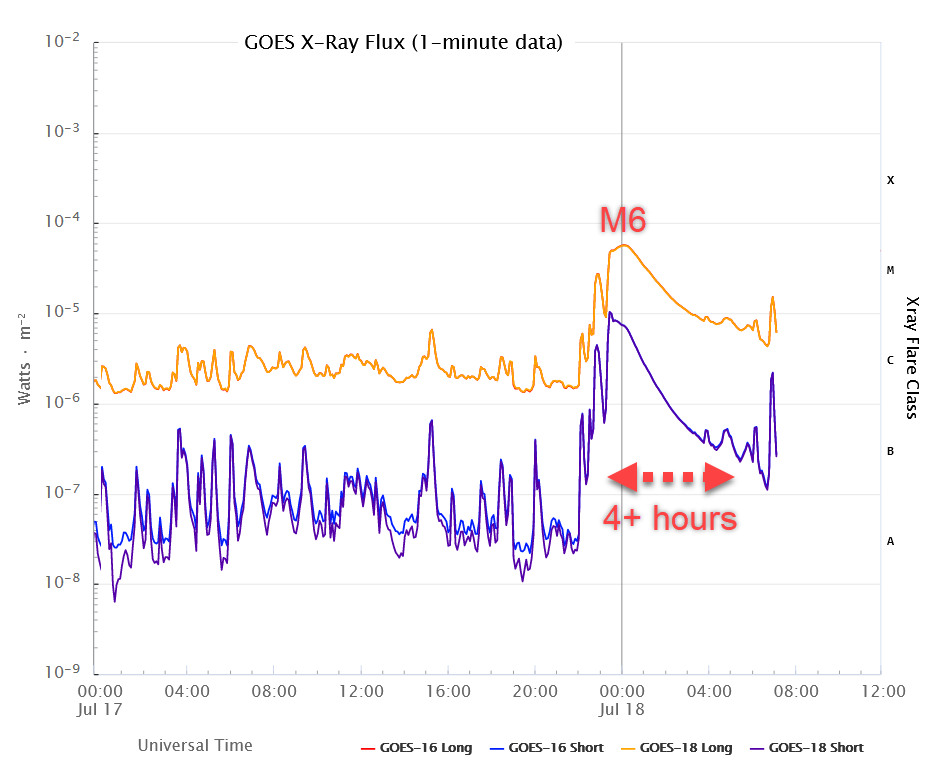
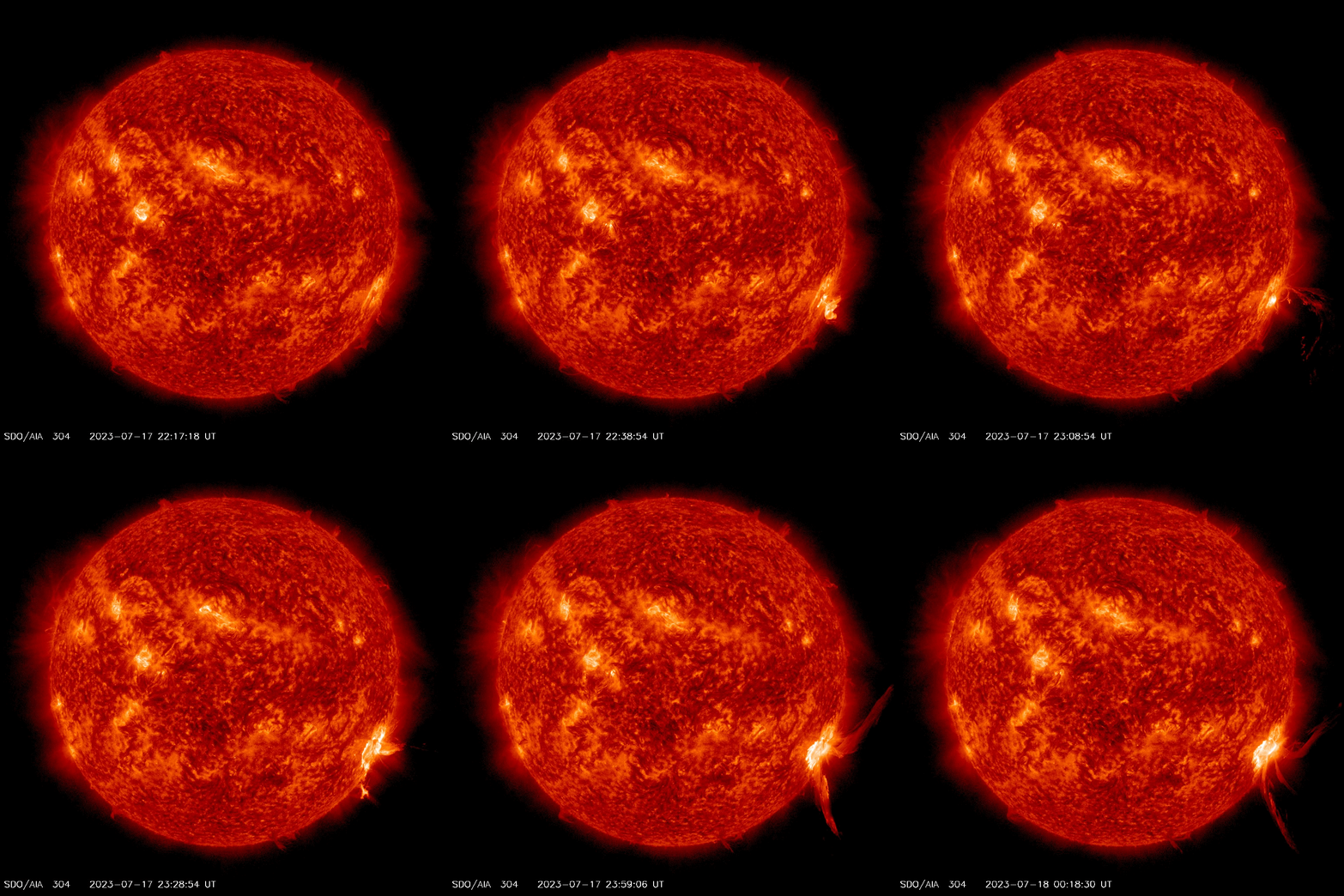
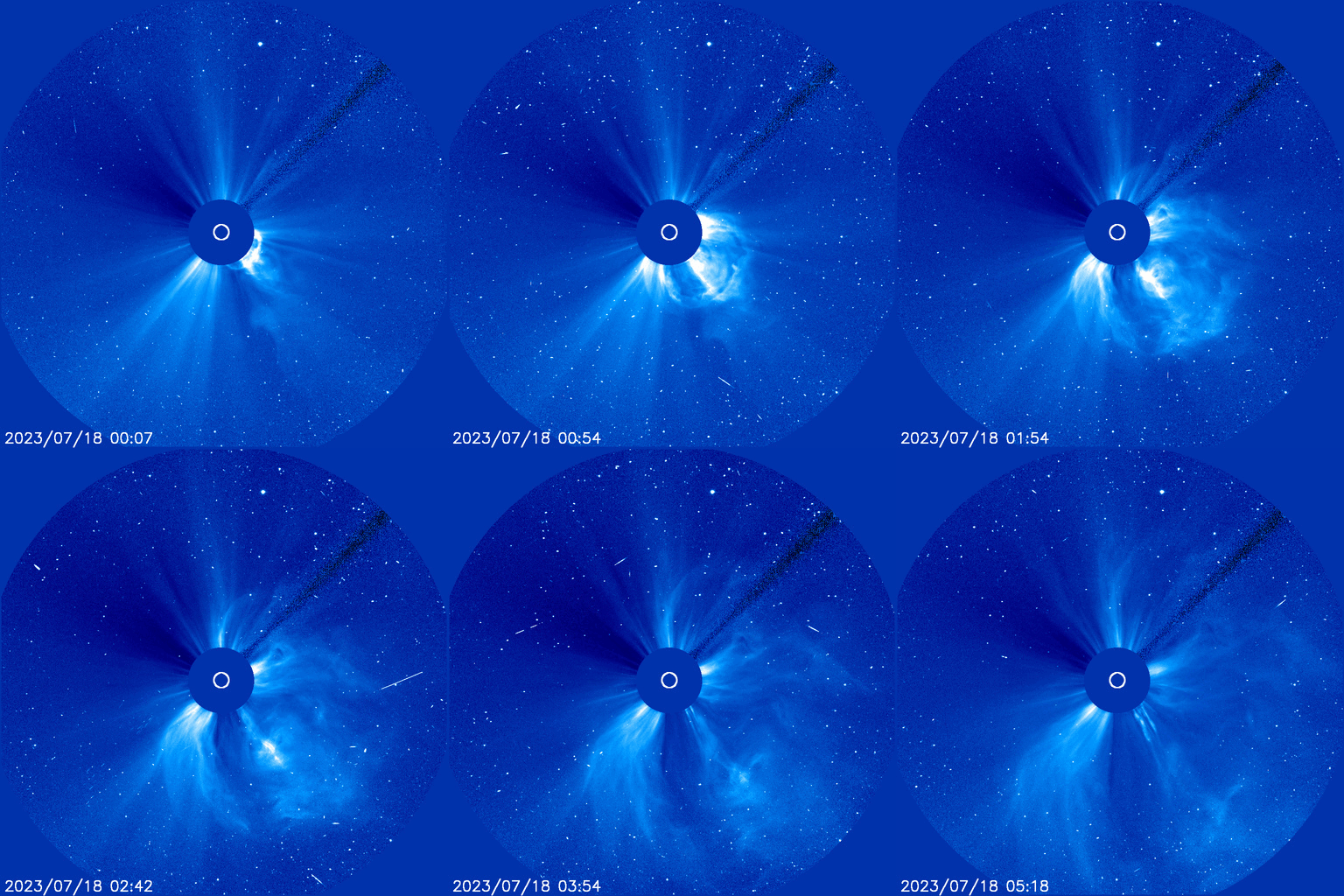
A SIGNIFICANT EXPLOSION ON THE SUN (UPDATED): We’ve been waiting for this. Big sunspot AR3363 just produced a significant solar flare, a long-duration M6-class event during the early hours of July 18th. NASA’s Solar Dynamics Observatory recorded the blast near the sun’s southwestern limb:

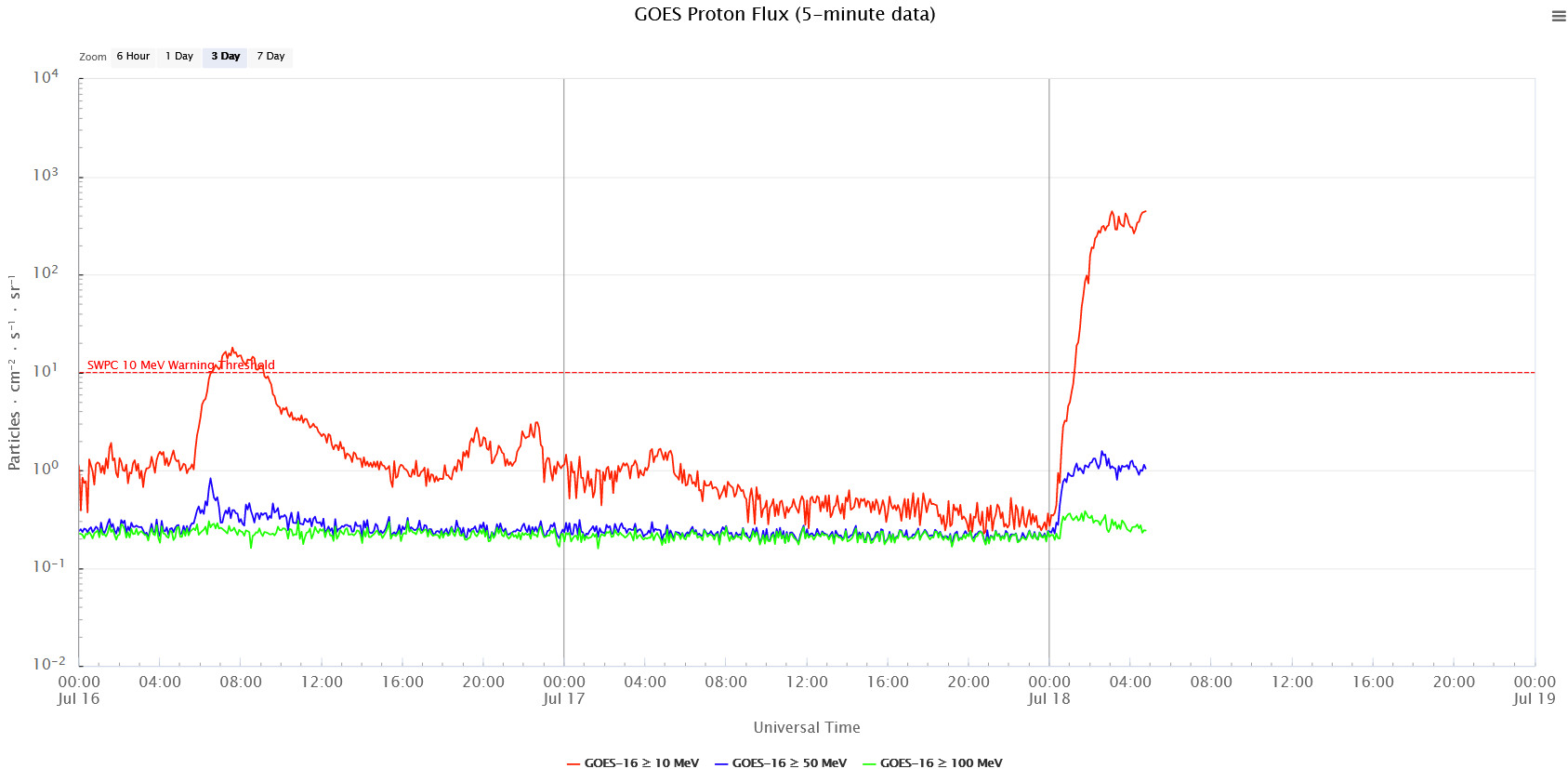
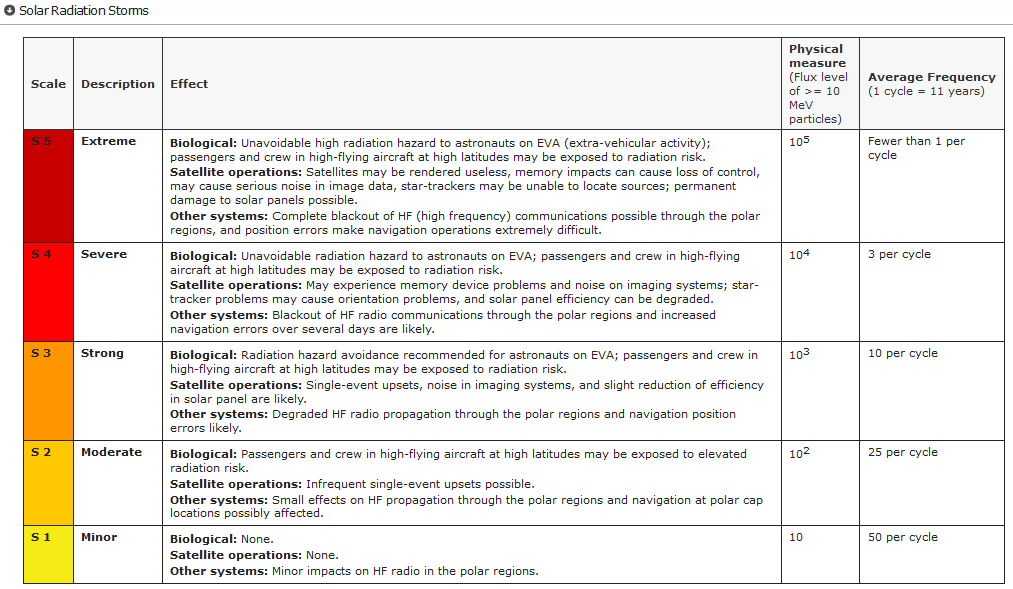
Energetic protons accelerated by the flare have reached Earth and are now peppering the top of our planet’s atmosphere. This is called a “radiation storm.” According to data from NOAA’s GOES-16 satellite, it is a category S2 event.

Although the explosion was not X-class, it was more powerful than many X-flares would be. Why? Because it lasted so long. The flare’s X-ray output was above M5 for more than an hour and above M1 for nearly 4 hours. It had plenty of time to lift a substantial CME out of the sun’s atmosphere.

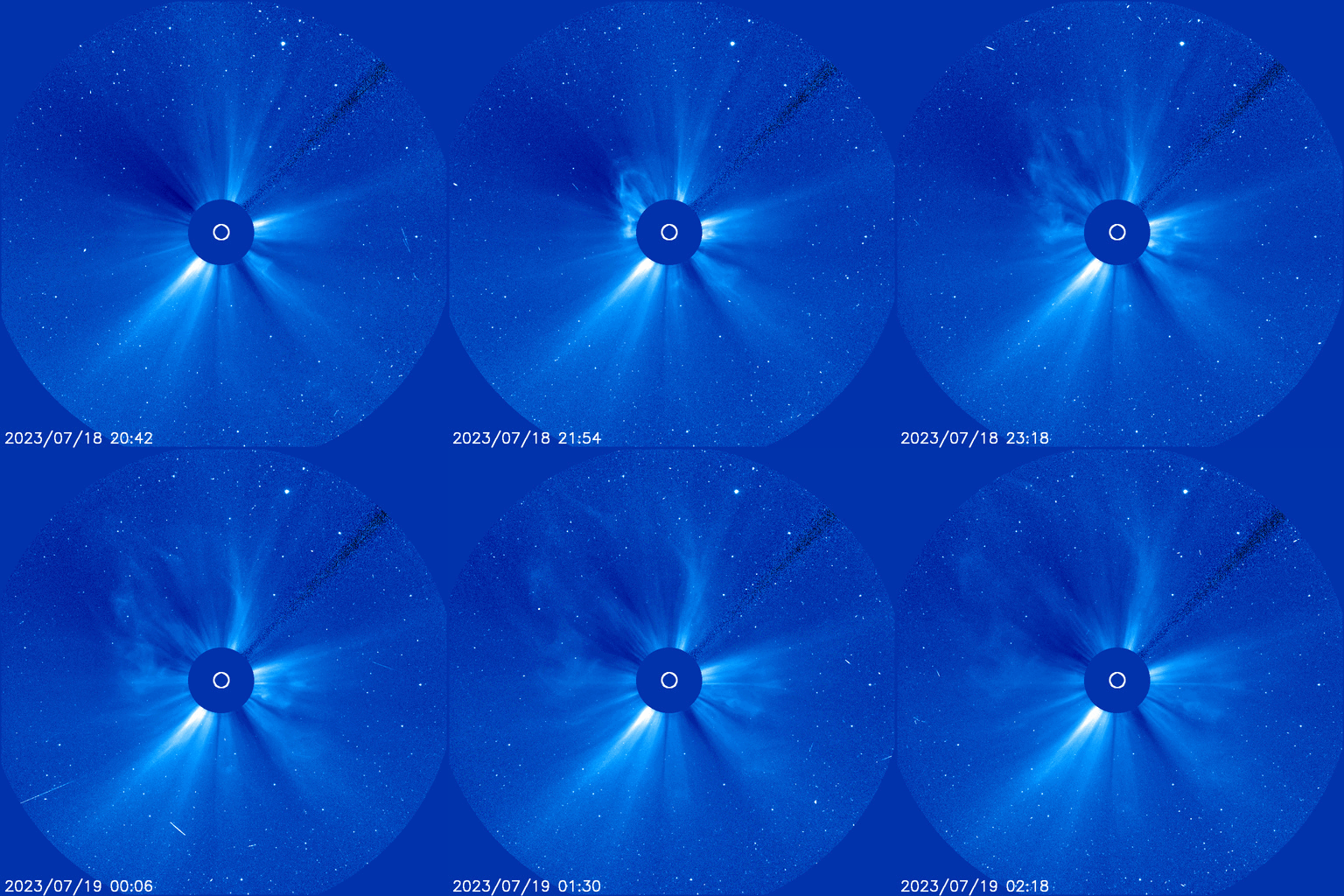
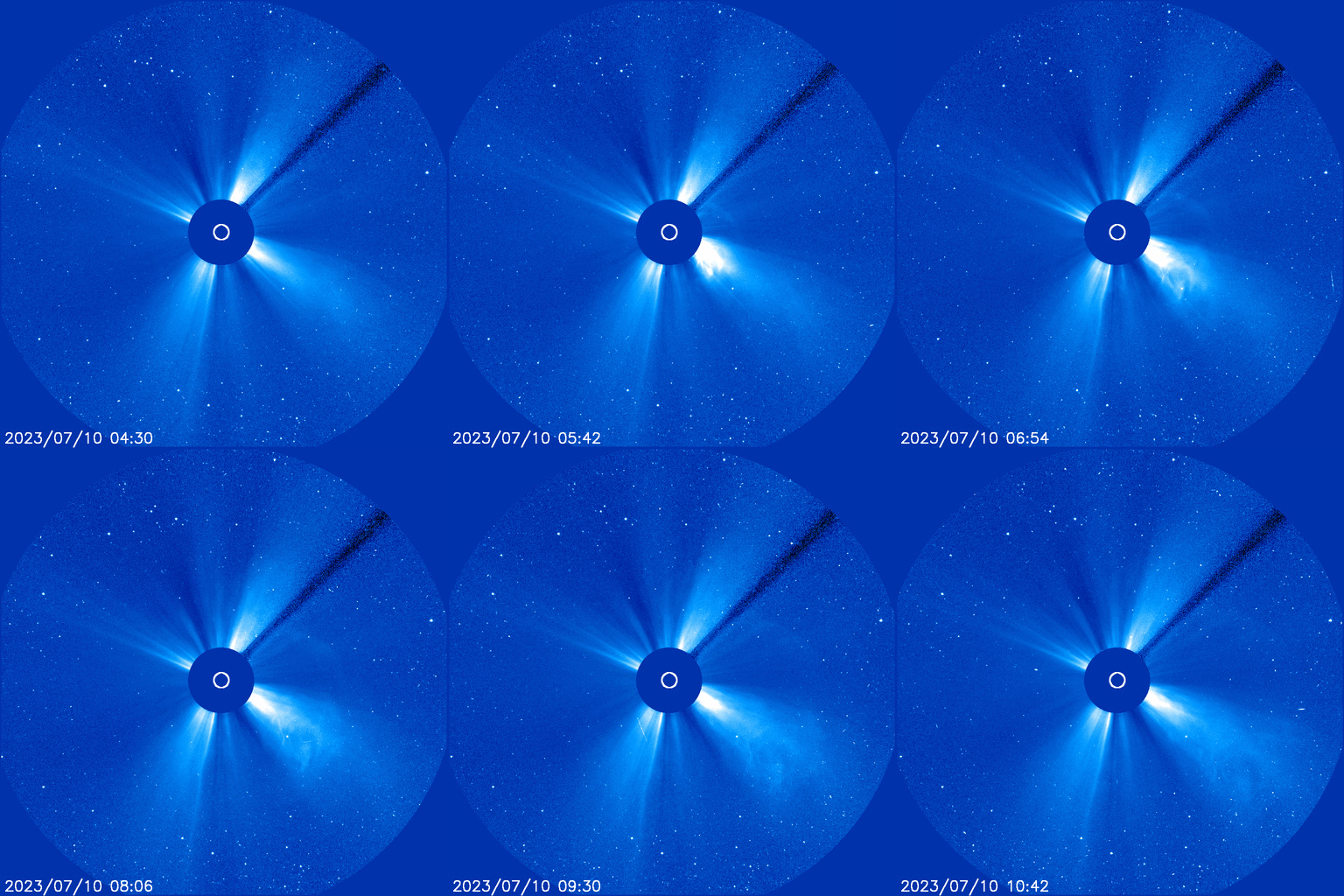
Indeed, SOHO coronagraphs have since detected a bright CME emerging from the blast site:


The snowy speckles in this image are energetic protons striking SOHO’s camera system

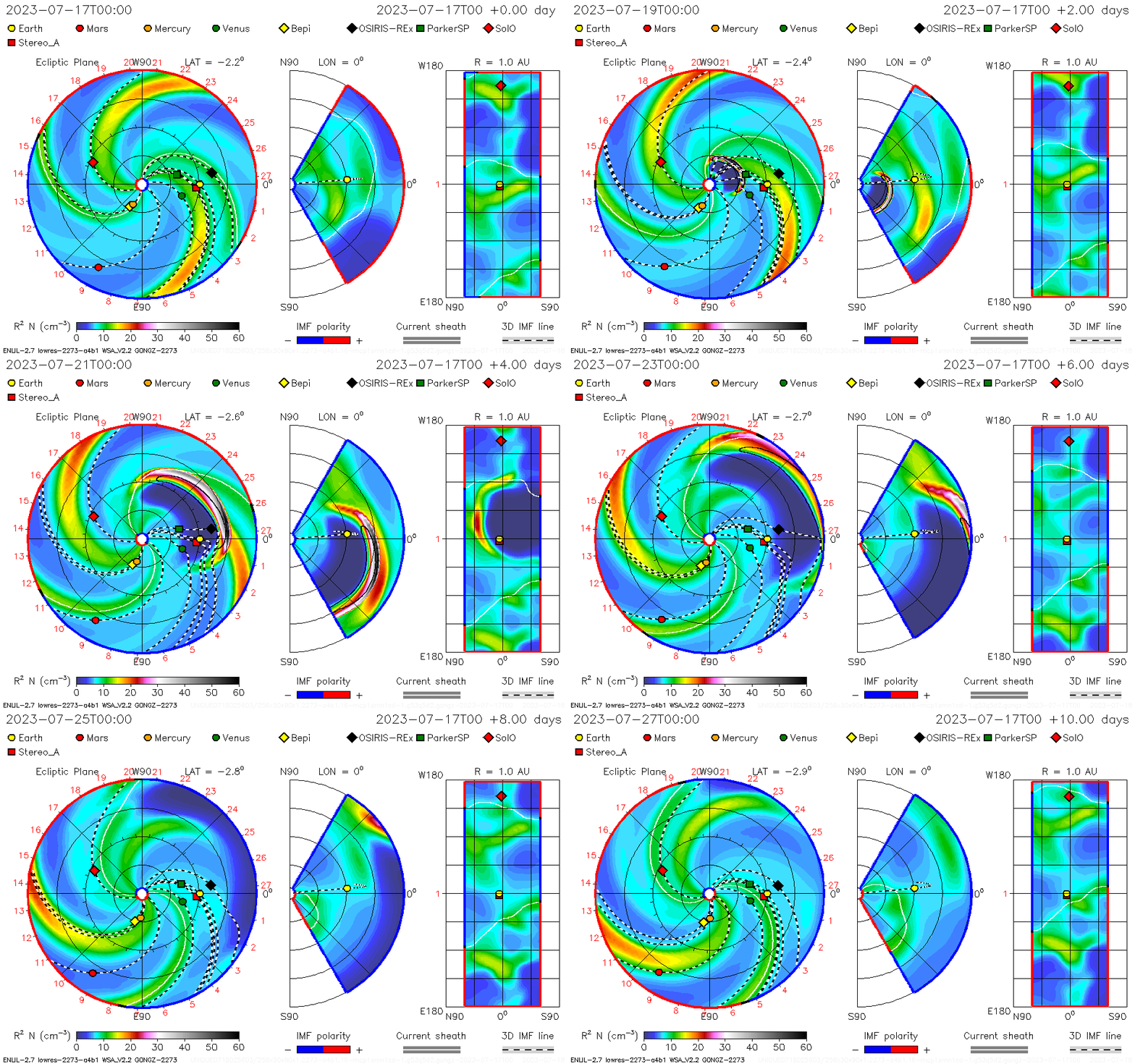
Although the CME is not heading directly for Earth, it appears to have an Earth-directed component. A NASA model suggests it could deliver an effective glancing blow as early as July 20th (0000 UT). NOAA is doing their own modeling, and results should be available soon.

Our preliminary forecast: The CME’s flank will reach Earth on July 20th. Its impact could spark G1 to G2-class geomagnetic storms, with a slight chance of G3. Stay tuned. Solar flare alerts: SMS Text

Realtime Space Weather Photo Gallery
Free:
Spaceweather.com Newsletter
Spaceweather.com for Tuesday, 7/11/23


GEOMAGNETIC STORM WATCH: Minor G1-class geomagnetic storms are possible on July 13th when a CME is expected to pass close to Earth. NASA and NOAA models of the CME give different results. NASA predicts a glancing blow, NOAA a clean miss. Either way, a close encounter could disturb Earth’s magnetic field and produce high latitude auroras. Aurora alerts: SMS Text

IS THIS GIANT SUNSPOT CRACKING UP? Sunspot AR3363 is so big, the Perseverance rover saw it from Mars. Now it might be cracking up. Peter Aniol saw a fissure forming yesterday when he photographed the sunspot from Montlaux, France:

The bright, linear gap dividing the sunspot is known as a “light bridge.” It measures 10,000 km from end to end.

The nature of light bridges is not fully understood. They often herald the break-up of a sunspot, with jets of plasma shooting up from the chasm as the sunspot decays. Some research suggests that magnetic fields at the base of a light bridge are busy cross-crossing and reconnecting–the same explosive process that sparks solar flares.

So which is it? Will the sunspot explode or quietly fall apart? No one can say. Readers with solar telescopes are encouraged to monitor the crack up.

Realtime Space Weather Photo Gallery
Free:
Spaceweather.com Newsletter

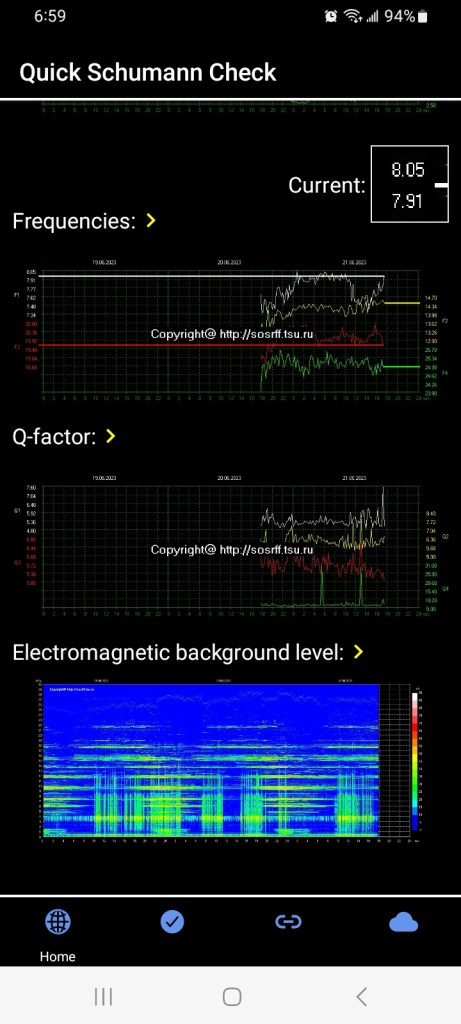
True Time Update for 6/21/23, Blue 9 Solar Storm, 9Tryptophan-7am in MI


We are starting out quite high today both in frequency and amplitude of the frequency. Please note that amplitude indicates SOUND. Electromagnetic energy waveforms make sound.

This is in full synchronicity with the Tzolkin, count of days/people, and tones of creation.

The ScR is monitoring the PSI BANK, the mind of earth as the sacred count of time. It merges exactly as the Haab, the solar calendar, and IChing and the multidimensional spacetime harmonic of evolution left for us by the Maya.

Q FACTOR

Q factors of the Schumann resonances are the factors which represent the sharpness of resonances of the earth ionosphere cavity. (and thus human brains, so you want to know this.) The earth as the lower boundary of the cavity can be recognized as a perfect conductor, while the ionosphere as an upper boundary is a leaky wall which has finite conductivities.

Spaceweather.com for Wednesday

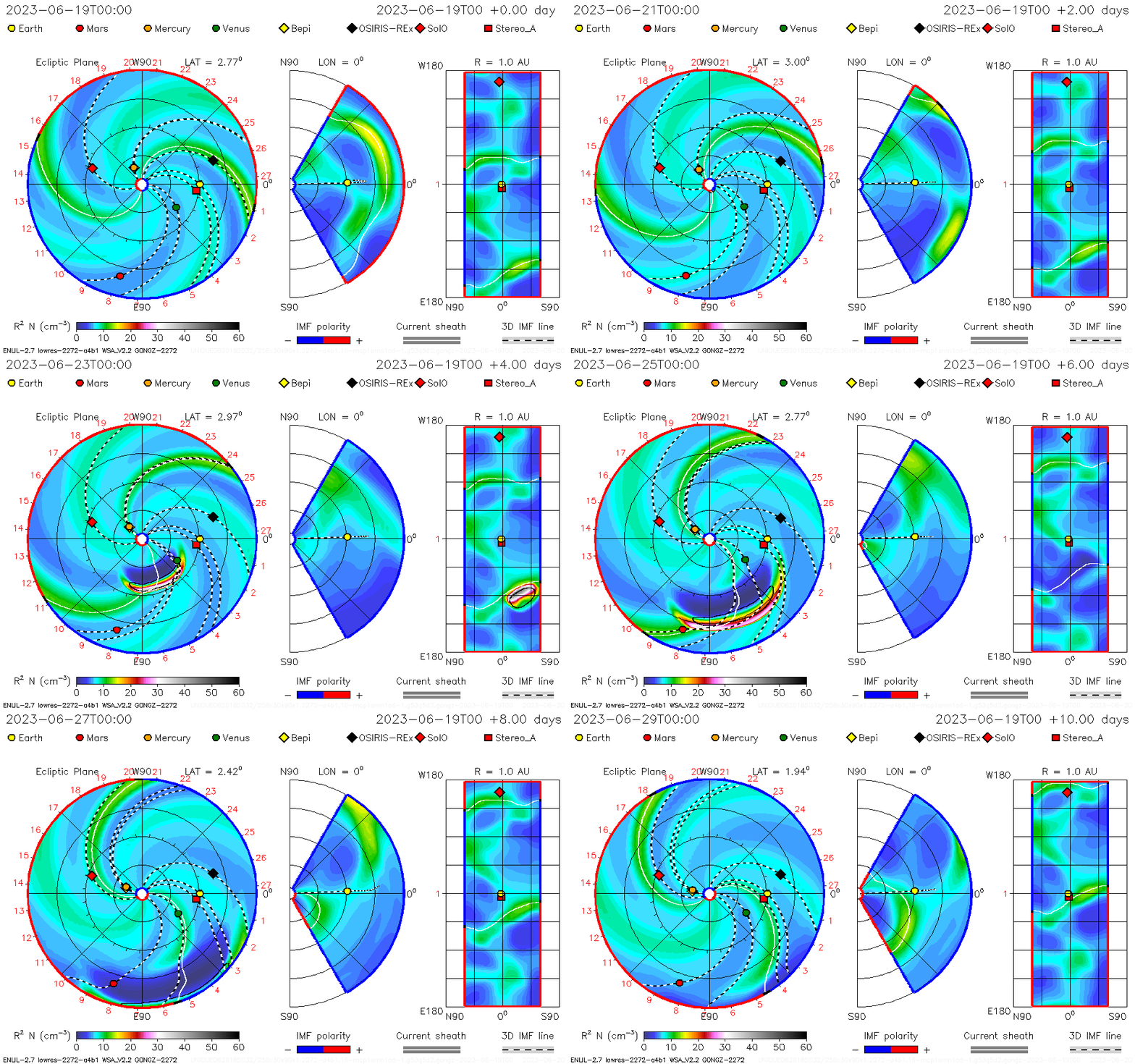
CME TO STRIKE VENUS AND MARS: A CME launched into space by yesterday’s X-flare (described below) may not strike Earth, however, it will hit Venus and Mars, according to a NASA model. The strike on Venus (June 22nd) will probably erode a small amount of the planet’s upper atmosphere, while the strike on Mars (June 25th) could spark auroras visible to MAVEN and other Mars-orbiting satellites.

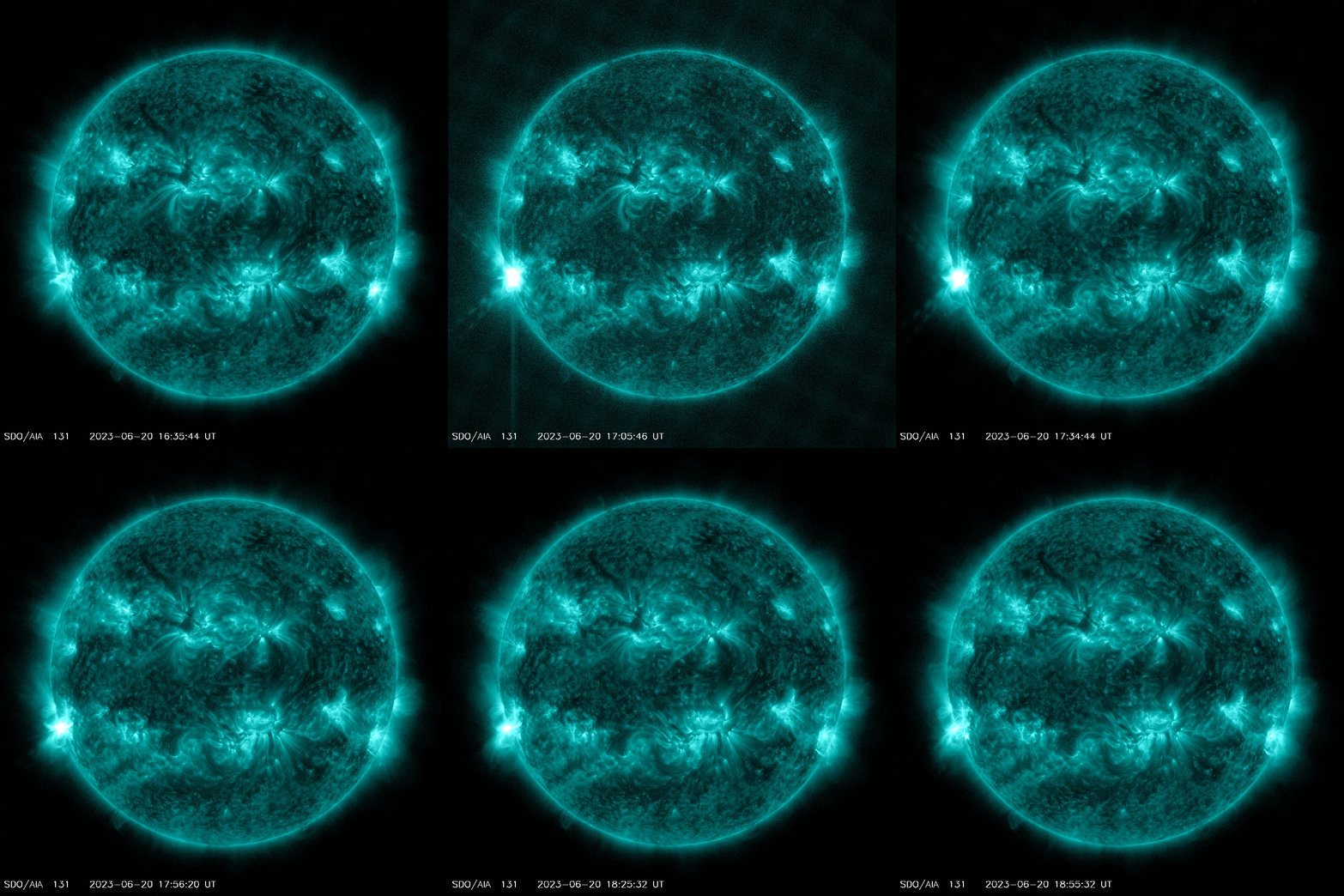
X-CLASS SOLAR FLARE AND CME: New sunspot AR3341 erupted on June 20th, producing an X1.1-class solar flare (1709 UT). NASA’s Solar Dynamics Observatory captured the extreme ultraviolet flash:

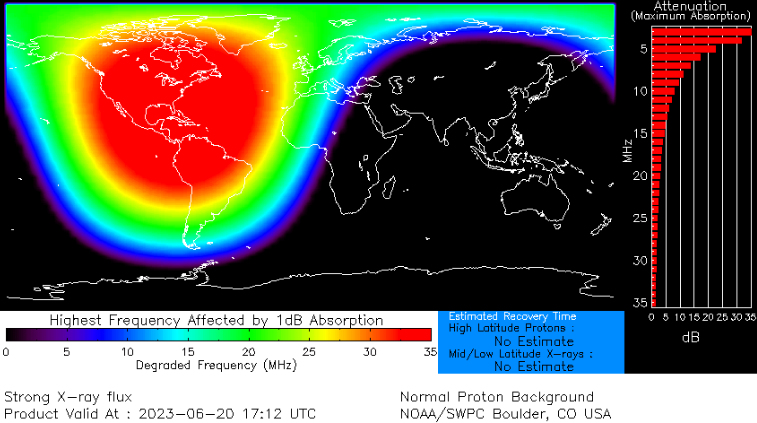
Radiation from the flare ionized the top of Earth’s atmosphere. This caused a deep shortwave radio blackout over North America: map. Aviators and ham radio operators may have noticed loss of signal at frequencies below 30 MHz for as much as 20 minutes after the flare.

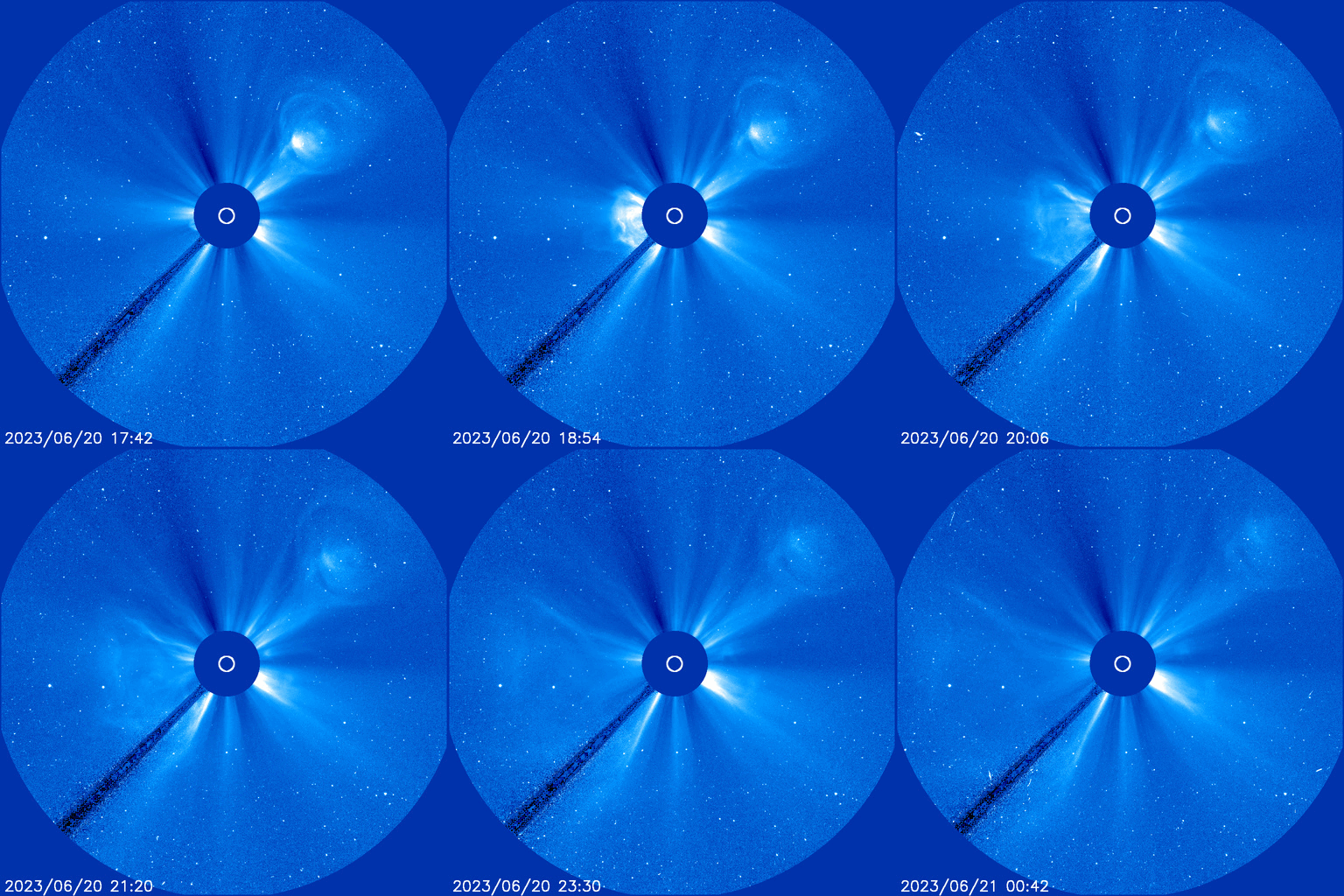
SOHO coronagraphs have since detected a CME. It is the fan-shaped cloud expanding away from the sun’s southeastern limb (8 o’clock position):

The CME’s expansion velocity exceeds 1000 km/s (2.2 million mph), according to Type II radio bursts detected by the US Air Force. It’s a fast mover that should deliver a potent blow to whatever it hits.

Earth is probably not in the strike zone, although a glancing blow may be possible on June 22nd or 23rd. Confirmation awaits modeling by NOAA forecasters. Solar flare alerts: SMS Text

Do X Class Solar Flares affect the ScR?

Yes.

It has been shown that an increase in the resonant frequency is proportional on the average to the logarithm of the X-ray radiation intensity to the power of 1.7. The magnitude of changes in the cavity frequency is related with the corresponding changes in the characteristic “magnetic” height of the conductivity profile of the lower ionosphere and compared with the results of the independent analysis performed by measuring VLF radio signals.

Article-“The Effect of Solar Flares on the ScR from Harvard Univ.
https://ui.adsabs.harvard.edu/abs/2017R%26QE…60..186S/abstract

This is even more nerdy/techy.

https://www.spaceweather.gov/

3D Astrology, in line with the I Ching and 4D Tzolkin lineup;

All Zodiac Signs
The sun is now in ♋️ Cancer
  • The Sun moves into Cancer today, marking the solstice. Until July 22nd, we are self-protective and insular. Our attention turns to our nests–our families, homes, base of operations, and anything that makes us feel safe and secure. Nurturing and caring for loved ones and pet projects become a sharper focus. We’re more invested in our personal lives in the month ahead.
  • This morning, before the Sun leaves Gemini, it forms a quincunx to Pluto, which can complicate decision-making. An adjustment may be necessary before we feel we’re moving forward. (100% sync with Blue 9 Torm mediated by PLUTO In 4D)
  • There may be a power shift or a setback that has us feeling temporarily out of sorts or powerless, prompting us to make changes. We might need to let something go to further our psychological growth.
  • However, as the day advances, Mercury forms a sextile to Mars, and then Chiron (Mars and Chiron are heading toward a trine aspect), and our minds engage. (100% sync with our antipose Red 9 Moon mediated by Mercury).
  • We want to do something with our ideas, learn, teach, or debate. We are exceptionally alert, resourceful, and aware. There is enthusiasm in our conversations and excitement about our interests and discoveries. We approach problems holistically, and our problem-solving skills run high.

Spaceweather.com


“Actually, it doesn’t take a strong solar storm to cause problems. In Feb. 2022, a minor geomagnetic storm dumped enough heat into the thermosphere that 38 newly launched Starlink satellites fell out of the sky. SpaceX has since started launching their Starlinks to higher initial altitudes to avoid the drag.
If current trends continue, the thermosphere will warm even more in 2023 and 2024. This is a matter of concern because Earth’s population of active satellites has tripled since SpaceX started launching Starlinks in 2019. The growing constellation of 4100 Starlinks now provides internet service to more than a million customers. An extreme geomagnetic storm like the Halloween Storms of 2003 could shift the positions of these satellites by many 10s of kilometers, increasing the risk of collisions and causing some of the lowest ones to de-orbit.
Stay tuned as the warming continues.”

6/3/23 Spaceweather NOAA

Auroras Galore at Low Latitude Because…


No one has said this, but I am going to. The poles of Earth are shifting, and the ringing in my brain is off-putting.

Keep in mind that as you look at the Tzolkin, the red light-time, 52-day cycle comes first, and the green light-time cycle 52-day cycle comes LAST.

We are currently in the red light cycle, but the green light hovers over all of the 5gdorce kin for now. I post that daily.

Spaceweather.com

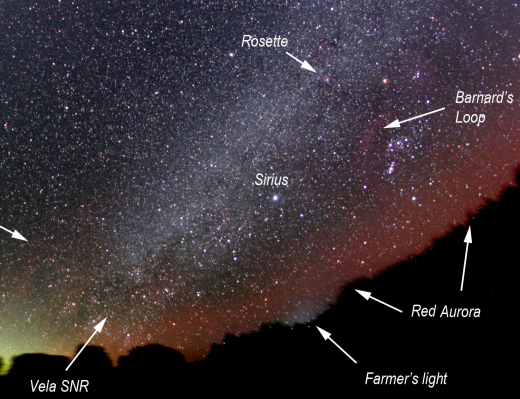
RED AURORAS OVER FLORIDA (AND ELSEWHERE): This hasn’t happened in nearly 20 years. On March 24th, auroras descended all the way to Florida. Bill Williams photographed their red glow from the Chiefland Astro Village:

What in the world? Normally, we have a very dark horizon looking out over the Suwannee River Basin and Gulf of Mexico,” says Williams. “But my 26-minute exposure taken to capture the Winter Milky Way showed an unusual red glow.”

“The mystery was solved the next day as Spaceweather.com described a severe geomagnetic storm well-seen in the U.S. As far as I know, at 29.4 degrees north latitude, we are the farthest south this aurora has been witnessed, and is the first I have seen here in Florida since 2003 and 1989!”

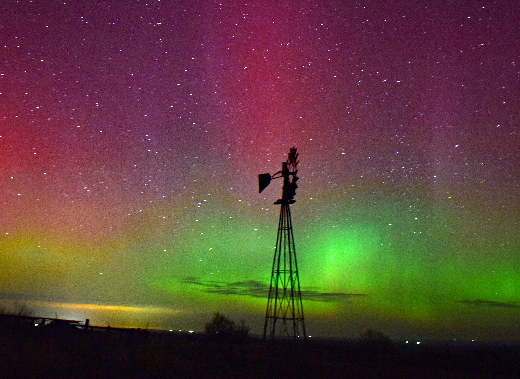
Most auroras are green, yet when auroras spread to low latitudes, the sightings are almost always red. There’s a simple reason. Ordinary green auroras come from oxygen atoms about 150 km above Earth’s surface. Red auroras are also caused by oxygen, but much higher up, between 150 km and 500 km.

This picture taken the same night by Dean Cosgrove of Curtis, Nebraska, (+40.6N) nicely illustrates the red-on-green altitude structure:

From far-south places like Florida, the greens are eclipsed by the northern horizon, leaving the higher reds to dominate the display.

Other notable sightings of low-latitude red auroras during last week’s storm include New Mexico (+32.8N), North Carolina (+36.5N), Colorado (+40.4N), and California (+39.7N).

Did *you* see red? Submit your photos here. Aurora alerts: SMS Text.

Note: Unrelated to auroras, another red glow called “airglow” can also be seen sometimes at low latitudes. Indeed, on any other night, airglow would be a leading explanation for what Williams photographed. But on March 24, 2023, during an extreme geomagnetic storm, with other red auroras being seen only a few degrees away, auroras are the most likely explanation.

Realtime Aurora Photo Gallery
Free:
Spaceweather.com Newsletter

AURORA DUNES SEEN DURING EXTREME STORM: Lots of unusual things were seen during last week’s extreme geomagnetic storm. Alan Dyer of Gleichen, Alberta, photographed one of them, shown here in a deep twilight photo at te onsett of the storm:

“I captured some ‘aurora dunes,'” Dyer says. “They are the horizontal green ripples to the left of Venus and the Moon.”

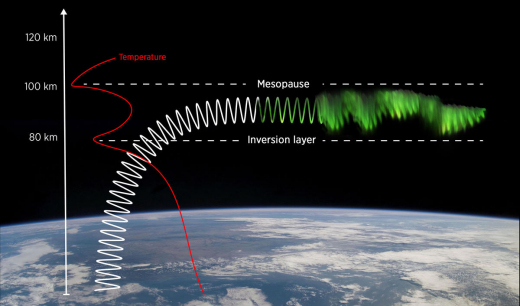
Aurora dunes are a recently identified form of Northern Lights named after their resemblence to ripples in desert sand. Researchers first explained them in a paper published only a few years ago. The dunes are a “mesospheric bore,” a type of atmospheric gravity wave that springs up from Earth’s surface and gets caught in a thermal waveguide ~100 km high. When solar wind particles rain down on the bore, they illuminate its rippling structure.

Sky watchers in the Arctic have been seeing dunes for years without understanding what they were. A breakthrough came on Oct. 7, 2018, when multiple groups photographed dunes from widely separated locations in Finland. Triangulation revealed the dunes to be ~100 km high with a pure, monochromatic wavelength of about 45 km.

This is a new field of study with potential for discovery. Monitoring aurora dunes may reveal previously hidden waves and waveguides at the boundary between Earth and space. If you see any, submit your photos here.

Realtime Aurora Photo Gallery
Free:
Spaceweather.com Newsletter