
Astronomers Capture Supermassive Black Hole Eruption Near Earth Spanning 16 Times the Full Moon in the Sky

Synchronicity is the Source of Consciousness
Time is the strands of past and future in our DNA, not the hands of time on a clock
Corey Goode told us this 6 years ago from observing off-planet portal systems and the cosmic web.
The Mayan Tzolkin projected through the sun onto the earth’s Psi Bank creates the aurora borealis.
The same projection IS your DNA. Every cell of our body is an aurora borealis. We just need to acknowledge it and focus it. We don’t need A.I.
https://www.cnn.com/2021/10/29/weather/northern-southern-lights-us-europe-wx-scn/index.html
This is done by taking care of our own bodies and being a good example to others, simply sharing or teaching rather than nagging or prodding. It’s important for people to choose it for themselves rather than you doing it for them. Human nature is to rebel against that.
Since the body IS TIME, we now understand that the balance between a past mindset and a future mindset is what creates synchronicity that we can observe around us in the matrix but especially in our own lives with family and friends. Synchronicity with people and events is like breathing or the change between light and dark. It’s completely natural.

Synchronicity is apparent and balanced constantly when there is a balance between the CA, civilizational advance strand, and the AC or aboriginal continuity strand of our DNA. In my opinion, our society has gotten far out of balance because of spending too much time dwelling on and rehashing THE PAST instead of creating our own future. Each individual needs to do this. I saw this saying yesterday.
The mediating planet is URANUS which rules Aquarius. The Moon is in Cancer. Mercury and the Moon form aspects to NEPTUNE that increase inspirational communication. This is in synchronicity with the ANALOG; White 5 Radiant Wind.
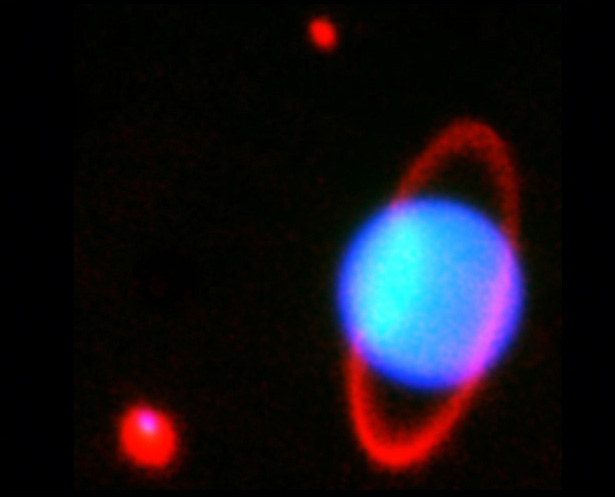

“Mystery Radio Waves Coming From Unknown Object in the Galaxy’s Center”
Giving earth Creative Tones tones 14 to 26 to diversify us further? Just an idea.💡
One of Saturn’s Moons; A water based one.
Note at 5:50 where he talks about amino acids present on the moon. I mentioned in a previous post that they are present on all of the planets and moons.
Saturn mediates Yellow Warrior ∞ Blue Night or Histidine and Alanine
Time is the strands of past and future in our DNA, not the hands of time on a clock



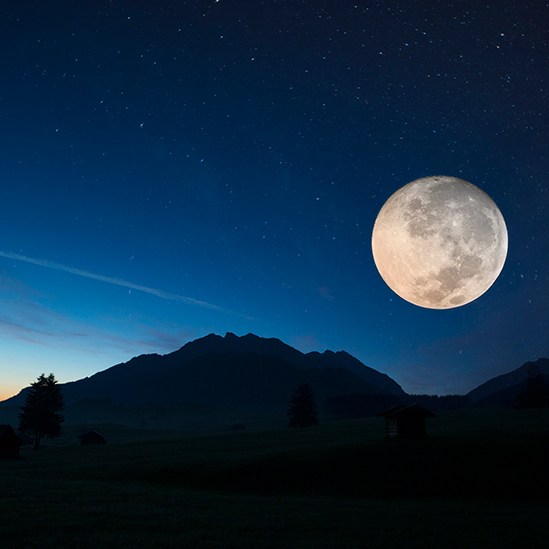
This enhancement was discovered by Edward Appleton in 1946. Credit: NASA’s Scientific Visualization Studio
This is a visualization of the Equatorial Fountain process in the ionosphere, whereby ions are driven away from the equator forming ion density enhancements to the north and south of the equator. Ions are just positive and negative charged particles.
This visualization is depicted near 50 degrees west longitude, where the magnetic equator crosses the geographic equator. (Yellow Warrior Time Portal?) Magnetic field lines near Earth are represented by the gold lines. Particles appear in a blue-white flash, representing the point where atoms are ionized, becoming positively charged (a proton) and releasing an electron (negative charge).
Now these charged particles can ‘feel’ the near-Earth electric and magnetic fields. Their motion becomes a combination of circular gyromotion due to the magnetic field and E-cross-B drift. At higher altitudes, the electric field is weaker, reducing the vertical motion, and the ion motion becomes dominated by the magnetic field and gravity, allowing the ion to ‘slide’ down the magnetic field line back to Earth.
At lower altitudes, the ions combine with free electrons in a process called recombination, represented by a red flash and fading of the particle trail. A slice of data from the IRI (International Reference Ionosphere) model represents the density of singly-ionized oxygen atoms is faded-in to compare to the particle motion. Red represents high ion density, green represents low ion density.
The camera finally pulls out from Earth, providing an overview of the enhanced ion density (red) above and below the magnetic equator on the dayside of Earth.
This enhancement was discovered by Edward Appleton in 1946. Credit: NASA’s Scientific Visualization Studio
This is a visualization of the Equatorial Fountain process in the ionosphere, whereby ions are driven away from the equator forming ion density enhancements to the north and south of the equator. Ions are just positive and negative charged particles.
This visualization is depicted near 50 degrees west longitude, where the magnetic equator crosses the geographic equator. (Yellow Warrior Time Portal?) Magnetic field lines near Earth are represented by the gold lines. Particles appear in a blue-white flash, representing the point where atoms are ionized, becoming positively charged (a proton) and releasing an electron (negative charge).
Now these charged particles can ‘feel’ the near-Earth electric and magnetic fields. Their motion becomes a combination of circular gyromotion due to the magnetic field and E-cross-B drift. At higher altitudes, the electric field is weaker, reducing the vertical motion, and the ion motion becomes dominated by the magnetic field and gravity, allowing the ion to ‘slide’ down the magnetic field line back to Earth.
At lower altitudes, the ions combine with free electrons in a process called recombination, represented by a red flash and fading of the particle trail. A slice of data from the IRI (International Reference Ionosphere) model represents the density of singly-ionized oxygen atoms is faded-in to compare to the particle motion. Red represents high ion density, green represents low ion density.
The camera finally pulls out from Earth, providing an overview of the enhanced ion density (red) above and below the magnetic equator on the dayside of Earth.
There are so many synchronicities with my Tzolkin research in this! And Dr. Luc Montagnier, Nobel winner molecular biologist is brought up. He worked with my friend, Dr. Chavez.
https://www.gaia.com/share/ckszbub8h000x0jpndz6f6iwl?rfd=RQvcgo&language[]=en

Saturn rules Capricorn and mediates Yellow Warrior-Histidine ~ Blue Night Alanine.
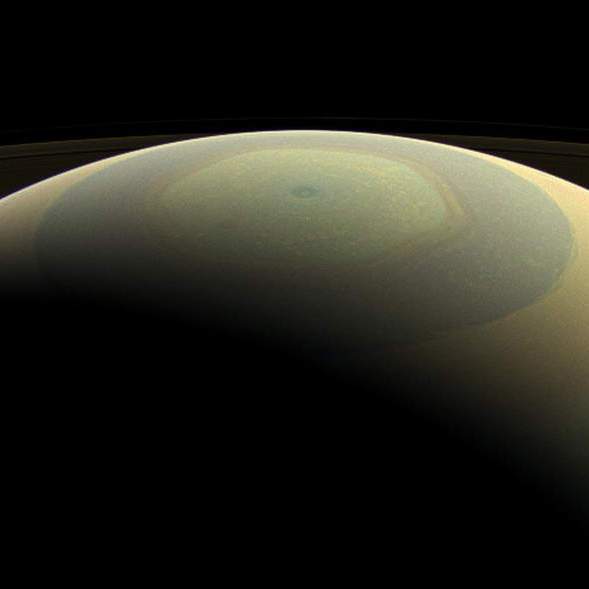
Dec. 5, 2010, the date they saw the huge “serpentine storm” on Saturn was Red 7 Resonant Dragon. Major synchronicity.
They all keep wondering where the changes are coming from. All Sentient DNA in our local system! My opinion; Physicist David Bohm’s bridge between implicate and explicate order connects galactic center to the interplanetary holon, all 10 planets. They all have Psi Banks and they all function according to the binary triplet configuration where the Zone of Transformation is in the middle, then there is a N. Polar Zone and S. Polar Zone.
The planets own Psi Bank regulates how Time moves on each planet according to the role it plays in the Tzolkin Harmonic. And of course they all regulate two archetypes or amino acids for evolution of life in our particular solar system. 13:20.
Saturn played a key role in keeping our species together after the Tiamat blowup. The changes are occurring bc it’s role for us is changing with our ascension. We no longer need its control.
David is Yellow 10 Planetary Seed.
In the Tzolkin Harmonic, Mercury mediates Red Moon Methionine (right foot) and White Dog Aspartic Acid (left foot).
I think it acts as a vitamin for the Interplanetary Holon the same way our Body Holon needs supplementation.
BY ARJUN WALIA AUGUST 10, 2021 36 SHARES 3 MINUTE READ

Martin Bernardi, CC BY-SA 4.0 , via Wikimedia Commons36Shares36
A study published in the Journal Space Exploration in 2016 provides an in depth analysis of images taken from Apollo 15 as well as the Lunar Reconnaissance Orbiter. According to the authors, there appears to be “two unusual features in the crater Paracelsus C on the far side of the moon,” the side that is never visible from Earth. By combining multiple images it becomes clear to them that what they are looking at are two walls “on either side of a narrow valley or passageway.”
Using single image shape from shading and 3D terrain visualization we show in a computer generated perspective view looking northeast that the southwest end appears to be the entrance to the passageway. A reverse angle view looking southwest shows the passageway ending at a rise of terrain at the other end, possibly leading underground. The terrain surrounding the two structures is not flat but appears “excavated ” by some unknown mechanism, natural or artificial. It is shown that these objects are visually different from the lunar background because their underlying structure is different.
The paper provides evidence supporting the hypothesis that certain features in the crater Paracelsus C on the far side of the moon may be artificial in origin.
The idea that these “passageways” may lead underground on the Moon correlates with the idea that the Moon may in fact be hollow, or at least partially. According to MIT’s Sean C. Solomon:
“The Lunar Orbiter experiments vastly improved our knowledge of the Moon’s gravitational field…indicating the frightening possibility that the Moon might be hollow.”
This was as far back as 1974, and it’s been a common theme. It arises due to the fact that we know very little about the Moon and all of the other moon’s within our solar system. That being said, the majority of scientific evidence points towards a solid Moon, but that doesn’t mean artificially built compartments within it are not a possibility.
The paper concludes by stating:
“Based on the evidence presented in this paper we believe this area in Paracelsus C is one such candidate that is worthy of future study by orbital missions and surface rovers. Both of the features analyzed in this area are statistically different from the surrounding terrain.”
Mark J. Carolotto, one of the authors of this paper, is an image scientist with almost 40 years of experience in satellite remote sensing, image analysis, digital image processing, satellite imaging, remote sensing and pattern recognition. He studied optics, signal and image processing at Carnegie-Mellon University from 1972-1981 where he received his Ph.D. in electrical engineering, and he works within the aerospace industry. He has authored and co-authored many peer-reviewed papers prior to this one.
On his YouTube channel, he provides some images from the paper in a video titled “Unusual Structures On The Far Side of The Moon.”
Reports and hypothesis about artificial structures on the moon are quite common, and have been a common theme for quite some time. In 1963, during the early years of SETI, Carl Sagan spoke about the possibility of extraterrestrial visitation, as pointed out by the study:
It is not out of the question that artifacts of these visits still exist, or even that some kind of base is maintained (possibility automatically) within the solar system to provide continuity for successive expeditions. Because of weathering and the possibility of detection and interference by the inhabitants of the Earth, it would be preferable not to erect such a base on the Earth’s surface. The Moon seems one reasonable alternative. Forthcoming high resolution photographic reconnaissance of the Moon from space vehicles – particularly the back side – might bear these possibilities in mind.
A number of books have been written over the years contemplating the subject. Amateur astronomer George Leonard’s 1976 book, Somebody Else is on the Moon is one example. Fred Steckling’s 1981 book, We Discovered Alien Bases on The Moon is another, and there are many more.
Fast forward to today and it’s hard to find solid evidence for structures on the Moon, but there are some strange leaks and testimony from people with interesting backgrounds that does make one ponder.
For example, a classified document published by Wikileaks clearly implies that the United States had a “secret” base on the Moon that was destroyed by Russia. The idea that this is, or was a reality, is strengthened given the fact that the U.S. government had plans to build a base on the Moon. Perhaps they already did? The leak from Wikileaks is dated 1979, a document from the government’s own publishing office from 1966 clearly shows one of the goals of the United States government was to build a base on the moon.
A memorandum that was addressed to the CIA director regarding “Military Thought (Top Secret)” by Lieutenant General Korenevskiy highlights this point even more. It also appears to be from the 1960’s:
“Already, interest in the moon is not limited to a study of questions and a discussion of discovered potentialities. Specific projects are being worked out which propose the construction of various structures under the surface of the moon from the freight compartments of missiles, and also the employment of various versions of pneumatic structures. The U.S. Army Corps of Engineers and also various American companies (“matin”, “Aerospace”, etc), are conducting a great deal of work in this direction.
Another document that compliments the Wikileaks one, also from the 1960’s comes from the CIA keeping tabs on Soviet space plans, a portion of it reads as follows:
“The soviets have additionally stated their intention to establish a lunar base subsequent to manned lunar landing…If Society manned lunar landing is undertaken as a follow-on to extensive earth orbital operations and instrumented exploration of the moon, it is likely that they will enjoy some advantage in the establishment of a lunar base….It is possible that a late lunar landing may be followed fairly rapidly by the establishment of a Soviet base on the moon.”
The idea that humans may have built structures on the Moon, or perhaps intelligent extraterrestrials currently or in the past, is a hypothesis contemplated by many. So why do so many see this as ridiculous? Well, perhaps it simply isn’t talked about. But this is a deeper question for later.
I found it curious that the authors of the paper state the following:
A decidedly conservative mainstream scientific establishment often rejects anomalies based on subject matter alone, i.e., there cannot be alien artifacts on the moon because there are no alien artifacts on the moon (or other planets). Such a view is an example of circular reasoning, based on the belief that extraterrestrials do not exist, or if they do exist that they could not have traveled to our solar system.
How much do our beliefs and perceptions about our world limit and hinder our ability to discover and acknowledge ideas and results that may not “fit the frame?” How much do we limit our consciousness and perceptions about our world, who we truly are, and what we are capable of as a result of our belief? Why are we mostly determined to say “this is the way things are.”
That being said, the collective mind does seem to be opening up and asking more questions at a quickening rate right now.
In addition, it supports Jose’s channeled work in Earth Ascending. It’s the Psi Bank; The Mind of GAIA or the EARTH HOLON.
Here’s what we’re talking about folks, applied to the Tzolkin. Do you see it?

By Elizabeth Howell May 11, 2018
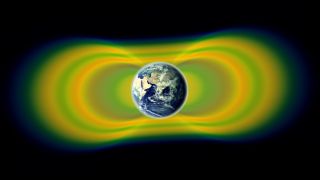
Two giant swaths of radiation, known as the Van Allen Belts, surrounding Earth were discovered in 1958. In 2012, observations from the Van Allen Probes showed that a third belt can sometimes appear. The radiation is shown here in yellow, with green representing the spaces between the belts. (Image credit: NASA/Van Allen Probes/Goddard Space Flight Center)
Giant donut-shaped swaths of magnetically trapped, highly energetic charged particles surround Earth. James Van Allen, a physicist at the University of Iowa, discovered these radiation belts in 1958 after the launch of Explorer 1, the first U.S. satellite. The radiation belts were eventually named after him.
Van Allen’s experiment on Explorer 1, which launched Jan. 31, 1958, had a simple cosmic ray experiment consisting of a Geiger counter (a device that detects radiation) and a tape recorder. Follow-up experiments on three other missions in 1958 — Explorer 3, Explorer 4 and Pioneer 3 — established that there were two belts of radiation circling the Earth.
While observations have continued for decades, our knowledge of the belts became more enhanced when the Van Allen Probes launched in 2012. They found that the belts were more complex than previously imagined.
The probes showed that the shape of the belts depends on what particle is being studied. They also uncovered information hinting there is less radiation than imagined in certain parts of the Van Allen belts, which means spacecraft and humans would not need as much radiation protection if they are voyaging in that region.
On the 60th anniversary of Explorer 1, NASA said that studies of the Van Allen belts are even more important today. “Our current technology is ever more susceptible to these accelerated particles because even a single hit from a particle can upset our ever smaller instruments and electronics,” said David Sibeck, Van Allen Probes mission scientist at NASA’s Goddard Space Flight Center in Maryland, in a 2018 statement. “As technology advances, it’s actually becoming even more pressing to understand and predict our space environment.”
Part of the interest in the Van Allen belts comes from where they are located. It is known that the belts can swell when the sun becomes more active. Before the probes launched, scientists thought the inner belt was relatively stable, but when it did expand, its influence extended over the orbit of the International Space Station and several satellites.
The outer belt fluctuated more often. The ISS has been permanently inhabited since 2000, with typical astronauts staying there for six months at a time. In 2015-16, NASA astronaut Scott Kelly and Russian cosmonaut Mikhail Kornienko remained there for almost a year. As astronauts stay in orbit for longer, their radiation exposure may also increase, leading to concerns about long-term habitation for astronauts in space.
So scientists are interested in close study of this region. In 2012, a new set of probes launched. The Van Allen Probes (formerly known as the Radiation Belt Storm probes) have several scientific goals, including discovering how the particles — ions and electrons — in the belts are accelerated and transported, how electrons are lost and how the belts change during geomagnetic storms.
The mission was planned to last two years, but as of May 2018 the probes were still operating at more than double the expected mission lifetime. 😲 However, fuel reserves are running low and the probes will likely retire in the next couple of years.
Usually, scientists take a few months after launch to calibrate their instruments, but a team with the Relativistic Electron Proton Telescope asked that their instrument be turned on almost immediately (three days after launch); they wanted to compare observations before another mission, SAMPEX (Solar, Anomalous, and Magnetospheric Particle Explorer), de-orbited and entered Earth’s atmosphere.
“It was a lucky decision,” NASA said in February 2013, noting that a solar storm had already caused the radiation belts to swell as soon as the instrument was turned on.
“Then something happened no one had ever seen before: the particles settled into a new configuration, showing an extra, third belt extending out into space,” the agency added. “Within mere days of launch, the Van Allen Probes showed scientists something that would require rewriting textbooks.”
Data gathered by the probes also showed that the radiation belts shield Earth from high-energy particles. “The barrier for the ultrafast electrons is a remarkable feature of the belts,” study lead author Dan Baker, of the University of Colorado in Boulder, said in a statement.
“We’re able to study it for the first time, because we never had such accurate measurements of these high-energy electrons before.” [Gallery: NASA’s Van Allen Probes]
This new information helped scientists model the belts’ changes. But there was more information to come. In January 2016, scientists revealed that the shape of the belts depends on what type of electron is being studied. This means the two belts are much more complex; depending on what is being observed, they can be a single belt, two separate belts or just an outer belt (with no inner belt at all.)
“The researchers found that the inner belt — the smaller belt in the classic picture of the belts — is much larger than the outer belt when observing electrons with low energies, while the outer belt is larger when observing electrons at higher energies,” NASA wrote at the time. “At the very highest energies, the inner belt structure is missing completely. So, depending on what one focuses on, the radiation belts can appear to have very different structures simultaneously.”
What is still poorly understood, however, is what happens when particles from the sun hit the belts during a geomagnetic storm. It is known that the number of electrons in the belts changes, either decreasing or increasing depending on the situation. Also, the belts eventually return to their normal shape after the storm passes. NASA said it isn’t clear what kind of storm will cause a specific type of belt configuration. Also, the agency noted, any previous observations were done only with electrons at a few energy levels. More work needs to be done.
Luckily, scientists got the chance to observe a storm up close in March 2015, when one of the Van Allen Probes happened to be situated inside the “right” spot in Earth’s magnetic field to see an interplanetary shock. NASA describes such shocks as similar to when a tsunami is triggered by an earthquake; in this case, a coronal mass ejection of charged particles from the sun creates a shock in specific areas of the belts.
“The spacecraft measured a sudden pulse of electrons energized to extreme speeds — nearly as fast as the speed of light — as the shock slammed the outer radiation belt,” NASA wrote at the time. “This population of electrons was short-lived, and their energy dissipated within minutes. But five days later, long after other processes from the storm had died down, the Van Allen Probes detected an increased number of even higher energy electrons. Such an increase so much later is a testament to the unique energization processes following the storm.”
In 2017, the Washington Post published an article with some of the sounds of space recorded from an instrument on the Van Allen Probes, called Electric and Magnetic Field Instrument Suite and Integrated Science (EMFISIS). Although humans cannot hear these sounds — because there is no medium in which the waves can carry the sound — translating this data was fairly straightforward, the Post wrote. “The electromagnetic waves are in the same frequency range as the part of the sound spectrum that is audible to humans. It was a simple matter to translate those radio waves as MP3s — turning EMFISIS data into a radio broadcast from the heavens.”
The Van Allen Probes are specially hardened to withstand the intense radioactive environment of the belts. Some spacecraft, however, are more vulnerable — especially when a solar storm hits. At worst, spacecraft can short out due to an electrical overload. Communications can also be disrupted. Fortunately, sometimes instruments can be turned on or off on a spacecraft during a solar storm.

Radiation, of course, also poses a human risk. Astronauts are subject to lifetime radiation limits from their time in space, to reduce any risk of cancer. Since only a few dozen people have spent six months or longer in space, however, it will take decades to understand the long-term effects of radiation on humans.
The astronauts on the ISS do not regularly spend time inside the belts, but from time to time solar storms expand the belts to the orbit of the space station. In the 1960s, several Apollo crews went through the Van Allen belts on their way to and from the moon. Their time in that radiation-intensive region, however, was very short, in part because the trajectory was designed to pass through the thinnest known parts. With more study, astronauts can be better protected for long-term stays in Earth orbit.
“We study radiation belts because they pose a hazard to spacecraft and astronauts,” said David Sibeck, the Van Allen Probes mission scientist at NASA’s Goddard Space Flight Center in Maryland, in an August 2016 NASA statement. “If you knew how bad the radiation could get, you would build a better spacecraft to accommodate that.”
Newer findings from the probes show that radiation in certain zones may be less harsh than scientists thought. In March 2017, the Van Allen Probes made a finding showing there is less radiation in the inner belts that previously theorized, which means less shielding is required for spacecraft and satellites in that region. The most energetic electrons residing in the inner radiation belt are there for less time than scientists thought beforehand.
The following year, the probes discovered that some communications wavelengths (called very low frequency communications) emanating from Earth are sometimes a sort of a shield against high-energy particle radiation in space. This means that human activity has effects even in the near-space environment around Earth.
As of 2018, the Van Allen Probes are running low on fuel and are expected to finish their mission around 2020. Goddard is working on a CubeSat (small spacecraft) mission called GTOSat that will continue studying the Van Allen belts.
“This mission of firsts will serve as a pathfinder for new radiation-tolerant technologies that could help scientists realize a long-sought dream: deploying a constellation of small satellites beyond low-Earth orbit to gather simultaneous, multi-point measurements of Earth’s ever-changing magnetosphere, which protects the planet from the constant assault of charged particles streaming off the sun,” NASA said in May 2018.
Elizabeth Howell is a contributing writer for Space.com who is one of the few Canadian journalists to report regularly on space exploration. She is pursuing a Ph.D. part-time in aerospace sciences (University of North Dakota) after completing an M.Sc. (space studies) at the same institution. She also holds a bachelor of journalism degree from Carleton University. Besides writing, Elizabeth teaches communications at the university and community college level. To see her latest projects, follow Elizabeth on Twitter at @HowellSpace.
Join our Space Forums to keep talking space on the latest missions, night sky and more! And if you have a news tip, correction or comment, let us know at: community@space.com.

The Schumann Resonance is very high today, literally off the chart and affecting every cell of our body.
Take it easy if you have very low energy, brain fog, sleepy, stomach ache, low appetite, moody, grumpy when usually you’re content or happy.
Water with lemon and light food is helpful. Try not to take anyone too seriously. This is a rough Mercury turned direct combined with White Dog Red Moon mediated by Mercury plus the Moon in Scorpio. Too much emotion on one day but it’s an upload through the antipode Yellow Sun which we have until dusk.
Corey Goode, Michael Salla and Jordan Sather
Our E.T. ancestors could destroy an asteroid in a heartbeat and would to make sure we survive. The genetic experiment on this planet is no joke. They’ve already shut down our ability to play with nuclear weapons.
As a species, we’re about to level up on the evolutionary scale. I don’t believe NASA wants us to know this. Gee, are they black hats? I don’t know that they are on the side of humans.
Until Disclosure happens and the full truth comes out, I wouldn’t believe any fear-mongering. They stand to benefit in huge profits on MARS by freaking everyone out on earth. Then they can continue to maraud and wreak havoc in our solar system. The Moon has already been secured so hang in there and don’t listen to mainstream science. They are on the side of the ORION group. This is B.S.
ROBBY BERMAN05 May, 2021

Credit: NASA/JPL
The asteroid 2021 PDC was first spotted on April 19, 2021 by the Pan-STARRS project at the University of Hawaii. By May 2, astronomers were 100% certain it was going to strike Earth somewhere in Europe or northern Africa. On October 20, 2021, the asteroid plowed into Europe, taking countless lives. (That’s a FUTURE date)
There was absolutely nothing anyone could do to deflect it from its deadly course. Experts could only warn a panicking population to get out of the way as soon as possible, if it was possible.
The above scenario is the result of a recently concluded NASA thought experiment.
The question the agency sought to answer was this: If we discovered a potentially deadly asteroid destined to hit Earth in six months, was there anything we could do to prevent a horrifying catastrophe? The disturbing answer is “no,” not with currently available technology.
While Europe can breathe easy for now, the simulation conducted by NASA/JPL’s Center for Near Earth Object Studies and presented at the 7th IAA Planetary Defense Conference is troubling. Space agencies spot “near-Earth objects” (NEOs) all the time. Many are larger than 140 meters in size, which means they’re potentially deadly.

Credit: ImageBank4U / Adobe Stock
“The level [at] which we’re finding the 140-meter and larger asteroids remains pretty stable, at about 500 a year. Our projection of the number of these objects out there is about 25,000, and we’ve only found a little over one-third of those so far, maybe 38% or so,” NASA’s Planetary Defense Office Lindley Johnson tells Space.com.
With our current technology, spotting an NEO comes down to whether we just happen to have a telescope pointing in its direction. To remove humanity’s blind spot, the Planetary Society — the same organization that deployed Earth’s first light sails — is developing the NEO Surveyor spacecraft, which they plan to deploy in 2025. According to the Planetary Society, it will be able to detect 90 percent of NEOs of 140 meters or larger, a vast improvement.

The DART spacecraft will attempt to deflect an asteroid.Credit: NASA
The NASA/JPL exercise made clear that six months is just not enough time with our current technology to prepare and launch a mission in time to nudge an NEO off its course. (Small course adjustments become significant over great distances, which is why “nudging” an asteroid is a potential strategy.)
What would such a mission look like? Hollywood aside — remember Armageddon?— we know of no good way to redirect an NEO headed our way. Experts believe that shooting laser beams at an incoming rock, exciting as it might look, is not a realistic possibility. Targeted nuclear blasts might work, but forget about landing Bruce Willis, Ben Affleck, and Liv Tyler on an asteroid to set off a course-altering bomb, especially just a month after its discovery (as was the case in the movie).
Another thing that might work is crashing a spacecraft into an NEO hard enough to shift its course. That’s the idea behind NASA’s Double Asteroid Redirection Test (DART). This mission will shoot a spacecraft at the (non-threatening) asteroid Dimorphos in the fall of 2022 in the hope of changing its trajectory.

The asteroid “2021 PDC” hit Europe in NASA’s simulation.Credit: NASA/JPL
The harrowing “tabletop exercise,” as NASA/JPL called it, took place across four days at the conference:
“Each time we participate in an exercise of this nature,” says Johnson, “we learn more about who the key players are in a disaster event, and who needs to know what information, and when.”
Practically speaking, little can be done to hurry technological development along other than budgeting more money toward that goal. Maybe we should have Bruce Willis on call, just in case.
His tone is like mine regarding the freaking SICK-CARE system. Just inept and I have twenty years worth of constant complaints and pain reports from my patients to back it up.
HOLISTIC Medicine is ANCIENT and has been suppressed and made illegal and illegitimate by the same global elite who are keeping DISCLOSURE in the closet. It isn’t going to last much longer. Human beings are viewed as royalty by our E.T. ancestors for good reason; Our Blood. No doctor or scientist in the system has any clue about how powerful our blood is when activated by our focused mind and aligned heart.
I hope you’re doing some critical thinking and getting on the self-empowerment train, taking care of yourself and keeping your T.V. off.
Most people are wrapped up in Science’s version of things in the present time period, usually the men who are more visual than intuitive. They like direct observation and then reductionist methods to define and feign control of reality rather than experience something directly, physically and intuitively as women do. There needs to be a new branch of science that includes the Higher Mind of Intuition data.
It would be worth it for you to purchase the book Earth Ascending so you can see the maps and explanation up close and personal and study it along with these posts.
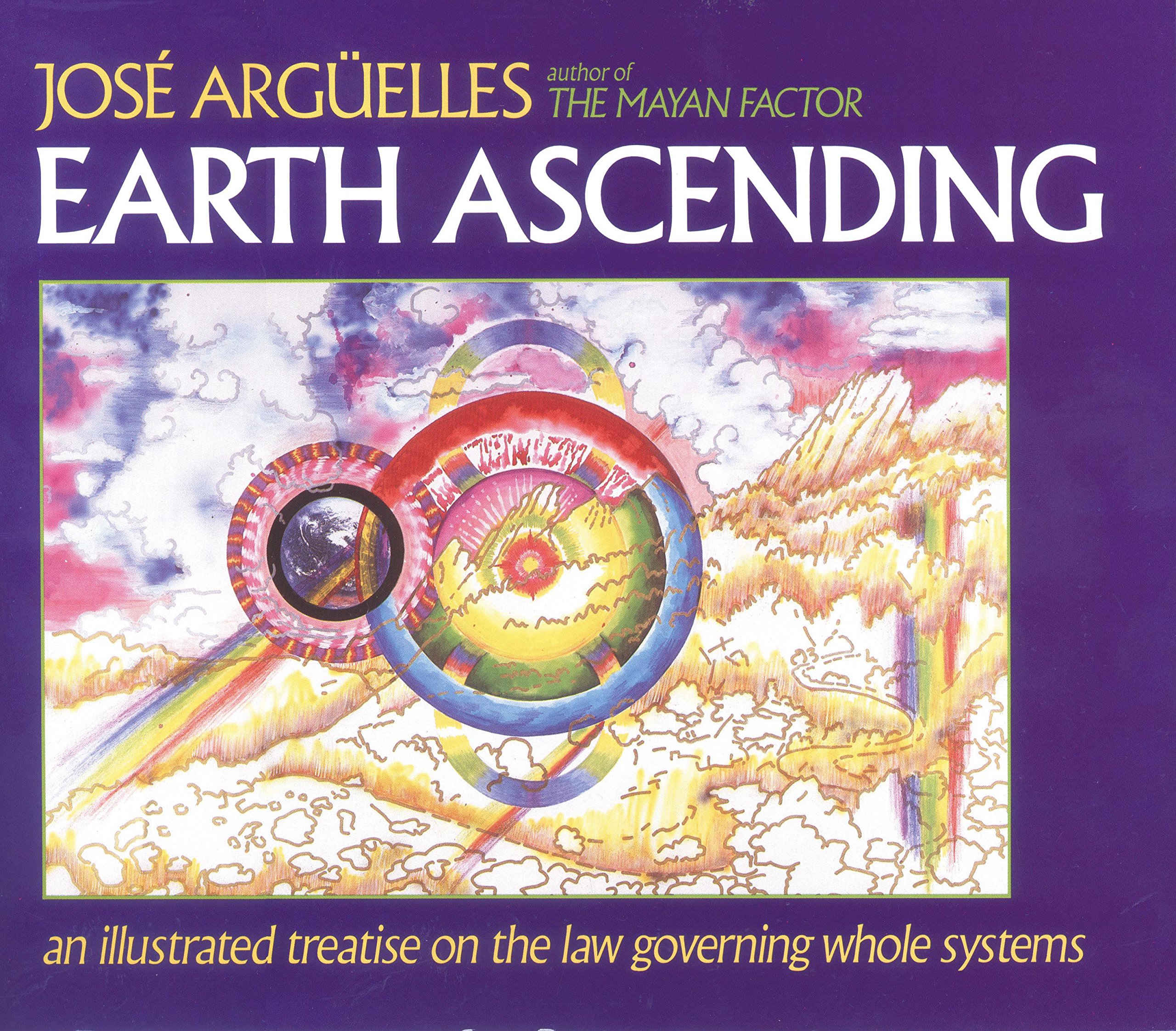

“Among the Maya north of the equator, the tool developed for recording the binary pulsation of the sunspots was the sacred calendar, with its cycle of thirteen units repeated twenty times for a total of 260 days. Sixteen of these Tzolkin cycles comprise an 11.3 year period, the time for one major binary sunspot cycle to complete itself. “-Pg. 94 Earth Ascending.
THAT’s THE MAYAN TZOLKIN. 260 x 16 =4160. 365 x 11 + 121.6 = 4136.6. It’s approximate given the solar year is not exactly 365 days. The rotation of the earth around the sun varies, even more now than before and it changes Time and DNA in the process.
“The pulsations of each of the binary spots would account for eight Tzolkin apiece, the same number of Tzolkin that comprise the psi bank warp (Map 1). From this information it is possible to conclude that the Mayans, expert calendar makers, sun worshipers par excellence, in devising the sacred calendar for whatever purposes, were actually recording in binary code from both the pulsation of sunspot cycle activity and the warp texture of the psi bank.”
The endemic rhythm of the planet is a simple 2 against 3 beat. Try it yourself. Beat a simple 2 counts with the left hand while you beat an even triplet or 3 beats with the right hand. Below is Map 1.
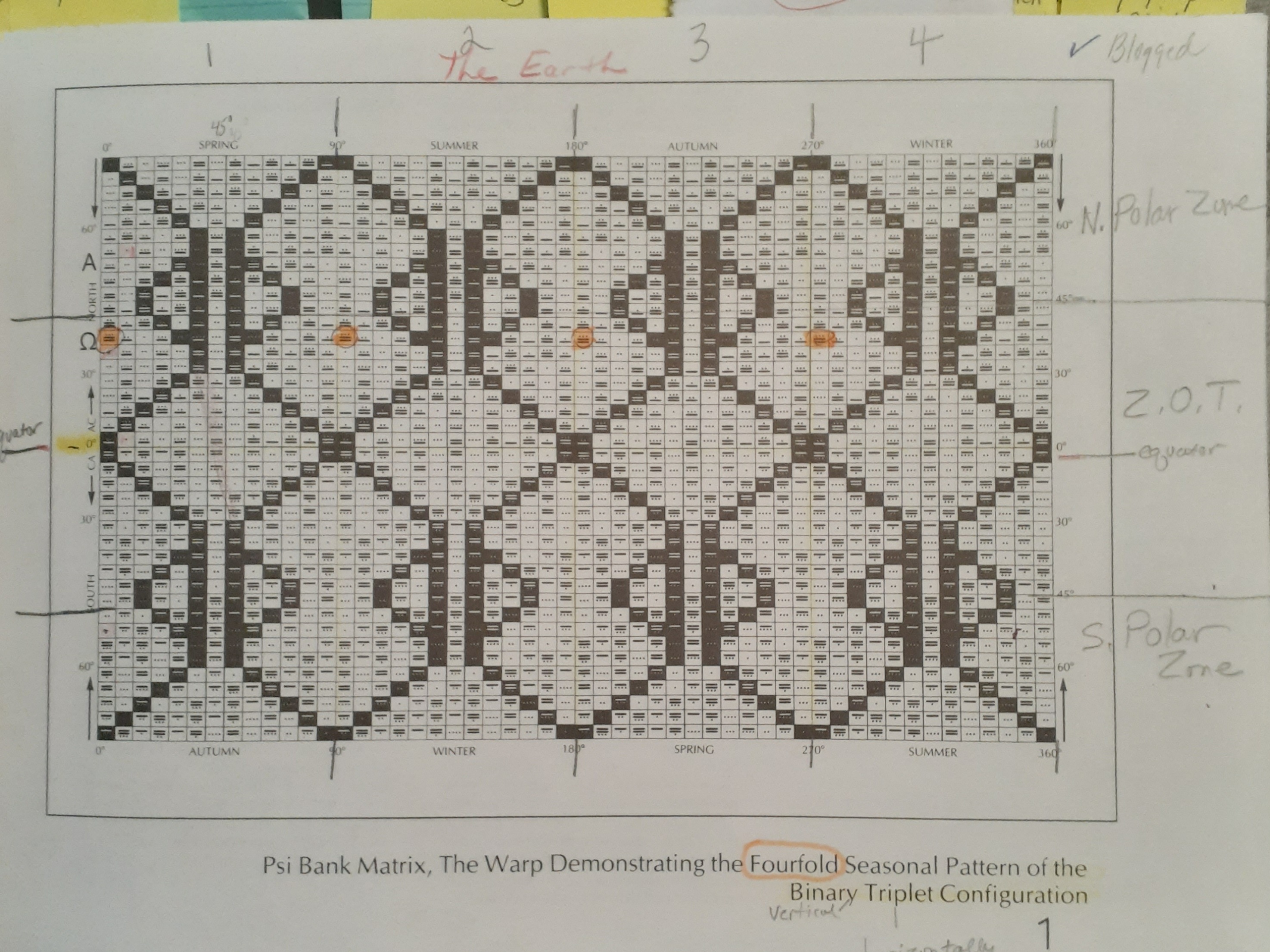
Enlarge this and study it. Note that it encapsulates the 260 sacred calendar with 13 horizontally across the top for each Tzolkin and 20 tribes down vertically. When you separate that into 3 sections, the N. Polar Zone, the Zone of Transformation or Z.O.T. and the S. Polar Zone of the Sun and the Earth it completes the Binary Triplet Configuration that creates the rhythm of our bodies, the earth and the sun as ONE unit. Our DNA evolves AS Rhythmic TIME through the movement of our Sun and Earth. This also overlays the human body. The Maya have always known this and tracked it. It’s never been any different. It’s ancient knowledge from our ancestors. Bless them.
“We first present the primary warp or longitudinal pattern of the psi bank matrix in all of its simple, inclusive majesty. The warp represents the celestial, heavenly, the electromagnetic weave of the psi bank as distinct from the latitudinal woof, representing the terrestrial, biological, and historic pattern (see map 37). Both warp and woof each consist of eight sections for a total of sixteen mutually interfacing parts. While the warp has a pattern identifiable as a repetition of eight of the 260-unit (20 rows across x 13 vertical) Tzolkin or Tonalpohualli, the Sacred Calendar of ancient Mesoamerican civilization, the woof is based on the progression by eights of the sixty-four kua or binary linear pattern of I Ching.“
“Encoded in the psi bank warp are four sets of binary triplet configurations set ninety degrees apart conjoined at the zero latitude or equatorial line. The four ninety-degree divisions encompass THE SURFACE OF THE EARTH. The ninety-degree divisions also correspond to the progression of the seasons in their north/south polarity, for a total of eight sets, each defined and characterized by a binary triplet configuration. The primal symmetry and primordial order of the warp pattern of the psi bank matrix distinguish it as the aboriginal generative field from which all other patterns, systems, structures, and orders of being and knowing are derived. The most primary of these structures, of course, is the binary triplet configuration itself.”-Pg. 30 of Earth Ascending
To be continued.

