I will regularly post changes to our solar system as well as earth since it’s part of our evolutionary neighborhood.
Saturn losing its rings is a very big deal. Its about the same Earth losing its frozen poles, a harbinger of change on both planets as I mentioned in my previous post. Jupiter and Mercury have been in the news lately too.
Saturn mediates Yellow Warrior histamine and Blue Night Alanine and it is the ruler of ♑ Capricorn the sea goat. 🐐
Jupiter mediates Arginine and histamine, Blue Eagle and YellownWarrior. It’s the home of the Pentagonal Storm at its south pole.
At the north pole, nine storms raged; a large central one bang on the pole, and eight smaller ones arrayed around it. At the south pole, there was a similar, but slightly different arrangement with six storms, five arrayed in an almost perfect pentagon around a central cyclone.Dec 13, 2019
DNA glyco protein Amino acids that make our flesh and blood are made from everything that came before us…150 different molecules from the Sun and planets; Stardust..and it’s sentience.
We have found that dew droplets of acidic water in a primordial CO2 atmosphere could enhance the replication of DNA molecules.”
Alan Ianeselli, Ph.D. student and first author of the research
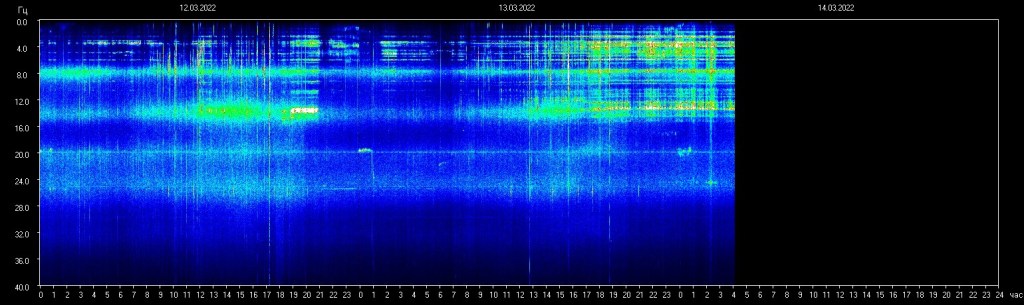
WHAT IS SCHUMANN RESONANCE AND WHY IT IS IMPORTANT FOR YOUR HEALTH
So Does the INterplanetary Holon. This is Tzolkonic.
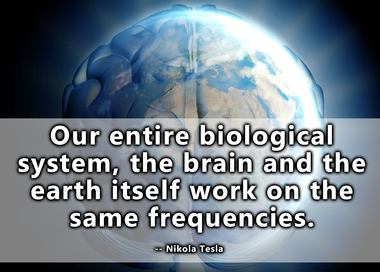
Mother Earth’s natural heartbeat rhythm is the frequency of 7.83 Hz, also known as the “Schumann Resonance”. A 7.83 Hz frequency is an alpha/theta brainwave frequency in the human brain. Alpha/Theta brainwave frequency is relaxed, dreamy, sleepy state, that is also when cell regeneration and healing happens. (I am like this most of the time-L.T.) It is no surprise that people nowadays, especially in bigger cities, are unbalanced, irritated, reactive, angry with diseases rising in astronomical numbers. We live in a time of technology, with superficial wavelengths that disrupt the natural earth’s frequency. Wifi, cell phones, and an array of electronics are part of our everyday lives. It is also why our bio-electromagnetic waves are out of balance. We are out of balance with Earth’s electromagnetic frequency. For example, the frequency of radiofrequency electromagnetic radiation (what powers cell phones, TVs, radio, etc) ranges from 30,000 Hz to 300 Billion Hz. That is a significant amount more than 7.83 Hz that the earth radiates. No wonder we are all out of balance and crave healing.
” The electromagnetic fields generated by power supply systems, telecommunications, appliances, computers, and other technology produced by humans are extremely powerful and in some cases have been associated with increased incidence of cancer, heart disease, depression, and other diseases. Exposure to strong electromagnetic fields in residential areas and in certain occupations has been documented as significantly increasing the incidence or risk of the listed diseases. Certain groups of people such as the elderly, children, women who are pregnant and the weak have been found to be more sensitive or susceptible to adverse effects from these fields than the rest of the population. (As is often the case with research, there are opposing opinions on the existence or extent of such adverse effects.) “, Hearth Math Institute
It has been proven by scientific experiments that by tuning into 7.83Hz, the planet’s own magnetic frequency people experience benefits like enhanced learning/memory, body rejuvenation, balance, improved stress tolerance, anti-jetlag, anti-mind control, and grounding. On the other hand, experiments were done, where Schumann resonance, the exposure of 7.83 Hz frequency was removed from individuals environment. The subjects reported migraine headaches, emotional distress, and other health problems. This shows how important it is to be in tune with the Earth’s magnetic frequency.
I guess those of us keeping an eye on this aren’t crazy or cultists. We just know the changes mean something dynamic about our evolution caused by THE SUN and Source. Heads up…or heads in the sand.
We need to focus on what we DO want instead of reacting and focusing our minds on what we don’t want. Denial of their agenda? You bet. Focus your attention on what you want to be helpful on the planet. Take your body and destiny clues from what I’ve taught you on here.
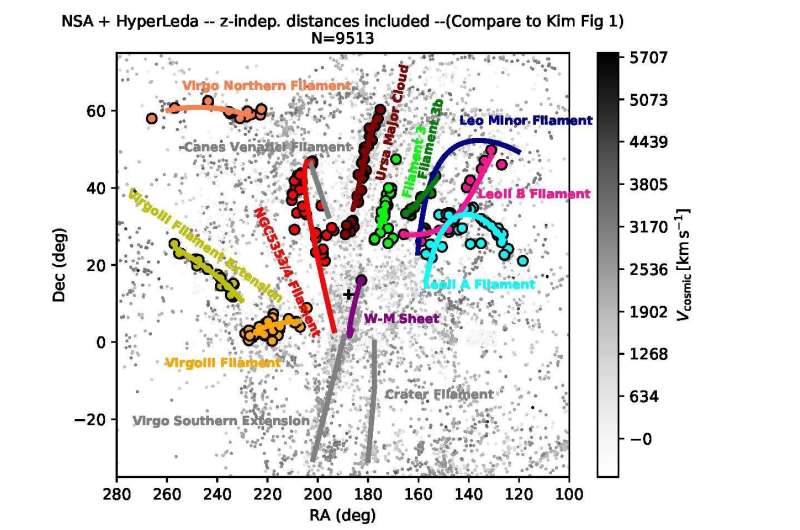
Position of the studied filaments. Credit: LASTRO/EPFL
The shape of galaxies and how they evolve depending on a web of cosmological filaments that run across the universe. According to a recent study headed by EPFL’s Laboratory of Astrophysics, this cosmic web plays a much bigger role than previously thought.
Across the universe, galaxies are distributed along what’s called the cosmic web, a complex network of filaments made up of ordinary and dark matter. And where those filaments intersect, galaxy clusters—collections of hundreds or even thousands of galaxies bound to each other by the force of gravity—tend to form. They are the biggest and densest clusters in the universe and are the subject of much research by astrophysicists. But precisely how filaments contribute to galactic evolution is still poorly understood.
To get deeper insight, an international team of scientists led by Prof. Pascale Jablonka and Gianluca Castignani from EPFL’s Laboratory of Astrophysics (LASTRO) examined the vast environment surrounding Virgo, a representative cluster in the local universe. It contains some 1,500 galaxies and is located around 65 million light-years away from our own galaxy, the Milky Way. The team’s findings have been published in two articles: one appearing in Astronomy & Astrophysics this past January and the other in Astrophysical Journal last fall.
“Many properties of galaxies, like their morphology, gas content, and star formation rate, are directly influenced by their environment,” says Jablonka. “We know that galaxies form fewer stars in very dense environments and adopt a more elliptical shape. But the exact role that filaments play in this transformation is still not clear. That’s what we wanted to investigate with our research.”
The scientists analyzed the properties of galaxies located around the Virgo cluster, across a region spanning 12 times the radius of the main cluster. Theirs is the largest study conducted to date on this topic and covers a sample size of some 7,000 galaxies, including 250 that are big enough for scientists to be able to precisely estimate their gas content—and especially the amount of cold, dense atomic hydrogen that stars are made out of. Measurements were taken using the decametric radio telescope in Nançay, France, and the IRAM-30m telescope in Pico Veleta, Spain.
A transitional environment
By combining the new data they collected with measurements from the literature, the scientists found that the properties of galaxies—namely, their shape, star formation rate, gas content, and the age and metal content of their stars—clearly change as the galaxies progress from more isolated positions towards filaments and eventually into clusters.
Filaments, therefore, seem to serve as a transitional environment where galaxies are pre-processed before falling into a cluster. In this environment, star formation slows or even stops altogether, elliptical shapes appear more frequently, and there is less atomic and molecular hydrogen, indicating that the galaxies are reaching the end of their active life. The scientists observed that a galaxy’s evolution through its life cycle corresponds to the local galaxy density: galaxies producing few or no stars made up less than 20% of the sample of isolated galaxies, but they accounted for 20–60% of galaxies in the filaments and some 80% of galaxies in the Virgo cluster. These findings open up new avenues of research on theories to explain galaxy formation and how galaxies evolve in tandem with major cosmic bodies.
This false-color graphic shows the topography of the far side of the Moon. The warmer colors indicate high topography and the bluer colors indicate low topography. The dashed circle shows the location of the mass anomaly under the basin. NASA/Goddard Space Flight Center/University of Arizona
June 11, 2019 by Dr Alfredo Carpineti
Our own Moon has one of the largest preserved craters in the Solar System, the South Pole-Aitken Basin, located on the far side of the satellite. The area is at the center of many investigations, with various orbiters and even the Chinese lander Chang’e-4 studying the region.
Now, researchers have discovered something anomalous underneath its surface. Planetary scientists have discovered a structure that weighs 2.18 billion billion kilograms and stretches for more than 300 kilometers (186 miles) in depth. As reported in the journal Geophysical Research Letters, the team suggests the mass might be from the asteroid that formed the crater.
“Imagine taking a pile of metal five times larger than the Big Island of Hawaii and burying it underground. That’s roughly how much unexpected mass we detected,” lead author Peter B. James, from Baylor University, said in a statement. The discovery was possible thanks to NASA’s Gravity Recovery and Interior Laboratory (GRAIL) mission, which measures subtle changes in the gravitational field of the Moon. These observations can be used to study the internal composition of our natural satellite.
As it turns out, the mass they measured is enough to weigh the entire basin floor downward by almost a kilometer (more than half a mile). Given that the crater is roughly 2,500 kilometers (1,550 miles) in diameter, that’s quite the pull. “When we combined that with lunar topography data from the Lunar Reconnaissance Orbiter, we discovered the unexpectedly large amount of mass hundreds of miles underneath the South Pole-Aitken basin,” James said. “One of the explanations of this extra mass is that the metal from the asteroid that formed this crater is still embedded in the Moon’s mantle.”
The team ran computer simulations to explain the anomaly. It is possible that when the asteroid hit roughly 4 billion years ago, it remained embedded in the mantle rather than sinking into the core. An alternative explanation centers on the solidification of the Moon, suggesting that the concentration of dense oxides might have formed as the magma ocean cooled and settled.
Interest in the South Pole-Aitken Basin from various space agencies is due to how special it is. The region can be used both to understand the interior composition of the Moon as well as to study its history. It is also the best laboratory to study what a catastrophic impact on the surface of a rocky planet would look like.
This false-color graphic shows the topography of the far side of the Moon. The warmer colors indicate high topography and the bluer colors indicate low topography. The dashed circle shows the location of the mass anomaly under the basin. NASA/Goddard Space Flight Center/University of Arizona
June 11, 2019 by Dr Alfredo Carpineti
Our own Moon has one of the largest preserved craters in the Solar System, the South Pole-Aitken Basin, located on the far side of the satellite. The area is at the center of many investigations, with various orbiters and even the Chinese lander Chang’e-4 studying the region.
Now, researchers have discovered something anomalous underneath its surface. Planetary scientists have discovered a structure that weighs 2.18 billion billion kilograms and stretches for more than 300 kilometers (186 miles) in depth. As reported in the journal Geophysical Research Letters, the team suggests the mass might be from the asteroid that formed the crater.
“Imagine taking a pile of metal five times larger than the Big Island of Hawaii and burying it underground. That’s roughly how much unexpected mass we detected,” lead author Peter B. James, from Baylor University, said in a statement. The discovery was possible thanks to NASA’s Gravity Recovery and Interior Laboratory (GRAIL) mission, which measures subtle changes in the gravitational field of the Moon. These observations can be used to study the internal composition of our natural satellite.
As it turns out, the mass they measured is enough to weigh the entire basin floor downward by almost a kilometer (more than half a mile). Given that the crater is roughly 2,500 kilometers (1,550 miles) in diameter, that’s quite the pull. “When we combined that with lunar topography data from the Lunar Reconnaissance Orbiter, we discovered the unexpectedly large amount of mass hundreds of miles underneath the South Pole-Aitken basin,” James said. “One of the explanations of this extra mass is that the metal from the asteroid that formed this crater is still embedded in the Moon’s mantle.”
The team ran computer simulations to explain the anomaly. It is possible that when the asteroid hit roughly 4 billion years ago, it remained embedded in the mantle rather than sinking into the core. An alternative explanation centers on the solidification of the Moon, suggesting that the concentration of dense oxides might have formed as the magma ocean cooled and settled.
Interest in the South Pole-Aitken Basin from various space agencies is due to how special it is. The region can be used both to understand the interior composition of the Moon as well as to study its history. It is also the best laboratory to study what a catastrophic impact on the surface of a rocky planet would look like.
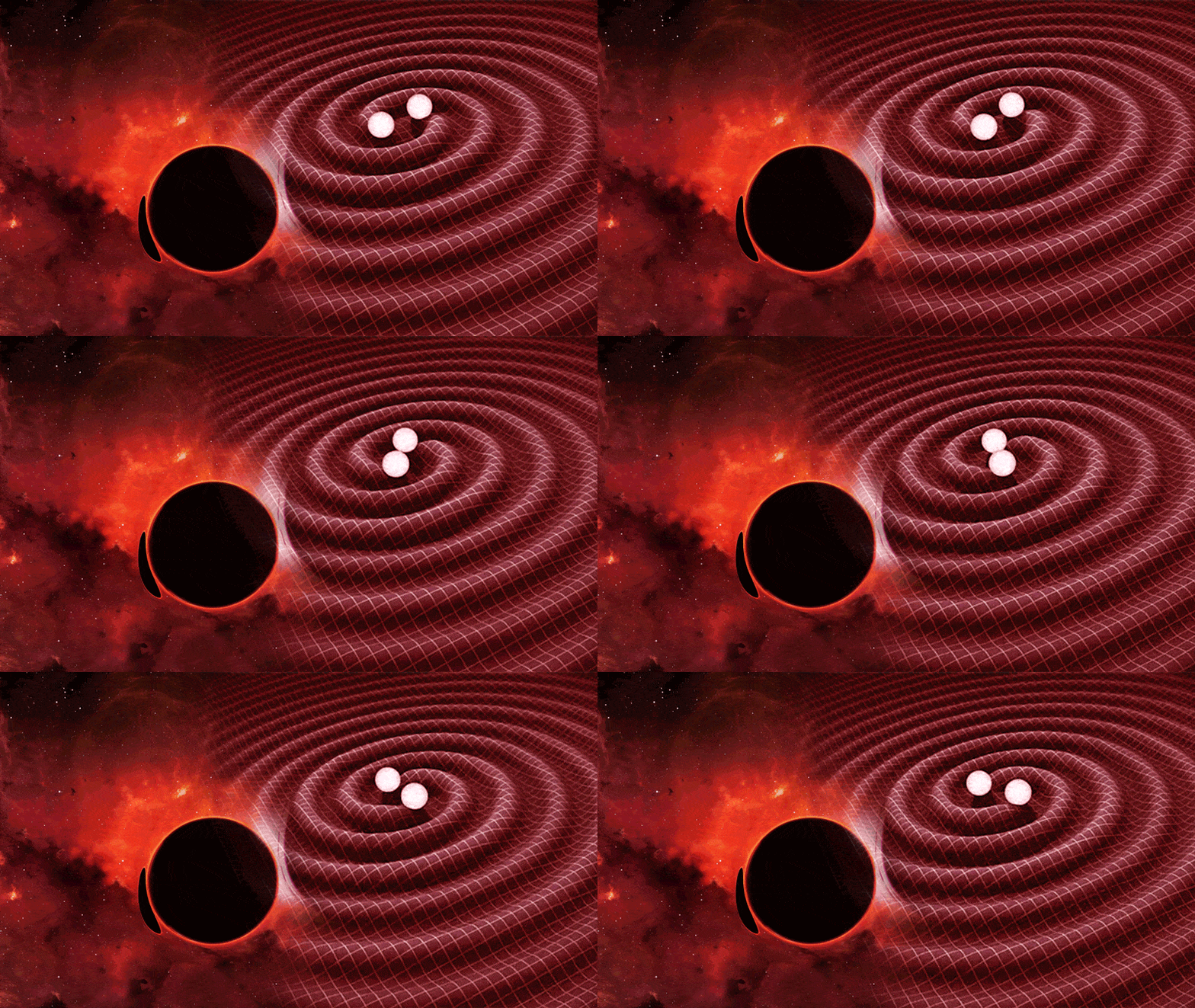
“The gravitational wave background is formed by many different overlapping gravitational-wave signals emitted from the cosmic population of supermassive binary black holes (i.e. two supermassive black holes orbiting each other and eventually merging) – similar to background noise from the many overlapping voices in a crowded hall.”
The link above.
“All dimensions are local just as time is local within them. Gravity is pulling in space and space starts piling upon itself and comes to a termination point. Gravity creates space-time. Little electromagnetic multidimensional eddies, microscopic twists occur and they spin down toward the center of the Earth. That’s what creates time and gravity and our experience of Time. It’s LOCAL to our planet, this little time bubble. Within the time bubble and the eddies, it’s like microscopic rain. Within those twists are other dimensions. In some of these dimensions, time is traveling backward and faster or forward and slower and there are other realities all within the little twisting space-time right now.
The ELM field of the earth interacts with the cosmic web, ley lines, and different energetic areas are activated at certain points. When things are in a certain position in space, planets, and stars, it activates that little region and it’s a time portal. You can either see bleed-through of beings on the other side or they can come across.”
Corey Goode, U.S. Military SSP, Oct. 9, 2020
Youtube video “Truth Quest, Episode 21.5, Aired October 26, 2020
“Time is DNA” page 17-18
Gravitational Waves spiral like the DNA/RNA double helix because gravity manifests DNA
“The gravitational wave background is formed by many different overlapping gravitational-wave signals emitted from the cosmic population of supermassive binary black holes (i.e. two supermassive black holes orbiting each other and eventually merging) – similar to background noise from the many overlapping voices in a crowded hall.”
“All dimensions are local just as time is local within them. Gravity is pulling in space and space starts piling upon itself and comes to a termination point. Gravity creates space-time. Little electromagnetic multidimensional eddies, microscopic twists occur and they spin down toward the center of the Earth. That’s what creates time and gravity and our experience of Time. It’s LOCAL to our planet, this little time bubble. Within the time bubble and the eddies, it’s like microscopic rain. Within those twists are other dimensions. In some of these dimensions, time is traveling backward and faster or forward and slower and there are other realitites all within the little twisting space-time right now.
The ELM field of the earth interacts with the cosmic web, ley lines, and different energetic areas are activated at certain points. When things are in a certain position in space, planets, and stars, it activates that little region and it’s a time portal. You can either see bleed-through of beings on the other side or they can come across.”
Corey Goode, U.S. Military SSP, Oct. 9, 2020
Youtube video “Truth Quest, Episode 21.5, Aired October 26, 2020





 Synchronicity is the Source of Consciousness
You must be logged in to post a comment.