I’m caught up on tracking the readings for all 12 layers of the ScR so I’ll give a shrot update here.
12/30/23- 6Asparagine symbolized as Blue 6 Rhythmic Monkey
The theme pulsed on F3, Tone 6 layer. It was consistently 20.14Hz all day.
The minor pulsars were A3 and Q3. A3 shot up to 20hz, the top of the range at Noon. Q3 shot up to the top of the range to 21hz at Dusk.
This was the day the app kept 62 on there as the amplitude in A1, the very top layer and left it there, even though it plummetted to 3 by dusk. Idk why they did that. Also notable was A2 at 40hz at noon
Once again the 4 FREQUENCY layers at the surface of the earth stayed UNIFORM level.
12/31/23- 7Glutamic Acid, Yellow 7 Resonant Human
Our theme was F2, Tone 7 and it stayed fairly level again on all 4 layers
The minor pulsars were A2 and Q2. A2 was up to 35.2hz at dawn and 25.2hz at noon. A3 was up to 20hz at Noon.
The Q2 tone 3 pulsar shot up to 17hz at Dusk and then Q4 supported going up to 29 at dusk. Q4 was 25hz at midnight.
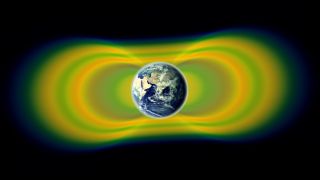
Outer Radiation belt has 4 amplitude layers (supposedly 5 with Tone 13). Inner Radiation Belt has 4 frequency layers that hum in unison above the earth’s surface. The inner Earth radiation layers have 4 QFactor layers. So as you look at the picture, 3 x 4 = 12; Earth, Inner Outer. But actually 13 once we uplevel.
It ended with Yellow 13 Cosmic Human. This is what it sounded like. These are all hertz levels.
What the scientists call the 3rd upper belt I assess as the 13th upper layer. Russia tracks 12 already. It comes and goes. It’s not steady at all because our minds have not switched to cosmic time 13:20. Our minds are clenched by the nefarious elite church and state at 12:60. We have to ignore them for that 13th belt to appear regularly.
A5-A1 are 12,000 miles above Earth.
F1-F4 are right at earth level and tend to remain constant but always go into Alpha hz.
QFactor are deep inner earth and tend to go way up at night. Then at midnight the F1 layer goes way up into Alpha while we’re sleeping in Delta state.
This is evolution of Glutamic Acid in all of nature.
Also affecting the vibe is the NEW MOON, a new 4-day Harmonic, a new 13-day cycle.
For Today, Yellow 13 Human I saw a drastic drop in the Amplitude measurements from dusk to midnight, Russia time, 10 hz worth.
Frequencies were again remarkably uniform from dawn to midnight in all four layers. That’s so interesting to me that the collective mind closer to the surface of the earth is far more consistent than the very high amplitudes or the deep inner earth Q factors.
In the Q Factor layers I saw a big hertz level drop in the two top layers of inner earth, noon to midnight, consistent at Q3 and then a big 20 hz rise up to 31 hertz inQ4 layerat midnight.
That tells me that as the earth gears up for Magnetic Tone 1 tomorrow, the inner earth crystals ramp up to stimulate the frequency rise for the new 13-day cycle.
Again, our accurate coordinates for time on earth and in our local system is 13:20. Literally, mathematically, that is the time coordinate. Like a spaceship would be calibrated.
The ScR monitors the Van Allen Belts/magnetosphere/ionosphere/Psi Bank for AMPLITUDE. Amplitude is an adjective that describes the fact of SOUND above the earth that is not audible to us. It’s happening in the etheric body of earth the same way time manifests in our etheric body.
The past and the future clutter peoples auras all the time, and I release it with Reiki so they can feel their central axis better.
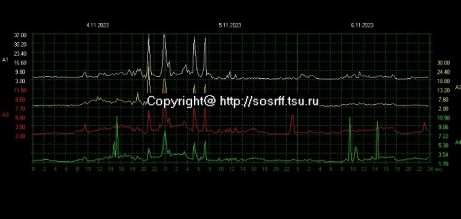
Today’s amplitude in the ScR. It moves over time during the day, just like the oracle. Midnight, dawn, noon, and dusk.
Take a look at this. There are 4 layers of measurement of sound. The first three layers look similar. The bottom on is different right on top of the earth.
So here’s what I’m 🤔 thinking. The top layer is the theme and analog, which ARE ONE in the oracle. I’ve never said anything different for 30 years. And they are mediated by the same planet.
Today, layers one, two, and three are Tone 4. Layer four is the Hidden Wisdom tone for Yellow 10 Seed and is Tone 10.
This makes total sense to me. What do you think?
The frequencies for today.
These are the same. The first frequency is theme~analog and so forth. Guide power F2, Antipode F3, Hidden Wisdom F4.
I can use this in the lab to stimulate amino acids, these exact hertz frequencies, and watch the magic happen…maybe. It’s hypothetical. The slower scientists might need to see this since they don’t feel or intuit anything.
You would think it’s proof enough that we enter multiple birthdays of people and events in our circle into the app, and they merge. My Tzolkin book is amazing. Everyone needs the app to keep track, but the apps aren’t good enough.
Maybe the Tones are discernable in 3D. But the amino acids are, we are, DNA is. Well, the 13 tone scale is, the gross, audible manifestation of the tones, like our bodies as the 20 amino acids.
But on BOTH levels, the etheric body and the etheric sound body, are not manifested visibly. They are manifest to me intuitively and somewhat literally when I’m doing Reiki. I can feel them. So I think it’s the ETHERIC level. Time does hang in the human aura so that may be it. People’s auras get glopped up with their past and wishes for the future.
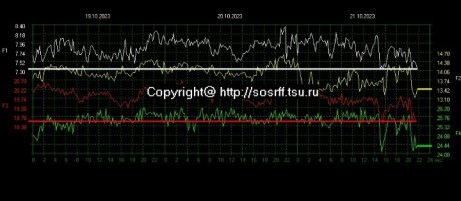
This is this mornings ScR from Tomsk, Russia. You can see there are 4 layers of frequency around the magnetosphere, above the earth, that the ScR reads. I’ve listed them here. The magnetosphere is not theoretical. It’s REAL and read and accepted by NASA and NOAA, but they don’t actually know what is is or why, or the source. According to Jose, it’s the MIND OF EARTH and many other scientists believe that our Sun and all of the planets are sentient, as do I. We call it the Psi Bank and it’s illuminated all throughout Earth Ascending.
Frequency 1 is on the surface. Then they go deeper.
The Ranges of sound on each frequency layer
The numbers in bold are for today-10/21/23-Saturday. The ranges in parentheses are what they COULD be and sometimes are. They are divided up into 6 possibilities by Tomsk for some reason.
F1-7.74hz going up to 8.18Alpha (7.30, 7.52, 7.74,7.96, 8.18, 8.40) Difference of .22 between frequencies or 20%.
F2-14.06Hz (13.10, 13.42, 13.74, 14.06, 14.38, 14.70) Difference of .32 between frequencies or 30%.
F3-19.74Hz (18.30, 18.78, 19.26, 19.74, 20.22, 20.70) Difference of .48 between frequencies or 50%
F4-25.32Hz (24.00, 24.44, 24.88, 25.32, 25.76, 26.20) Difference of .44 between frequencies or 45%
Might F1, frequency layer one be the pulse of Tones 1, 5, 9, and 13.
Might F2, frequency layer two be the pulse of Tones 2, 6, and 10
Might F3, frequency layer three be the pulse of Tones 3, 7, and 11
Might F4, frequency layer four be the pulse of Tones 4, 8, and 12.
The idea might be that in F1 there are 4 layers of frequency that pulse The Moon, God from the Interior World, Snake God, and Aquatic Deity from Interior World-Snake God again
F2 has 3 layers of frequency that pulse the Lord of Sacrifice, Lord of Rain and Storm, and Deity of Death
F3 has 3 layers of frequency that pulse the Deity of Wind and Rain, the Jaguar God Underground, and Lord of ground and Mountain
F4 has 3 layers of frequency that pulse The Old Sun, the Corn God, and Venus
That’s where I am. IDK. I just keep looking at it from both sides.
Lyrics
Bows and flows of angel hair And ice cream castles in the air And feather canyons everywhere I’ve looked at clouds that way But now they only block the sun They rain and snow on everyone So many things I would have done But clouds got in my way
I’ve looked at clouds from both sides now From up and down and still somehow It’s cloud’s illusions, I recall I really don’t know clouds at all
Moons and Junes and Ferris wheels The dizzy dancing way you feel When every fairy tale comes real I’ve looked at love that way But now it’s just another show You leave ’em laughin’ when you go And if you care, don’t let them know Don’t give yourself away
I’ve looked at love from both sides now From win and lose and still somehow It’s love’s illusions, I recall I really don’t know love at all
Tears and fears and feeling proud To say, “I love you” right out loud Dreams and schemes and circus crowds I’ve looked at life that way But now old friends are acting strange They shake their heads, they say I’ve changed Well something’s lost but something’s gained In living every day
I’ve looked at life from both sides now From win and lose and still somehow It’s life’s illusions, I recall I really don’t know life at all
In addition, it supports Jose’s channeled work in Earth Ascending. It’s the Psi Bank; The Mind of GAIA or the EARTH HOLON.
Here’s what we’re talking about folks, applied to the Tzolkin. Do you see it?
Imagine the Tzolkin exactly around this with + and -negative ELM polarity in the amino acids creating the double helix in the GAP kin. The 365-day solar year sprockets exactly with the 260-day cycle. The Tzolkin is square around the human in the middle. The upwelling is the North Polar Zone, the center is the Zone of Transformation and the downwelling is the South Polar Zone. The Torus are the Van Allen Belts around the Earth.See Below.
Two giant swaths of radiation, known as the Van Allen Belts, surrounding Earth were discovered in 1958. In 2012, observations from the Van Allen Probes showed that a third belt can sometimes appear. The radiation is shown here in yellow, with green representing the spaces between the belts. (Image credit: NASA/Van Allen Probes/Goddard Space Flight Center)
Giant donut-shaped swaths of magnetically trapped, highly energetic charged particles surround Earth. James Van Allen, a physicist at the University of Iowa, discovered these radiation belts in 1958 after the launch of Explorer 1, the first U.S. satellite. The radiation belts were eventually named after him.
Van Allen’s experiment on Explorer 1, which launched Jan. 31, 1958, had a simple cosmic ray experiment consisting of a Geiger counter (a device that detects radiation) and a tape recorder. Follow-up experiments on three other missions in 1958 — Explorer 3, Explorer 4 and Pioneer 3 — established that there were two belts of radiation circling the Earth.
While observations have continued for decades, our knowledge of the belts became more enhanced when the Van Allen Probes launched in 2012. They found that the belts were more complex than previously imagined.
The probes showed that the shape of the belts depends on what particle is being studied. They also uncovered information hinting there is less radiation than imagined in certain parts of the Van Allen belts, which means spacecraft and humans would not need as much radiation protection if they are voyaging in that region.
On the 60th anniversary of Explorer 1, NASA said that studies of the Van Allen belts are even more important today. “Our current technology is ever more susceptible to these accelerated particles because even a single hit from a particle can upset our ever smaller instruments and electronics,” said David Sibeck, Van Allen Probes mission scientist at NASA’s Goddard Space Flight Center in Maryland, in a 2018 statement. “As technology advances, it’s actually becoming even more pressing to understand and predict our space environment.”
Early probe findings
Part of the interest in the Van Allen belts comes from where they are located. It is known that the belts can swell when the sun becomes more active. Before the probes launched, scientists thought the inner belt was relatively stable, but when it did expand, its influence extended over the orbit of the International Space Station and several satellites.
The outer belt fluctuated more often. The ISS has been permanently inhabited since 2000, with typical astronauts staying there for six months at a time. In 2015-16, NASA astronaut Scott Kelly and Russian cosmonaut Mikhail Kornienko remained there for almost a year. As astronauts stay in orbit for longer, their radiation exposure may also increase, leading to concerns about long-term habitation for astronauts in space.
So scientists are interested in close study of this region. In 2012, a new set of probes launched. The Van Allen Probes (formerly known as the Radiation Belt Storm probes) have several scientific goals, including discovering how the particles — ions and electrons — in the belts are accelerated and transported, how electrons are lost and how the belts change during geomagnetic storms.
The mission was planned to last two years, but as of May 2018 the probes were still operating at more than double the expected mission lifetime. 😲 However, fuel reserves are running low and the probes will likely retire in the next couple of years.
Usually, scientists take a few months after launch to calibrate their instruments, but a team with the Relativistic Electron Proton Telescope asked that their instrument be turned on almost immediately (three days after launch); they wanted to compare observations before another mission, SAMPEX (Solar, Anomalous, and Magnetospheric Particle Explorer), de-orbited and entered Earth’s atmosphere.
“It was a lucky decision,” NASA said in February 2013, noting that a solar storm had already caused the radiation belts to swell as soon as the instrument was turned on.
“Then something happened no one had ever seen before: the particles settled into a new configuration, showing an extra, third belt extending out into space,” the agency added. “Within mere days of launch, the Van Allen Probes showed scientists something that would require rewriting textbooks.”
Protective shield
Data gathered by the probes also showed that the radiation belts shield Earth from high-energy particles. “The barrier for the ultrafast electrons is a remarkable feature of the belts,” study lead author Dan Baker, of the University of Colorado in Boulder, said in a statement.
“We’re able to study it for the first time, because we never had such accurate measurements of these high-energy electrons before.” [Gallery: NASA’s Van Allen Probes]
This new information helped scientists model the belts’ changes. But there was more information to come. In January 2016, scientists revealed that the shape of the belts depends on what type of electron is being studied. This means the two belts are much more complex; depending on what is being observed, they can be a single belt, two separate belts or just an outer belt (with no inner belt at all.)
“The researchers found that the inner belt — the smaller belt in the classic picture of the belts — is much larger than the outer belt when observing electrons with low energies, while the outer belt is larger when observing electrons at higher energies,” NASA wrote at the time. “At the very highest energies, the inner belt structure is missing completely. So, depending on what one focuses on, the radiation belts can appear to have very different structures simultaneously.”
What is still poorly understood, however, is what happens when particles from the sun hit the belts during a geomagnetic storm. It is known that the number of electrons in the belts changes, either decreasing or increasing depending on the situation. Also, the belts eventually return to their normal shape after the storm passes. NASA said it isn’t clear what kind of storm will cause a specific type of belt configuration. Also, the agency noted, any previous observations were done only with electrons at a few energy levels. More work needs to be done.
Luckily, scientists got the chance to observe a storm up close in March 2015, when one of the Van Allen Probes happened to be situated inside the “right” spot in Earth’s magnetic field to see an interplanetary shock. NASA describes such shocks as similar to when a tsunami is triggered by an earthquake; in this case, a coronal mass ejection of charged particles from the sun creates a shock in specific areas of the belts.
“The spacecraft measured a sudden pulse of electrons energized to extreme speeds — nearly as fast as the speed of light — as the shock slammed the outer radiation belt,” NASA wrote at the time. “This population of electrons was short-lived, and their energy dissipated within minutes. But five days later, long after other processes from the storm had died down, the Van Allen Probes detected an increased number of even higher energy electrons. Such an increase so much later is a testament to the unique energization processes following the storm.”
In 2017, the Washington Post published an article with some of the sounds of space recorded from an instrument on the Van Allen Probes, called Electric and Magnetic Field Instrument Suite and Integrated Science (EMFISIS). Although humans cannot hear these sounds — because there is no medium in which the waves can carry the sound — translating this data was fairly straightforward, the Post wrote. “The electromagnetic waves are in the same frequency range as the part of the sound spectrum that is audible to humans. It was a simple matter to translate those radio waves as MP3s — turning EMFISIS data into a radio broadcast from the heavens.”
Designing better spacecraft
The Van Allen Probes are specially hardened to withstand the intense radioactive environment of the belts. Some spacecraft, however, are more vulnerable — especially when a solar storm hits. At worst, spacecraft can short out due to an electrical overload. Communications can also be disrupted. Fortunately, sometimes instruments can be turned on or off on a spacecraft during a solar storm.
The shape of the Van Allen belts can vary widely depending on how energetic the individual electrons are, and general conditions in the Earth’s magnetic environment. During geomagnetic storms (4), all three regions in the belts can balloon. (Image credit: NASA GODDARD/DUBERSTEIN)
Radiation, of course, also poses a human risk. Astronauts are subject to lifetime radiation limits from their time in space, to reduce any risk of cancer. Since only a few dozen people have spent six months or longer in space, however, it will take decades to understand the long-term effects of radiation on humans.
The astronauts on the ISS do not regularly spend time inside the belts, but from time to time solar storms expand the belts to the orbit of the space station. In the 1960s, several Apollo crews went through the Van Allen belts on their way to and from the moon. Their time in that radiation-intensive region, however, was very short, in part because the trajectory was designed to pass through the thinnest known parts. With more study, astronauts can be better protected for long-term stays in Earth orbit.
“We study radiation belts because they pose a hazard to spacecraft and astronauts,” said David Sibeck, the Van Allen Probes mission scientist at NASA’s Goddard Space Flight Center in Maryland, in an August 2016 NASA statement. “If you knew how bad the radiation could get, you would build a better spacecraft to accommodate that.”
Newer findings from the probes show that radiation in certain zones may be less harsh than scientists thought. In March 2017, the Van Allen Probes made a finding showing there is less radiation in the inner belts that previously theorized, which means less shielding is required for spacecraft and satellites in that region. The most energetic electrons residing in the inner radiation belt are there for less time than scientists thought beforehand.
The following year, the probes discovered that some communications wavelengths (called very low frequency communications) emanating from Earth are sometimes a sort of a shield against high-energy particle radiation in space. This means that human activity has effects even in the near-space environment around Earth.
As of 2018, the Van Allen Probes are running low on fuel and are expected to finish their mission around 2020. Goddard is working on a CubeSat (small spacecraft) mission called GTOSat that will continue studying the Van Allen belts.
“This mission of firsts will serve as a pathfinder for new radiation-tolerant technologies that could help scientists realize a long-sought dream: deploying a constellation of small satellites beyond low-Earth orbit to gather simultaneous, multi-point measurements of Earth’s ever-changing magnetosphere, which protects the planet from the constant assault of charged particles streaming off the sun,” NASA said in May 2018.
Elizabeth Howell is a contributing writer for Space.com who is one of the few Canadian journalists to report regularly on space exploration. She is pursuing a Ph.D. part-time in aerospace sciences (University of North Dakota) after completing an M.Sc. (space studies) at the same institution. She also holds a bachelor of journalism degree from Carleton University. Besides writing, Elizabeth teaches communications at the university and community college level. To see her latest projects, follow Elizabeth on Twitter at @HowellSpace.
Join our Space Forums to keep talking space on the latest missions, night sky and more! And if you have a news tip, correction or comment, let us know at: community@space.com.