A major disruption of the polar vortex appears to be underway as the Arctic stratosphere suddenly warms. Researchers call this a “sudden stratospheric warming event.” It’s caused by planetary atmospheric waves crashing into the vortex and breaking it up. Cold air spilling out of the weakened vortex could plunge the USA, Canada, and parts of Europe into bitter cold little more than a week before the arrival of Spring. This also marks the end of polar stratospheric cloud season for Arctic observers.
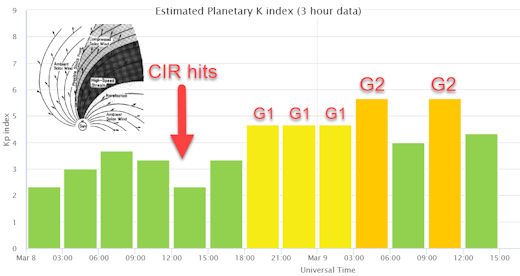
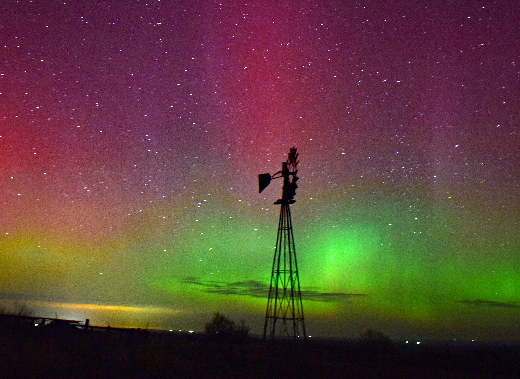
CIR HITS EARTH, SPARKS AURORAS: If you’ve never heard of a co-rotating interaction region (CIR), just think of it as a mini CME. One hit Earth on March 8th, sparking more than 10 hours of geomagnetic storms. “The auroras in Minnesota were some of the brightest I’ve seen in a while,” reports Anna Eastman, who watched the show from the Agassiz Wildlife Refuge:
CIRs are transition zones between fast – and slow-moving streams of solar wind. They contain magnetic fields and shock waves akin to those of CMEs. While CMEs require some sort of explosion on the sun, CIRs do not. They form gently from the sandwiching of solar wind streams–no solar flare required.
A fast-moving solar wind stream has arrived on the heels of the CIR. This is the same stream that created the CIR in the first place by compressing a region of slower solar wind ahead of it. Blowing 600 km/s, the fast stream could cause additional category G1 (Minor) storms on March 10th. High-latitude sky watchers should remain alert for auroras. Aurora alerts: SMS Text.
The arrival of the CIR on March 8th immediately caused a G1-class (Minor) storm, intensifying to category G2 (Moderate) on March 9th. Sky watchers in Iceland, Canada, and multiple US states from New York to Utah saw the geomagnetic glow. “Even with a bright Moon, it was a beautiful light show,” she says.
Click on the inset diagram to learn more about CIRs.
Now, there is an organized solar calendar. The sunspot cycle controls Time, and the time harmonic is synced exactly with solar time as galactic time. The Maya were not kidding around.
At the end of October, Turkish astronomer Senol Sanli made a composite image of the month’s sunspots, all 31 days. Take a look. Notice anything? (It’s not always 31)
There are more sunspots in the sun’s southern hemisphere–more than three times as many according to the Solar Influences and Data Analysis Center. This is the 4th month in a row the southern hemisphere has significantly outperformed the north.
(This is due to the binary triplet configuration of time. This is a preponderance of the S. Polar Zone of rhe earth holon, the bottom 5 lines of 13 tones at the bottom of the Tzolkin. They are strong movement in Seed, Night, Wind, Dragon, and Sun tribes which are Valine, Alanine, Glycine, Cysteine, and the Stop Codon in evolving RNA sequence.)
What’s going on? Solar physicists have long known that the two hemispheres of the sun don’t always operate in sync. (They are just dominant at different times based on evolutionary needs on earth)
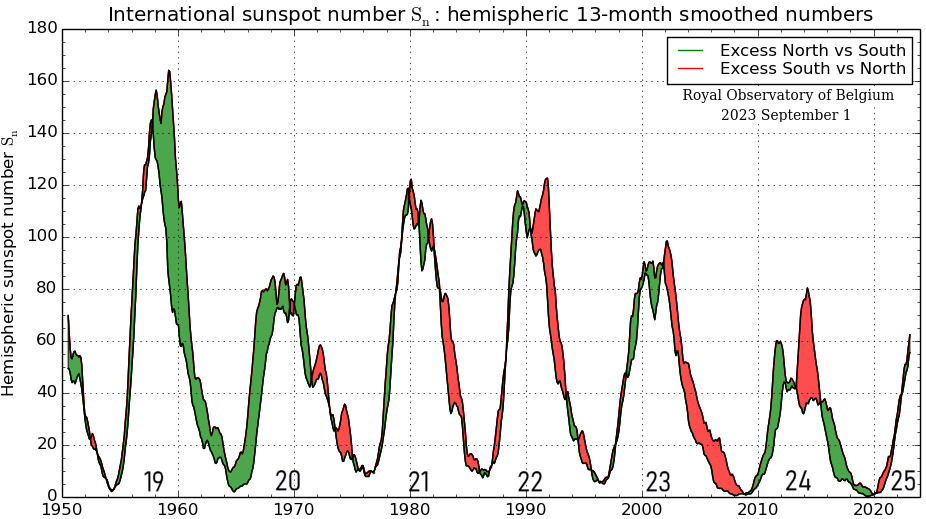
Solar Max in the north can be offset from Solar Max in the south by as much as two years–a delay known as the “Gnevyshev gap.” The assymetry is illustrated in this graph of hemispheric sunspot numbers from the last 6 solar cycles:
Is the sun’s southern hemisphere experiencing its Solar Max right now? Maybe. We won’t know for sure until years from now when we can look back and see the final shape of Solar Cycle 25. Meanwhile, stay tuned for more southern sunspots.
SUNSPOT NUMBERS REMAIN HIGH: So far this month, average sunspot numbers are hovering between 200 and 250. If this continues for another 12 days, August 2024 will end up as the spottiest month. It will be the spottiest month in more than 20 years. August 2024 will rival the peak of old Solar Cycle 23. No mainstream forecasters predicted that Solar Cycle 25 (the current cycle) would be so strong. The sun has its own plans. Solar flare alerts:SMS Text
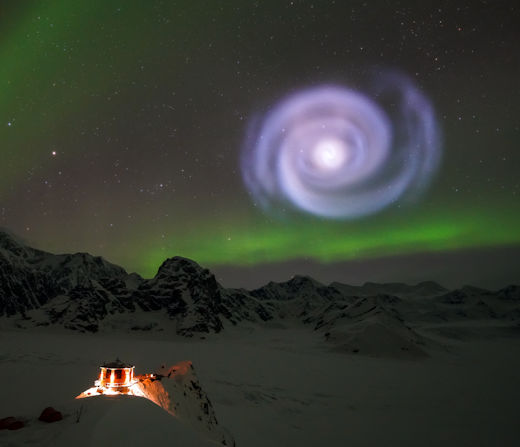
WAITING FOR THE NEXT SPACEX SPIRAL: For more than a year, Zach Goldberg has been wondering what he saw. The aurora photographer was camping in Denali National Park in April 2023. Out of nowhere, a giant blue spiral pinwheeled across the night sky.
“We had no idea what it was,” says Goldberg. “Fortunately, we already had our cameras out for the auroras.” This is what he saw:
Mystery solved: It was a “SpaceX spiral.” On April 15, 2023, SpaceX launched a Falcon 9 rocket from California’s Vandenberg Space Force Base. It carried 51 small satellites to Earth-orbit, a mission known as Transporter-7. When the rocket’s discarded upper stage passed over Alaska, it vented its unused fuel.
Spirals are a common side-effect of Transporter ride share missions. Within these Falcon 9 rockets, satellites from various clients have different destinations. SpaceX must rotate the rocket’s second stage for deployment. The de-orbit burn and fuel dump naturally spirals.
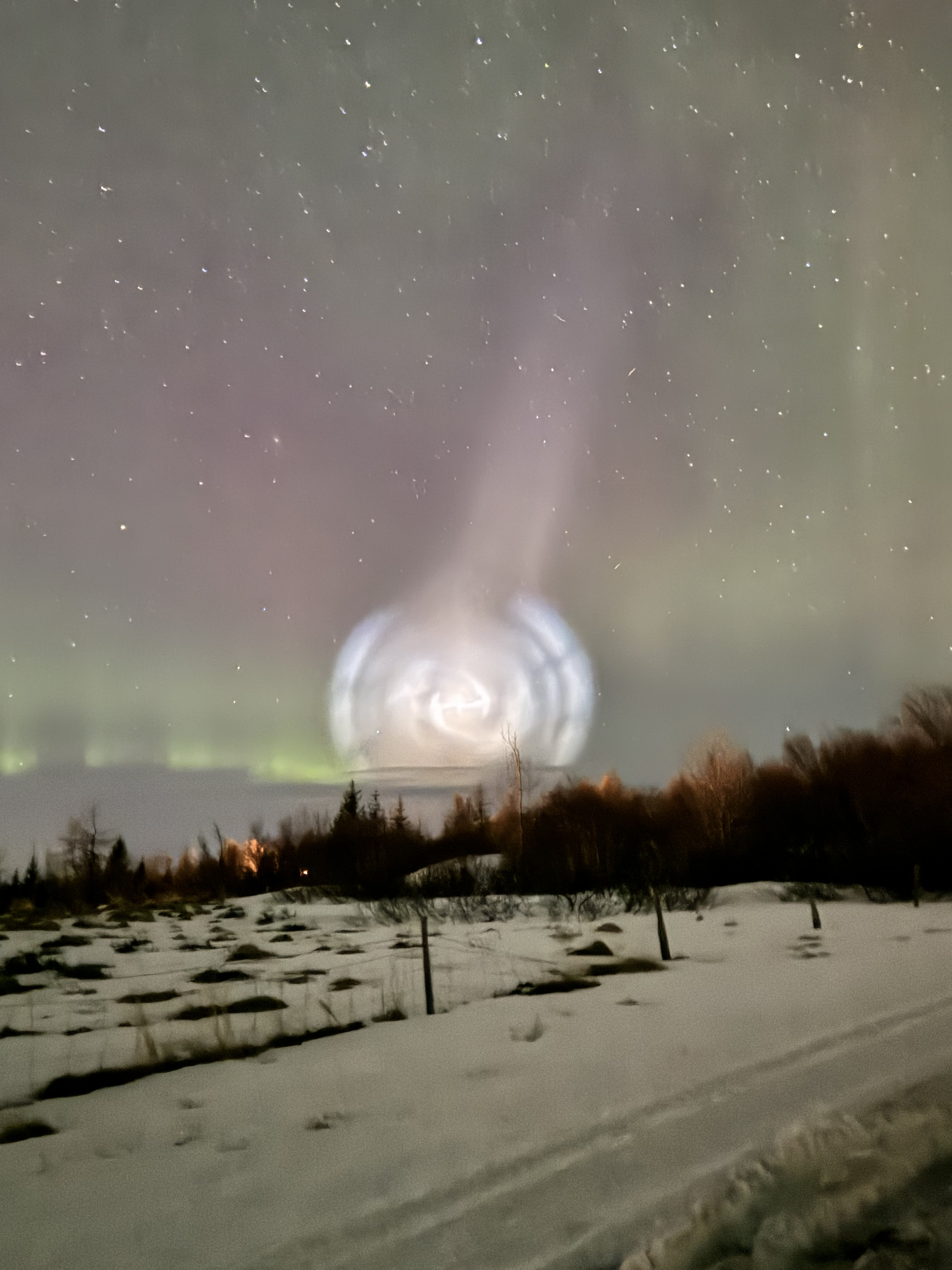
Another spiral appeared on March 5, 2024, when Transporter-10 deployed 53 satellites:
“I caught this in Akureyri, Iceland, around 1 a.m. local time,” says photographer Shang Yang. “It looked otherworldly against the Northern Lights!”
When will it happen again? Possibly in two months. The Transporter-12 mission is currently scheduled for October 2024. It could dump its fuel into a northern autumn sky filled with equinox auroras and Orionid meteors. Arctic photographers are encouraged to monitor the launch schedule and submit your images here.
Extrapolating into the future, Solter worries that satellite debris could weaken Earth’s magnetic field–the same magnetic field that protects us from cosmic rays and solar storms.
Sierra Solter-NASA
I’m real popular on X.com posting stuff like this and actually all of my projects. NOT!
I appreciate NASA studying the issue though.
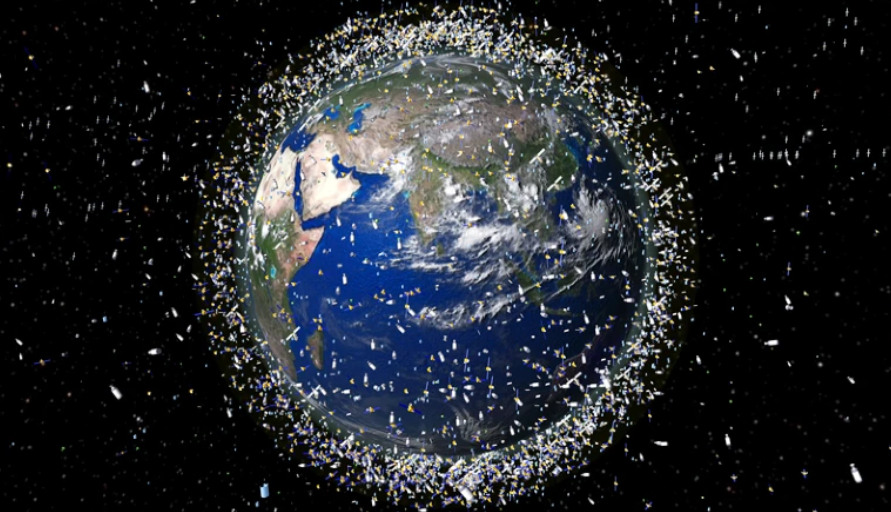
WILL MEGACONSTELLATIONS DAMAGE EARTH’S MAGNETIC FIELD? Something unprecedented is happening in Earth orbit. In only a few short years, the satellite population has skyrocketed, more than doubling since 2020. In the past year alone, more satellites have been launched than during the first thirty years of the Space Age. Much of this activity is driven by SpaceX and its growing megaconstellation of Starlink internet satellites.
Environmentalists have raised many concerns about Starlink including light-pollution of the night sky, a potentially hazardous traffic jam in low-Earth orbit, and even ozone depletion. Copycat megaconstellations by other companies and countries will only multiply these concerns.
Now there’s a new reason to worry. According to a new study by Sierra Solter, megaconstellations could alter and weaken Earth’s magnetic field.
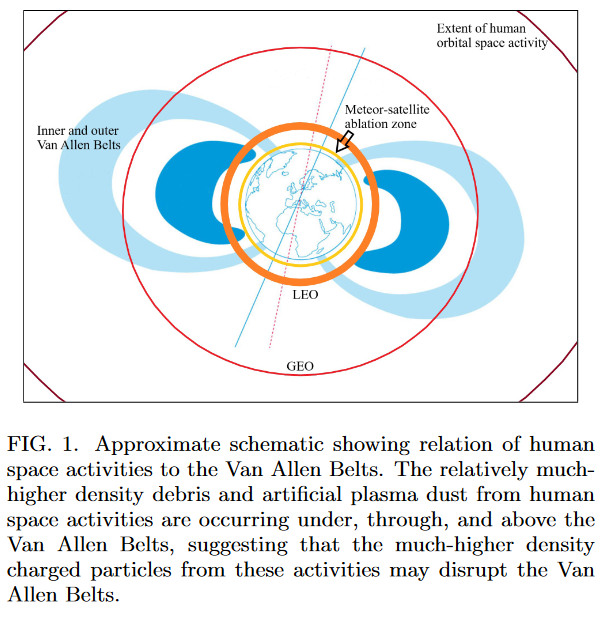
Solter is a graduate student at the University of Iceland, working on her PhD in plasma physics. She recently realized something overlooked by many senior colleagues: “More than 500,000 satellites are expected in decades ahead, primarily to build internet megaconstellations. Every satellite that goes up will eventually come down, disintegrating in Earth’s atmosphere. This will create a massive layer of conducting, electrically charged particles around our planet.”
To understand the scale of the problem, consider the following: If you gathered up every charged particle in Earth’s Van Allen Belts, their combined mass would be only 0.00018 kg. Other components of the magnetosphere such as the ring current and plasmasphere are even less massive. For comparison, “the mass of a second generation Starlink satellite is 1250 kilograms, all of which will become conductive debris when the satellite is eventually de-orbited,” says Solter.
Metal debris from a single deorbited Starlink satellite is 7 million times more massive than the Van Allen Belts. An entire megaconstellation is billions of times more massive. These ratios point to a big problem.
“The space industry is adding enormous amounts of material to the magnetosphere in comparison to natural levels of particulate matter,” says Solter. “Due to the conductive nature of the satellite debris, this may perturb or change things.”
There is already evidence of this process in action. A 2023 study by researchers using a high-altitude NASA aircraft found that 10% of aerosols in the stratosphere contain aluminum and other metals from disintegrating satellites and rocket stages. These particles are drifting down from “the ablation zone” 70 to 80 km above Earth’s surface where meteors and satellites burn up.
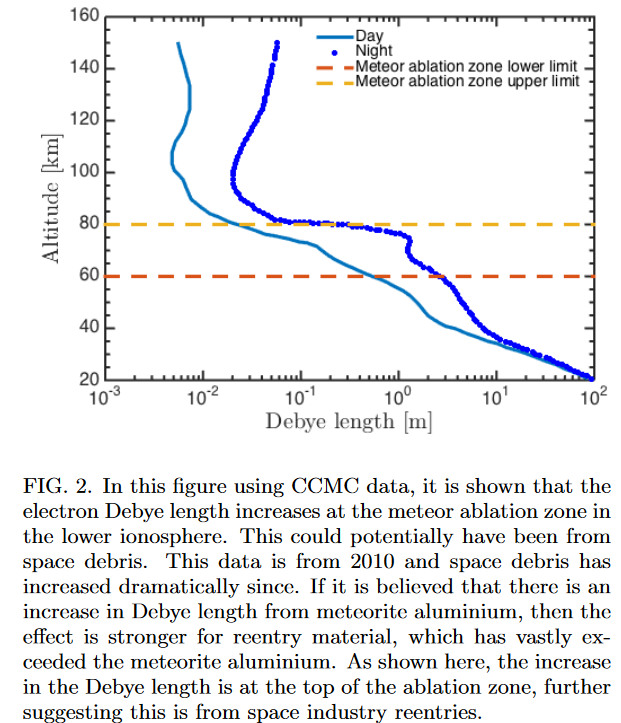
Solter decided to look for changes in the electrical properties of the ablation zone–and she found something. A NASA model of the upper atmosphere shows a sharp increase in the “Debye Length” just where satellites break apart when they deorbit:
“Debye Length” is a number that tells researchers how far an unbalanced electrical charge can be felt in conducting plasmas. The fact that it changes abruptly in the same place satellites disintegrate may be significant.
Extrapolating into the future, Solter worries that satellite debris could weaken Earth’s magnetic field–the same magnetic field that protects us from cosmic rays and solar storms.
“It’s a textbook undergraduate physics problem,” she explains. “Suppose you put a conductive shell (satellite debris) around a spherical magnet (Earth). Outside the shell, the magnetic field goes to zero due to shielding effects. This is a highly simplified comparison, of course, but we might actually be doing this to our planet.”
Solter’s preliminary study appears to show that the space industry is indeed perturbing the environment. “It is very concerning,” she concludes. “We absolutely cannot dump endless amounts of conductive dust into the magnetosphere and not expect some kind of impact. Multidisciplinary studies of this pollution are urgently needed.”
For more information, you can read Solter’s original research here.
In the Maya Harmonic, we move from the North Polar Zone 5 kin to the Zone of Transformation 15 kin to the South Polar Zone 5 kin every 20 days. But the onus of alpha and omega points keeps moving with the 375 day solar year as the Harmonic calibrated True Time or Haab.
This is more proof that the time patterns I have figured out over 30 years are accurate in alignment with the sun and the rest of our local system. People need to put their thinking caps on and belly up to my table so they can know the time changes coming. Please share.
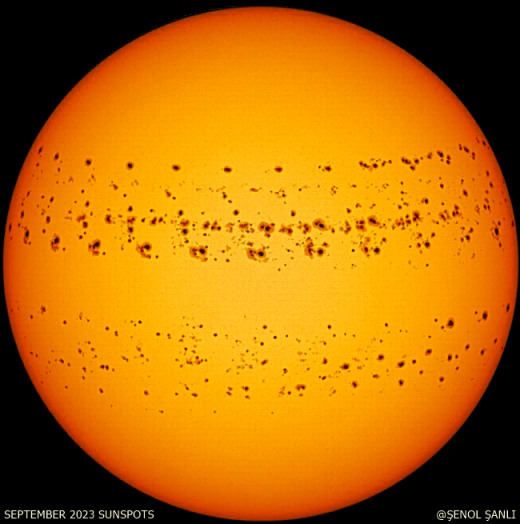
THE NORTHERN HEMISPHERE OF THE SUN IS IN CHARGE: For the second month in a row, sunspot counts in the sun’s northern hemisphere are more than double the south. The assymetry is obvious in this summary of September’s sunspots compiled by astronomer Senol Sanli using data from NASA’s Solar Dynamics Observatory:
According to the Royal Observatory of Belgium’s Solar Influences Data Analysis Center, in September the monthly sunspot number for the sun’s northern hemisphere was 90, the southern hemisphere was only 44; that’s a ratio of 2-to-1 in favor of the north. August was about the same. Looking back over an entire year, the north is leading the south by an average of 50%.
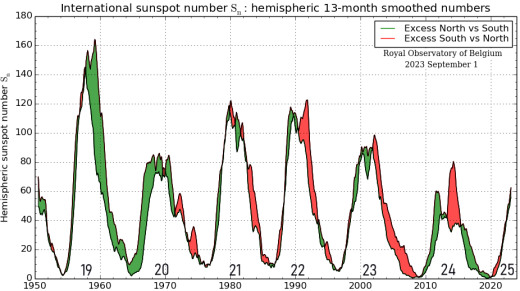
What’s going on? In fact, it’s not unusual for the sun’s northern and southern hemispheres to be out of synch. As long ago as the 19th century, solar cycle pioneers Spoerer (1889) and Maunder (1890) noted that there were often long periods of time when most sunspots were found preferentially in one hemisphere and not the other. This plot from the Royal Observatory of Belgium shows assymetries throughout the last 6 solar cycles:
Until recently, Solar Cycle 25 was pretty evenly matched, north vs. south. Sunspot counts from August and September, however, suggest that the northern hemisphere may be seizing control–at least temporarily. This has happened during the upslope of all four previous solar cycles (21-24).
One possible explanation for this phenomenon may be that the two hemispheres of the sun have their own solar cycles, one out of phase with the other by about a year. Indeed, Solar Max is often double peaked. You can see it in the hemispheric sunspot plot. In the three most recent cycles (22-24), north peaked before south, creating two surges of solar activity separated by a “Gnevyshev gap.” Solar Cycle 25 might continue this trend.
A complete discussion of sunspot asymmetries is included in David Hathaway’s excellent review article “The Solar Cycle.”
Is that like punching a hole in a wall because they’re giving you a hard time? I’m bugging him too much. 😆 lol. I’m sick of all the fake Elon unverified accounts following me. It was 10 a day, and now I directly tweeted to him, asking that everyone on there be required to be verified. I don’t have time for this. It’s very controversial but all the spam and grifters on there are wasting time and $.
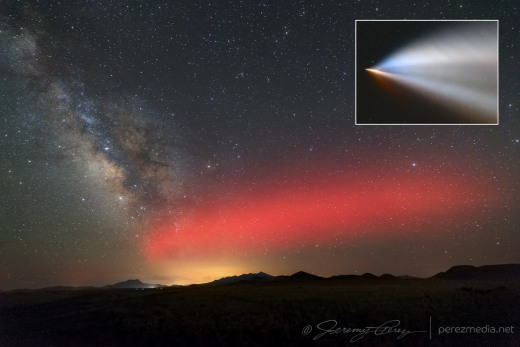
SPACEX JUST PUNCHED A HOLE IN THE IONOSPHERE: On the evening of July 19th, SpaceX launched a Falcon 9 rocket from Vandenberg Space Force Base in California. Sky watchers from southern California to Arizona witnessed a magnificent exhaust plume. At the San Francisco Volcanic Field north of Flagstaff, photographer Jeremy Perez saw something extra:
“After the rocket passed overhead, a red fluorescent glow expanded southward and crossed over the Milky Way,” says Perez. “It was visible for almost 20 minutes.”
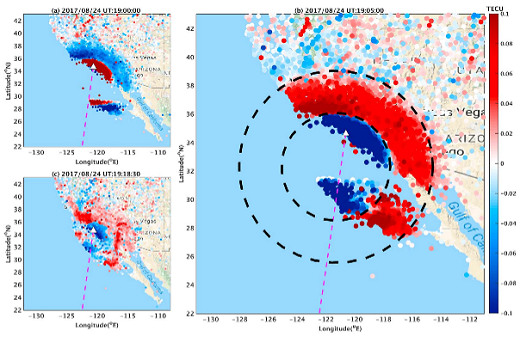
The red glow is a sign that the rocket punched a hole in the ionosphere–something SpaceX and others have been doing for years. One famous example occured on August 25, 2017, when a Falcon 9 rocket carrying Taiwan’s FORMOSAT-5 satellite created a hole four times bigger than the state of California. On June 19, 2022, another Falcon 9 punched a hole over the east coast of the USA, sparking a display of red lights from New York to the Carolinas that many observers mistook for aurora borealis.
“This is a well studied phenomenon when rockets are burning their engines 200 to 300 km above Earth’s surface,” explains space physicist Jeff Baumgardner of Boston University. “The red glow appears when exhaust gasses from the rocket’s 2nd stage cause the ionosphere to recombine quickly.”
Rocket engines spray water (H2O) and carbon dioxide (CO2) into the ionosphere, quenching local ionization by as much as 70%. A complicated series of charge exchange reactions between oxygen ions (O+) and molecules from the rocket exhaust produce photons at a wavelength of 6300 Å–the same color as red auroras.
Above: Electron density maps show a hole in the ionosphere formed by a SpaceX rocket in 2017. [more]
“I reviewed footage from the July 19th launch,” says Baumgardner. “It shows the second stage engine burning at 286 km near the ionosphere’s F-region peak for that time of day. So, it is quite possible that an ionospheric ‘hole’ was made.”
Once rare, ionospheric “punch holes” are increasingly common with record numbers of rocket launches led by SpaceX sending Starlink satellites to low-Earth orbit. Ham radio operators may notice them when shortwave signals fail to skip over the horizon, shooting through holes instead of bouncing back to Earth. Sudden GPS errors can also result from the anomalies. These effects may be troublesome, but they are shortlived; re-ionization occurs as soon as the sun comes up again.
It’s creepy that the doctors tell us not to eat sodium or to buy potassium supplements. People tend to be low on both and then end up in the ER which fills their pocketbooks of course.
We know that the amino acid proteins are the building blocks of our 3D flesh, and the symbols for the 20 Mayan tribes represent them, but the electrolyte minerals charge our ELM field that makes up our etheric body.
Sodium and potassium must be gotten in our food, or you’ll get sick and die. The demonization of sodium and potatoes by sick care is incorrect. They are both important electrolytes for good health.
If you eat a whole food diet and not processed food, which is overloaded with sodium because it’s bad food, you won’t get enough.
In comes Mercury with its odd tail made of sodium, raising our amplitude. (See article below) Mercury mediates White Dog~Red moon, which we just passed, and rules communication in our brains. That requires sodium, especially in our conscious state, when our eyes are open with alpha brainwaves. The universe is working hard to keep us awake and evolving gradually.
CHANCE OF FLARES TODAY: NOAA forecasters say there is a 40% chance of M-class solar flares today. The most likely source is fast-growing sunspot AR3280, which has an unstable ‘beta-gamma’ magnetic field and is almost directly facing Earth. Solar flare alerts:SMS Text.
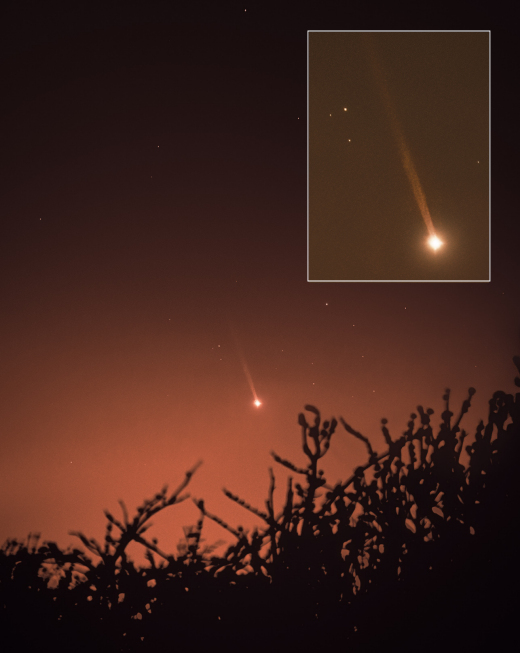
THE SODIUM TAIL OF MERCURY: Astronomy used to be so simple. Comets had tails, and planets did not. Mercury is making things complicated. When Dr. Sebastian Voltmer of Spicheren, France, photographed the planet this week, it exhibited a magnificent plume of gas flowing behind it:
“Mercury is NOT a comet, but it sure looks like one,” says Voltmer. “Solar wind and micro-meteorites hitting the planet eject sodium atoms from Mercury’s surface. This creates a yellow-orange tail of sodium gas that is around 24 million kilometers long.”
First predicted in the 1980s, Mercury’s tail was discovered in 2001. The gaseous plume is made of many elements from Mercury’s rocky surface, not only sodium. Sodium, however, dominates the scattering of sunlight and gives the tail its striking yellow hue.
People watching Mercury climb up the evening sky this month may be wondering “why didn’t I see a tail?” Answer: A special filter is required. “I used a 589 nanometer filter tuned to the yellow glow of sodium,” says Voltmer. “Without such a filter, Mercury’s tail is almost invisible to the naked eye.”
Mercury’s tail waxes and wanes in brightness as it orbits the sun. The predictable pattern is shown in this movie from NASA’s MESSENGER spacecraft, which spent years observing Mercury’s tail from close range:
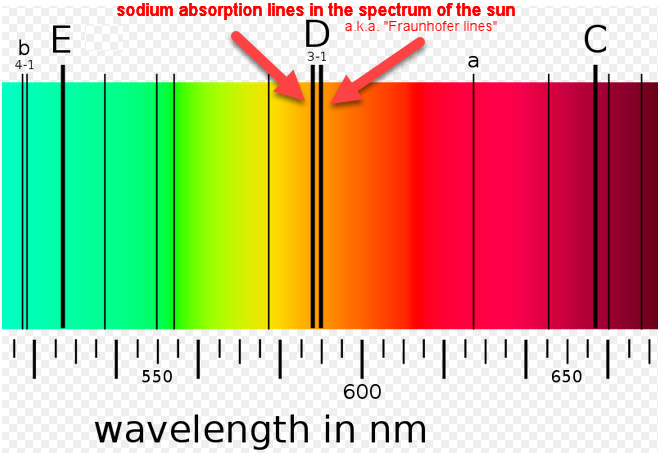
For reasons having to do with the Doppler shift of sodium absorption lines in the solar spectrum, Mercury’s tail is most luminous when the planet is ±16 days from perihelion (closest approach to the sun).
This means the tail’s maximum luminosity is only a few days away. Mercury will be 16 days past perihelion on Monday, April 17th, located in the sunset sky almost directly below Venus. If you have a sodium filter, take a look!
No one has said this, but I am going to. The poles of Earth are shifting, and the ringing in my brain is off-putting.
Keep in mind that as you look at the Tzolkin, the red light-time, 52-day cycle comes first, and the green light-time cycle 52-day cycle comes LAST.
We are currently in the red light cycle, but the green light hovers over all of the 5gdorce kin for now. I post that daily.
Spaceweather.com
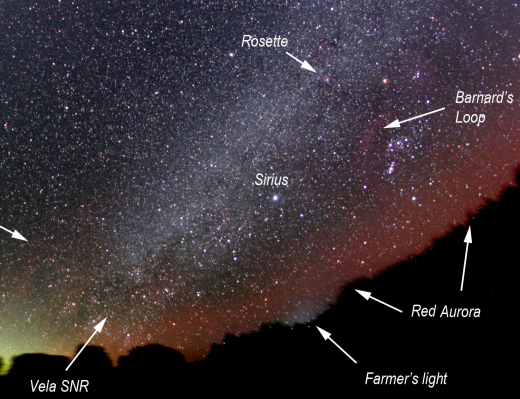
RED AURORAS OVER FLORIDA (AND ELSEWHERE): This hasn’t happened in nearly 20 years. On March 24th, auroras descended all the way to Florida. Bill Williams photographed their red glow from the Chiefland Astro Village:
What in the world? Normally, we have a very dark horizon looking out over the Suwannee River Basin and Gulf of Mexico,” says Williams. “But my 26-minute exposure taken to capture the Winter Milky Way showed an unusual red glow.”
“The mystery was solved the next day as Spaceweather.com described a severe geomagnetic storm well-seen in the U.S. As far as I know, at 29.4 degrees north latitude, we are the farthest south this aurora has been witnessed, and is the first I have seen here in Florida since 2003 and 1989!”
Most auroras are green, yet when auroras spread to low latitudes, the sightings are almost always red. There’s a simple reason. Ordinary green auroras come from oxygen atoms about 150 km above Earth’s surface. Red auroras are also caused by oxygen, but much higher up, between 150 km and 500 km.
This picture taken the same night by Dean Cosgrove of Curtis, Nebraska, (+40.6N) nicely illustrates the red-on-green altitude structure:
From far-south places like Florida, the greens are eclipsed by the northern horizon, leaving the higher reds to dominate the display.
Other notable sightings of low-latitude red auroras during last week’s storm include New Mexico (+32.8N), North Carolina (+36.5N), Colorado (+40.4N), and California (+39.7N).
Did *you* see red? Submit your photos here. Aurora alerts:SMS Text.
Note: Unrelated to auroras, another red glow called “airglow” can also be seen sometimes at low latitudes. Indeed, on any other night, airglow would be a leading explanation for what Williams photographed. But on March 24, 2023, during an extreme geomagnetic storm, with other red auroras being seen only a few degrees away, auroras are the most likely explanation.
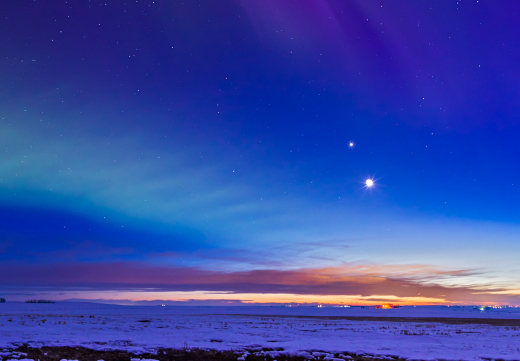
AURORA DUNES SEEN DURING EXTREME STORM: Lots of unusual things were seen during last week’s extreme geomagnetic storm. Alan Dyer of Gleichen, Alberta, photographed one of them, shown here in a deep twilight photo at te onsett of the storm:
“I captured some ‘aurora dunes,'” Dyer says. “They are the horizontal green ripples to the left of Venus and the Moon.”
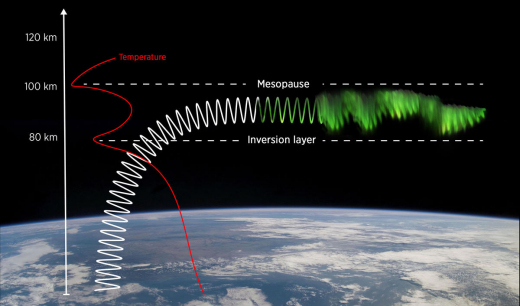
Aurora dunes are a recently identified form of Northern Lights named after their resemblence to ripples in desert sand. Researchers first explained them in a paper published only a few years ago. The dunes are a “mesospheric bore,” a type of atmospheric gravity wave that springs up from Earth’s surface and gets caught in a thermal waveguide ~100 km high. When solar wind particles rain down on the bore, they illuminate its rippling structure.
Sky watchers in the Arctic have been seeing dunesfor years without understanding what they were. A breakthrough came on Oct. 7, 2018, when multiple groups photographed dunes from widely separated locations in Finland. Triangulation revealed the dunes to be ~100 km high with a pure, monochromatic wavelength of about 45 km.
This is a new field of study with potential for discovery. Monitoring aurora dunes may reveal previously hidden waves and waveguides at the boundary between Earth and space. If you see any, submit your photos here.
BREAKING🚨: A massive 'hole' 30 times Earth's size has just opened on the Sun, blasting solar winds that'll hit our planet by end of this week https://t.co/0Z40SzLXx3