Spaceweather.com-7/27/23


BIG FARSIDE SUNSPOT: There’s a spot on the farside of the sun so large it is affecting the way the whole sun vibrates. Helioseismic echoes pinpoint the active region in the sun’s southern hemisphere not far behind the sun’s southeastern limb. It should rotate into view this weekend. Solar flare alerts: SMS Text

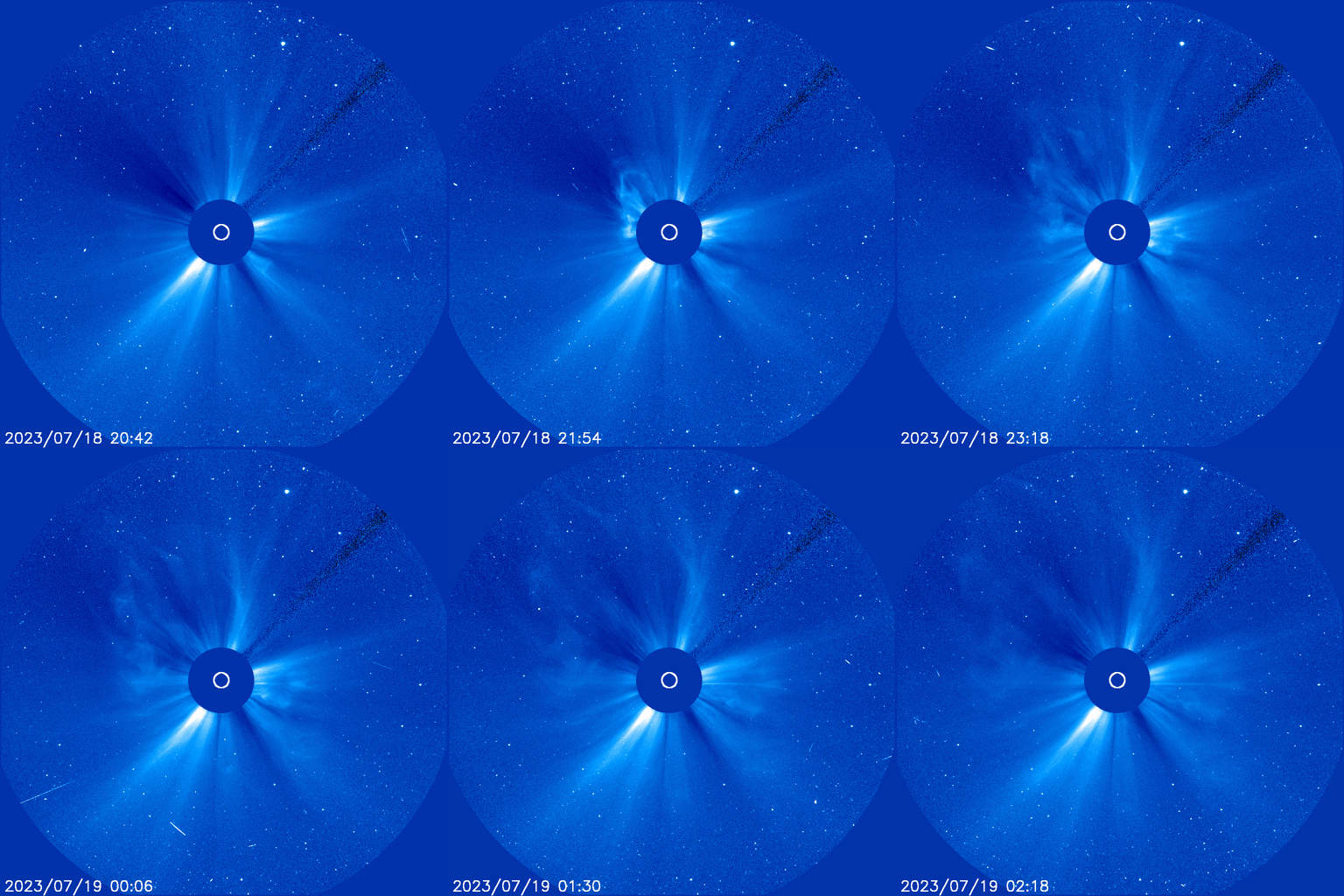
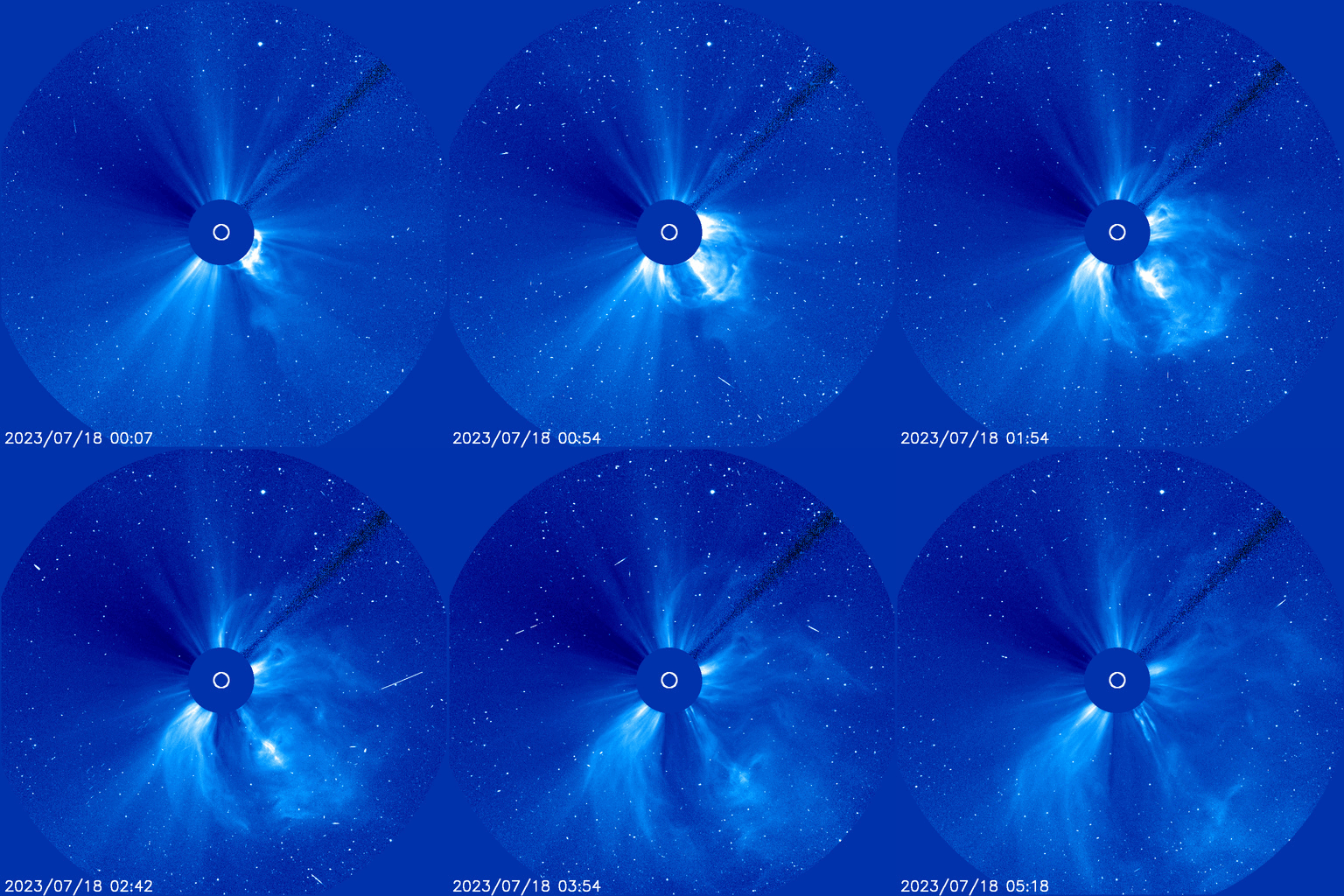
A FARSIDE CME JUST HIT SOLAR ORBITER: Two days ago, a bright CME rocketed away from the farside of the sun. Its plane-of-sky speed in SOHO coronagraph images exceeded 1,500 km/s (3.4 million mph):
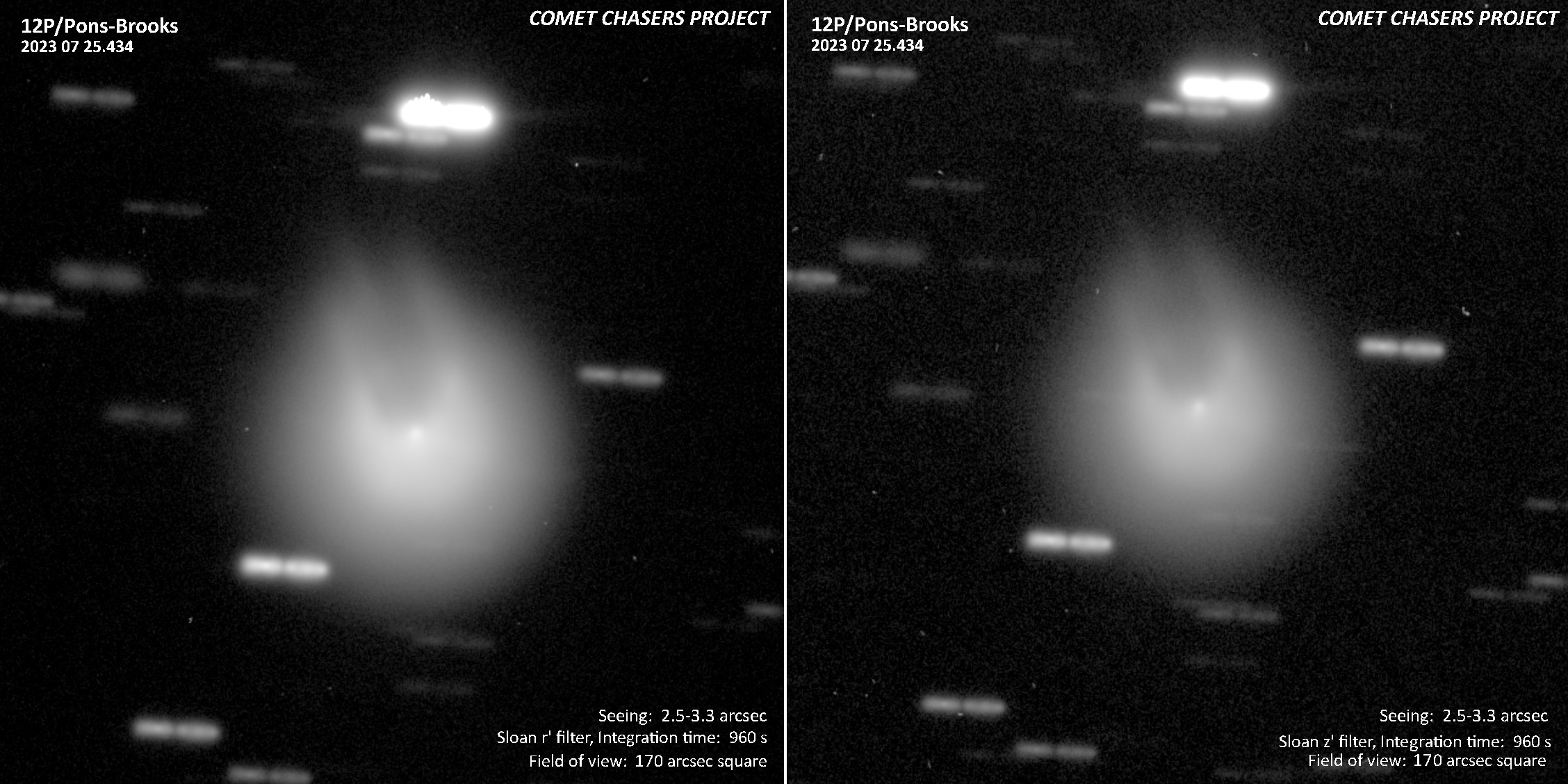
If this CME had hit Earth, a strong (possibly severe) geomagnetic storm would have surely resulted. Instead, it flew in the opposite direction and hit Europe’s Solar Orbiter (SolO) spacecraft.

The CME reached SolO on July 26th (0200 UT), barely 32 hours after it left the sun. Considering that a typical CME would take two or three days to reach the spacecraft at its current location, a transit of only 32 hours confirms this CME was a fast-mover. (THE MAYAN NEW YEAR, WHITE 5 WIZARD)

This was definitely a big event,” says George Ho of the Johns Hopkins Applied Physics Lab, co-principal investigator for the Energetic Particle Detector suite onboard Solar Orbiter. Ho checked the data right after the initial explosion on July 24th and saw a 10,000-fold increase of 50 MeV ions reaching the spacecraft. “This indicates a strong incoming interplanetary shock.”

This plot shows two waves of energetic particles washing over Solar Orbiter:
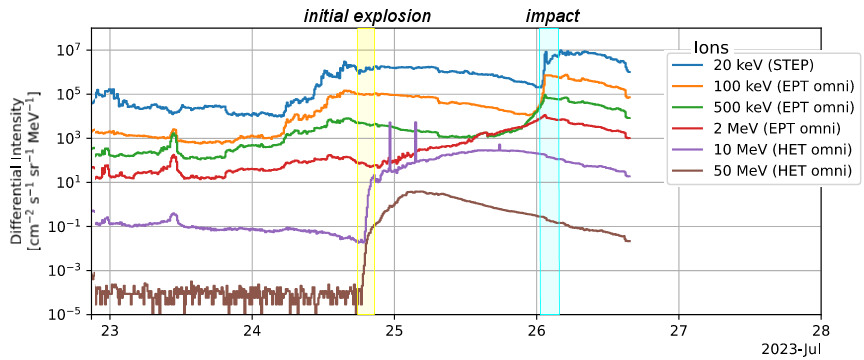

Above: Data from Solar Orbiter’s EPD/Electron-Proton Telescope (Principal Investigator Javier Pacheco from University of Alcala, Spain).

The first wave (yellow) was accelerated by whatever unseen explosion launched the CME. Traveling close to the speed of light, these particles reached the spacecraft soon after the blast. A second wave (blue) traveled with the CME itself and hit the spacecraft 30+ hours later.

“During the 1989 Quebec blackout, it was this type of shock-driven particle increase during the CME arrival that knocked off the power,” notes Ho.

Launched in Feb. 2020, Solar Orbiter is on a mission to study solar storms at point blank range. Mission accomplished. This storm actually swallowed the spacecraft. Mission scientists will analyze the data from this storm and others to improve future forecasts of space weather. Stay tuned.

Realtime Space Weather Photo Gallery
Free:
Spaceweather.com Newsletter
SpaceX Punched a hole in the Psi Bank


Is that like punching a hole in a wall because they’re giving you a hard time? I’m bugging him too much. 😆 lol. I’m sick of all the fake Elon unverified accounts following me. It was 10 a day, and now I directly tweeted to him, asking that everyone on there be required to be verified. I don’t have time for this. It’s very controversial but all the spam and grifters on there are wasting time and $.

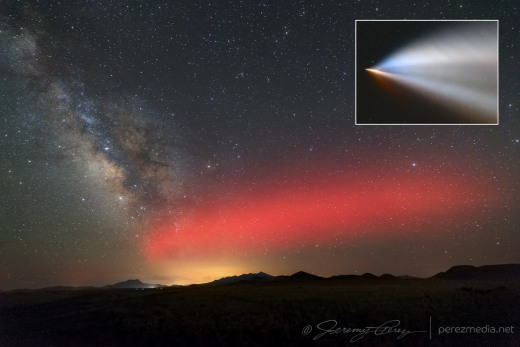
SPACEX JUST PUNCHED A HOLE IN THE IONOSPHERE: On the evening of July 19th, SpaceX launched a Falcon 9 rocket from Vandenberg Space Force Base in California. Sky watchers from southern California to Arizona witnessed a magnificent exhaust plume. At the San Francisco Volcanic Field north of Flagstaff, photographer Jeremy Perez saw something extra:

“After the rocket passed overhead, a red fluorescent glow expanded southward and crossed over the Milky Way,” says Perez. “It was visible for almost 20 minutes.”

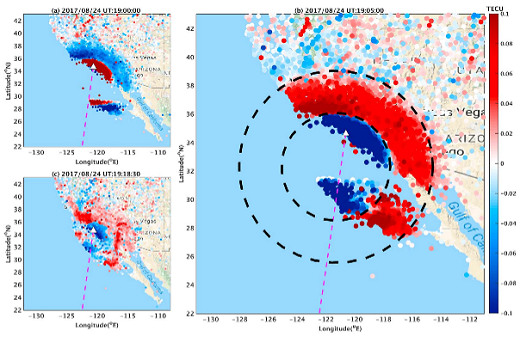
The red glow is a sign that the rocket punched a hole in the ionosphere–something SpaceX and others have been doing for years. One famous example occured on August 25, 2017, when a Falcon 9 rocket carrying Taiwan’s FORMOSAT-5 satellite created a hole four times bigger than the state of California. On June 19, 2022, another Falcon 9 punched a hole over the east coast of the USA, sparking a display of red lights from New York to the Carolinas that many observers mistook for aurora borealis.

“This is a well studied phenomenon when rockets are burning their engines 200 to 300 km above Earth’s surface,” explains space physicist Jeff Baumgardner of Boston University. “The red glow appears when exhaust gasses from the rocket’s 2nd stage cause the ionosphere to recombine quickly.”

Rocket engines spray water (H2O) and carbon dioxide (CO2) into the ionosphere, quenching local ionization by as much as 70%. A complicated series of charge exchange reactions between oxygen ions (O+) and molecules from the rocket exhaust produce photons at a wavelength of 6300 Å–the same color as red auroras.


Above: Electron density maps show a hole in the ionosphere formed by a SpaceX rocket in 2017. [more]

“I reviewed footage from the July 19th launch,” says Baumgardner. “It shows the second stage engine burning at 286 km near the ionosphere’s F-region peak for that time of day. So, it is quite possible that an ionospheric ‘hole’ was made.”

Once rare, ionospheric “punch holes” are increasingly common with record numbers of rocket launches led by SpaceX sending Starlink satellites to low-Earth orbit. Ham radio operators may notice them when shortwave signals fail to skip over the horizon, shooting through holes instead of bouncing back to Earth. Sudden GPS errors can also result from the anomalies. These effects may be troublesome, but they are shortlived; re-ionization occurs as soon as the sun comes up again.

Readers, did you see a red glow from this week’s SpaceX launch? Submit your photos here.

more images: from David Blanchard of Flagstaff, AZ (he also saw the red glow); from Dennis Mammana of Borrego Springs, California; from Andrew Corkill of Riverside, California; from Chris Cook of Laguna Beach, California; from Art Brown of San Diego, California;

Realtime Space Weather Photo Gallery
Free:
Spaceweather.com Newsletter
Spaceweather.com


Nature does not have nor make laws. Humans do. Nature has HABITS.

Rupert Sheldrake, PhD mega brilliant natural biologist

CME IMPACT (THE FIRST OF TWO): A CME just hit Earth’s magnetic field (July 20th at 1651 UT): data. This is the first of two CMEs forecasters have been tracking en route to Earth. The second should reach our planet tomorrow, July 21st. The combined effect of these two CMEs could cause G1 to G2-class geomagnetic storms with high-latitude auroras. Aurora alerts: SMS Text

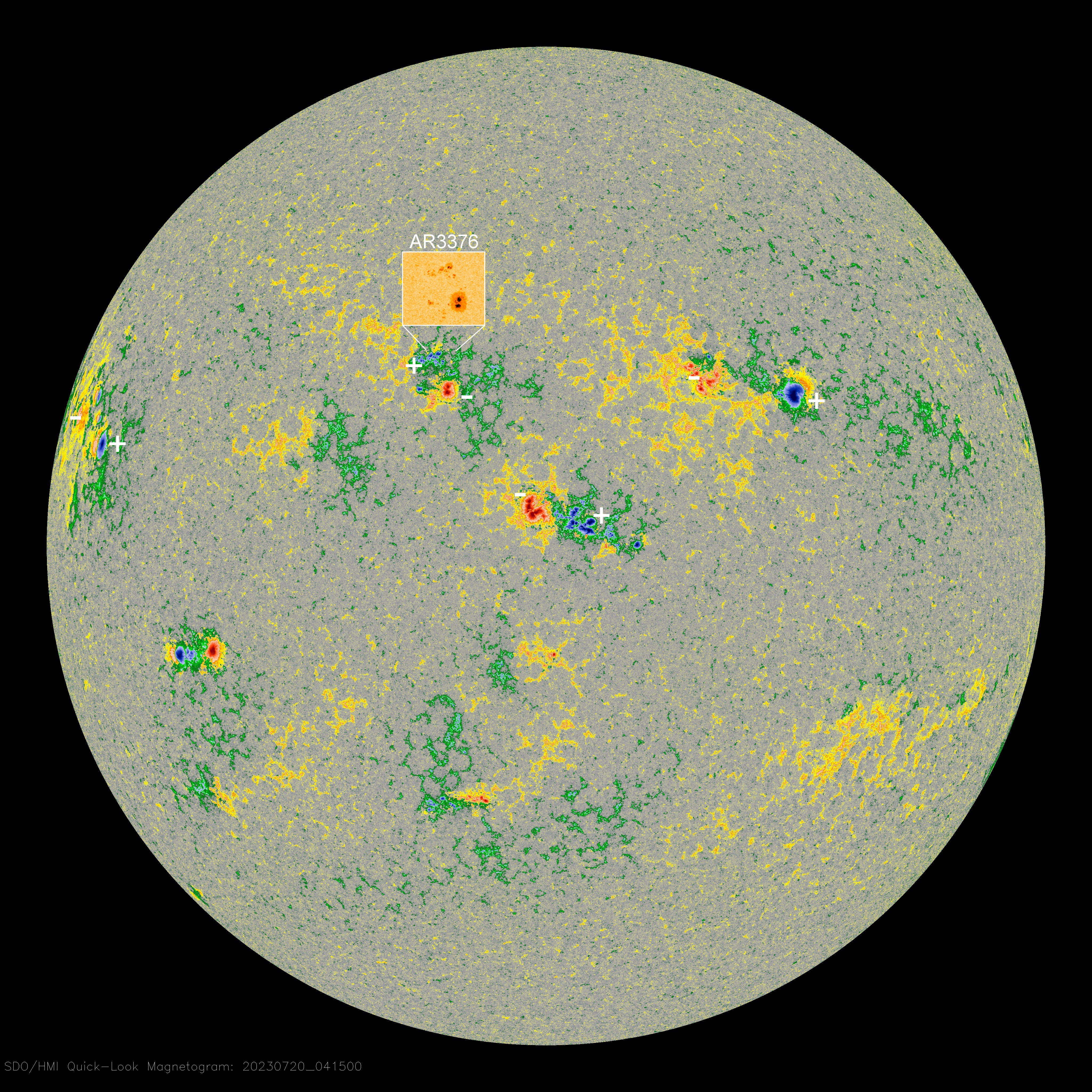
RARE REVERSED-POLARITY SUNSPOT: Sunspot AR3376 is breaking the law: Hale’s Law. Its magnetic polarity is reversed compared to other sunspots in the sun’s northern hemisphere:

(A sunspot can’t break the law. See above. It’s simply changing which nature DOES in evolution. Humans can’t control it, nor should they.)

According to Hale’s Law, Solar Cycle 25 sunspots in the sun’s northern hemisphere should have a -/+ polarity (negative on the left, positive on the right). AR3376 is reversed; its polarity is +/-.

Studies show that about 3% of all sunspots violate Hale’s Law. In most ways, reversed polarity sunspots are totally normal. They have about the same lifespan and size as ordinary sunspots. In one important way, however, they are different.

According to a 1982 survey by Frances Tang of the Big Bear Solar Observatory, reversed polarity sunspots are more than twice as likely to develop unstable magnetic fields in which + and – are mixed together. Reversed polarity sunspots are therefore more likely to explode.

Stay tuned for flares from AR3376. Solar flare alerts: SMS Text

Realtime Space Weather Photo Gallery
Free:
Spaceweather.com Newsletter
Earth is getting a Radiation Storm due to a massive explosion of a sunspot


It will hit Earth by July 20th. This a proton storm, positive charge in line with where we are in the binary polarity of the DNA harmomic, our evolution.

GEOMAGNETIC STORM WATCH: Intermittent G1-class geomagnetic storms are possible for the next 2 days as Earth’s magnetic field reverberates from a series of CME impacts and near misses since July 16th. The storms could intensify to category G2 or G3 on July 20th when a new and more potent CME arrives. See below. Aurora alerts: SMS Text

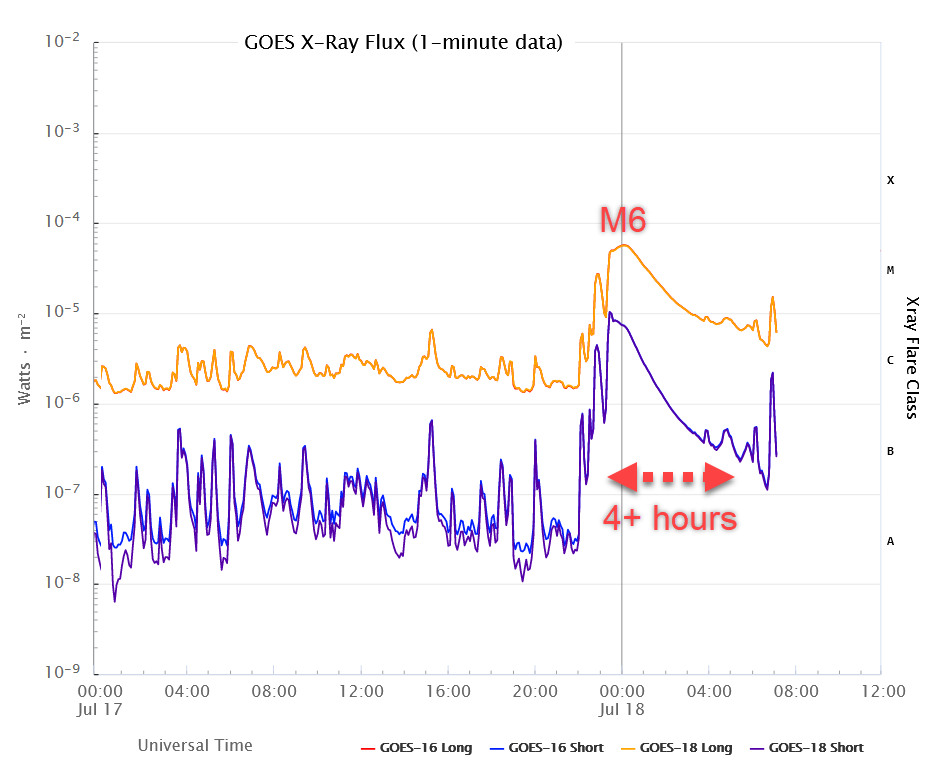
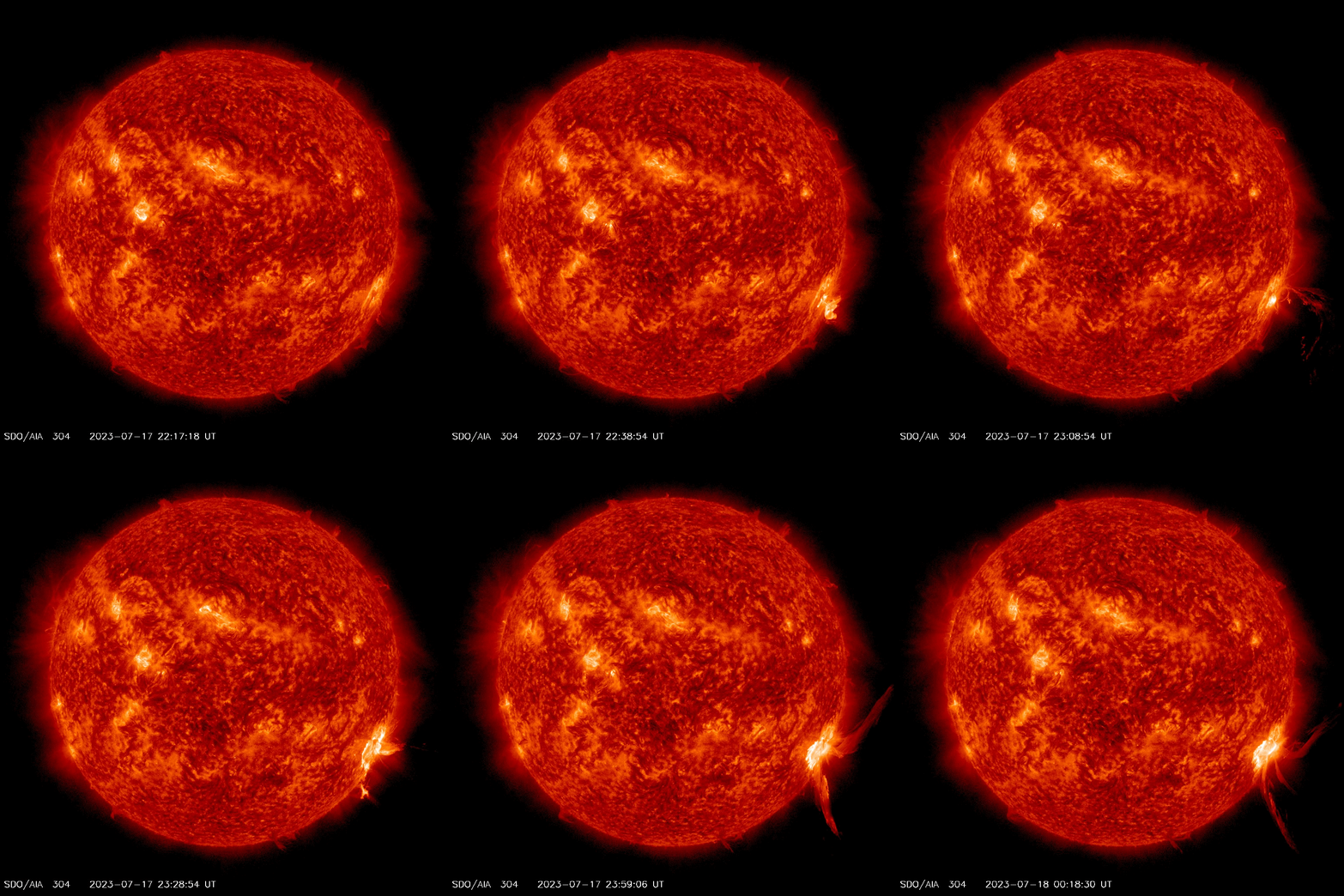
A SIGNIFICANT EXPLOSION ON THE SUN (UPDATED): We’ve been waiting for this. Big sunspot AR3363 just produced a significant solar flare, a long-duration M6-class event during the early hours of July 18th. NASA’s Solar Dynamics Observatory recorded the blast near the sun’s southwestern limb:

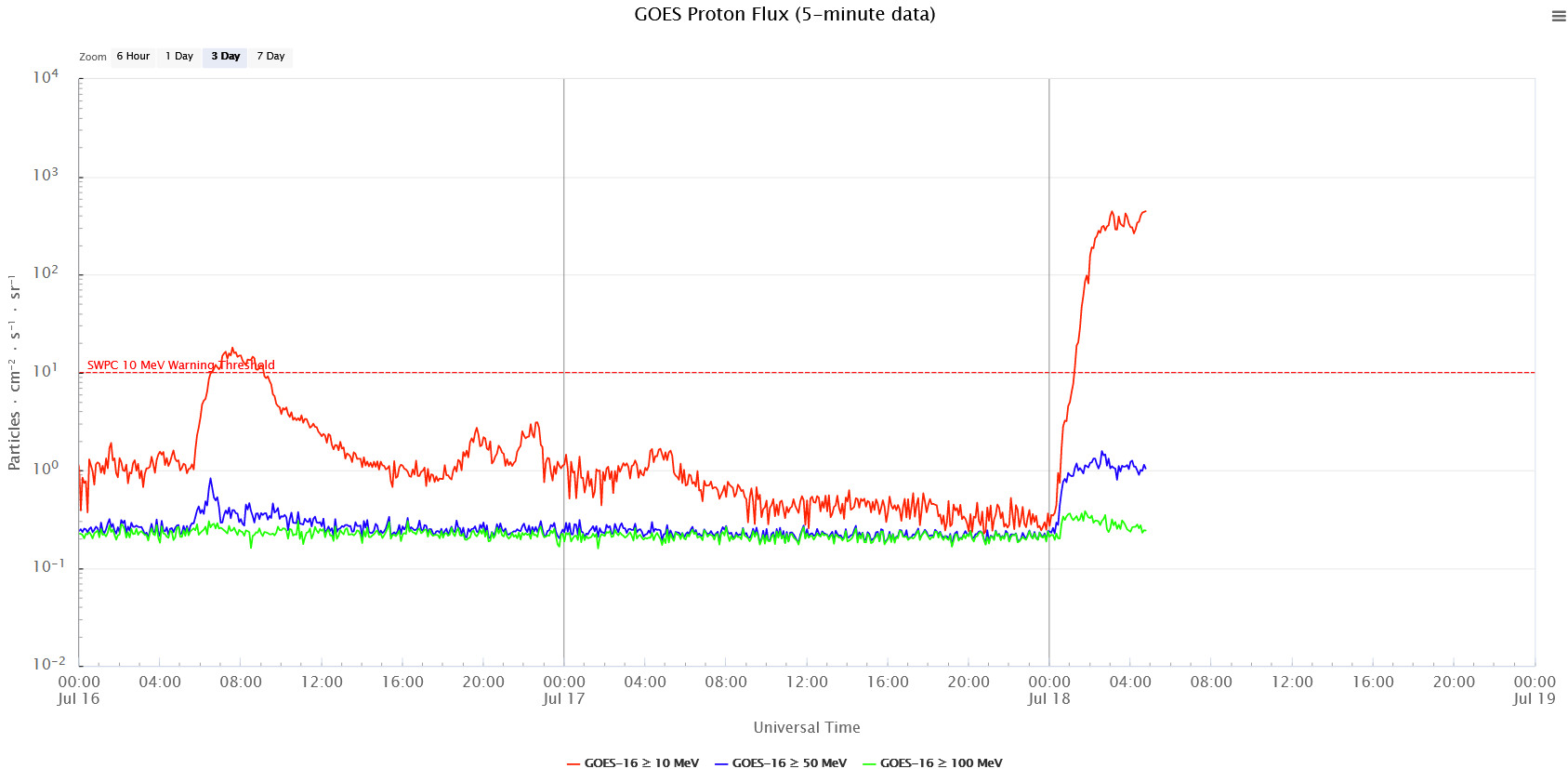
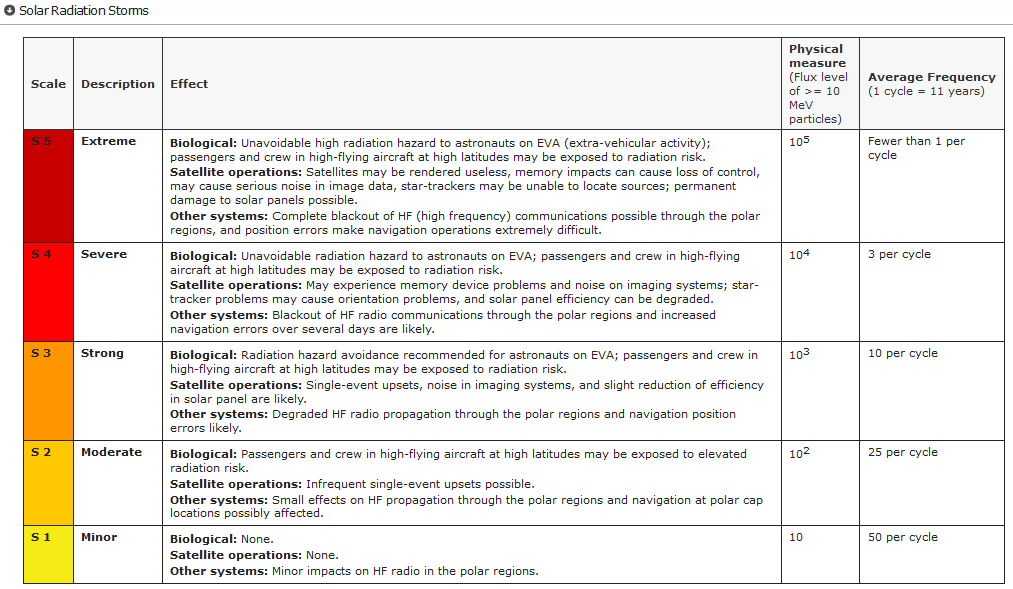
Energetic protons accelerated by the flare have reached Earth and are now peppering the top of our planet’s atmosphere. This is called a “radiation storm.” According to data from NOAA’s GOES-16 satellite, it is a category S2 event.

Although the explosion was not X-class, it was more powerful than many X-flares would be. Why? Because it lasted so long. The flare’s X-ray output was above M5 for more than an hour and above M1 for nearly 4 hours. It had plenty of time to lift a substantial CME out of the sun’s atmosphere.

Indeed, SOHO coronagraphs have since detected a bright CME emerging from the blast site:


The snowy speckles in this image are energetic protons striking SOHO’s camera system

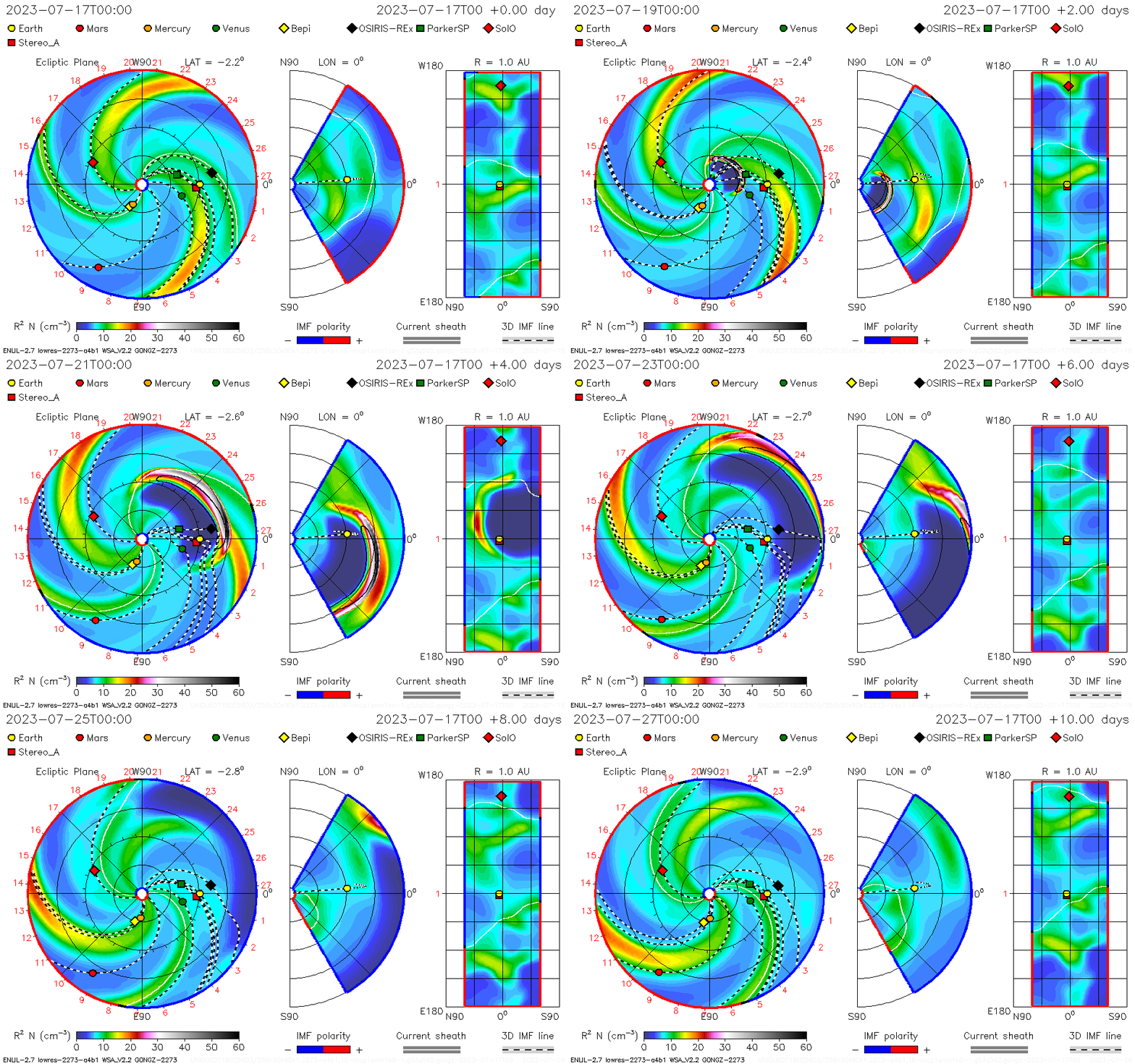
Although the CME is not heading directly for Earth, it appears to have an Earth-directed component. A NASA model suggests it could deliver an effective glancing blow as early as July 20th (0000 UT). NOAA is doing their own modeling, and results should be available soon.

Our preliminary forecast: The CME’s flank will reach Earth on July 20th. Its impact could spark G1 to G2-class geomagnetic storms, with a slight chance of G3. Stay tuned. Solar flare alerts: SMS Text

Realtime Space Weather Photo Gallery
Free:
Spaceweather.com Newsletter
Spaceweather.com Newsletter-7/6/23


Subscribe to continue reading

Subscribe to get access to the rest of this post and other subscriber-only content.

Spaceweather.com


“Actually, it doesn’t take a strong solar storm to cause problems. In Feb. 2022, a minor geomagnetic storm dumped enough heat into the thermosphere that 38 newly launched Starlink satellites fell out of the sky. SpaceX has since started launching their Starlinks to higher initial altitudes to avoid the drag.
If current trends continue, the thermosphere will warm even more in 2023 and 2024. This is a matter of concern because Earth’s population of active satellites has tripled since SpaceX started launching Starlinks in 2019. The growing constellation of 4100 Starlinks now provides internet service to more than a million customers. An extreme geomagnetic storm like the Halloween Storms of 2003 could shift the positions of these satellites by many 10s of kilometers, increasing the risk of collisions and causing some of the lowest ones to de-orbit.
Stay tuned as the warming continues.”

6/3/23 Spaceweather NOAA

Physical Aspects: Sodium is an important Mineral for our Bodies


It’s creepy that the doctors tell us not to eat sodium or to buy potassium supplements. People tend to be low on both and then end up in the ER which fills their pocketbooks of course.

We know that the amino acid proteins are the building blocks of our 3D flesh, and the symbols for the 20 Mayan tribes represent them, but the electrolyte minerals charge our ELM field that makes up our etheric body.

Sodium and potassium must be gotten in our food, or you’ll get sick and die. The demonization of sodium and potatoes by sick care is incorrect. They are both important electrolytes for good health.

If you eat a whole food diet and not processed food, which is overloaded with sodium because it’s bad food, you won’t get enough.

In comes Mercury with its odd tail made of sodium, raising our amplitude. (See article below) Mercury mediates White Dog~Red moon, which we just passed, and rules communication in our brains. That requires sodium, especially in our conscious state, when our eyes are open with alpha brainwaves. The universe is working hard to keep us awake and evolving gradually.

CHANCE OF FLARES TODAY: NOAA forecasters say there is a 40% chance of M-class solar flares today. The most likely source is fast-growing sunspot AR3280, which has an unstable ‘beta-gamma’ magnetic field and is almost directly facing Earth. Solar flare alerts: SMS Text.

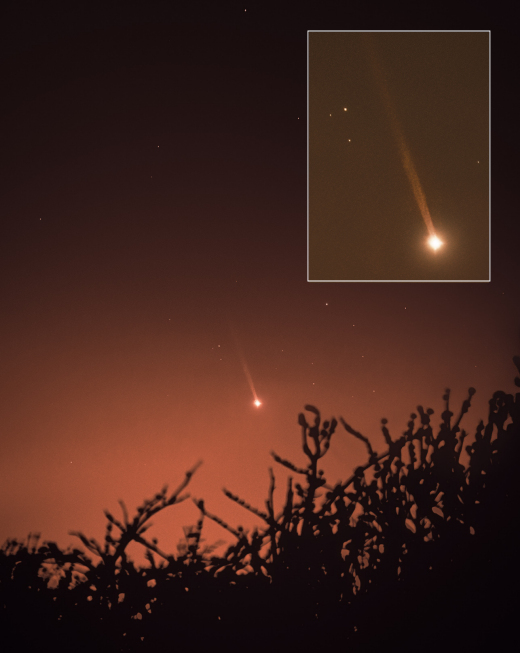
THE SODIUM TAIL OF MERCURY: Astronomy used to be so simple. Comets had tails, and planets did not. Mercury is making things complicated. When Dr. Sebastian Voltmer of Spicheren, France, photographed the planet this week, it exhibited a magnificent plume of gas flowing behind it:

“Mercury is NOT a comet, but it sure looks like one,” says Voltmer. “Solar wind and micro-meteorites hitting the planet eject sodium atoms from Mercury’s surface. This creates a yellow-orange tail of sodium gas that is around 24 million kilometers long.”

First predicted in the 1980s, Mercury’s tail was discovered in 2001. The gaseous plume is made of many elements from Mercury’s rocky surface, not only sodium. Sodium, however, dominates the scattering of sunlight and gives the tail its striking yellow hue.

People watching Mercury climb up the evening sky this month may be wondering “why didn’t I see a tail?” Answer: A special filter is required. “I used a 589 nanometer filter tuned to the yellow glow of sodium,” says Voltmer. “Without such a filter, Mercury’s tail is almost invisible to the naked eye.”

Mercury’s tail waxes and wanes in brightness as it orbits the sun. The predictable pattern is shown in this movie from NASA’s MESSENGER spacecraft, which spent years observing Mercury’s tail from close range:

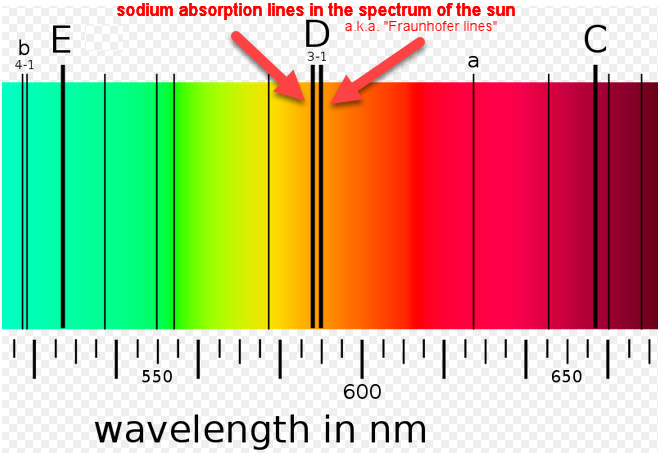
For reasons having to do with the Doppler shift of sodium absorption lines in the solar spectrum, Mercury’s tail is most luminous when the planet is ±16 days from perihelion (closest approach to the sun).

This means the tail’s maximum luminosity is only a few days away. Mercury will be 16 days past perihelion on Monday, April 17th, located in the sunset sky almost directly below Venus. If you have a sodium filter, take a look!

more images: from Nicolae-Adrian Corlaci of Bucharest, Romania; from Paul Robinson near Memphis, TN

Realtime Space Weather Photo Gallery
Free:
Spaceweather.com Newsletter
The Sun’s Magnetic Poles Will Finish Flipping Earlier Than Expected


Subscribe to continue reading

Subscribe to get access to the rest of this post and other subscriber-only content.

Auroras Galore at Low Latitude Because…


No one has said this, but I am going to. The poles of Earth are shifting, and the ringing in my brain is off-putting.

Keep in mind that as you look at the Tzolkin, the red light-time, 52-day cycle comes first, and the green light-time cycle 52-day cycle comes LAST.

We are currently in the red light cycle, but the green light hovers over all of the 5gdorce kin for now. I post that daily.

Spaceweather.com

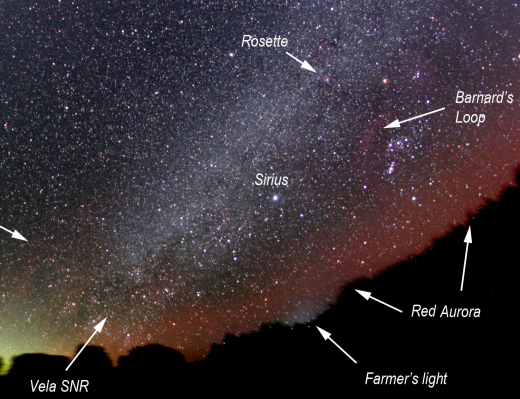
RED AURORAS OVER FLORIDA (AND ELSEWHERE): This hasn’t happened in nearly 20 years. On March 24th, auroras descended all the way to Florida. Bill Williams photographed their red glow from the Chiefland Astro Village:

What in the world? Normally, we have a very dark horizon looking out over the Suwannee River Basin and Gulf of Mexico,” says Williams. “But my 26-minute exposure taken to capture the Winter Milky Way showed an unusual red glow.”

“The mystery was solved the next day as Spaceweather.com described a severe geomagnetic storm well-seen in the U.S. As far as I know, at 29.4 degrees north latitude, we are the farthest south this aurora has been witnessed, and is the first I have seen here in Florida since 2003 and 1989!”

Most auroras are green, yet when auroras spread to low latitudes, the sightings are almost always red. There’s a simple reason. Ordinary green auroras come from oxygen atoms about 150 km above Earth’s surface. Red auroras are also caused by oxygen, but much higher up, between 150 km and 500 km.

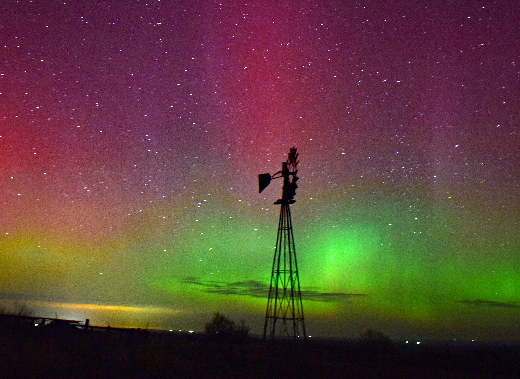
This picture taken the same night by Dean Cosgrove of Curtis, Nebraska, (+40.6N) nicely illustrates the red-on-green altitude structure:

From far-south places like Florida, the greens are eclipsed by the northern horizon, leaving the higher reds to dominate the display.

Other notable sightings of low-latitude red auroras during last week’s storm include New Mexico (+32.8N), North Carolina (+36.5N), Colorado (+40.4N), and California (+39.7N).

Did *you* see red? Submit your photos here. Aurora alerts: SMS Text.

Note: Unrelated to auroras, another red glow called “airglow” can also be seen sometimes at low latitudes. Indeed, on any other night, airglow would be a leading explanation for what Williams photographed. But on March 24, 2023, during an extreme geomagnetic storm, with other red auroras being seen only a few degrees away, auroras are the most likely explanation.

Realtime Aurora Photo Gallery
Free:
Spaceweather.com Newsletter

AURORA DUNES SEEN DURING EXTREME STORM: Lots of unusual things were seen during last week’s extreme geomagnetic storm. Alan Dyer of Gleichen, Alberta, photographed one of them, shown here in a deep twilight photo at te onsett of the storm:

“I captured some ‘aurora dunes,'” Dyer says. “They are the horizontal green ripples to the left of Venus and the Moon.”

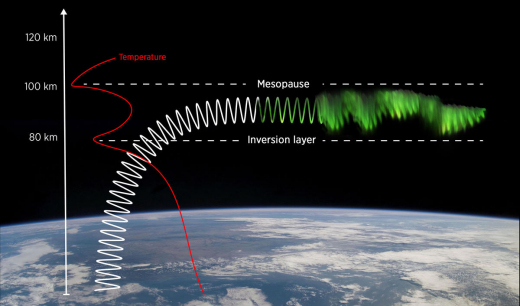
Aurora dunes are a recently identified form of Northern Lights named after their resemblence to ripples in desert sand. Researchers first explained them in a paper published only a few years ago. The dunes are a “mesospheric bore,” a type of atmospheric gravity wave that springs up from Earth’s surface and gets caught in a thermal waveguide ~100 km high. When solar wind particles rain down on the bore, they illuminate its rippling structure.

Sky watchers in the Arctic have been seeing dunes for years without understanding what they were. A breakthrough came on Oct. 7, 2018, when multiple groups photographed dunes from widely separated locations in Finland. Triangulation revealed the dunes to be ~100 km high with a pure, monochromatic wavelength of about 45 km.

This is a new field of study with potential for discovery. Monitoring aurora dunes may reveal previously hidden waves and waveguides at the boundary between Earth and space. If you see any, submit your photos here.

Realtime Aurora Photo Gallery
Free:
Spaceweather.com Newsletter
The Sun…for Now