
The technosphere acolytes are ignoring the options for a safer chip that would be in affinity with the god of Silicon on the crust of earth.
Silicon is in affinity with the rest of the natural world so a balanced syntropic chip could be made that would conserve energy efficiently and syntropically without offending the entropic male brute force ego. You would have MORE energy and the chip wouldn’t be a failure bc it would be COHERENT.
Is that still fun or does something have to blow up? It’s too boring? Then paint a female sexbot with purple hair on the side of the chip and do it anyway.
The fact that they aren’t interested in a balanced chip or solving the pain points proves that they are on a destructive path toward humans and the earth in pursuit of absolute control, power, and money. We have to pivot.
Naive humans will be in fearful denial about that all day. They wish no good for us and the natural world. It’s obvious by their choices and actions.
Silicon is silica or sand, quartz crystal. In nature, it is silica but cannot be absorbed by plant roots if the plant has too little silica. All plants have some. If your plants need silica it has to be absorbed via silicic acid which is a water soluble form of silicon. The plants with the most silica are bamboo, horsetail, and nettle leaf.
Silicon is the second-most abundant element in the Earth’s crust, and it bonds with oxygen to create silicon dioxide, also known as silica, the main component of sand, clay, granite, amethyst, quartz, glass, computer chips, and fiber-optic cables.
So silicon in the earth’s crust bonds to oxygen to create silicon dioxide known as silica or sand, clay, granite, quartz, glass, and the like. Silica then has a nuclear reaction through amino acid TYROSINE or White Mirror in the Time Harmonic. It is an essential amino acid for humans. Silica induces nuclear factor-Kappa B activation through amino acid Tyrosine phosphorylation of I Kappa B alpha in RAW264.7 macrophages.
Silica is also a form of silicon, when it finally comes to rest in plant tissues such as stalks, stems and leaves, that delivers plant benefits. But first silicon must take a long road, going through many chemical conversions—from silicate to silica to silicic acid before it gets there. Nevertheless, everything is connected and oulsing on each other, just like our bodies.
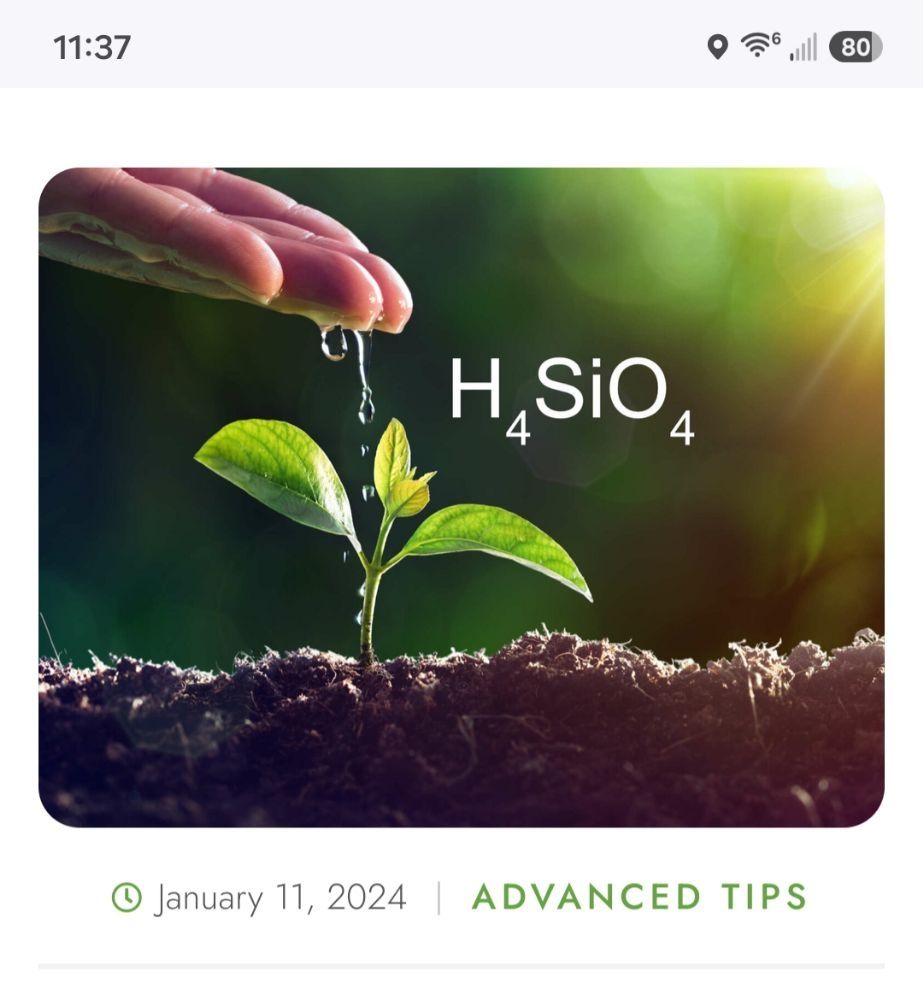
Given how common silicon is in the universe, it may come as a surprise that plants growing in nature do not always have abundant levels of this beneficial element available to them. This is because the form in which silicon most often appears in nature, silica, cannot be absorbed by plant roots. Plants can take up silicon only in the form of silicic acid— also known as monosilicic acid or orthosilicic acid. Silicic acid is the only water-soluble form of silicon.
That makes the application of silicon in the grow room a bit tricky. Because silicon and silica in and of themselves cannot be absorbed by plants—and silicic acid is unstable, readily converting into insoluble silica—it typically needs to be bottled as a silicate (e.g., potassium silicate, calcium silicate). Silicates are both water-soluble and stable, so they can be mixed in a nutrient solution, where the plants absorb its silicon component in the form of silicic acid. It is silicic acid that travels within the plant to the shoots, leaves and other external organs and gets deposited as silica.
I don’t see an open-mindedness about making a coherent computer chip in affinity with the natural world. That means they remain in the time warp and will hit a wall. Ok.
Maybe…a human engineer would listen and help innovate but NVIDIA has a huge corner on the market and is “monied” with an 80% profit margin on their chips. AI prophets pay it. Insane.

