Cysteine and methionine are two amino acids that contain sulfur. Methionine is an essential amino acid, whereas cysteine is synthesized from methionine and therefore is nonessential.
Methionine is the START CODON in the A.A. Sequence. Red Moon Tribe is Methionine and contains sulfur.
Dragon Tribe is Tribe #1; Cysteine which contains Sulfur. The #1 element starting life on Earth.
Red Moon Tribe is Tribe #10; Start Codon which contains Sulfur. It’s the central A.A. starting the sequence in the chain Amino Acids; BOTH RED.
This is a big synchronicity with science.
China's ambitious goals for manned missions & a space station by 2023 using rocket propelled craft is a cover for their secret space program using EM & antigravity technologies stolen/given to them by Deep State for a future conflict with US SSPs: https://t.co/QJN7qG6xIJ
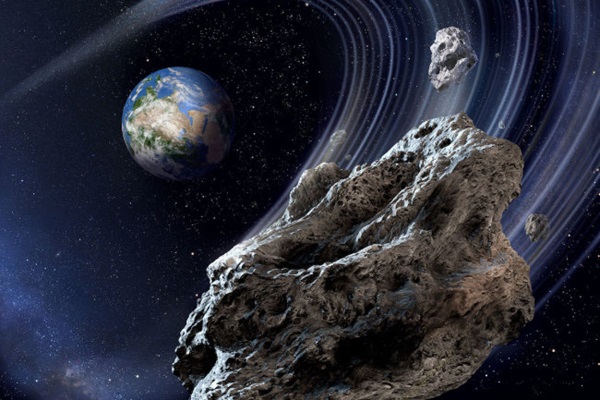
Investigators have also found nucleobases, key ingredients of DNA, in meteorites before. However, it has been very difficult to prove that these molecules are not contamination from sources on Earth. [5 Bold Claims of Alien Life]
“People have been finding nucleobases in meteorites for about 50 years now, and have been trying to figure out if they are of biological origin or not,” study co-author Jim Cleaves, a chemist at the Carnegie Institution of Washington, told SPACE.com.
To help confirm if any nucleobases seen in meteorites were of extraterrestrial origin, scientists used the latest scientific analysis techniques on samples from a dozen meteorites — 11 organic-rich meteorites called carbon aceous chondrites and one ureilite, a very rare type of meteorite with a different chemical composition. This was the first time all but two of these meteorites had been analyzed for nucleobases.
The analytical techniques probed the mass and other features of the molecules to identify the presence of extraterrestrial nucleobases and see that they apparently did not come from the surrounding area.
Two of the carbonaceous chondrites contained a diverse array of nucleobases and structurally similar compounds known as nucleobase analogs. Intriguingly, three of these nucleobase analogs are very rare in Earth biology and were not found in soil and ice samples from the areas near where the meteorites were collected at the parts-per-billion limits of their detection techniques.
“Finding nucleobase compounds not typically found in Earth’s biochemistry strongly supports an extraterrestrial origin,” Cleaves said.
“At the start of this project, it looked like the nucleobases in these meteorites were terrestrial contamination — these results were a very big surprise for me,” study lead author Michael Callahan, an analytical chemist and astrobiologist at NASA Goddard Space Flight Center, told SPACE.com.
Lab experiments showed that chemical reactions of ammonia and cyanide, compounds that are common in space, could generate nucleobases and nucleobase analogs very similar to those found in the carbonaceous chondrites. However, the relative abundances of these molecules between the experiments and the meteorites differed, which might be due to further chemical and thermal influences from space.
These findings reveal that meteorites may have been molecular tool kits, providing the essential building blocks for life on Earth, Cleaves said. [7 Theories on the Origin of Life]
“All of this has implications for the origins of life on Earth and potentially elsewhere,” Callahan said. “Are these building blocks of life transferred to other places where they might be useful? Can alternative building blocks be used to build other things?”
In a different study, researchers discovered molecules that make up key parts of a vital biological pathway, the citric acid cycle, in a number of carbonaceous chondrites. The citric acid cycle is “thought by many experts to be among the most ancient of biological processes,” study co-author George Cooper, a chemist at NASA Ames Research Center, told SPACE.com. “One function of this cycle is respiration, when organisms give off carbon dioxide.”
“It is always exciting to find extraterrestrial and ancient 4.6 billion-year-old organic compounds that might have had a role in early life,” Cooper added.
Cleaves, Cooper and their colleagues detailed their findings in two studies online Aug. 8 in the Proceedings of the National Academy of Sciences.
Follow SPACE.com contributor Charles Q. Choi on Twitter @cqchoi. Visit SPACE.com for the latest in space science and exploration news on Twitter @Spacedotcom and on Facebook.
Join our Space Forums to keep talking space on the latest missions, night sky and more! And if you have a news tip, correction or comment, let us know at: community@space.com.
“The U.S. currently possesses revolutionary technologies that could render current aerospace capabilities obsolete: “[M]ost Americans and most members of Congress have not had time to really look deeply at what is going on here. … [T]echnology can be built today (that can)… deliver any human being from any place on planet Earth to any other place in less than an hour.”
Article by Brett Tingely December 11, 2019 (thedrive.com)
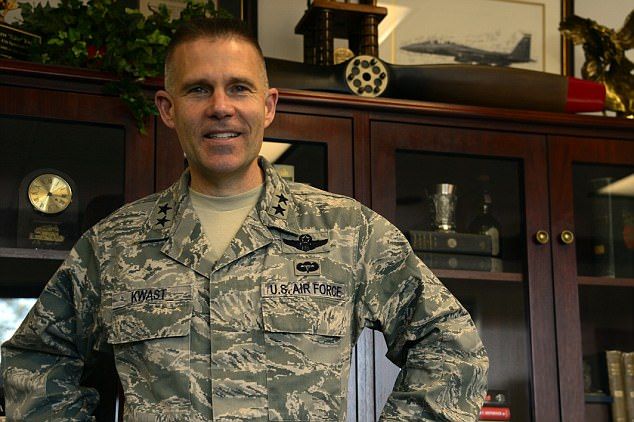
• US Air Force Lieutenant General Steven L. Kwast (pictured above) served as Commander of the 47th Operations Group at Laughlin Air Force Base and the 4th Fighter Wing at Seymour Johnson Air Force Base, and had support within the Armed Forces to be appointed as the Commander of the Pentagon’s Space Force. Instead, Kwast retired this past September. On November 20, 2019, Kwast gave a lecture titled “The Urgent Need for a U.S. Space Force” at Hillsdale College in Washington, D.C.
• In his talk, Kwast claimed that China is already building a “Navy in space” complete with the space-based equivalents of “battleships and destroyers”, and that the US is not keeping up. We know that China has been rapidly expanding its presence in space in recent years, placing a lander on the Moon last year as a possible first step toward a permanent Moon base. China has also been developing “mothership” aircraft from which to launch ‘space planes’ and other payloads into space. China has been investing heavily in manned and unmanned space technologies that rivals, and in some ways, exceeds our own. Kwast believes we need a Space Force in order to counter Chinese advances and win the competition over the economy of the future and, as an extension, the political values for the future.
• Kwast says the “the power of space will change world power forever” and that it’s up to the United States military to leverage that power. The nature of the power of a competitive advantage is “you either have it and your values rule or you do not have it and you must submit. We see that play out again and again in history and it’s playing out now,” Kwast argues. “[China] will pass us in the next few years if we do not do something. They will win this race and then they will put roadblocks up to space.”
• Around the 12:00 mark in the speech (see video below), Kwast makes the somewhat bizarre claim that
“The U.S. currently possesses revolutionary technologies that could render current aerospace capabilities obsolete: “[M]ost Americans and most members of Congress have not had time to really look deeply at what is going on here. … [T]echnology can be built today (that can)… deliver any human being from any place on planet Earth to any other place in less than an hour.”
• Other military leaders have made curious comments lately alluding that we could be on the precipice of a great leap in transportation technology. There are many within the U.S. military and analyst community who feel a great need to boost investment in American space technologies and the U.S. military’s presence in space. That vision is taking root across the Defense Department.
• Kwast has published several op-eds in recent years pushing for the U.S. military to take on a greater role in space in order to ensure American economic dominance and what he sees as the continued proliferation of American values. Some have said that Kwast was blacklisted and prematurely relieved of his duties after speaking out on space-related issues in violation of a service-wide gag order. Kwast declined to comment.
• Is all this setting the stage for a new space race that will benefit mankind by furthering scientific and technological development, or is it ushering in the conditions for the first great space war?
Recently retired U.S. Air Force Lieutenant General Steven L. Kwast gave a lecture last month that seems to further signal that the next major battlefield will be outer space. While military leadership rattling the space sabers is nothing new, Kwast’s lecture included comments that heavily hint at the possibility that the United States military and its industry partners may have already developed next-generation technologies that have the potential to drastically change the aerospace field, and human civilization, forever. Is this mere posturing or could we actually be on the verge of making science fiction a reality?
Who Is Steven Kwast?
According to his official USAF biography, Lt. Gen. Kwast graduated from the United States Air Force Academy with a degree in astronautical engineering, and also holds a master’s degree in public policy from Harvard’s Kennedy School of Government. Kwast previously served as Commander of the 47th Operations Group at Laughlin Air Force Base and the 4th Fighter Wing at Seymour Johnson AFB. Kwast boasts more than 3,300 flight hours in the F-15E, T-6, T-37, and T-38 and over 650 combat hours.
Lt. Gen. Kwast most recently served as Commander of the Air Education and Training Command (AETC) at Joint Base San Antonio (JBSA), but retired in August. According to some reports, Kwast was prematurely relieved of his duties at JBSA and blacklisted for promotion after speaking out on space-related issues despite a service-wide gag order. Kwast declined to comment on the reports and retired on September 1, 2019.
Despite the controversy surrounding his removal from his post at AETC, some defense analysts and Lt. Gen. Kwast’s own supporters within the Armed Forces were suggesting prior to his retirement that he should be appointed as Commander of the Pentagon’s budding Space Force. Kwast has published several op-eds in recent years pushing for the U.S. military to take on a greater role in space in order to ensure American economic dominance and what he sees as the continued proliferation of American values.
Gaining The High Ground In Space
Kwast delivered a lecture at Hillsdale College in Washington, D.C. on November 20, 2019, titled “The Urgent Need for a U.S. Space Force.” Kwast’s wide-ranging speech described the power of new technologies to revolutionize humankind, referencing the competitive advantage the discovery of fire offered to early humans and the strategic value that nuclear weapons offered 20th-century superpowers. When it comes to current revolutionary technologies, Kwast says the “the power of space will change world power forever” and that it’s up to the United States military to leverage that power: “As a historian, reflecting on the fact that throughout the history of mankind… technology has always changed world power. But the story of rejecting the new and holding and clinging to the paradigms of the past is why no civilization has ever lasted forever, and values are trumped by other values when another civilization figures out a way of finding a competitive advantage. The nature of power, you either have it and your values rule or you do not have it and you must submit. We see that play out again and again in history and it’s playing out now.”
As has been common as of late, Lt. Gen Kwast cites rapidly growing Chinese military and technological advances as the reason why the United States must invest heavily in new space-based technologies. “We can say today we are dominant in space but the trend lines are what you have to look at and they will pass us in the next few years if we do not do something. They will win this race and then they will put roadblocks up to space,” Kwast argues, “because once you get the high ground, that strategic high ground, it’s curtains for anybody trying to get to that high ground behind them.”
1:06:24 video of Steven Kwast on the Need for Space Force (‘Hillsdale College’ YouTube)