This illuminates who is in the Earth Alliance as far as world leaders, Trumps family connection to Disclosure via his uncle who promoted Tesla’s work for humanity and who the negative E.T.’s are and who the good ones are. The Galactic Federation is in charge.
While it’s true that our DNA contains components of all 20 amino acids or the Tribes of Time, it is my belief that with the visitation to this planet of Jeshua, White 3 Electric Dog, his release of White 13 Cosmic Dog or 13 Aspartic Acid in HF33 onto our planet has given humans the ability to uplift the negative DNA in our bodies to ascension and become ONE with Source…via the heart of Christ. It’s in the Mystic Column or the human spine. That energy activation through the Sun is the key to healing any cellular defects NOW PRESENT in us.
Since Trump is going to attempt to return the U.S. to the Gold Standard I thought it would be interesting to see what gold meant to the Maya and how they used it. In addition, here is an article on how we would go about making the switch. I’m really questioning it and will have to ponder it further. It’s important to note that the single reason that this whole Plandemic is happening, the election rigged, and in 1963, Kennedy shot, was because they wanted to return to the Gold Standard. It’s social implications and history are very controversial. Yet…there is FAR, FAR more gold in our local system than anyone knows. We just have to mine it. -Corey Goode
Just in the last week, my cryptocurrency has dropped $100.00 in value.
From zoomorphic masks to the secrets of lost metallurgy, how and why did gold become such an important representation of wealth and power for Mesoamerica’s Aztecs, Mayans and Mixtecs?
The Mesoamerican region and its cultural areas in the Pre-Columbian era
Mesoamerica is the region where North and South America meet, extending from contemporary central Mexico to Honduras and Nicaragua. Since 1500 BC it has been home to many great civilizations, including the Maya, Aztecs, Olmecs, Mixtecs, Toltecs and Zapotecs. Anthropological and archaeological explorations in the area have emphasized the importance of sculpture, pottery, textiles, precious stones, and gold to these peoples.
So, when is Mesoamerican goldsmithery dated from? In fact, compared to other ancient civilizations, the emergence of gold metalwork in Central America occurred relatively late, with distinctive works apparent in west Mexico from around 800 AD[1]. The region is unique for its interesting metallurgical technology. The Mesoamerican peoples’ interest in the sound, color and reflectivity of their
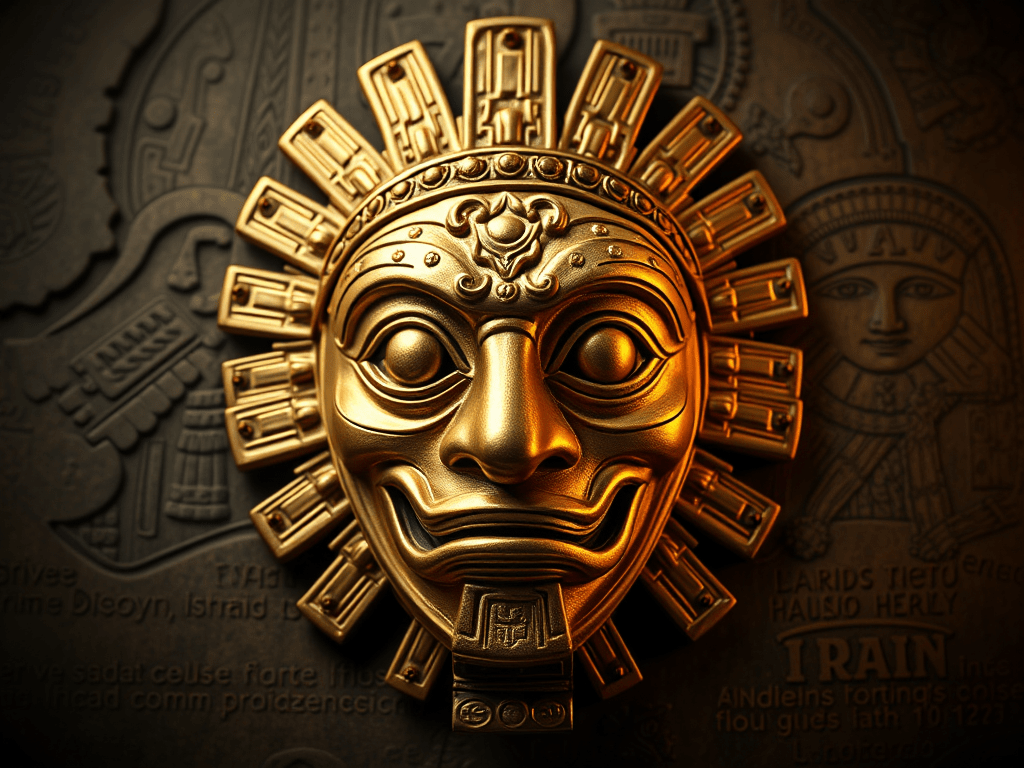
A golden Maya mask. 13th century
ornaments[2] informed the choices of their craftsmen who focused on making jewelry, display items, sheet metal breastplates, crowns and objects that could produce sound. All these items incorporated a variety of techniques developed by artisans and rendered in shadings, engravings and embossing.
Golden Aztec-Mixtec pendants. Circa 1400-1515
Today, our most important source of information for the pre-Colombian Mesoamerican gold work and jewelry manufacture is the descriptions contained within the Florentine Codex (1548 – 1561), a tome written under the supervision of the Franciscan priest Bernardino de Sahagún.
In the ninth book of the codex, Sahagún describes and illustrates the manufacturing processes and technology employed by Mesoamerican goldsmiths to produce the artefacts by depletion gilding and a now lost wax casting technique, which involved the pouring of molten metal into a mold that has been created by taking an impression from a wax model. Once the mold is made, the wax model is melted and drained away[3]. The level of sophistication embodied by the gold artifacts and jewelry from the period is only replicable today using modern technology. The gap in our knowledge of how such pieces were made has led to a range of different theories, all trying to explain the lost secrets that allowed Mesoamericans to reach their remarkable levels of craftsmanship.
Depiction of various crafts in the Florentine Codex, Book IX
Aztec Gold Work
As tribute, the Aztecs were often gifted raw gold materials including powders, ingots and sometimes even foil. These were often brought from the Oaxaca and Guerrero areas. Interestingly, manufactured gold pieces (e.g. pendants) were also offered as presents to rulers, priests or elite warriors, although this was less common. Historical sources also show that goldsmiths from the Oaxaca region often worked in Aztec workshops to produce artifacts for Aztec rulers and ceremonies[4].
A gold Aztec lip plug in the shape of a vulture’s head. Circa 800 – 900 AD
The Maya
Although gold was panned in the Guatemala highlands, it was not produced in great quantity. For the most part, Mayans traded for their gold with other Mesoamerican peoples[5]. The largest cache of gold and other precious metals found in the Maya territory were dredged from the sacred well at Chichén Itzá, the former Mayan city and flagship archaeological site located on the Yucatán peninsula and dating from the ninth century AD.
Mayan temple of the Count at Palenque. Circa 600 AD
The gold found in this sacred hoard contained different zoomorphic pieces, pendants, bells and figurines cast via the lost wax process[6] as well as hammered discs with mythological scenes of human sacrifice and warfare. Judging by the style, shape and size of the artifacts, it is believed that this cache may well represent the first significant trade network of gold in Mesoamerica. It is also considered the biggest collection of gold work discovered in the region.
Mixtec goldsmithing
The Mixtec civilization developed in what is now the Oaxaca state of Mexico, thriving from 900 AD until the Spanish conquest in the 16th century. Mixtecs were the most skilled goldsmiths of Mesoamerica[7], and about 80% of the existing Mesoamerican gold artifacts belong to this culture. The gold collections found in their territory include chin ornaments or ‘bezotes’, a huge solar pendant (from the tombs of Zaachila) and various zoomorphic pieces rendered in bells, beads, foils, necklaces, rings and earrings[8]. Most of the items found are remarkable in terms of the quality of gilding techniques and the ornate depictions of animals, plants, gods and mythical beings. These pieces show the significance of gold metallurgy in the Mixtec comprehension of religious worship, ceremonial practices, mythology and warfare.
A Mixtec gold pendant. Circa 1200 AD-
Huitzilopochtli, the Mixtec war deity
By the end of the Mesoamerican Age, goldsmithing had become wide-spread across the lands of today’s central and western Mexico, although gold artifacts were accessible only to the elites who used them both as symbols of power and for ritual purposes in burials and ceremonial offerings. Only high levels of society were allowed to wear jewelry made of the precious metal – the great symbol of the Sun and the gods that represented it.
[1] p. 290; Sil J., Guerrero G., Vargas J., Díaz E., Vázquez E. 2009. ‘Technological and material features of the gold work of Mesoamerica,’ ArcheoSciences, 33: 289-297.
[2] p. 329; Hosler, D. 2014. ‘Mesoamerican Metallurgy: The Perspective from the West,’ p. 329-359 in Roberts B., Thornton (eds.). 2014. Archaeometallurgy in Global Perspective: Methods and Syntheses, Springer: New York, NY.
[4] p. 291; Sil J., Guerrero G., Vargas J., Díaz E., Vázquez E. 2009. ‘Technological and material features of the gold work of Mesoamerica,’ ArcheoSciences, 33: 289-297.
[5] p. 318; Foster, L. 2002. Handbook to Life in the Ancient Maya World, Oxford University Press: New York.
[6] p. 291; Sil J., Guerrero G., Vargas J., Díaz E., Vázquez E. 2009. ‘Technological and material features of the gold work of Mesoamerica,’ ArcheoSciences, 33: 289-297.
[7] p. 292; Sil J., Guerrero G., Vargas J., Díaz E., Vázquez E. 2009. ‘Technological and material features of the gold work of Mesoamerica,’ ArcheoSciences, 33: 289-297.
[8] p. 515; Ortiz-Diaz, E., Sil, J. 2009. ‘An Historical Approach to a Gold Pendant: The study of Different Metallurgic Techniques in Ancient Oaxaca, Mexico, During the Late Postclassic Period,’ p. 511-518 in Archaeometallurgy in Europe: 2nd International Conference, Aquileia, Italy, Associazione Italiana di Metallurgia: Milano.
We only have this from 1996. The cabal wants all of them gone. They’ve gotten three Kennedy’s now. They would love to get Trump.So would koolaid drinking Dems who voted for Biden.
This is a must watch video by Dr. Michael Salla on the 57th anniversary of JFK assassination. 9 minutes. Share with your friends via email.
Just for the record, I’m not convinced about the agenda behind linking these two people. Supposedly John John is Q. I have no problem believing he’s alive. People’s deaths are faked for all kinds of reasons. And Dr. Salla is supporting whatever the agenda is. I question everyone these days. -Lisa T. 12/29/22




 Synchronicity is the Source of Consciousness
You must be logged in to post a comment.