
THESE RED LIGHTS ARE NOT AURORAS: Last Sunday, March 3rd, a CME hit Earth’s magnetic field. The surprisingly strong impact sparked a G2-class geomagnetic storm with bright auroras around the Arctic Circle. Upon closer inspection, however, not all of those lights were auroras. Some were “SAR arcs”:
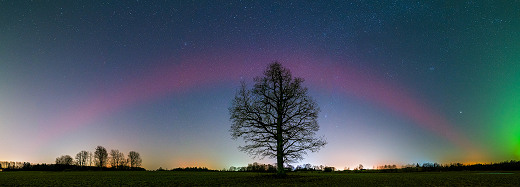
During the storm, Märt Varatu photographed this red ‘bow over Kiia küla, Estonia. “It was a strong SAR arc,” he says.
SARs were discovered in 1956 at the beginning of the Space Age. Researchers didn’t know what they were and unwittingly gave them a misleading name: “Stable Auroral Red arcs” or SARs. In fact, they are not auroras.
Auroras appear when charged particles rain down from space, hitting the atmosphere and causing it to glow like the picture tube of an old color TV. SARs form differently. They are a sign of heat energy leaking into the upper atmosphere from Earth’s ring current system, a donut-shaped circuit carrying millions of amps around our planet. During the geomagnetic storm of March 3rd, this ring current sprang a significant leak. (That is the AMPLITUDE layer of the ScR. It could be supporting the C1 Cosmic layer to appear that pluses with Tone13.-LT)
The same red arcs were widely observed from Latvia to eastern Russia. Vladimir Nerush photographed this fragment just east of Moscow:
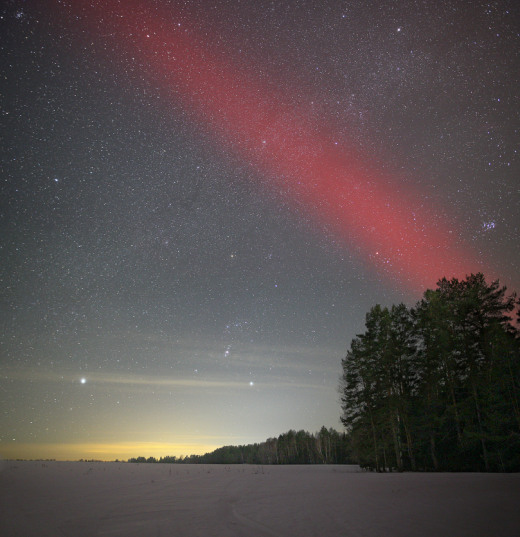
“It emerged from the trees and passed right by the Pleiades,” says Nerush. “The red color was so pure.”
Indeed, SAR arcs are among the reddest things in the sky, with a monochromatic glow at 6300 Å that comes from atomic oxygen in the upper atmosphere. The human eye is relatively insensitive to light at this wavelength; we have a hard time seeing SAR arcs. Cameras catch them easily, though. Pro tip for photographers: Use a 6300 Å filter.
more images: from Juris Seņņikovs of Dobele, Latvia; from Ilgonis Vilks of Jurmala, Latvia
This was Nov. 8, 2023-same thing
Earth’s Ring Current System Just Sprang a Leak
 Synchronicity is the Source of Consciousness
