From NOAA-Spaceweather.com
GEOMAGNETIC STORM WATCH–CONTINUED: NOAA forecasters remain confident that a CME will graze Earth’s magnetic field on June 1st. It was hurled into space by an X1.4-flare on May 29th. The glancing blow could cause G2-class geomagnetic storms. CME impact alerts: SMS Text
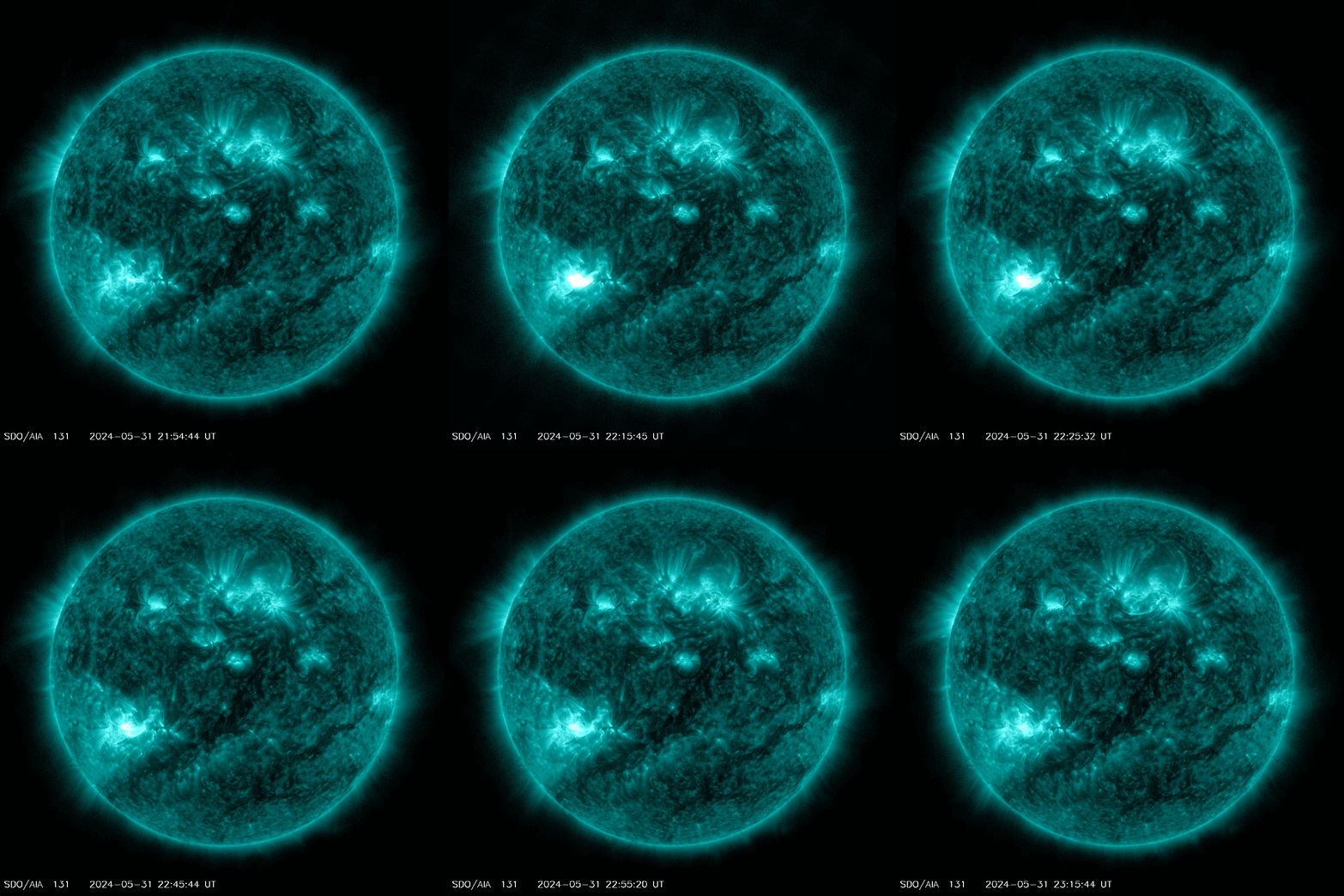
YET ANOTHER X-FLARE: Sunspot AR3664 (a.k.a. AR3697) has decayed, but it is still potent. On May 31st it emitted another X-flare (X1.1), the third this week. NASA’s Solar Dynamics Observatory captured the extreme ultraviolet flash:
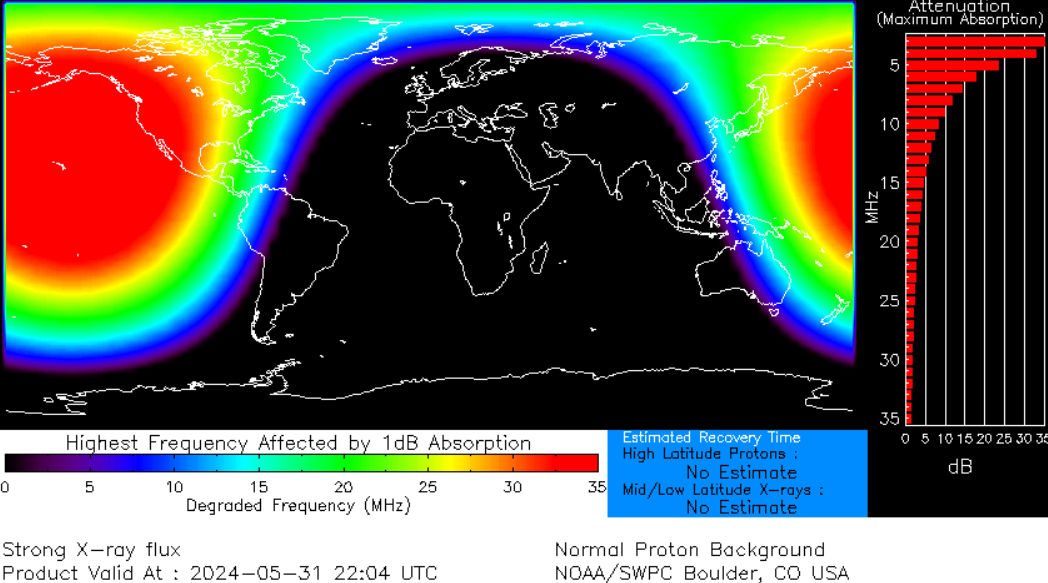
Radiation from the flare ionized the top of Earth’s atmosphere, briefly causing a shortwave radio blackout over the Pacific side of North America. Signals below 30 MHz faded for as much as 30 minutes after the flare’s peak (May 31st @ 2203 UT).
The flare, while intense, was too brief to lift a significant CME out of the sun’s atmosphere. SOHO coronagraph images show no solar storm clouds heading for Earth.
What makes a decaying sunspot like AR3664 so active? This magnetic map provides the answer:
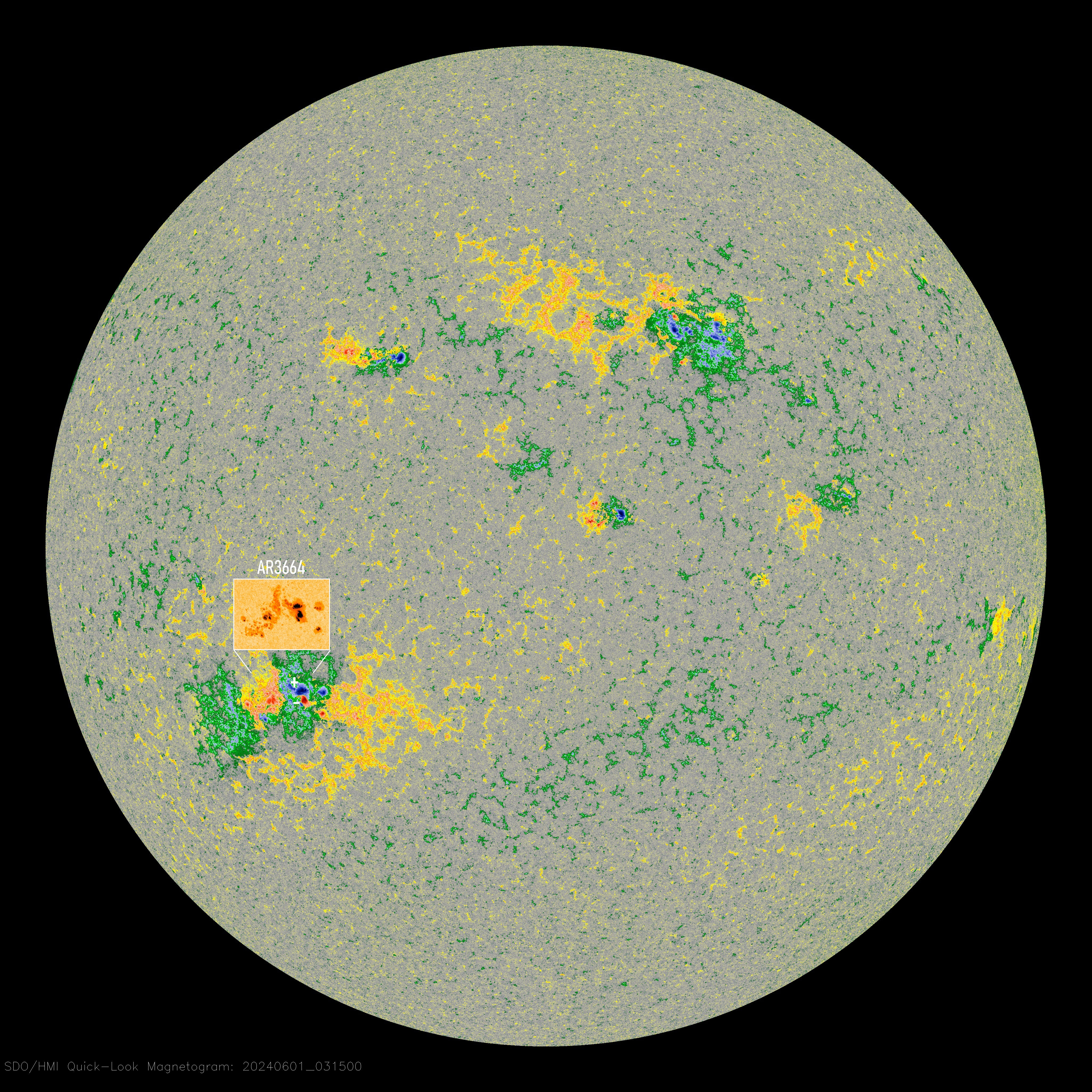
Within the sunspot’s primary core, two oppositely-signed magnetic poles are crowded together, + vs. -. (Just like the Tzolkin Harmonic and our DNA-same thing) When this happens, magnetic recombination (Tone 1 in the magnetosphere QFactor Layer) can cause very powerful explosions even from a sunspot that’s falling apart. NOAA forecasters estimate a 35% chance of X-flares and a 75% chance of M-flares on June 1st. Solar flare alerts: SMS Text
Realtime Space Weather Photo Gallery
Free: Spaceweather.com Newsletter
SPACE WEATHER BALLOON DATA: Almost once a week, Spaceweather.com and the students of Earth to Sky Calculus fly space weather balloons to the stratosphere over California. These balloons are equipped with sensors that detect secondary cosmic rays, a form of radiation from space that can penetrate all the way down to Earth’s surface. Our monitoring program has been underway without interruption for 7 years, resulting in a unique dataset of in situ atmospheric measurements.
Latest results (July 2022): Atmospheric radiation is decreasing in 2022. Our latest measurements in July 2022 registered a 6-year low:
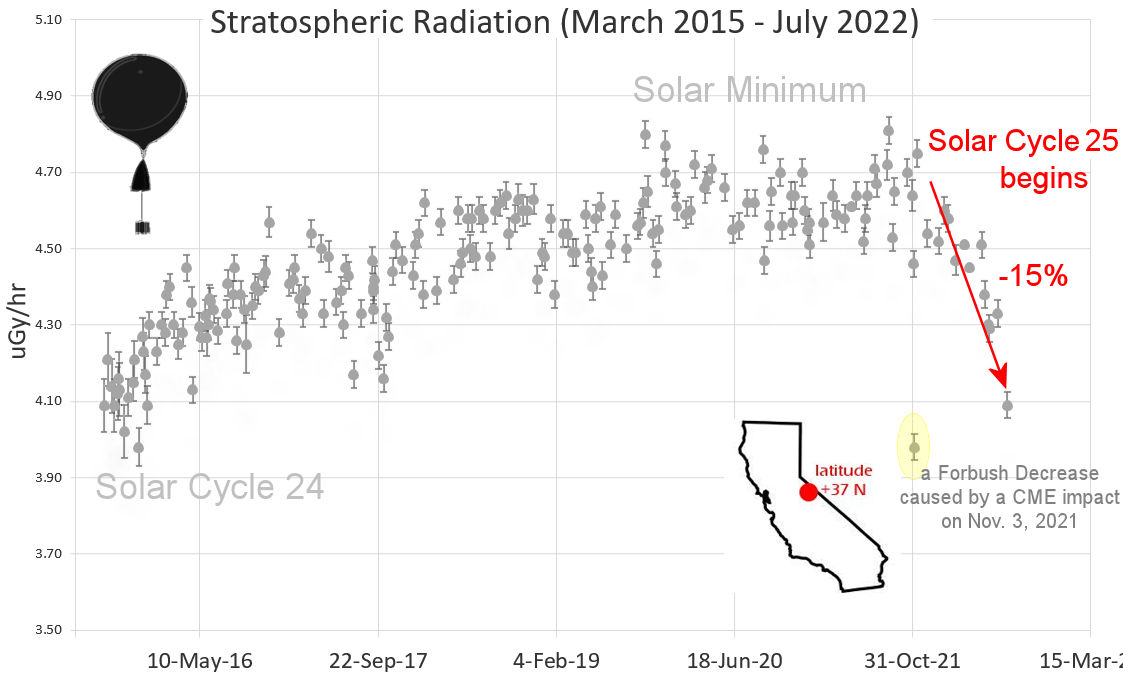
What’s going on? Ironically, the radiation drop is caused by increasing solar activity. Solar Cycle 25 has roared to life faster than forecasters expected. The sun’s strengthening and increasingly tangled magnetic field repels cosmic rays from deep space. In addition, solar coronal mass ejections (CMEs) sweep aside cosmic rays, causing sharp reductions called “Forbush Decreases.” The two effects blend together to bring daily radiation levels down.
.Who cares? Cosmic rays are a surprisingly “down to Earth” form of space weather. They can alter the chemistry of the atmosphere, trigger lightning, and penetrate commercial airplanes. According to a study from the Harvard T.H. Chan school of public health, crews of aircraft have higher rates of cancer than the general population. The researchers listed cosmic rays, irregular sleep habits, and chemical contaminants as leading risk factors. A number of controversial studies (#1, #2, #3, #4) go even further, linking cosmic rays with cardiac arrhythmias and sudden cardiac death.
(So when you see reports saying that solar activity and the hertz ELM levels in the magnetosphere won’t affect you physically, they are lying. NASA I think, says they don’t. NOAA is not the same as NASA. They work together but basically, NASA is the Feds and they keep secrets from humanity big time. NOAA doesn’t.)
Technical notes: The radiation sensors onboard our helium balloons detect X-rays and gamma-rays in the energy range 10 keV to 20 MeV. These energies span the range of medical X-ray machines and airport security scanners.
Data points in the graph labeled “Stratospheric Radiation” correspond to the peak of the Regener-Pfotzer maximum, which lies about 67,000 feet above central California. When cosmic rays crash into Earth’s atmosphere, they produce a spray of secondary particles that is most intense at the entrance to the stratosphere. Physicists Eric Regener and Georg Pfotzer discovered the maximum using balloons in the 1930s and it is what we are measuring today.
 Synchronicity is the Source of Consciousness