THE HIGHEST SUNSPOT NUMBER IN 22 YEARS: The average sunspot number for May 2024 was 172, the highest value in 22 years. So far, June is even higher at 200. If this continues for the rest of the month, June could log the highest sunspot counts since Dec. 2001, rivaling the peak of potent Solar Cycle 23. Solar flare alerts: SMS Text
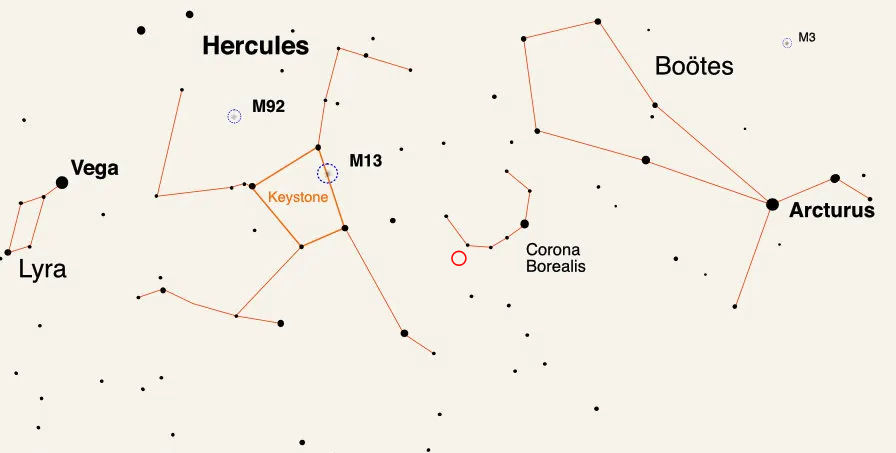
A NOVA WILL EXPLODE THIS SUMMER (PROBABLY): The night sky is about to get a new star. Sometime this summer, astronomers believe, a nova will explode in the constellation Corona Borealis (the Northern Crown). The exploding star will be bright enough to see with the naked eye even from light-polluted cities.
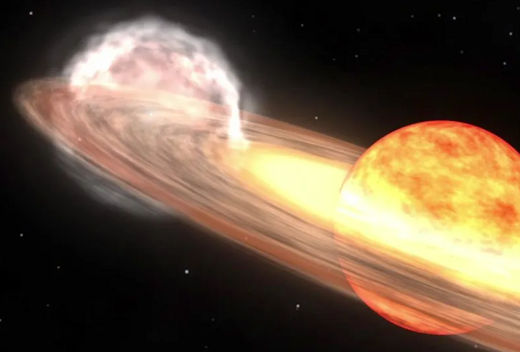
A NASA artist’s concept of the T CrB binary star system
“It’s a once-in-a-lifetime event,” says Rebekah Hounsell of NASA’s Goddard Space Flight Center. “I believe it will create a lot of new astronomers out there.”
T Coronae Borealis (T CrB) is a binary system 3,000 light-years from Earth. It consists of a white dwarf orbiting an ancient red giant. Hydrogen from the red giant is being pulled down onto the surface of the white dwarf, accumulating toward a critical mass. Eventually, it will trigger a thermonuclear explosion.
The last time T CrB exploded was in 1946. About a year before that blast, the system suddenly dimmed–a pattern astronomers called the “pre-eruption dip.” In 2023, T CrB dipped again, heralding a new eruption. If the 1946 pattern repeats itself, the nova should occur between now and September 2024.
A sky map showing the location of T CrB (red circle)
The outburst will be brief. Once it erupts, the nova will be visible to the naked eye for a little less than a week – but Hounsell is confident it will be quite a sight to see. The expected magnitude is between +2 and +3, similar to stars in the Big Dipper.
“Typically, nova events are faint and far away,” says Elizabeth Hays, chief of the Astroparticle Physics Laboratory at NASA Goddard. “This one will be really close, with a lot of eyes on it. We can’t wait to get the full picture of what’s going on.”
Realtime Space Weather Photo Gallery
Free: Spaceweather.com Newsletter
Cosmic Rays
Solar Cycle 25 is intensifying, and this is reflected in the number of cosmic rays entering Earth’s atmosphere. Neutron counts from the University of Oulu’s Sodankyla Geophysical Observatory show that cosmic rays reaching Earth are slowly declining–a result of the yin-yang relationship between the solar cycle and cosmic rays.
 Synchronicity is the Source of Consciousness