
SUNSPOT NUMBERS AT A 20-YEAR HIGH: For the second month in a row, the monthly-average sunspot number is cruising toward a 20-year high. The current value, around 230, would eclipse every month since Sept. 2001, which occured during the peak of old Solar Cycle 23. The current cycle (Solar Cycle 25) was not supposed to be this strong, and it may become even stronger before Solar Max is finished. Solar flare alerts: SMS Text
AN EXPLOSION OF AURORAS: At first glance, you might think these images have been Photoshopped. They have not. At the stroke on midnight on Aug. 11/12, Canadian photographer Alan Dyer witnessed an explosion of brightly colored auroras:
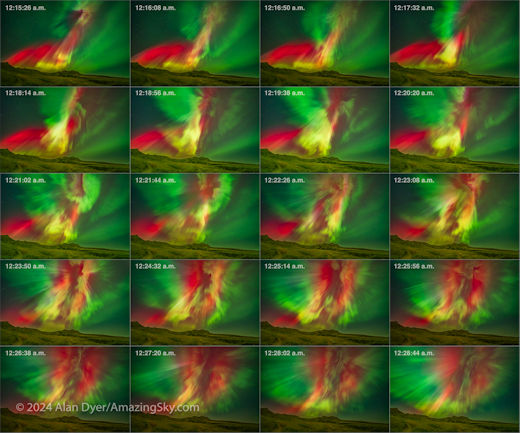
“The event began with intense reds sweeping in from the east and engulfing the sky,” says Dyer, who recorded the display from Grasslands National Park in southwest Saskatchewan. “The greens followed, mixing with the reds to produce a bouquet of yellows and oranges.” It was over in less than 15 minutes.
Researchers call this an “auroral substorm.” First recognized in the early 1960s by a young Japanese physicist named Shun-ichi Akasofu, substorms have been studied for more than 50 years, yet to this day they are almost entirely unpredictable.
Substorms are caused by explosions in Earth’s magnetic tail. This movie from NASA shows the process in action:
The explosion, caused by magnetic reconnection in the overstretched tail, shoots a beam of energetic electrons and protons directly toward Earth. Auroras mark the broad spot where the particles strike Earth’s atmosphere.
“The substorm was at true midnight when we are looking straight down the magnetotail,” says Dyer. At the time, a strong geomagnetic storm was underway, so Earth’s magnetic tail was being stretched–a lot. It was the perfect setup for a blast.
Realtime Space Weather Photo Gallery
Free: Spaceweather.com Newsletter
 Synchronicity is the Source of Consciousness