
A major disruption of the polar vortex appears to be underway as the Arctic stratosphere suddenly warms. Researchers call this a “sudden stratospheric warming event.” It’s caused by planetary atmospheric waves crashing into the vortex and breaking it up. Cold air spilling out of the weakened vortex could plunge the USA, Canada, and parts of Europe into bitter cold little more than a week before the arrival of Spring. This also marks the end of polar stratospheric cloud season for Arctic observers.
CIR HITS EARTH, SPARKS AURORAS: If you’ve never heard of a co-rotating interaction region (CIR), just think of it as a mini CME. One hit Earth on March 8th, sparking more than 10 hours of geomagnetic storms. “The auroras in Minnesota were some of the brightest I’ve seen in a while,” reports Anna Eastman, who watched the show from the Agassiz Wildlife Refuge:
CIRs are transition zones between fast – and slow-moving streams of solar wind. They contain magnetic fields and shock waves akin to those of CMEs. While CMEs require some sort of explosion on the sun, CIRs do not. They form gently from the sandwiching of solar wind streams–no solar flare required.
A fast-moving solar wind stream has arrived on the heels of the CIR. This is the same stream that created the CIR in the first place by compressing a region of slower solar wind ahead of it. Blowing 600 km/s, the fast stream could cause additional category G1 (Minor) storms on March 10th. High-latitude sky watchers should remain alert for auroras. Aurora alerts: SMS Text.
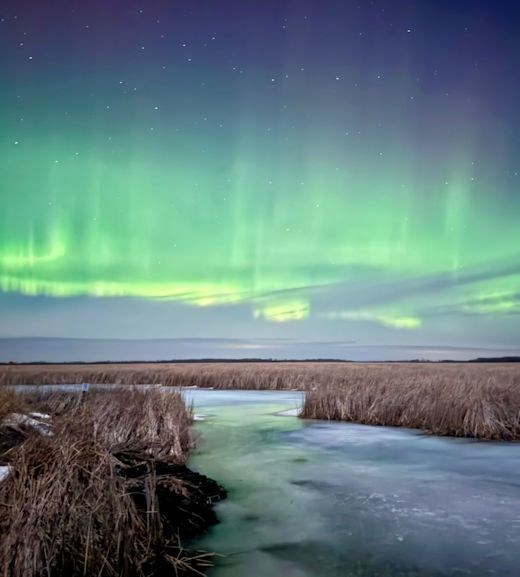
“Even with a bright Moon, it was a beautiful light show,” she says.
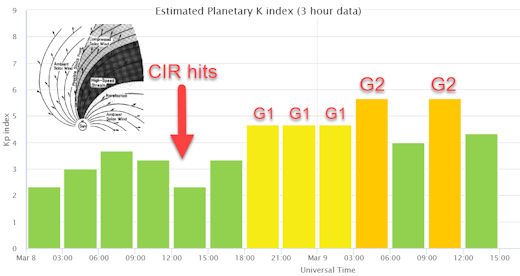
Click on the inset diagram to learn more about CIRs.
 Synchronicity is the Source of Consciousness